Experts have designed these Class 9 Science Notes and Exploration Chapter 8 Journey Inside the Atom Class 9 Notes for effective learning.
Class 9 Science Chapter 8 Journey Inside the Atom Notes
Class 9 Science Exploration Chapter 8 Notes
Class 9 Science Chapter 8 Notes – Class 9 Journey Inside the Atom Notes
→ Alpha Particle (α): Positively charged particle consisting of 2 protons and 2 neutrons.
Example: Alpha particles emitted in Rutherford’s gold foil experiment.
→ Atomic Number (Z): Number of protons present in the nucleus.
Example: Carbon has Z = 6.
→ Bohr’s Model of Atom: Electrons revolve in fixed energy levels (shells) without losing energy.
Example: Hydrogen has one electron in the first shell (K-shell).
→ Dalton’s Atomic Theory: First scientific theory of atoms, stating they are indivisible and indestructible.
Example: Hydrogen atom is the smallest unit of hydrogen.
→ Electron (e–): Negatively charged particle revolving around the nucleus.
Example: Charge = – 1; mass is negligible.
→ Mass Number (A): Sum of protons and neutrons in the nucleus.
Example: Oxygen has A = 16.
→ Neutron (n): Neutral particle with mass nearly equal to proton, discovered by James Chadwick in 1932.
Example: Helium nucleus has 2 protons + 2 neutrons.

→ Nucleus: Dense central part of an atom containing protons and neutrons.
Example: Accounts for most of the atom’s mass.
→ Octet Rule: Atoms tend to have 8 electrons in their valence shell for stability.
Example: Neon has a complete octet, so it is inert.
→ Proton (p+): Positively charged particle present in the nucleus.
Example: Hydrogen nucleus has one proton.
→ Rutherford’s Gold Foil Experiment: Alpha particles scattered by gold foil proved the existence of a dense nucleus.
Example: Some particles bounced back, showing the nucleus is very small but massive.
→ Rutherford’s Nuclear Model: Atom has a small, dense, positively charged nucleus with electrons revolving around it.
Example: Like planets orbiting the sun.
→ Scattering: Deflection of particles from their path when they strike atoms.
Example: Alpha particles deflected in gold foil experiment.
→ Thomson’s Model of Atom (Plum Pudding Model): Atom is a sphere of positive charge with electrons embedded in it.
Example: Like raisins in a pudding.
→ Valence Electrons: Electrons in the outermost shell that take part in chemical reactions.
Example: Sodium has 1 valence electron.
→ Valence Shell: The outermost shell of an atom where valence electrons are found.
Example: Chlorine has 7 electrons in its valence shell.
Introduction
Matter is anything that has mass and occupies space, and it exists in three states – solid, liquid, and gas. All matter is made up of extremely small particles called atoms, which are the basic building blocks of everything around us. Atoms are indivisible in chemical reactions and combine in fixed ratios to form molecules. In solids, atoms are tightly packed, giving a definite shape and volume; in liquids, atoms are less tightly packed, allowing flow with a definite volume but no fixed shape; and in gases, atoms are far apart, giving neither definite shape nor volume.
Rediscovering the Roots of Atomic Theory
Over 2,000 years ago, Acharya Kanada in India described indivisible particles called parmanus, while Greek philosophers Leucippus and Democritus proposed similar particles called atomos (meaning indivisible). These were imaginary ideas, not based on experiments. Much later, scientific laws and experiments gave atomic theory a solid foundation.
Dalton (1808) said matter is made of indivisible atoms, identical for each element, combining in whole- number ratios. Later, Thomson (1897) discovered electrons → the “plum pudding model.” Rutherford (1911) found nucleus → the nuclear model. Bohr (1913) proposed electrons in fixed shells. Modem quantum model shows electrons in orbitals.
A Short Historical Journey Through Atomic Models
Scientists discovered that certain elements emit invisible energy and particles called radiation, a phenomenon known as radioactivity. This discovery showed that atoms are made up of smaller particles and are not indivisible, as was previously believed.
In 1897, J. J. Thomson studied the conduction of electric current through gases at very low pressure using a glass tube fitted with two electrodes and a high voltage. He observed rays travelling from the cathode (negative electrode) to the anode (positive electrode), which were called cathode rays.
By studying their behaviour in electric and magnetic fields, he concluded that cathode rays consist of negatively charged particles with very small mass compared to atoms. These particles were later named electrons. This discovery showed that atoms are not indivisible but are made up of smaller subatomic particles.
The nature of cathode rays does not depend on the material of the cathode or the gas inside the cathode ray tube. This shows that electrons are universal particles present in all atoms of every element. The charge of an electron is -1.602 × 10⁻¹⁹ C, which is taken as -1 for convenience.
Thomson’s Model of an Atom
According to Thomson,
- An atom consists of a positively charged sphere and the electrons are embedded in it.
- The negative and positive charges are equal in magnitude. So, the atom as a whole is electrically neutral.
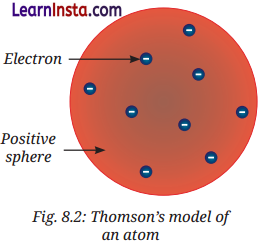
It was the first model of an atom to be put forward and taken into consideration.
He proposed a model of the atom be similar to that of a Christmas pudding or a watermelon.
The red edible part of the watermelon is compared with the positive charge in the atom, while the black seeds in the watermelon are compared with the electrons which are embedded in it.
→ Testing Thomson’s model: The gold foil experiment
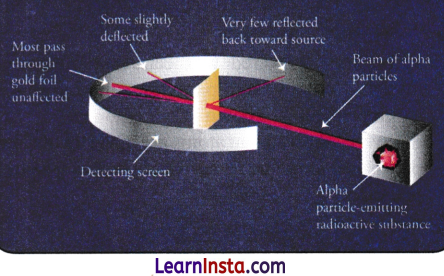
In 1911, Geiger and Marsden, under Rutherford, carried out the famous gold foil experiment. They directed a narrow beam of positively charged alpha particles at a thin sheet of gold foil. According to Thomson’s model, the positive charge was spread evenly, so the particles were expected to pass through with little deflection. However, while most passed straight through, some were deflected sharply and a few even bounced back. This surprising scattering showed that the atom’s positive charge and most of its mass are concentrated in a small, dense nucleus, leading to Rutherford’s nuclear model of the atom.
Rutherford Model of an Atom
A. Rutherford Model of an Atom
In this experiment, fast-moving alpha (α)-particles were made to fall on a thin gold foil. His observations were:
- A major fraction of the α-particles bombarded towards the gold sheet passed through it without any deflection, and hence most of the space in an atom is empty.
- Some of the α-particles were deflected by the gold sheet by very small angles, and hence the positive charge in an atom is not uniformly distributed.
- The positive charge in an atom is concentrated in a very small volume.
- Very few of the α-particles were deflected back; that is, only a few a-particles had nearly 180° angle of deflection. So the volume occupied by the positively charged particles in an atom is very small as compared to the total volume of an atom.
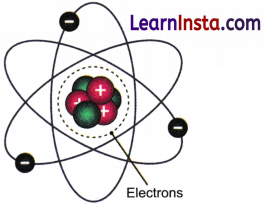
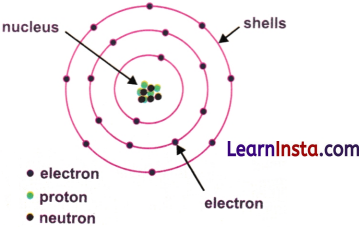
Electrons revolve around the nucleus like planets orbit the sun, so it is called the planetary model.
B. Limitations of Rutherford’s model
- Stability Problem: According to classical physics, electrons revolving around the nucleus should continuously lose energy as radiation. This would make them spiral into the nucleus, causing the atom to collapse. But atoms are stable, so Rutherford’s model could not explain this.
- Energy Levels Not Explained: Rutherford’s model did not explain how electrons are arranged around the nucleus or why they do not radiate energy while revolving. .
- Atoms would collapse: According to this model, atoms would continuously lose energy, follow a spiral path, and eventually fall into the positively charged nucleus. This flow showed why Rutherford’s model was incomplete.
C. Discovery of the Proton
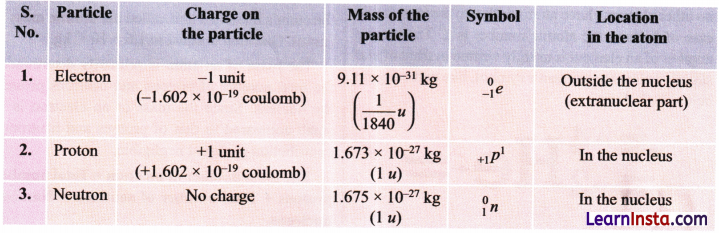
Rutherford discovered that the centre of an atom, called the nucleus, carries a positive charge because of particles known as protons. Protons are much heavier than electrons and have a charge equal in size but opposite in sign. For an atom to stay balanced, the number of protons must match the number of electrons.
For example, a carbon atom has 6 protons and 6 electrons, while an oxygen atom has 8 protons and 8 electrons. Since the positive and negative charges cancel each other out, these atoms — like all others — remain electrically neutral.
Bohr’s Model of the Atom
Bohr came up with the following postulates to overcome the objections raised against Rutherford’s model.
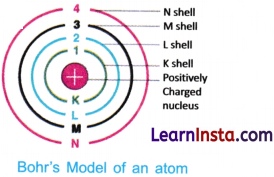
- Electrons revolve around the nucleus in stable orbits without the emission of radiant energy. Each orbit has a definite energy and is called an energy shell or energy level.
- An orbit or energy level is designated as K, L, M, and N shells. When the electron is in the lowest energy level, it is said to be in the ground state.
- An electron emits or absorbs energy when it jumps from one orbit or energy level to another.
- When it jumps from a higher energy level to a lower energy level, it emits energy, while it absorbs energy when it jumps from a lower energy level to a higher energy level.
- Electrons shells have a strictly defined maximum capacity.
What Components Contribute to the Mass of an Atom?
Rutherford’s model stated that most of the atom’s mass is concentrated in the nucleus, with light electrons revolving around it. But scientists noticed that helium, with two protons, had about four times the mass of hydrogen, not double. This led to the discovery of Neutron.
→ Discovery of the Neutron
This puzzle was solved in 1932 when James Chadwick discovered the neutron, a neutral particle with a mass nearly equal to that of a proton. Neutrons, along with protons, are packed in the nucleus and account for most of the atom’s mass. Hydrogen is the only atom without a neutron. Thus, the nucleus contains both protons (positive charge) and neutrons (no charge), explaining atomic mass more accurately. This shows why atoms are heavier than just the mass of their protons – because neutrons also add weight.
Symbols of Elements
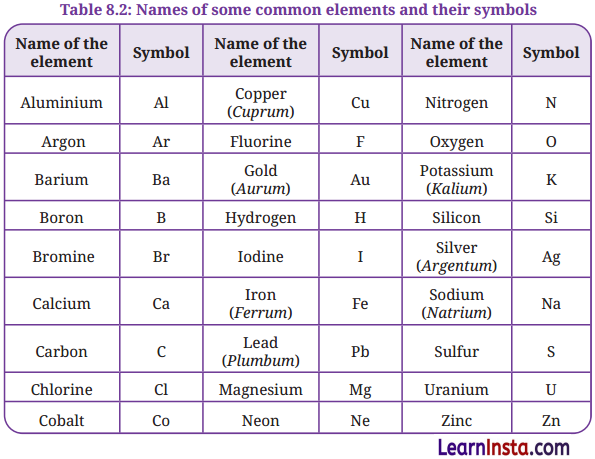
John Dalton introduced pictorial symbols in 1803 to represent elements like hydrogen, carbon, oxygen, sulphur, silver, iron, copper, and others, making chemistry easier to study. Later, in 1813, Berzelius suggested using letters from Latin names, which gave rise to alphabetic chemical symbols. Today, the International Union of Pure and Applied Chemistry (IUPAC) approves names and symbols of elements.
The rules are simple: the first letter of a symbol is always uppercase, and if there is a second letter, it is lowercase. For example, hydrogen is H, aluminium is Al, cobalt is Co, chlorine is Cl, and zinc is Zn. This evolution from Dalton’s pictorial symbols to Berzelius’s alphabetic system and finally to modem IUPAC standards created a universal language for chemistry.
Atomic Number
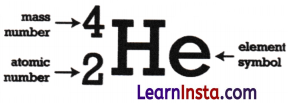
The number of protons in an atom is called its atomic number. This number is significant because it is unique for atoms of a given element. All atoms of an element have the same number of protons, and every element has a different number of protons in its atoms. For example, all helium atoms have two protons, and no other elements have atoms with two protons. In the case of helium, the atomic number is 2. The atomic number of an element is usually written in front of and slightly below the element’s symbol, like in the Figure below for helium.
Atoms are neutral in electrical charge because they have the same negative electrons as positive protons. Therefore, the atomic number of an atom also tells us how many electrons the atom has.
Mass Number
There is another number in the figure given above for helium. That number is the mass number, which is the atom’s mass in a unit called the atomic mass unit (amu). One amu is equal to 1.6 x 10⁻²⁷ kg.
The mass of an atom is primarily determined by the total number of protons and neutrons present in the nucleus. Since the mass of an electron is very small compared to that of protons and neutrons, its contribution is almost negligible.
The mass number of an atom = Total number of protons + Total number of neutrons = Number of nucleons.
Consider helium again. Most helium atoms have two neutrons in addition to two protons. Therefore the mass of most helium atoms is four atomic mass units (2 amu for the protons + 2 amu for the neutrons). However, some helium atoms have more or less than two neutrons.
How Are Electrons Distributed in Different Energy Levels?
Bohr and Bury gave the following rules for the distribution of electrons around the nucleus.
- Electrons revolve around the nucleus in different orbits or shells. These energy shells are represented by numbers 1,2, 3, 4 or K, L, M, N.
- The maximum number of electrons in any shell cannot exceed 2n2, where n is the number of that energy level. Thus for
K-shell, n = 1, no. of electrons = 2 × 12 = 2
L-shell, n = 2, no. of electrons = 2 × 22 = 8
M-shell, n = 3, no. of electrons = 2 × 32 = 18
N-shell, n = 4, no. of electrons = 2 × 42 = 32. - The outermost orbit of an atom cannot have more than 8 electrons and the next to the outermost shell (penultimate shell) can have at the most 18 electrons.
- It is not absolutely necessary that an orbit has its full quota of electrons before starting to fill the next higher orbit but the shells are filled in a stepwise manner.
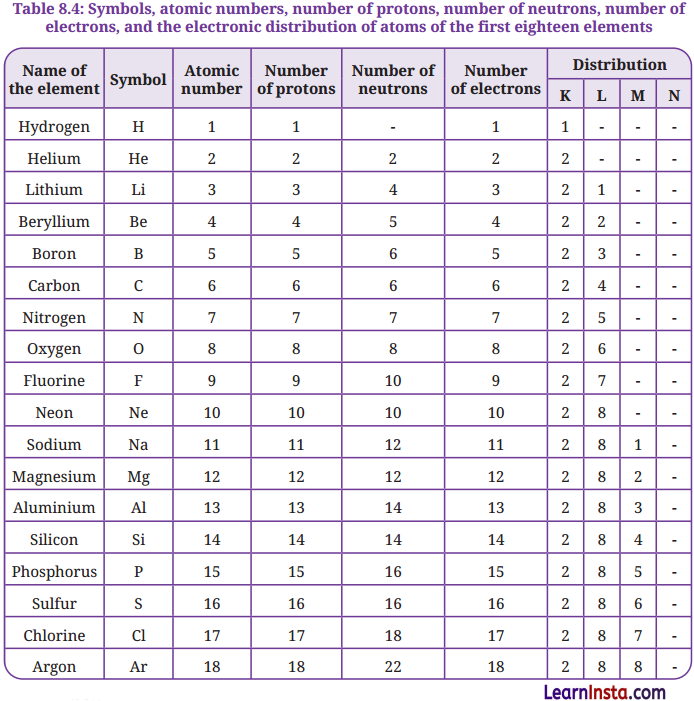
The composition of atoms of the first eighteen elements is given in Table below.
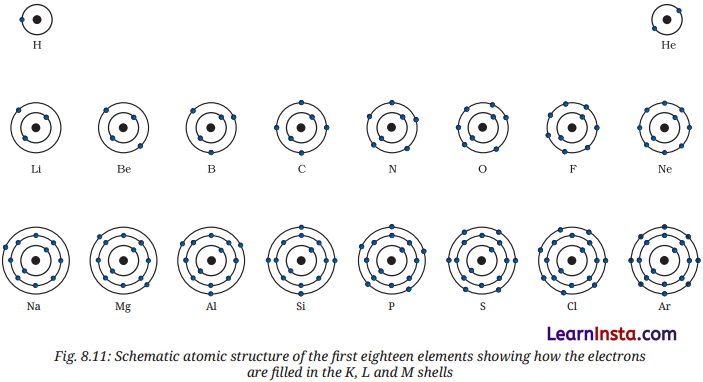
Schematic atomic structure of the first eighteen elements is given below. Dots represent electrons and circles the orbits or energy levels.
Combining Capacity of An Atom: Valency
Valency: An element’s valency is the number of hydrogen atoms which can combine with or replace (directly or indirectly) one of the element’s atoms. Oxygen, for instance, has six valence electrons but its valency is 2. Some elements may have more than one power combination (or valency), while others may have only one.
Atoms combine with one another because they want to achieve stability, and this stability is usually explained by the octet rule, which states that atoms tend to have eight electrons in their outermost shell like noble gases. The outermost shell of an atom is called the valence shell, and the electrons present in it are known as valence electrons. These valence electrons are the ones that take part in chemical reactions. The ability of an atom to combine with other atoms is called its valency or combining capacity, and it depends directly on the number of valence electrons.
For example, sodium has one valence electron in its valence shell, so its valency is one, while oxygen has six valence electrons and needs two more to complete its octet, so its valency is two. In general, metals show valency equal to the number of valence electrons they lose, while non metals show valency equal to the number of electrons they gain to complete the octet.
A Deeper Look Into Atomic Structure
Isotopes:
Isotopes are the atoms in which the number of neutrons differs and the number of protons is the same. From the above definition of atomic mass and the atomic number, we can conclude that isotopes are those elements having the same atomic number and different mass numbers.
Let us know something about the isotopes of hydrogen: There are three isotopes of hydrogen and these are protium, deuterium, and tritium. All three of them have the same number of protons, but the numbers of neutrons differ. In protium the number of neutrons is zero, in deuterium, it is one and in tritium, the number of neutrons is two.
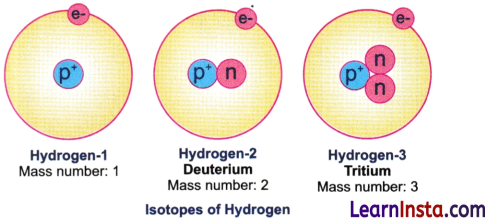
In the case of elements, a sample consists of more than one kind of atom called isotopes. Therefore, the Mass of a sample of atoms is also represented as weighted average mass and is called average atomic mass. Average atomic mass of Hydrogen is 1.008 u.
The weighted average of the atomic masses of an element’s various naturally occurring isotopes is its atomic weight.
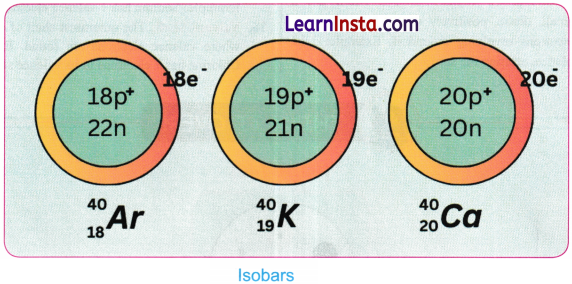
Isobars:
Isobars are atoms (nuclides) of different chemical elements which differs in the chemical property but has the same physical property. So, we can say that isobars are those elements which have a different atomic number but the same mass number. Their chemical property is different because there is a difference in the number of electrons. It has the same atomic mass but different atomic no. This is because an additional number of neutrons compensates for the difference in the number of nucleons.
The example of two Isotopes and Isobars is iron and nickel. Both have the same mass number which is 58 whereas the atomic number of iron is 26, and the atomic number of nickel is 28.