Experts have designed these Class 9 Science Notes and Exploration Chapter 7 Work Energy and Simple Machines Class 9 Notes for effective learning.
Class 9 Science Chapter 7 Work Energy and Simple Machines Notes
Class 9 Science Exploration Chapter 7 Notes
Class 9 Science Chapter 7 Notes – Class 9 Work Energy and Simple Machines Notes
→ Energy: Capacity to do work.
→ Inclined Plane: Sloping surface used to raise loads with less effort.
→ Joule (J): SI unit of work (1 N × 1 m).
→ Kinetic Energy (KE): Energy due to motion.
→ Law of Conservation of Energy: Energy can neither be created nor destroyed, only transformed.
→ Lever: Rigid bar pivoted at a fulcrum (classes I, II, III).
→ Mechanical Advantage (MA): Ratio of load to effort.
→ Mechanical Energy: Sum of KE (Kinetic Energy) and PE (Potential Energy).
→ Negative Work: Force and displacement in opposite directions.
→ No Work: Force applied but no displacement.
→ Positive Work: Force and displacement in the same direction.
→ Potential Energy (PE): Energy due to position, mgh.
→ Power: Rate of doing work.
→ Pulley: Wheel with a groove for rope, changes direction of force.
→ Simple Machine: Device that makes work easier by multiplying force or changing direction.
→ Watt (W): SI unit of power (1 J/s).
→ Work: Product of force and displacement in the direction of force.

Work Done by a Constant Force
→ Work: Work is said to be done whenever a force acts on a body and the body moves in the direction of the force.
Two conditions need to be satisfied for work to be done. These are as follows:
- A force should act on the body.
- The body must be displaced in the direction of the applied force.
If either of the above two conditions is not satisfied, then work is not done.
Work done by a constant force when a body moves in the direction of applied force. As shown in Fig., suppose a force F acts on a body. The body moves through a distance s in the direction of the force.
Work done = Force × Displacement
or W = F × s
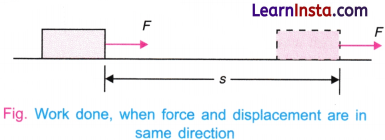
Thus, work done by a force acting on a body is equal to the magnitude of the force multiplied by the distance moved in the direction of the force.
The SI unit of work is joule (J). One joule of work is said to be done when a force of one newton displaces a body through a distance of 1 metre in its own direction.
Thus,
1 joule = 1 newton × 1 metre or 1 J = 1 Nm.
Work done is a scalar quantity because it has only magnitude and no direction.
As 1 N = 1 kg m/s2
Hence 1 J = 1 N × 1 m
= 1 kg m/s2 × 1 m
= 1 kg m2/s2 = 1 kg m2 s-2
→ When is work done equal to zero?
Work done by a constant force is zero in the following scenarios:
- Zero Displacement (s = 0): If a force is applied to an object but the object does not move, no work is done.
Example: Pushing against a solid, stationary wall. - Zero Force (F): If an object moves, but no force is acting upon it, no work is done.
→ Positive and negative work done:
Positive work:
Work done by a force is positive if the force acts in the direction of displacement.
Example:
When a horse pulls a cart, the applied force and displacement are in the same direction, the work done by the horse is positive.
Negative work:
Work done by a force is negative if the force acts opposite to the direction of displacement.
Example:
When brakes are applied to a moving vehicle, the work done by the braking force is negative. The braking force acts in the backward direction while the displacement of the vehicle is in the forward direction.
Example 1:
Determine the work done in pushing a cart through a distance of 50 m against the force of friction equal to 150 N.
Solution:
Here F = 150 N,
s = 50 m
Work done, W = F × s
= 150 N × 50 m = 7500 J.
Example 2:
A car weighing 1000 kg and travelling at 30 m/s stops at a distance of 50 m decelerating uniformly. What is the force exerted on it by the brakes? What is the work done by the brakes?
Solution:
Here,
m = 1000 kg,
u = 30 m/s,
v = 0,
s = 50 m
∵ v2 – u2 = 2 as
∴ 0 – 302 = 2a × 50
or a = – \(\frac{900}{100}\) = – 9 m/s2
∴ Deceleration = – 9 m/s2
and decelerating force, F = ma
= 1000 × (- 9) = – 9000 N
Work done by the brakes, W = F × s
= – 9000 × 50 J = – 450000 J.
The Work-Energy Theorem
Energy: Energy of a body is defined as its capacity or ability to do work. When a body is capable of doing more work, it is said to possess more energy.
Examples:
- When a fast moving cricket ball hits a stationary wicket, it throws away the wicket. The moving ball possesses energy and hence does work on the wicket.
- A hammer raised through a certain height possesses energy. When it falls on a nail placed on a piece of wood, it drives the nail into the wood.
The work-energy theorem states that the total work done on an object is equal to the change in its energy.
Work done on an object = change in its energy
Since energy is measured by the amount of work that a body can do, so units of energy are the same as those of work.
The SI unit of energy is joule (J). The kilojoule (kJ) is a greater unit of energy that is sometimes used. 1000 J is equivalent to 1 kJ.
Forms of Energy
Mechanical energy (potential energy + kinetic energy), heat energy, chemical energy, electrical energy, and light energy are some of the different forms of energy. The various forms of energy have their source and their methods of preservation.
Mechanical Energy
Mechanical Energy is the total energy an object possesses due to its motion (kinetic energy) and position/configuration (potential energy). It is the ability to do work, calculated as the sum of kinetic and potential energy. Common examples include a swinging pendulum or a falling object.
→ Kinetic energy: The energy possessed by a body by virtue of its motion is called its ‘kinetic energy’. A moving object can do work. The amount of work which a moving object can do before coming to rest is equal to its kinetic energy.
Examples:
- A fast moving stone can break a window pane. The stone has kinetic energy due to its motion and so it can do work.
- The kinetic energy of air is used to run windmills.
- The kinetic energy of running water is used to run watermills.
- A bullet fired from a gun can pierce a target due to its kinetic energy.
The SI unit of kinetic energy is joule (J).
Expression for kinetic energy:
The kinetic energy of a body can be determined by calculating the amount of work required to set the body into motion with the velocity v from its state of rest as shown in Fig.
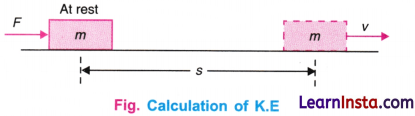
Let m = mass of the body
u = 0 = initial velocity of the body
F = force applied on the body
a = acceleration produced in the body in the direction of force
v = final velocity of the body
s = distance covered by the body
As v2 – u2 = 2as
v2 – 02 = 2as
or a = \(\frac{v^2}{2 s}\)
As the force and displacement are in the same direction, the work done on the body is
W = Fs
⇒ W = ma s (∵ F = ma)
⇒ W = m \(\frac{v^2}{2 s}\) × s (∵ a = \(\frac{v^2}{2 s}\))
∴ W = ½ mv2
This work done appears as the kinetic energy of the body. (∵ From work energy theorem)
∴ K = ½ mv2
Example 3:
A bullet of mass 10 g is fired with a velocity of 80 m/s. What is its kinetic energy?
Solution:
Here, m= 10 g = \(\frac{1}{100}\) kg,
v = 80 m/s
K.E. = ½ mv2
= \(\frac{1}{12}\) × \(\frac{1}{100}\) × (80)2 = 32 J.
Example 4:
Two bodies of equal masses move with uniform velocities of 2v and 3v respectively. Find the ratio of their kinetic energies.
Solution:
Let the mass of each body be m .
K.E. of the first body,
K1 = ½ m (2v)2
K.E. of the second body,
K2 = ½ m (3v)2
Ratio of the kinetic energies
\(\frac{K_1}{K_2}=\frac{\frac{1}{2} m \cdot 4 v^2}{\frac{1}{2} m \cdot 9 v^2}\)
= \(\frac{4}{9}\) = 4 : 9
→ Potential energy: The energy possessed by a body by virtue of its position or shape is called its ‘potential energy’.
Examples of P.E. due to position:
- Water stored in a dam has potential energy.
- A stone lying on the roof of the building has potential energy.
Examples of P.E. due to shape:
(i) In a toy car, the wound spring possesses potential energy. As the spring is released, its potential energy changes into kinetic energy which moves the toy car.
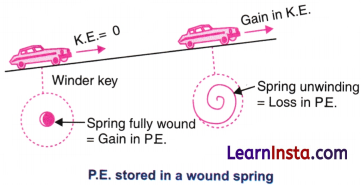
(ii) A stretched bow possesses potential energy. As soon as it is released, it shoots the arrow into the forward direction with a large velocity. The potential energy of the stretched bow gets converted into the kinetic energy of the arrow.
Gravitational potential energy: When an object is raised through a certain height above the ground, its energy increases. This is because work is done on it against gravity. The energy present in such an object is called gravitational potential energy.
The gravitational potential energy of an object at a point above the ground is defined as the work done in raising it from the ground to that point against gravity.
Expression for potential energy:
Consider a body of mass m lying at point A on the earth’s surface, where its potential energy is taken as zero. Its weight mg acts vertically downwards. In order to lift the body to another position B at a height h, we have to apply a minimum force equal to mg in the upward direction. So work is done on the body against the force of gravity.
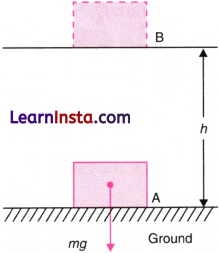
Work done = Force × Displacement
or W = F s
But F = mg and s = h (as h = height)
∴ W = mg × h = mgh
The work done (mgh) on the body is equal to the gain in energy of the body. This is the potential energy (U) of the body. Thus,
U = mgh
The potential energy of the body is due to the work done on it against the force of gravity. So, this energy is called gravitational potential energy.
Example 5:
A rocket of 3 × 10⁶ kg mass takes off from a launching pad and acquires a vertical velocity of 1 km/s at an altitude of 25 km. Calculate
(a) the potential energy, and
(b) the kinetic energy. (Take the value of g = 10 m/s2.)
Solution:
Here m = 3 × 10⁶ kg,
v = 1 km/s = 1000 m/s
h = 25 km = 25000 m,
g = 10 m/s2
(a) U = mgh
= 3 × 106 × 10 × 25000
= 7.5 × 10¹¹ J
(b) K = ½ mv2
= ½ × 3 × 106 × (1000)2
= 1.5 × 10¹² J.
Example 6:
A bag of wheat weighs 200 kg. To what height should it be raised so that its potential energy may be 9800joules? (g = 9.8 m/s2).
Solution:
Here, m = 200 kg,
g = 9.8 m/s2,
U(P.E.) = 9800 J
∵ U = mgh
∴ 9800 = 200 × 9.8 × h
or h = \(\frac{9800}{200 \times 9.8}\) = 5 m.
→ Conservation of mechanical energy: The sum of the kinetic energy and the potential energy of an object is called its mechanical energy.
Let KE = kinetic energy
PE = potential energy
E = mechanical energy
Then E = KE + PE
According to the principle of conservation of mechanical energy, the total mechanical energy of a system is conserved i.e., the energy can neither be created nor be destroyed; it can only be internally converted from one form to another if the forces doing work on the system are conservative in nature.
Power
- Power is described as the rate of doing work or it can be the rate of transfer of energy.
- It measures the speed of work done.
- If an object does a work Win time t, then power is given by:
Power = \(\frac{\text { Work }}{\text { Time }}\)
P = \(\frac{W}{t}\)
The SI unit of power is Watt, having the symbol W.
1 watt = 1 joule/second or 1 W = 1 J s-1.
1 kilowatt = 1000 watts,
1 kW = 1000 W,
1 kW = 1000 J s-1.
1 kWh is equal to 1000 J s-1 of energy utilized in one hour (or 1 kW).
1 kWh = 1 kW × 1 h = 1000 W × 3600 s
= 3600000 J = 3.6 × 10⁶ J
Example 7:
The work done by the heart for each beat is 1 joule. Calculate the power of the heart if it beats 72 times in a minute.
Solution:
Work done by the heart per beat = 1 J
Work done by the heart in 72 beats,
W= 1 × 72 = 72 J
Time taken, t = 1 min = 60 s W 72 J
Power, P = \(\frac{W}{t}\)
= \(\frac{72 \mathrm{~J}}{60 \mathrm{~s}}\) = 1.2 W
Example 8:
The heart does 1.5 J of work in each heart beat. How many times per minute does it beat if its power is 2 watt?
Solution:
Work done in each beat = 1.5 J
Time taken, t = 1 min = 60 s
Power, P = 2 W = 2 Js-1
Total work done = P × t
= 2 Js-1 × 60 s = 120 J
Simple Machines
Simple machines are devices that make work easier by changing the magnitude or direction of force. We will study simple machines like a pulley, an inclined plane and a lever.
Mechanical advantage (MA) is the ratio of load to effort.
Mechanical advantage (MA) = \(\frac{\text { load }}{\text { effort }}\)
Where load = weight of the object lifted
Effort = Force applied
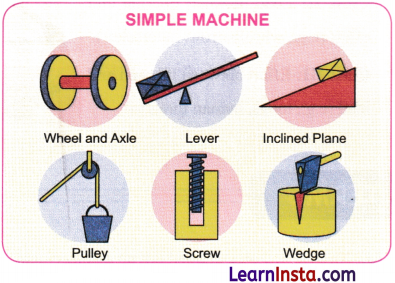
→ Pulley:
In a pulley, a cord wraps around a wheel. It is a simple machine that is used to change the direction of the force. When the wheel rotates, the cord can move in either direction. By attaching a hook to the cord, the wheel’s rotation can be used to raise or lower objects, making work easier. Various types of pulley help in making a variety of lifting and moving tasks easier. A pulley system is necessary to hoist a flag on a flag pole. A rope is attached to the pulley to raise and lower the flag more easily.
Types:
- Fixed pulley (changes direction only, MA = 1).
- Movable pulley (reduces effort, MA >1).
→ Inclined Plane:
An inclined plane (simple machine) is a sloping plane used to raise heavy bodies. Inclined planes make it easier to lift objects to greater heights. There are two ways to raise an object: it can be either raised by lifting it straight up or by pushing it diagonally up.
Lifting an object straight up moves the object in the shortest distance, but a more significant force must be exerted. Using an inclined plane to lift objects requires a smaller force but must be exerted over a long distance. A few everyday examples of inclined planes include sidewalk ramps, highway access ramps, inclined conveyor belts, and switchback roads.
mechanical advantage = \(\frac{\text { load }}{\text { effort }}\)
= \(\frac{m g}{F^{\prime}}\)
= \(\frac{L}{h}\)
Example 9:
A ramp is 10 metres long and has a mechanical advantage of 5. What is the vertical height of the lamp ?
Solution:
Given: Length (L) = 10 m;
MA = 5
Formula h = \(\frac{L}{MA}\) = 2 m
Hence, the height of the ramp = 2 metres.
Example 10:
A worker need’s to push a 1200 N crate up a ramp that is 32 m long and 8 m high. Assuming no friction, how much force (efforts) must they apply?
Solution:
Here, L = 32 m,
h = 8 m
Now, mechanical advantage = \(\frac{\text { load }}{\text { effort }}\)
= \(\frac{32 \mathrm{~m}}{8 \mathrm{~m}}\) = 4
Formula =\(\frac{\text { Land }}{\text { MA }}\)
= \(\frac{1200}{4}\)
= 300 N
Hence, the worker needs to apply 300 N of force.
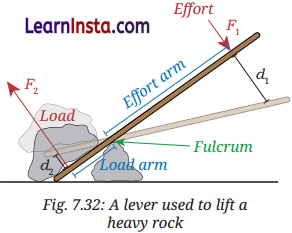
→ Lever: A lever is a tool that is used to pry objects loose. Levers are also used to lift objects. A lever has an arm that turns against a fulcrum. Exerting a force on one end of the pivot creates a force on the other end of the lever. The applied force is either increased or decreased based on the distance from the fulcrum to the load and from the fulcrum to the effort. A few examples of levers are the hammer that we used to pry nails loose and the kids’ favourite see-saw.
Key Components of a Lever:
- Fulcrum (F): The stationary point or axis around which the lever rotates.
- Load (L): The external force or weight that the lever is intended to move or overcome.
- Effort (E): The input force applied to the lever to move the load.
- Load Arm: The perpendicular distance from the fulcrum to the point where the load is applied.
- Effort Arm: The perpendicular distance from the fulcrum to the point where the effort is applied.
It works on the principle of moments:
F1 × d1 = F2 × d2
Mechanical advantage =\(\frac{\text { load }}{\text { effort }}=\frac{\text { effort arm }}{\text { load arm }}\)
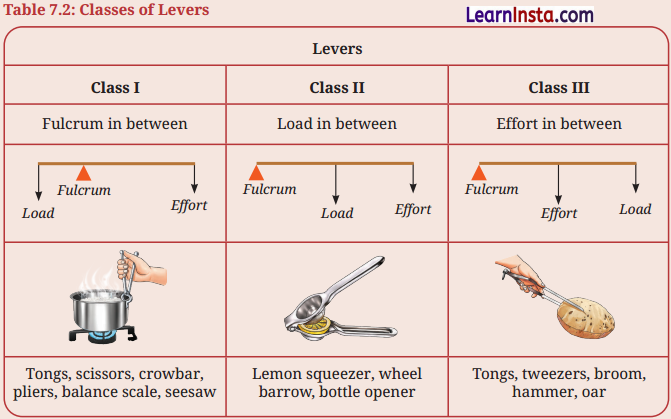
→ Classes of levers:
- Class I: Fulcrum between effort and load (e.g., tongs, scissors, crowbar).
- Class II: Load between fulcrum and effort (e.g., wheelbarrow, nutcracker).
- Class III: Effort between fulcrum and load (e.g., tongs, human forearm).