Get the simplified Class 7 Maths Extra Questions Chapter 2 Arithmetic Expressions Class 7 Extra Questions and Answers with complete explanation.
Class 7 Arithmetic Expressions Extra Questions
Class 7 Maths Chapter 2 Arithmetic Expressions Extra Questions
Class 7 Maths Chapter 2 Extra Questions
Question 1.
Ravi spends ₹ 30 everyday on his school transport. Write the expression for the total amount he spends on transport in a week from Monday to Friday.
Answer:
Given, total money spent by Ravi on his school transport in a day = ₹ 30
Since, the total number of days from Monday to Friday = 5
Therefore, the expression for the total amount spent on school transport = 5 × 30.
Note Arithmetic expression ‘5 × 30 read as ‘5 times ’30’ or ‘product of 5 and 30.
Question 2.
Fill in the blanks to make the expressions equal on both sides of the ‘ = ‘ sign.
(i) 18 + ………. = 25 + 3
(ii) 40 – ………. = 7 × 5
(iii) 9 × ………. = 72 + 4
(iv) 50 ÷ ………. = 10 – 5
Answer:
(i) 18 + 10 = 25 + 3
(ii) 40 – 5 = 7 × 5
(iii) 9 × 2 = 72 + 4
(iv) 50 ÷ 10 = 10 – 5

Question 3.
Arrange the following expressions in ascending (increasing) order of their values.
(i) 92 – 37
(ii) 8 × 7
(iii) 45 + 15
(iv) 100 ÷ 4
Answer:
(i) We have, 92 – 37 = 55
(ii) We have, 8 × 7 = 56
(iii) We have, 45 + 15 = 60
(iv) We have, 100 + 4 = 25
Therefore, the following expressions in ascending (increasing) order of their values are 100 ÷ 4 < 90 – 37 < 8 × 7 < 45 + 15. Question 4. Which is greater 500 + 150 or 510 + 100 ? Answer: We have, 500 + 150 = 650 and 510 + 100 = 610 Hence, 650 > 610 i.e. 500 + 150 > 510 + 100.
Question 5.
Which is smaller 250 – 100 or 250 – 90?
Answer:
We have, 250 – 100 = 150 and 250 – 90 = 160
Hence, 150 < 160 i.e. 250 – 100 < 250 – 90. Question 6. Use ‘>’ or ‘<‘ or ‘=’ in each of the following expressions to compare them. (i) 350 + 189 ▢ 146 + 385 (ii) 173 – 140 ▢ 272 – 145 (iii) 264 + 589 ▢ 364 + 489 (iv) 285 – 154 ▢ 245 – 129 Answer: (i) We have, 350 + 189 = 539 and 146 + 385 = 531 Hence, 539 > 531 i.e. 350 + 189 > 146 + 385.
(ii) We have, 173 – 140 = 33 and 272 – 145 = 127 Hence, 33 < 127 i.e. 173 – 140 < 272 – 145. (iii) We have, 264 + 589 = 853 and 364 + 489 = 853 Hence, 853 = 853 i.e. 264 + 589 = 364 + 489 (iv) We have, 285 – 154 = 131 and 245 – 129 = 116 Hence, 131 > 116 i.e. 285 – 154 > 245 – 129.
Question 7.
Rina brought 24 crayons to school. Meena brought 6 boxes of crayons with 3 crayons in each box. How many crayons did Rina and Meena bring to school in total?
Answer:
Given, the number of crayons brought by Rina = 24, the number of boxes of crayons brought by Meena = 6 and the number of crayons in each box = 3
So, the total number of crayons brought by Meena to school = 6 × 3
Therefore, the mathematical expression of given information = 24 + 6 × 3
Hence, the total number of crayons brought by Rina and Meena to school = 24 + 18 = 42.
Question 8.
Write a story/situation for the expression 79 + 31 – 10 and find its value.
Answer:
Given, the arithmetic expression is 79 + 31 – 10.
Story Riya went to a bookstore and bought 79 books for her school library. Later, she received 31 more books as a donation. However, she decided to give away 10 books to a nearby children’s center. How many books does Riya have now?
Given, the number of books bought by Riya = 79 and number of books received by Riya as a donation = 31
Since, she decided to give away 10 books to nearby children’s center.
So, the required expression is 79 + 31 – 10.
Now, 79 + 31 – 10 = 100
Hence, Riya has 100 books now.
Question 9.
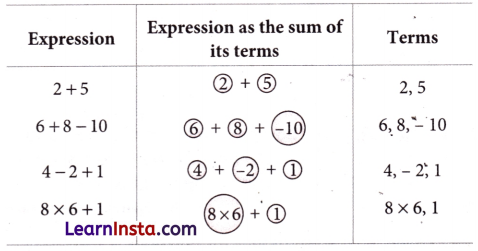
In the following table, some expressions are given. Complete the table.
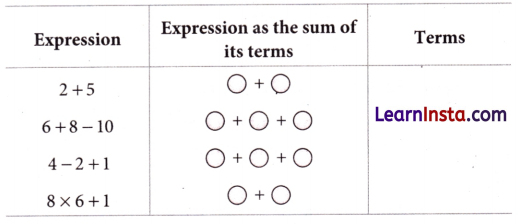
Answer:
The complete table as shown as below.
Question 10.
Solve
(i) (5 + 8) × 2
(ii) 9 ×(3 – 1)
(iii) 8 ×(1 + 3)
(iv) (12 – 3) × 2
Answer:
(i) We have, (5 + 8) × 2 = 5 × 2 + 8 × 2 = 10 + 16 = 26
(ii) We have, 9 ×(3 – 1) = 9 × 3 – 9 × 1 = 27 – 9 = 18
(iii) We have, 8 ×(1 + 3) = 8 × 1 + 8 × 3 = 8 + 24 = 32
(iv) We have, (12 – 3) × 2 = 12 × 2 – 3 × 2 = 24 – 6 = 18
Question 11.
If 63 × 18 = 1134, then find out 73 × 18.
Answer:
Given, 63 × 18 = 1134
∵ 73 × 18 means 73 times 18.
Now, 73 × 18 = (63 + 10) × 18
= 63 × 18 + 10 × 18
= 1134 + 180
= 1314
Question 12.
Ravi bought a notebook for ₹ 28 and a pen for ₹12. He gave the shopkeeper ₹100. Write an expression to calculate the change that Ravi will get back.
Answer:
Given, Ravi spent money for notebook = ₹ 28
and he spent money for pen = ₹ 12
So, the total cost of notebook and pen = ₹(28 + 12)
Since, he gave ₹ 100 to the shopkeeper.
So, we write that expression as 100 – (28 + 12).
By removing brackets, we have
100 – (28 + 12) = 100 – 28 – 12
∴ We can first subtract 28 from 100 and then subtract 12 from the result. We will get 60.
Also, evaluating the expression within the brackets first, we have
100 – 40 = 60
Hence, Ravi will get back ₹ 60.
Question 13.
Solve
(i) 25 – (7 + 4)
(ii) 50 – (5 – 4)
(iii) 40 – (16 + 4)
(iv) 15 – (4 × 2)
Answer:
(i) We have, 25 – (7 + 4) = 25 – 7 – 4 = 25 – 11 = 14
(ii) We have, 50 – (5 – 4) = 50 – 5 + 4 = 50 – 1 = 49
(iii) We have, 40 – (16 + 4) = 40 – 4 = 36
(iv) We have, 15 – (4 × 2) = 15 – 8 = 7
Question 14.
Aisha has a collection of rare stamps. She keeps 28 stamps in one album and 35 stamps in another. She decides to give away 10 stamps from the second album to a friend. Write an expression for the number of stamps remaining with Aisha. Also, find its value.
Answer:
Given, the number of stamps kept by Aisha in first album = 28,
the number of stamps kept by Aisha in second album = 35 and the number of stamps given by Aisha to her friend from second album = 10
So, the expression of above information = 28 + (35 – 10) Hence, the number of stamps remaining with Aisha
= 28 + (35 – 10) = 28 + 25 = 53.
Question 15.
Asha bought a notebook for ₹ 20 and a pen for ₹10. She gave the shopkeeper ₹ 50. Write an expression that can help her to calculate the change that Asha will get back from the shopkeeper. Also, find its value.
Answer:
Given, cost of notebook = ₹ 20 and cost of pen = ₹ 10 and the money given by Asha to the shopkeeper = ₹ 50 Hence, the total money gotten by Asha from the shopkeeper = 50 – (20 + 10) = 50 – 30 = 20 i.e. ₹ 20.
Question 16.
Neha climbs 8 metres up a ladder and then goes down 3 metres. Write an expression to show how high she is from the ground. Further, check whether the commutative property of addition holds or not.
Answer:
Given, Neha climbs 8 metres up and goes down 3 metres.
Then, the height is 8 – 3 = 5 metres above the ground.
∴ The expression for the given situation is 8 + (-3).
Checking for commutativity
Since, 8 + (-3) = 8 – 3 = 5
and (-3) + 8 = 5
i.e. 8 + (-3) = (-3) + 8
Hence, the commutativity of addition holds.
Question 17.
Find the value of the following expression.
2-4+6-8+10-12+14-16+18-20
Answer:
Grouping two consecutive numbers as pairs :
We have,
(2 – 4) + (6 – 8) + (10 – 12) + (14 – 16) + (18 – 20)
= -2 + (-2) + (-2) + (-2) + (-2)
= -2 – 2 – 2 – 2 – 2
= -10