Students often refer to Class 8 Ganita Prakash Solutions and NCERT Class 8 Maths Part 2 Chapter 7 Area Question Answer Solutions to verify their answers.
Class 8 Maths Ganita Prakash Part 2 Chapter 7 Solutions
Ganita Prakash Class 8 Chapter 7 Solutions Area
Class 8 Maths Ganita Prakash Part 2 Chapter 7 Area Solutions Question Answer
7.1 Rectangle and Squares
NCERT In-Text Questions (Page 148)
Question 1.
Try to think of different creative ways to divide a square into 4 parts of equal area.
Solution:
Do it yourself.
NCERT In-Text Questions (Page 150)
Question 1.
Why do we count the number of unit squares to assign measures for area? Couldn’t we have just used the perimeter of a region, i.e., the length of its boundary as a measure of its area?
Solution:
We count number of unit squares because area measures the amount of surface covered, not the length around it.
Perimeter measures only the length of the boundary.

Question 2.
Find two rectangles that are examples of such regions. If needed, use a grid paper (given at the end of the book) for this.
Solution:
Perimeter = 20 units
Area = 16 sq. units

Perimeter = 18 units
Area = 18 sq. units

Perimeter of Rectangle 1 > Perimeter of Rectangle 2,
but Area of Rectangle 1 < Area of Rectangle 2.
Question 3.
Also, give an example of two regions of other shapes, where the region with the larger perimeter has the smaller area! This property should be visually clear in your example.
Solution:
Do it yourself.
Figure it Out (Pages 150-152)
Question 1.
Identify the missing sidelengths.

Solution:
(i)
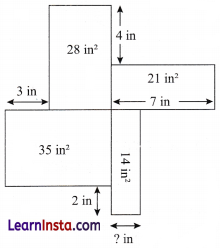
Area of a rectangle = length × width
For the 21 in2 rectangle:
Width = 7 in, length = \(\frac {21}{7}\) in = 3 in
For the 28 in2 rectangle:
Length = (4 + 3) in = 7 in
width = \(\frac {28}{7}\) in = 4 in
For the 35 in2 rectangle:
Width = (3 + 4) in = 7 in
length = \(\frac {35}{7}\) in = 5 in
For the 14 in2 rectangle:
Length = (5 + 2) in = 7 in
Width = \(\frac {14}{7}\) in = 2 in
Therefore, the missing sidelength is 2 in.
(ii)
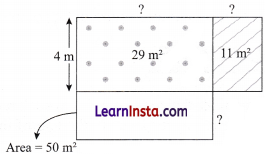
Area of a rectangle = length × width
For the 29 m2 rectangle:
Length = 4 m, width = \(\frac {29}{4}\) m = 7.25 m
For the 11 m2 rectangle:
Length = 4 m, width = \(\frac {11}{4}\) m = 2.75 m
For the 50 m2 rectangle:
Width = 7.25 m, length = \(\frac {50}{7.25}\) m = 6.9 m (approx.)
Thus, the missing sidelength is 6.9 m.
Question 2.
The figure shows a path (the shaded portion) laid around a rectangular park EFGH.

(i) What measurements do you need to find the area of the path? Once you identify the lengths to be measured, assign possible values of your choice to these measurements and find the area of the path. Give a formula for the area.
An example of a formula— Area of a rectangle = length × width.
[Hint: There is a relation between the areas of EFGH, the path, and ABCD.]
(ii) If the width of the path along each side is given, can you find its area? If not, what other measurements do you need? Assign values of your choice to these measurements and find the area of the path. Give a formula for the area using these measurements.
[Hint: Break the path into rectangles.]
(iii) Does the area of the path change when the outer rectangle is moved while keeping the inner rectangular park EFGH inside it, as shown?

Solution:
(i) To find the area of the path, we need these measurements:
Outer length and outer width (including the path)
Inner length and inner width (excluding the path)
Once these are known, the area of the path is found by subtracting the inner area from the outer area.
Example:
Dimension of outer rectangle: 12 m × 8 m
Dimension of inner rectangle: 10 m × 6 m
Formula:
Area of path = (Area of outer rectangle) – (Area of inner rectangle)
Area of path = (12 × 8) – (10 × 6)
= 96 – 60
= 36 m2
(ii) No, knowing only the width of the path is not enough to find its area.
The length and breadth of the park are also needed.
Example:
Let Inner length = l = 10 m
Inner breadth = b = 6 m
Width of path = w = 1 m
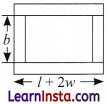
Break the path into rectangles (two along the length and two along the breadth):
Area of path = 2(l + 2w) × w + 2bw = 2lw + 2bw + 4w2
Substituting values:
2(10) (1) + 2 (6) (1) + 4 (1)2 = 20 + 12 + 4 = 36 m2
Formula:
Area of path = 2w(l + b) + 4w2 = 2w(l + b + 2w)
We can also find the area of the path if the outer dimensions (excluding the path) are given.
Then, formula: Area of path = 2lw + 2bw – 4w2, where l and b are outer length and breadth, respectively.
(iii) No, the area remains the same.
When the path widens in some area and narrows in others, the additional area is balanced by the area reduced, so the total area of the path remains unchanged.
Question 3.
The figure shows a plot with sides 14 m and 12 m, and with a crosspath. What other measurements do you need to find the area of the crosspath? Once you identify the lengths to be measured, assign some possible values of your choice and find the area of the path. Give a formula for the area based on the measurements you choose.

Solution:
The other measurement needed is the width of the crosspath (say w m).
Example:
Let the width of the path = 2 m
Plot dimensions: 14 m × 12 m
The crosspath consists of two rectangles
One along the length
One along the breadth
Area of crosspath = 14 × w + 12 × w
The central square (w × w) is counted twice, so subtract it once.
Area of the path = 14w + 12w – w2
Substituting w = 2:
28 + 24 – 4 = 48 m2
Formula:
Area of crosspath = w(l + b) – w2 = w(l + b – w)
l and b are the length and breadth of the plot, respectively.
Question 4.
Find the area of the spiral tube shown in the figure. The tube has the same width throughout.
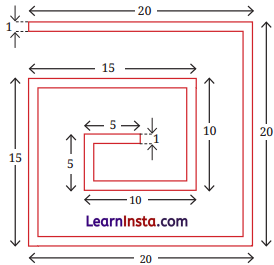
[Hint: There are different ways of finding the area. Here is one method.]
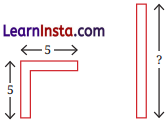
What should be the length of the straight tube if it is to have the same area as the bent tube on the left?
Solution:
The path has a uniform width of 1 unit, so its area can be found by adding the areas of all rectangular strips that make up the spiral.

Adding the given areas from the figure:
20 + 19 + 19 + 14 + 14 + 9 + 9 + 4 + 4 = 112 sq. units
The bent tube has a uniform width of 1 unit.
Its area is found by adding the lengths of the two arms and then subtracting the overlapping square at the corner (counted twice).
Area of arms: 5 + 5 = 10 sq. unit
Overlapping square area: 1 × 1 = 1 sq. units
Area of bent tube = 10 – 1 = 9 sq. units
For a straight tube of the same width (1 unit) to have the same area:
Length × 1 = 9 sq. units
Length of the straight tube = 9 units.
Question 5.
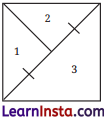
In this figure, if the sidelength of the square is doubled, what is the increase in the areas of the regions 1, 2, and 3? Give reasons.
Solution:
Let the original sidelength of the square be s.
Then, the area of the square = s2
When the sidelength is doubled, the new side length becomes 2s.
Then, area of square = (2s)2 = 4s2
So, the area of the square becomes four times the original area.
The lines dividing the square split the square into smaller regions, and they do not affect its size.
So when the square is enlarged, each region (1, 2, and 3) also increases to four times its original area.
Thus, the new area = 4 × original area
Increase = 4A – A = 3A.
Question 6.
Divide a square into 4 parts by drawing two perpendicular lines inside the square as shown in the figure.

Rearrange the pieces to get a larger square, with a hole inside.
You can try this activity by constructing the square using cardboard, thick chart paper, or similar materials.
Solution:
Do it yourself.
Triangles
NCERT In-Text Questions (Page 153)
Question 1.
Find the area of ∆XDC.

Solution:
Area of rectangle ABCD = DC × AD
= 5 × 4
= 20 sq. units
The area of ∆XDC is half the area of rectangle ABCD.
Area of ∆XDC = \(\frac {1}{2}\) × 20 = 10 sq. units
Triangles between Parallel Lines with a Common Base
NCERT In-Text Questions (Pages 156-157)
Question 1.
Line l || BC. Consider the different triangles that have BC as their base, and with their third vertex lying anywhere on l.
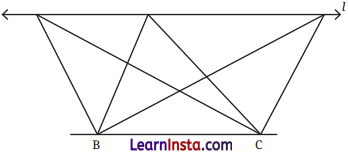
(i) Which of these triangles has the maximum area, and which has the minimum area?
(ii) Which of these triangles has the maximum perimeter, and which has the minimum perimeter?
Solution:
(i) Area of triangle = \(\frac {1}{2}\) × base × height
Base = BC (same for all triangles)
Height = Perpendicular distance from line l to BC (same for all triangles since all vertices lie on l)
Therefore, all the triangles have an equal area.
(ii) The perimeter of the triangle is maximized when the sum of the two sides from the vertex to B and C is maximized.
This occurs when the third vertex is at the point on either side of line l that is farthest from the midpoint of line segment BC, creating the longest possible sides.
Therefore, the triangle with its vertex at the farthest point from the midpoint of BC on either side of line l has maximum perimeter.
NCERT In-Text Questions (Page 157)
Question 1.
Analyse whether A lies on the perpendicular bisector of BC.

Solution:
A point lies on the perpendicular bisector of a line segment if it is equidistant from the endpoints.
From the symmetry of the figure, AB = AC
Therefore, point A is equidistant from B and C, which implies that A lies on the perpendicular bisector of BC.
Figure it Out (Pages 157-159)
Question 1.
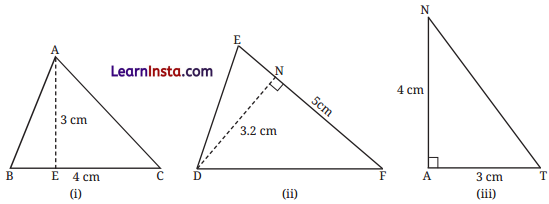
Find the areas of the following triangles:
Solution:

(i) Area of triangle = \(\frac {1}{2}\) × base × height
= \(\frac {1}{2}\) × 4 × 3
= 6 cm2
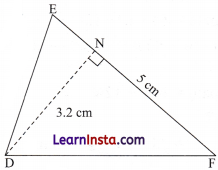
(ii) Area of triangle = \(\frac {1}{2}\) × base × height
= \(\frac {1}{2}\) × 5 × 3.2
= 8 cm2

(iii) Area of triangle = \(\frac {1}{2}\) × base × height
= \(\frac {1}{2}\) × 3 × 4
= 6 cm2
Question 2.
Find the length of the altitude BY.

Solution:
Area using base BC and altitude AX:
Area of ∆ABC = \(\frac {1}{2}\) × AX × BC
= \(\frac {1}{2}\) × 4 × 6
= 12 sq. units
Area using altitude BY on base AC:
Area of ∆ABC = \(\frac {1}{2}\) × AC × BY = \(\frac {1}{2}\) × 8 × BY
Area of ∆ABC = \(\frac {1}{2}\) × AX × BC = \(\frac {1}{2}\) × AC × BY
12 = 4 × BY
⇒ BY = 3 units
Question 3.
Find the area of ∆SUB, given that it is isosceles, SE is perpendicular to UB, and the area of ∆SEB is 24 sq. units.
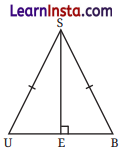
Solution:
Consider the ∆SEU and ∆SEB,
SU = SB (Equal sides of an isosceles triangle)
∠SEU = ∠SEB = 90° (SE is perpendicular to UB)
SE = SE (Common side)
⇒ ∆SEU ≅ ∆SEB (By RHS congruence criterion)
Congruent triangles have equal areas, so:
Area of ∆SEU = Area of ∆SEB = 24 sq. units
Area of ∆SUB = Area of ∆SEU + Area of ∆SEB
= 24 + 24
= 48 sq. units
Question 4.
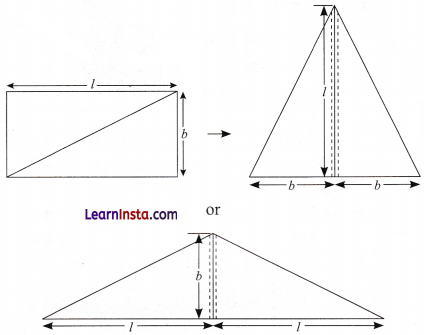
[Sulba-Sutras] Give a method to transform a rectangle into a triangle of equal area.
Solution:
1. Take the rectangle ABCD.
2. Draw a diagonal, say AC, dividing the rectangle into two triangles.
3. Each triangle has half the area of the rectangle.
4. Place the two congruent triangles together along either the length or the breadth of the rectangle so that they form a single triangle.
The base of this triangle becomes twice the breadth or twice the length of the rectangle, and its height becomes the length or the breadth of the rectangle, respectively.
Question 5.
[Sulba-Sutras] Give a method to transform a triangle into a rectangle of equal area.
Solution:
1. Draw a perpendicular from a vertex of the isosceles triangle to the opposite side. This gives the height and splits the triangle into two right-angled triangles.
2. Place the two right-angled triangles together along their equal sides.
3. Form a rectangle whose length is half the base of the triangle, and whose width is the height of the triangle (or equivalently, the full base and half the height).
4. Rearrange without overlap or gaps. Since only cutting and shifting are used, the area is preserved.

Question 6.
ABCD, BCEF, and BFGH are identical squares.

(i) If the area of the red region is 49 sq. units, then what is the area of the blue region?
(ii) In another version of this A figure, if the total area enclosed by the blue and red regions is 180 sq. units, then what is the area of each square?
Solution:
(i) Let the side of the square be s.
Then the area of the red region = \(\frac {1}{2}\) × s × 2s = s2
s2 = 49 sq. units
⇒ s = 7 units
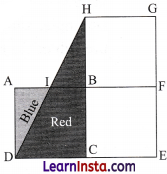
Now, consider ∆ADI and ∆BHI,
AD = BH (Sides of identical squares)
∠DIA = ∠HIB (Vertically opposite angles)
∠DAI = ∠HBI = 90°
∆ADI ≅ ∆BHI (By AAS congruence criterion)
AI = BI (By CPCT)
AI + BI = 7 units
⇒ 2AI = 7 units (Side of a square)
⇒ AI = \(\frac {7}{2}\) units
Now, area of blue region = \(\frac {1}{2}\) × AI × AD
= \(\frac {1}{2}\) × \(\frac {7}{2}\) × 7
= \(\frac {49}{4}\) sq. units.
(ii) From part (i), we know that,
Area of blue region = \(\frac {1}{4}\) × Area of red region
Area of blue region + Area of red region = 180 sq. units
⇒ \(\frac {1}{4}\) × Area of red region + Area of red region = 180 sq. units
⇒ \(\frac {5}{4}\) × Area of red region = 180 sq. units
⇒ Area of red region = 180 × \(\frac {4}{5}\) = 144 sq. units
⇒ \(\frac {1}{2}\) × s × 2s = 144 sq. units
⇒ s = 12 units
∴ Area of a square = s2 = 144 sq. units
Question 7.
If M and N are the midpoints of XY and XZ, what fraction of the area of ∆XYZ is the area of ∆XMN? [Hint: Join NY]

Solution:
Joining NY, we get a ∆NYX in which NM divides XY into two equal parts.
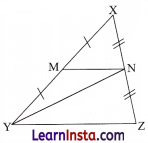
We know that, in a triangle, the line joining a vertex to the midpoint of its opposite side divides the triangle into two triangles of equal area.
Thus, area of ∆XNM = area of ∆NMY ….(i)
Also, YN divides XZ into two equal parts.
Thus, area of ∆NYZ = area of ∆NYX …..(ii)
From (i) and (ii), we get
Area of ∆XNM = \(\frac {1}{2}\) × area of ∆NYX
and area of ∆NYX = \(\frac {1}{2}\) × area of ∆XYZ
Therefore, area of ∆XNM = \(\frac {1}{2}\) × \(\frac {1}{2}\) × area of ∆XYZ = \(\frac {1}{4}\) × area of ∆XYZ
Question 8.
Gopal needs to carry water from the river to his water tank. He starts from his house. What is the shortest path he can take from his house to the river and then to the water tank? Roughly recreate the map in your notebook and trace the shortest path.

Solution:
The river constrains the path into two straight segments: House to River (HR) and River to Tank (RT).
We need to minimize the total distance HR + RT.
By using a reflection of the water tank across the river line:
1. The distance from the river crossing point to the actual water tank (RT) is mathematically equal to the distance from the river crossing point to the reflected water tank (RT’).
This is due to symmetry and the definition of a reflection.
2. The problem then transforms into finding the shortest path from the house (H) to the reflected tank (T’) that touches the river line.
3. The shortest distance between H and T’ is a single straight line HT’.
4. The point where this straight line crosses the river is the unique spot that minimizes the total distance HR + RT.

Area of any Polygon
NCERT In-Text Questions (Page 159)
Question 1.
How do we find the area of this pentagon?
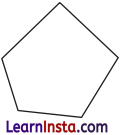
Solution:
Label the vertices of the pentagon as A, B, C, D, and E.
Choose vertex A as a fixed vertex.
Join E vertex A to non-adjacent vertices C and D.
By joining AC and AD, we divide the pentagon into three triangles: ∆ABC, ∆ACD, and ∆ADE.
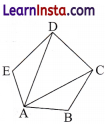
Now, calculate the area of each triangle and add them to get the area of the given pentagon.
Figure it Out (Page 160)
Question 1.
Find the area of the quadrilateral ABCD given that AC = 22 cm, BM = 3 cm, DN = 3 cm, BM is perpendicular to AC, and DN is perpendicular to AC.

Solution:
Area of quadrilateral ABCD = Area of ∆ABC + Area of ∆ADC
Area of ∆ABC = \(\frac {1}{2}\) × AC × BM
= \(\frac {1}{2}\) × 22 × 3
= 33 cm2
Area of ∆ADC = \(\frac {1}{2}\) × AC × DN
= \(\frac {1}{2}\) × 22 × 3
= 33 cm2
Area of quadrilateral ABCD = 33 + 33 = 66 cm2
Question 2.
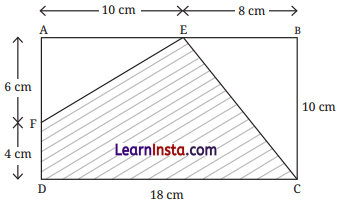
Find the area of the shaded region given that ABCD is a rectangle.
Solution:
Area of shaded region = Area of rectangle ABCD – (Area of ∆AEF + Area of ∆BCE)
Area of rectangle ABCD = DC × BC
= 18 × 10
= 180 cm2
Area of ∆AEF = \(\frac {1}{2}\) × AE × AF
= \(\frac {1}{2}\) × 6 × 10
= 30 cm2
Area of ∆BCE = \(\frac {1}{2}\) × BE × BC
= \(\frac {1}{2}\) × 8 × 10
= 40 cm2
Area of shaded region = 180 – (30 + 40)
= 180 – 70
= 110 cm2
Question 3.
What measurements would you need to find the area of a regular hexagon?
Solution:
To find the area of a regular hexagon, we need the length of one side.
A regular hexagon can be divided into 6 congruent equilateral triangles.
Knowing the sidelength allows us to find the area of one triangle and hence the total area of the hexagon.
Question 4.
What fraction of the total area of the rectangle is the area of the blue region?

Solution:
Area of rectangle = l × b

The blue region consists of two triangles whose bases are equal to the breadth of the rectangle.
Area of blue region = \(\frac {1}{2}\) × b × h1 + \(\frac {1}{2}\) × b × h2 = \(\frac {1}{2}\) × b × (h1 + h2)
We observe that, h1 + h2 = l
Thus, area of blue region = \(\frac {1}{2}\) × b × l or \(\frac {1}{2}\) × l × b
Therefore, area of blue region = \(\frac {1}{2}\) × area of rectangle
Question 5.
Give a method to obtain a quadrilateral whose area is half that of a given quadrilateral.
Solution:
Let ABCD be the given quadrilateral.
1. Draw one of its diagonals, say AC.
This divides the quadrilateral into two triangles, ΔABC and ΔADC
2. Find the midpoint M of the diagonal AC.
3. Join the midpoint M to the two vertices B and D.
4. The quadrilateral BMDA is the required quadrilateral.
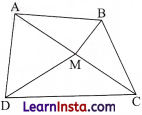
Reason: The diagonal AC divides the quadrilateral ABCD into two triangles of equal base.
A median of a triangle divides it into two triangles of equal area.
Since M is the midpoint of AC, BM, and DM, one the median of ΔABC and ΔADC, respectively.
Thus, each part of the new quadrilateral BMDA is exactly half the area of the original area.
Parallelogram
NCERT In-Text Questions (Page 162)
Question 1.
Can the area of the parallelogram be determined by taking another side as the base and its corresponding height?
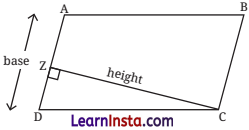
Solution:
Yes
Figure it Out (Pages 162-164)
Question 1.
Observe the parallelograms in the figure below.

(i) What can we say about the areas of all these parallelograms?
(ii) What can we say about their perimeters? Which figure appears to have the maximum perimeter, and which has the minimum perimeter?
Solution:
(i) All the parallelograms are drawn with the same base and the same height.
Hence, all the parallelograms have equal areas.
That is 5 × 3 = 15 sq. units.
(ii) Although the areas of all the parallelograms are equal, the sidelengths of the parallelograms are different.
Hence, their perimeters are also different.
The figure with the maximum slant appears to have the maximum perimeter.
Hence, Figure (g) has the maximum perimeter.
Question 2.
Find the areas of the following parallelograms:

Solution:
Area of parallelogram = base × height
(i)

Here, base = 7 cm, height = 4 cm
Area = 7 × 4 = 28 cm2
(ii)

Here, base = 5 cm, height = 3 cm
Area = 5 × 3 = 15 cm2
(iii)

Here, base = 5 cm, height = 4.8 cm
Area = 5 × 4.8 = 24 cm2
(iv)
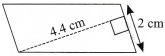
Here, base = 2 cm, height = 4.4 cm
Area = 2 × 4.4 = 8.8 cm2
Question 3.
Find QN.

Solution:
Area of a parallelogram = base × height
Taking base SR and corresponding height QM
Area = 12 × 6 = 72 cm2
Now, taking the base PS and the corresponding height QN
Area = 7.6 × QN
Equating both areas,
7.6 × QN = 72
⇒ QN = \(\frac {72}{7.6}\) = 9.47 cm
Question 4.
Consider a rectangle and a parallelogram of the same sidelengths: 5 cm and 4 cm. Which has the greater area?
[Hint: Imagine constructing them on the same base.]
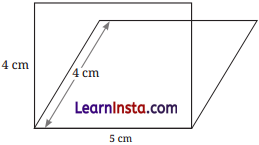
Solution:
Area of a rectangle = length × breadth
= 5 × 4
= 20 cm2
Area of parallelogram = base × height
Here, base = 5 cm, sidelength = 4 cm
Since the parallelogram is slanted, its height is less than 4 cm.
Thus, area of parallelogram < 5 × 4 = 20 cm2
Therefore, the rectangle has the greater area.
Question 5.
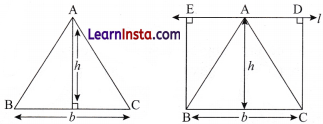
Give a method to obtain a rectangle whose area is twice that of a given triangle. What are the different methods that you can think of?
Solution:
1. Take a triangle ABC.
2. Measure the length of one side of the triangle and designate this as the base (b).
3. Find the perpendicular distance from the base to the opposite vertex. This is the height (h) of the triangle.
4. Draw a rectangle with one side equal to the base of the triangle (b) and the adjacent side equal to the height of the triangle (h).
The area of the constructed rectangle is b × h.
Since the area of the given triangle is \(\frac {1}{2}\) × b × h,
The rectangle’s area is indeed twice that of the triangle.
Or
Take a triangle ABC.
Draw a line l through vertex A parallel to base BC.
Through vertices B and C, draw lines perpendicular to line l.
The two lines meet line l at points E and D, respectively, forming a rectangle BCDE.
Question 6.
[Sulba-Sutras] Give a method to obtain a rectangle of the same area as a given triangle.
Solution:
Let ∆ABC have height h and base b.
So, its area is \(\frac {1}{2}\)bh.
Now, draw a perpendicular bisector l of its altitude.
Now, draw perpendicular lines from A and B to l.
Suppose that cut l at D and E.
ABDE is the required rectangle.
Area of ABDE = b × \(\frac {h}{2}\) = \(\frac {1}{2}\)bh

Question 7.
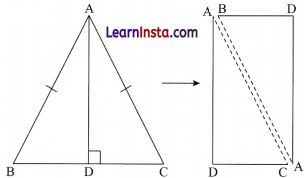
[Sulba-Sutras] An isosceles triangle can be converted into a rectangle by dissection in a simpler way. Can you find out how to do it?
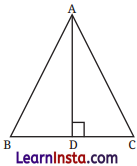
[Hint: Show that triangles ΔADB and ΔADC can be made into halves of a rectangle. Figure out how they should be assembled to get a rectangle. Use cut-outs if necessary.]
Solution:
1. From the vertex between the equal sides of the triangle, draw a line perpendicular to the base.
This line is the height and divides the triangle into two identical right-angled triangles.
2. Cut it along the height to separate the triangle into two right triangles.
3. Take one of the right triangles and rotate it 180°.
4. Place the rotated triangle next to the other along the hypotenuse.
The two triangles together now form a rectangle with length = half the base of the triangle, and width = height of the triangle.
Question 8.
[Sulba-Sutras] Give a method to convert a rectangle into an isosceles triangle by dissection.
Solution:
1. Draw the rectangle having length = l and width = w.
2. Draw a diagonal that divides the rectangle into two right-angled triangles, each with area = \(\frac {1}{2}\) × l × w.
3. Cut it along the diagonal to separate the rectangle into two right triangles.
4. Rotate one triangle by 180°.
5. Rearrange as shown so that their heights align.
This forms the isosceles triangle with:
Base = 2 × rectangle’s width (2w)
Height = rectangle’s length (l)
Area of the triangle = \(\frac {1}{2}\) × l × 2w
= l × w
= Area of the rectangle

Question 9.
Which has a greater area- an equilateral triangle or a square of the same side length as the triangle? Which has a greater area: two identical equilateral triangles together or a square of the same side length as the triangle? Give reasons.
Solution:
Let the sides of an equilateral triangle and a square be s.
Now, we draw a perpendicular (h) from one vertex to the opposite side.
We know that, in an equilateral triangle, the perpendicular bisects the base.
Using Baudhayana-Pythagoras theorem in the right-angled triangle formed:
h2 + \(\left(\frac{s}{2}\right)^2\) = s2
⇒ h2 = s2 – \(\left(\frac{s}{2}\right)^2\)
⇒ h2 = \(\frac {3}{4}\)s2
⇒ h = \(\frac{\sqrt{3}}{2} s\)
Area of equilateral triangle = \(\frac {1}{2}\) × b × h
= \(\frac{1}{2} \times s \times \frac{\sqrt{3}}{2} s\)
= \(\frac{\sqrt{3}}{4} s^2\)
Area of square = side2 = s2
Since \(\frac{\sqrt{3}}{4}\) < 1, a square has greater area.
Now, area of 2 identical equilateral triangles = 2 × \(\frac{\sqrt{3}}{4} s^2\)
= \(\frac{\sqrt{3}}{2} s^2\)
~ 0.866s2
Therefore, a square has an area greater than the area of 2 identical equilateral triangles.
Rhombus
NCERT In-Text Questions (Page 166)
Question 1.
Simplify the expression to show that we get the same formula for the area of a rhombus in terms of its diagonals.

Solution:
Area of rhombus ABCD = Area (∆ADB) + Area (∆CDB)
= (\(\frac {1}{2}\) × AO × BD) + (\(\frac {1}{2}\) × CO × BD)
= \(\frac {1}{2}\) × BD × (AO + CO)
= \(\frac {1}{2}\) × BD × AC
Trapezium
NCERT In-Text Questions (Pages 166-167)
Question 1.
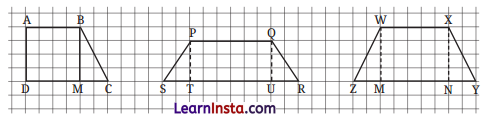
Find the areas of the following trapeziums by breaking them into figures whose areas can be computed.
Solution:
(i) Area of square ABMD = 42 = 16 sq. units
Area of triangle BMC = \(\frac {1}{2}\) × 2 × 4 = 4 sq. units
Area of trapezium ABCD = 16 + 4 = 20 sq. units
(ii) Area of rectangle PQUT = 6 × 3 = 18 sq. units
Area of triangle PTS = \(\frac {1}{2}\) × 2 × 3 = 3 sq. units
Area of triangle QUR = \(\frac {1}{2}\) × 2 × 3 = 3 sq. units
Area of trapezium PQRS = 18 + 3 + 3 = 24 sq. units
(iii) Area of rectangle WXNM = 5 × 4 = 20 sq. units
Area of triangle WMZ = \(\frac {1}{2}\) × 2 × 4 = 4 sq. units
Area of triangle XNY = \(\frac {1}{2}\) × 2 × 4 = 4 sq. units
Area of trapezium WXYZ = 20 + 4 + 4 = 28 sq. units
Question 2.
Will Approach 2 work for any type of trapezium?
Solution:
Area of ABCD = area of ∆BCG + area of parallelogram ABGD
= \(\frac {1}{2}\) × GC × BE + DG × AF
= \(\frac {1}{2}\) × GC × BF + DG × AF
= \(\frac {1}{2}\) × (b – a) × h + a × h
= \(h\left[\frac{1}{2}(b-a)+a\right]\)
= \(h\left(\frac{1}{2} b+\frac{1}{2} a\right)\)
= \(\frac {1}{2}\) × h(a + b)

Since a rectangle is also a parallelogram, we can find the area of any type of trapezium by spliting in parallelogram and triangles.
Finding the Area Using Two Copies of the Trapezium
Figure it Out (Pages 169-170)
Question 1.
Find the area of a rhombus whose diagonals are 20 cm and 15 cm.
Solution:
Area of rhombus = \(\frac {1}{2}\) × product of diagonals
= \(\frac {1}{2}\) × 20 × 15
= 150 cm2
Question 2.
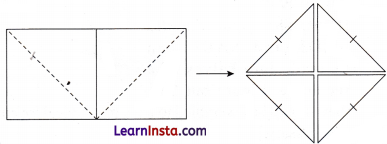
Give a method to convert a rectangle into a rhombus of equal area using dissection.
Solution:
1. Draw the rectangle of length l and width w.
2. Divide the rectangle into two equal rectangles by drawing a line parallel to the width through the midpoint of the length.
3. Draw a diagonal in each of the two smaller rectangles, in opposite directions.
4. Cut along these diagonals to obtain four congruent right-angled triangles.
5. Rearrange the four triangles so that their hypotenuses form the sides of a new figure.
6. The four equal hypotenuses become the four equal sides of a rhombus.
Question 3.
Find the areas of the following figures:

Solution:
(i)

Area of trapezium = \(\frac {1}{2}\) × height × sum of the parallel sides
= \(\frac {1}{2}\) × 16 × (10 + 7)
= \(\frac {1}{2}\) × 16 × 17
= 136 ft2
(ii)

Area of trapezium = \(\frac {1}{2}\) × height × sum of the parallel sides
= \(\frac {1}{2}\) × 14 × (24 + 36)
= \(\frac {1}{2}\) × 14 × 60
= 420 m2
(iii)

Area of trapezium = \(\frac {1}{2}\) × height × sum of the parallel sides
= \(\frac {1}{2}\) × 10 × (14 + 6)
= \(\frac {1}{2}\) × 10 × 20
= 100 in2
(iv)
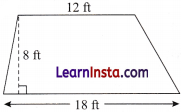
Area of trapezium = \(\frac {1}{2}\) × height × sum of the parallel sides
= \(\frac {1}{2}\) × 8 × (12 + 18)
= \(\frac {1}{2}\) × 8 × 30
= 120 ft2
Question 4.
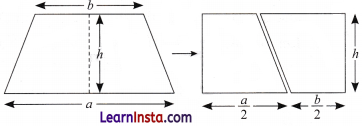
[Sulba-Sutras] Give a method to convert an isosceles trapezium to a rectangle using dissection.
Solution:
1. Take an isosceles trapezium with two parallel sides (one longer, one shorter) and two equal slant sides. Its height is the perpendicular distance between the parallel sides.
2. Draw a perpendicular from the midpoint of the shorter parallel side to the longer parallel side. This divides the trapezium into two equal right-angled trapeziums.
3. Cut off the trapezium along the perpendicular.
4. Rearrange the trapeziums along the slanted edges to form a rectangle.
The length of the rectangle will be the average of the two parallel sides, and the width will be the height of the trapezium.
Question 5.
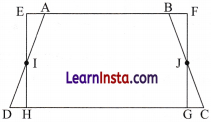
Here is one of the ways to convert trapezium ABCD into a rectangle EFGH of equal area-

Given the trapezium ABCD, how do we find the vertices of the rectangle EFGH?
[Hint: If ΔAHI ≅ ΔDGI and ΔBEJ ≅ ΔCFJ, then the trapezium and rectangle have equal areas.]
Solution:
Given the trapezium ABCD with AB || DC
Take the midpoints of the non-parallel sides AD and BC of the trapezium as I and J, respectively.
Through points I and J, draw perpendiculars to DC.
Let these perpendiculars meet DC at points G and F, respectively.
Extend AB beyond A to point H and beyond B to point E, where these perpendiculars meet AB.
This forms two triangles on either side of the trapezium.
Now, consider ΔAHI and ΔDGI,
AI = DI (I is the midpoint)
∠AHI = ∠DGI = 90°
∠AIH = ∠DIG (Vertically opposite angles)
Thus, ΔAHI ≅ ΔDGI (By AAS congruence criterion)
Now, consider ΔBEJ and ΔCFJ,
BJ = CJ (J is the midpoint)
∠BEJ = ∠CFJ = 90°
∠AJE = ∠CJF (Vertically opposite angles)
Thus, ΔBEJ ≅ ΔCFJ (By AAS congruence criterion)
Thus, the rectangle EFGH is the required rectangle having area equal to the trapezium ABCD.
Question 6.
Using the idea of converting a trapezium into a rectangle of equal area, and vice versa, construct a trapezium of area 144 cm2.
Solution:
1. Take a rectangle EFGH where EF = 18 cm and FG = 8 cm. (Since 18 × 8 = 144)
2. Mark the midpoint of the side EH as point I and the midpoint of side FG as point J.
3. To transform this into a trapezium, draw a line through I and a line through J that are tilted at any angle (except 90°) relative to the vertical sides.
4. Let the line through I intersect the side EF at point A and the extension of the side HG at point D.
5. Let the line through J intersect the side EF at point B and the extension of the side HG at point C.
Since both the triangles on either side of the rectangle are congruent,
Therefore, the area of rectangle EFGH = the area of trapezium ABCD.
Question 7.
A regular hexagon is divided into a trapezium, an equilateral triangle, and a rhombus, as shown. Find the ratio of their areas.

Solution:
The equilateral triangle is made up of 1 small equilateral triangle. The rhombus is made up of 2 such equilateral triangles.
The trapezium is made up of the remaining 3 equilateral triangles.
Since all these small equilateral triangles are congruent, their areas are equal.

Therefore, Area of trapezium: Area of equilateral triangle: Area of rhombus = 3 : 1 : 2
Question 8.
ZYXW is a trapezium with ZY || WX. A is the midpoint of XY. Show that the area of the trapezium ZYXW is equal to the area of ∆ZWB.

Solution:
Consider ∆AZY and ∆ABX,
AY = AX (A is the midpoint)
∠YAZ = ∠XAB (Vertically opposite angles)
∠AYZ = ∠AXB (Alternate interior angles)
Thus, ∆AZY ≅ ∆ABX (By ASA congruence criterion)
Hence, area of ∆AZY = area of ∆ABX
Adding the area of the quadrilateral AXWZ to both sides, we get
Area of trapezium ZYXW = area of ∆ZWB.
Areas in Real Life
NCERT In-Text Questions (Pages 170-171)
Question 1.
What do you think is the area of an A4 sheet?
Its sidelengths are 21 cm and 29.7 cm. Now find its area.
Solution:
Area of an A4 sheet = length × width
= 29.7 × 21
= 623.7 cm2
Question 2.
What do you think is the area of the tabletop that you use at school or at home? You could perhaps try to visualise how many A4 sheets can fit on your table.
Solution:
Do it yourself.
Question 3.
Express the following lengths in centimeters:
(i) 5 in
(ii) 7.4 in
Solution:
(i) 1 in = 2.54 cm
5 in = 2.54 × 5 = 12.7 cm
(ii) 1 in = 2.54 cm
7.4 in = 2.54 × 7.4 = 18.796 cm
Question 4.
Express the following lengths in inches:
(i) 5.08 cm
(ii) 11.43 cm
Solution:
(i) 2.54 cm = 1 in
5.08 cm = \(\frac {5.08}{2.54}\) = 2 in
(ii) 2.5 cm = 1 in
11.43 cm = \(\frac {11.43}{2.54}\) = 4.5 in
Question 5.
Evaluate the quotient.
Solution:
161.29 cm2 = \(\frac {161.29}{6.4516}\) m2 = 25 in2
Question 6.
What do you think is the area of your classroom?
Areas of the classroom, house, etc., are generally measured in ft2 or m2.
Solution:
Do it yourself.
Question 7.
How many in2 is 1 ft2?
Solution:
1 ft2 = 122 in2 = 144 in2

Question 8.
What do you think is the area of your school? Make an estimate and compare it with the actual data.
Larger areas of land are also measured in acres.
1 acre = 43,560 ft2
Besides these units, different parts of India use different local units for measuring area, such as bigha, gaj, hatha, dhur, cent, ankanam, etc.
Solution:
Do it yourself.
Question 9.
Find out the local unit of area measurement in your region.
Solution:
Do it yourself.
Question 10.
What do you think is the area of your village/town/city?
Make an estimate and compare it with the actual data.
Larger areas are measured in km2.
Solution:
Do it yourself.
Question 11.
How many m2 is a km2?
Solution:
1 km2 = 10002 m2 = 1000000 m2
Question 12.
How many times is your village/town/city bigger than your school?
Solution:
Do it yourself.
Question 13.
Find the city with the largest area in (i) India, and (ii) the world.
Solution:
Do it yourself.
Question 14.
Find the city with the smallest area in (i) India, and (ii) the world.
Solution:
Do it yourself.