Students often refer to Class 7 Ganita Prakash Solutions and NCERT Class 7 Maths Part 2 Chapter 4 Another Peek Beyond the Point Question Answer Solutions to verify their answers.
Class 7 Maths Ganita Prakash Part 2 Chapter 4 Solutions
Ganita Prakash Class 7 Chapter 4 Solutions Another Peek Beyond the Point
Class 7 Maths Ganita Prakash Part 2 Chapter 4 Another Peek Beyond the Point Solutions Question
4.1 A Quick Recap of Decimals (Pages 67-68)
Question.
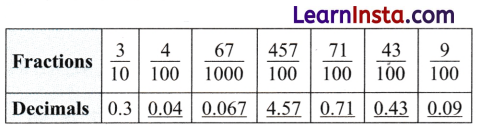
Jonah and Pallabi play a game. Jonali says a fraction and Pallabi gives the equivalent decimal. Write Pallabi’s answer in the blank spaces.
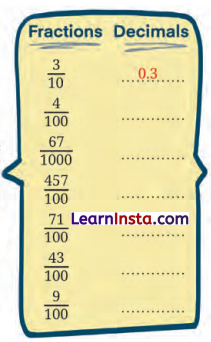
Solution:
Question.
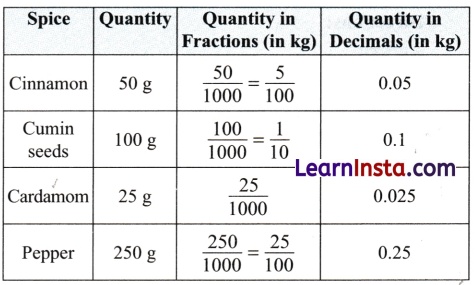
Jonali goes …. 250g of Pepper.
Express each of the quantities in kilograms by writing them in terms of fractions as well as decimals.
Solution:

Question.
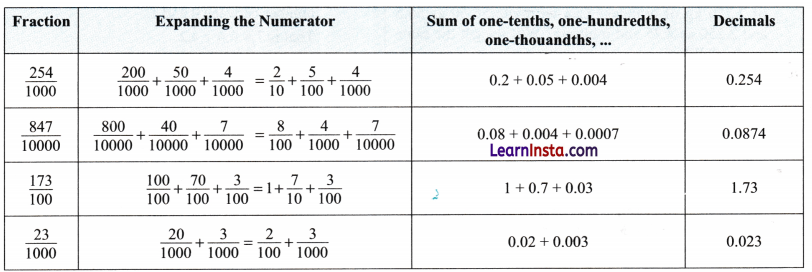
Write the following fractions as a sum of fractions and also as decimals:
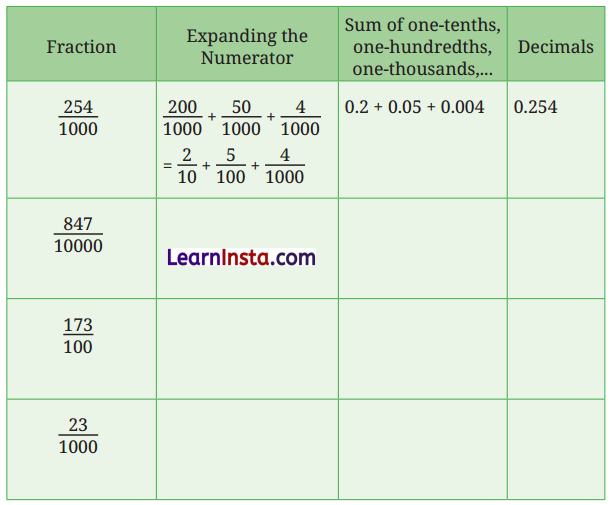
Solution:
4.2 Decimal Multiplication (Pages 70 – 71)
Question.
Can the product of two decimals be a natural number?
Solution:
Yes, the product of two decimals can be a natural number.
For example:
1 .25 x 3.2 = 4, which is a natural number.
Question.
Can the product of a decimal and a natural number be a natural number?
Solution:
Yes, the product of a decimal and a natural number can
be a natural number.
For example, let us multiply a decimal number 0.25 by the natural number 12.
0.25 x 12 = 3
Question.
In this case, the result is 3, which is a natural number.
Suppose we know that 596 x 248 147808, can you immediately write down the product of 5.96 X 24.8?
Solution:
To find the product, we can use relationship between the
numbers.
Given, 596 x 248 – 147808
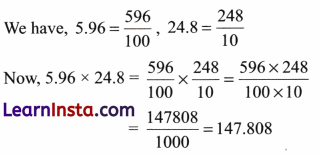
Therefore, the product of 5.96 x 24.8 = 147.808.
Figure It Out (Pages 73-74)
Question 1.
Recall that a tenth is 0.1, a hundredth is 0.01, and so on. Find the following products in tenths, hundredths and so on:
(a) 6 x 4 tenths = 24 tenths
(b) 7 x 0.3
(c) 9 x 5 hundredths
Solution:
(b) 7 x 0.3 = 7 x 3 tenths = 21 tenths
(c) 9 x 5 hundredths = (9×5) hundredths = 45 hundredths
Question 2.
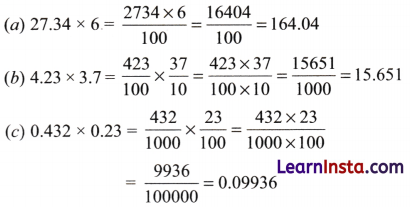
Find the products:
(a) 27.34 x 6
(b) 4.23 x 37
(c) 0.432 x 0.23
Answer:
Question 3.
Thejus needs 1.65 m of cloth for a shirt. Flow many metres of cloth are needed for 3 shirts?
Solution:
Cloth required for 1 shirt = 1.65 m
Cloth required for 3 shirts = 3 x 1.65 = 4.95 m.
Therefore, Thejus needs 4.95 m of cloth to make 3 shirts.
Question 4.
Meenu bought 4 notebooks and 3 erasers. The cost of each book was 15.50 and each eraser was ₹2.75. How much did she spend in all?
Solution:
Cost of 1 notebook = ₹15.50
So, cost of 4 notebooks = 4 x 15.50 = ₹62
Cost of 1 eraser = ₹2.75
So, cost of 3 erasers = 3 x 2.75 = ₹8.25
Total money she spent in all = ₹62 + ₹8.25 = ₹70.25
Thus, Meenu spent ₹70.25 in all.
Question 5.
The thickness of a rupee coin is 1.45 mm. What is the total height of the cylinder formed by placing 36 rupee coins one over the other? Write the answer in centimetres.
Solution:
Thickness of a rupee coin = 1.45 mm
Number of coins = 36
Total height of cylinder formed by placing coins one over the other
= 1.45 x 36 = 52.2 mm
52.2 mm = \(\frac{52.2}{10}\) = 5.22 [Since, 1 mm = \(\frac{1}{10}\) cm
Thus, the total height of the cylinder formed is 5.22 cm.
Question 6.
The price of 1 kg of oranges is ₹ 56.50. What is the price of 2.250 kg of oranges? Can we write 56.50 as 56.5 and 2.250 as 2.25 and multiply? Will we get the same product? Why?
Solution:
Price of 1 kg of oranges =₹ 56.50
Price of 2.250 kg of oranges 56.50 x 2.250=₹ 127.125
So, the total price of oranges =₹ 127.13 (rounded to paise).
Yes, we can write ₹56.50 as ₹56.5 and 2.250 as 2.25 because the zeros after the decimal point do not change the value of a decimal number.
Multiplying either pair gives the same product, since the place value of digits does not change when trailing zeros are added or removed after the decimal point.
Question 7.
Dwarakanath purchases notebooks at a wholesale price of ₹23.6 per piece and sells each notebook at ₹30/-. How much profit does he make if he sells 50 books in a week?
Solution:
Wholesale price per notebook = ₹23.60
Selling price per notebook =₹ 30
Profit on 1 notebook =30-23.60=₹ 6.40
Profit on 50 notebooks =50 x 6.40=₹ 320
Therefore, Dwarakanath makes a profit of ₹ 320 in a week.
Question 8.
Given that 18 x 12=216, find the products:
(a) 18 x 1.2
(b) 18 x 0.12
(c) 1.8 x 1.2
(d) 0.18 x 0.12
(e) 0.018 x 0.012
(f) 1.8 x 12
In which of the cases above is the product less than 1 ?
Solution:
Given 18 x 12=216
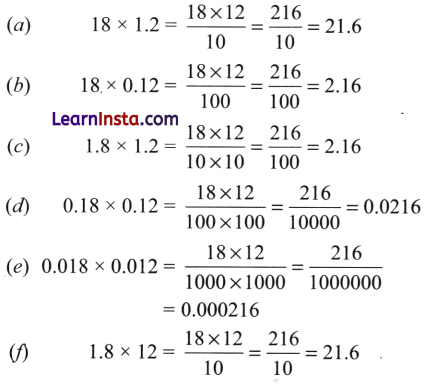
Clearly, in parts (d) and (e) the products are less than 1.
Question 9.
In which of the following multiplications is the product less than 1? Can you find the answer without actually doing the multiplications?
(a) 7 × 0.6
(b) 0.7 × 0.6
(c) 0.7 × 6
(d) 0.07 × 0.06
Solution:
(a) 7 x 0.6: Here, one number is greater than 1 and one number is between 0 and 1. So, the product is less than the number greater than 1 and greater than the number between 0 and 1.
That is 7 x 0.6 = 4.2.
(b) 0.7 x 0.6: Here, both numbers are between 0 and 1 or less than 1, so the product is less than both the numbers.
That is 0.7 x 0.6 = 0.42.
(c) 0.7 x 6: Here, one number is between 0 and 1 and one number is greater than 1. So, the product is less than the number greater than 1 and greater than the number between 0 and 1.
That is 0.7 x 6 = 4.2.
(d) 0.07 x 0.06: Here, both numbers are between 0 and 1 or less than 1, so the product is less than both the numbers. That is 0.07 x 0.06 = 0.0042.
Question 10.
Multiplying the following numbers by 10, 100 and 1000 to complete the table.
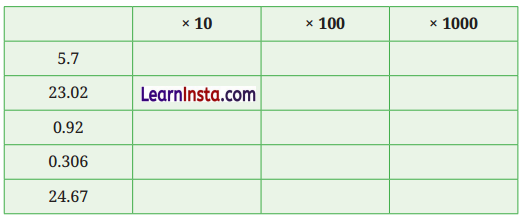
Answer:
| x 10 | x 1oo | x 1000 | |
| 5.7 | 57 | 570 | 5700 |
| 23.02 | 230.2 | 2302 | 23020 |
| 0.92 | 9.2 | 92 | 920 |
| 0.306 | 3.06 | 30.6 | 306 |
| 24.67 | 246.7 | 2467 | 24670 |
4.3 Decimal Division (Page 75)
Question.
What is 0.039 m in centimetres and millimetres?
Solution:
0.039 m = 0.039 x 1oo cm = 3.9 cm[1 metre = 100 cm]
O.039m=3.9cm=3.9x 10mm=39 mm [1 cm= 10mm]
Question.
By looking at these … are zeroes in the divisor!
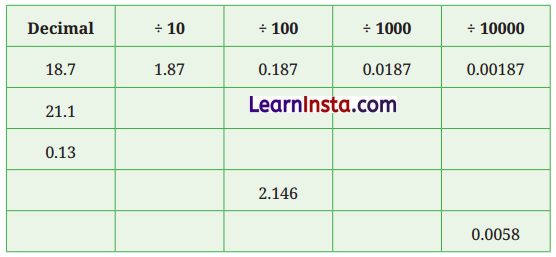
Solution:
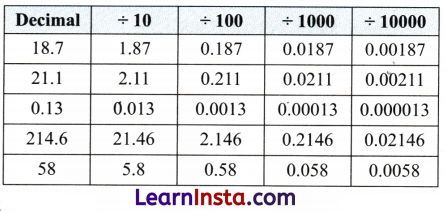
Figure It Out (Page 83)
Question 1.
Find the quotient by converting the denominator into 1, 10, 100 or 1000 and then verify the solution by the long division method (division by place value).
(a) \(\frac{18}{5}\)
(b) \(\frac{415}{4}\)
(c) \(\frac{1217}{2}\)
(d) \(\frac{4827}{8}\)
Solution:
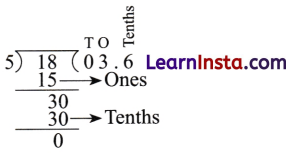
(a) To convert 5 into 10, multiply both numerator and denominator by 2. (Since,10÷5=2)
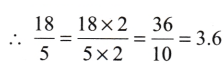
Verification:
(b) Convert denominator 4 into 100 by multiplying both numerator and denominator by 25.
(Since 100÷4=25)

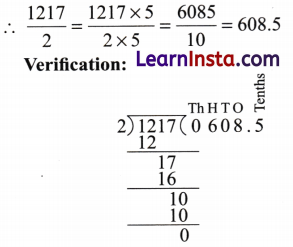
(c) Convert denominator 2 into 10 by multiplying both numerator and denominator by 5.
(Since 10 ÷ 2 = 5)
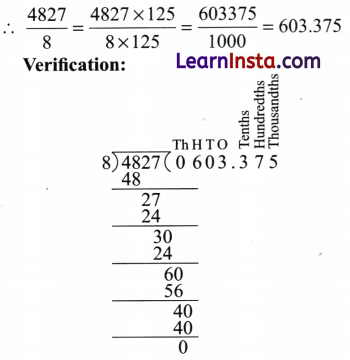
(d) Convert the denominator 8 into 1000 by multiplying both numerator and denominator by 125.
(Since 1000 ÷ 8=125 )
Question 2.
Choose the correct answer:
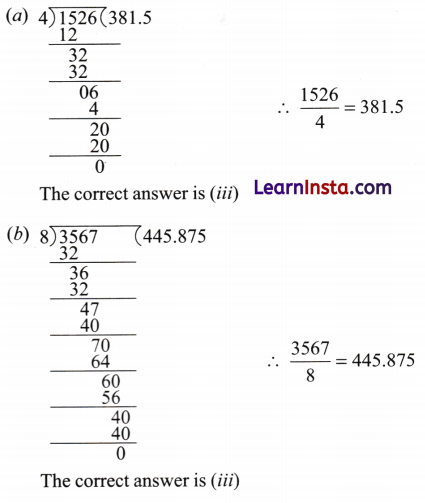
(a) \(\frac{1526}{4}\)
(i) 38.15
(ii) 380.15
(iii) 381.5
(iv) 381.05
(b) \(\frac{3567}{8}\)
(i) 4458.75
(ii) 44.5875
(iii) 445.875
(iv) 4458.75
Solution:
Question 3.
What is the quotient?
(a) 132 ÷4 = ………….
(b) 112÷4 = ………….
(c) 1.32 – 4= ………….
(d) 0.132 – 4= ………….
Solution:
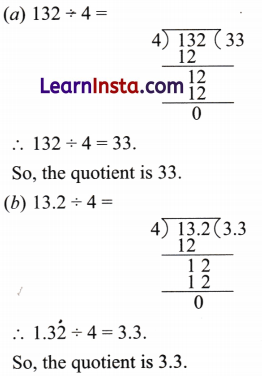
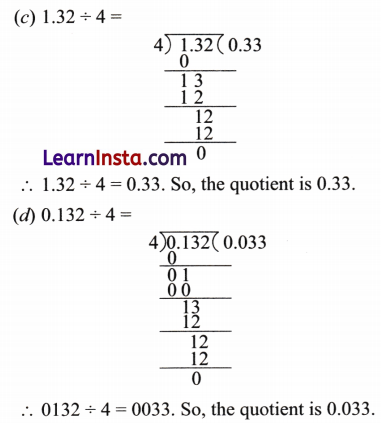
Does This Ever End? (Pages 85 – 86)
Can you find the quotients of 10 ÷ 9 and 100 ÷ 11?
Solution:
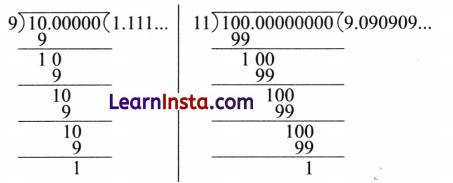
It is clear from these divisions that quotient for such divisions cannot be expressed using a finite number of digits.
Question.
To find one such number, you can find 1 ÷ 17 in decimal, and use the repeating block of digits.
Solution:
1 ÷ 17=0.0588235294117647…
The repeating cycle is 0588235294117647, which is 16 digits long. If we multiply this cycle by numbers from 1 to 16, we will get same number but digit cycled around.
So, 0588235294117647 is another cyclic number.
Dividend, Divisor, and Quotient (Page 86)
Question.
Will the quotient be always greater than the dividend when the divisor is a decimal? Try it out with different values of the divisor.
Describe the relationship between the dividend, divisor, and the quotient. Create a table for capturing this relationship in different situations, like we did for multiplication.
Solution:
- If the divisor is greater than 1, the quotient is less than the dividend.
For example, 4.5 + 1.5 = 3. Flere, 1.5(divisor) is greater than 1 and 3(quotient) is less than 4.5 (dividend). - If the divisor is less than 1, the quotient is greater than the dividend.
For example, 42 + 0.2 = 210. Here, 0.2(divisor) is less than 1 and 210(quotient) is greater than 42 (dividend). - If the divisor is equal to 1, then the quotient and dividend are equal.
For example, 36 + 1 = 36. Here, the quotient is 1, so the dividend and quotient are equal.
| Dividend | Divisor | Quotient | Relationship |
| 4.5 | 1.5 | 3 | Quotient < Dividend |
| 42 | 0.2 | 210 | Quotient > Dividend |
| 36 | 1 | 36 | Quotient = Dividend |
Figure It Out (Pages 86-87)
Question 1.
Express the following fractions in decimal form:
(a) \(\frac{2}{5}\)
(b) \(\frac{13}{4}\)
(c) \(\frac{4}{50}\)
(d) \(\frac{5}{8}\)
Solution:

Question 2.
Find the quotients:
(a) 24.86 ÷ 1.2
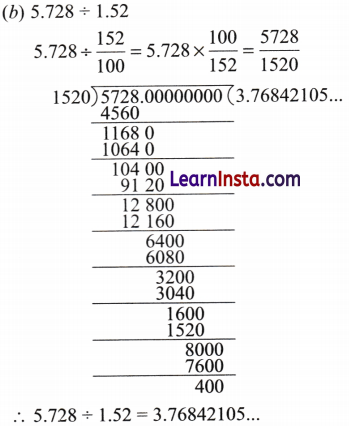
(b) 5.728 ÷ 1.52
Solution:
(a) 24.86 ÷ 1.2
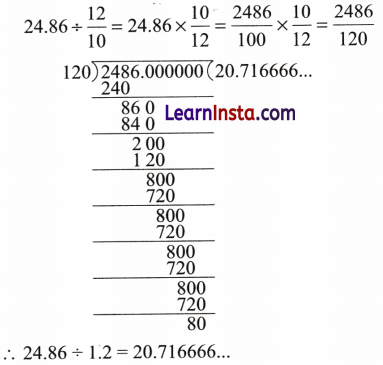
Question 3.
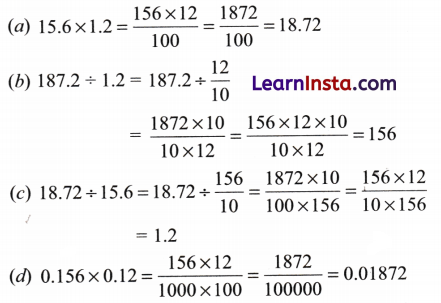
Evaluate the following using the information 156 x 12 = 1872.
(a) 15.6 x 1.2 ___
(b) 187.2÷1.2 ____
(c) 18.72 ÷ 15.6 = _____
(d) 0.156 x 0.12 = _____
Solution:
Question 4.
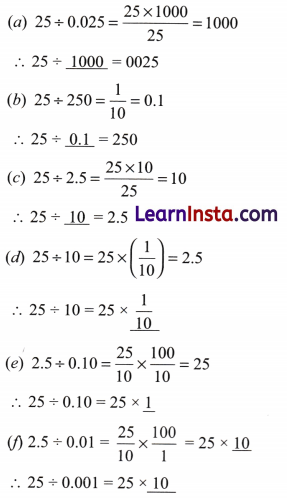
Evaluate the following:
(a) 25 ÷ ______ = 0.025
(b) 25 ÷ _____ = 250
(c) 25 ÷ ____ = 2.5
(d) 25 ÷ 10 = 25 × ____
(e) 25 + 0.10 = 25 × ____
(f) 25 ÷ 0.01 = 25 × ____
Solution:
Question 5.
Find the quotient:
(a) 2.46 + 1.5 =…………
(b) 2.46 + 0.15 =…………
(c) 2.46 + 0.015=…………
Is the quotient obtained in 24.6 + 1.5 the same as the quotient obtained in 2.46 + 0.15?
Solution:
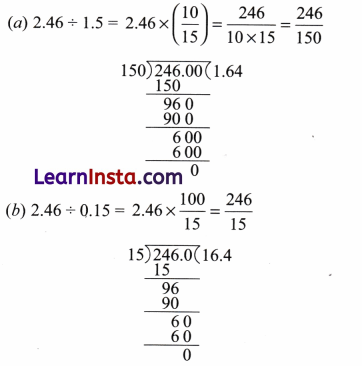
Now, let us check if the quotient obtained in 24.6 + 1.5 is the same as the quotient obtained in 2.46 + 0.15.
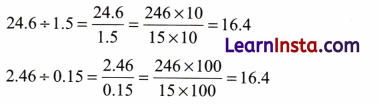
So, the quotient is the same in both cases.
Question 6.
A 4 m long wooden block has to be cut into 5 pieces of equal length. What is the length of each piece?
Solution:
Length of each piece = Total length of wooden block ÷ Number of pieces
= 4 ÷ 5 = 0.8 m
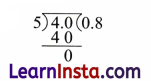
Length of each piece of wooden block is 0.8 m long.
Question 7.
If the perimeter of a regular polygon with 12 sides is 208.8 cm, what is the length of its side?
Solution:
Length of each side = Perimeter of a regular polygon ÷ Number of sides
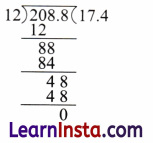
= 208.8 ÷ 12
= 17.4 cm
Therefore, the length of each side is 17.4 cm.
Question 8.
3 litres of watermelon juice is shared among 8 friends equally. How much watermelon juice will each get? Express the quantity of juice in millilitres.
Solution:
Given 3 litres of watermelon juice is shared equally among 8 friends.

Each friend gets = 3 ÷ 8 = 0.375 litres
Convert to millilitres:
0. 375 x 1000 = 375 mL
∴ Each friend gets 375 mL of juice.
Question 9.
A car covers 234.45 km using 12.6 litres of petrol. What is the distance travelled per litre?
Solution:
Given, a car covers 234.45 km using 12.6 litres of petrol.
Distance per litre = 234.45 ÷ 12.6
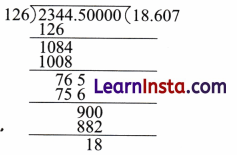
Thus, the car travels 18.61 km per litre (approximately).
Question 1.0.
13.5 kg of flour (aata) was distributed equally among 15 students. How much flour did each student receive?
Solution:
Total flour = 13.5 kg
Number of students = 15
Each student will receive: 13.5 =15 = 0.9 kg
Thus, each student received 0.9 kg of flour.

Page 87
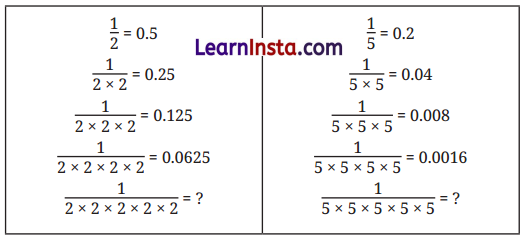
What pattern do you observe? Why are 2 and 5 related in this way?
Solution:
\(\frac{1}{2 \times 2 \times 2 \times 2 \times 2}\) =0.03125 and
\(\frac{1}{5 \times 5 \times 5 \times 5 \times 5}\)=0.00032
We observe that:
- When the denominator is multiplied by 2, the decimal value is halved each time.
- When the denominator is multiplied by 5, the decimal value is divided by 5 each time.
2 and 5 are related in this way because the base of our number system is 10, and 10=2 × 5.
That means multiplying 2 and 5 repeatedly can result in multiples of 10 .
4.4 Look Before You Leap!
Making an Adjustment (Page 89)
Do you know which month has this extra day?
Solution:
In a leap year (a year divisible by 4), February has 29 days instead of the usual 28 days.
That is why a leap year has 366 days instead of 365
February has the extra day in a leap year.
Making Yet Another Adjustment
(Pages 92-93)
With this final scheme of leap years can you calculate the number of calendar days in 10,000 years and the number of actual days the Earth will take to make 10,000 revolutions around the Sun? What is the difference? If there is a big difference, can you suggest a way to fix this problem?
Solution:
In 10,000 years, number of years divisible by 400 = 25
Years divisible by 100 but not divisible by 400 =100-25 = 75
Years divisible by 4 = 2500
Years divisible by 4 but not divisible by 100 and 400 = 2500- 100 = 2400
Total leap years in 10,000 years = 2400 + 25 = 2425
Total common years = 10000 – 2425 = 7575
Each common year = 365 days; each leap year = 366 days.
∴ Number of Calendar days in 10000 years
= 7575 x 365 + 2425 x 366 = 10000 x 365 + 2425
= 3650000 + 2425 = 3652425 days
Actual Earth days for 10,000 revolutions
= 365.2422 x 10000 = 3652422 days
Difference: Calendar days – Actual days
= 3652425 – 3652422 = 3 days
Three extra days in 10,000 years is small but cumulative. To reduce the gap we can make another adjustment like considering the years divisible by 4,000 as non-leap years.
Question.
Do you wonder how people figured out that the Earth completes one revolution around the Sun in exactly 364.2422 days?
Solution:
Ancient astronomers carefully observed the position of the Sun and stars in the sky over long periods of time. They noticed that the Sun appears in the same spot in the sky (for example, at sunrise behind a specific hill or star) after a little more than 365 days. By comparing many such observations over hundreds of years, they refined the length of the year.
Later, with precise instruments like telescopes and atomic clocks, scientists were able to measure the Earth’s motion more accurately. They found that one complete revolution of Earth around the Sun — called a tropical year — actually takes about 365.2422 days, not 365.
Figure it Out (Pages 93-95)
Question 1.
A 210 gram packet of peanut chikki costs ₹ 70.5, while a 110 gram packet of potato chips costs ₹ 33.25. Which is cheaper?
Solution:
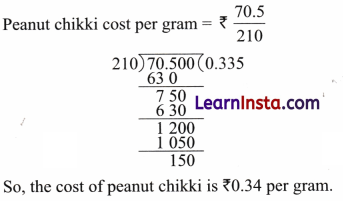
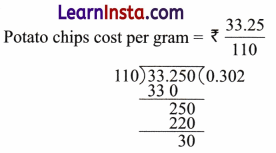
So, the cost of potato chips is ₹ 0.30 per gram.
Clearly, potato chips are cheaper, as they cost ₹ 0.30 per gram, while peanut chikki costs ₹0.34 per gram.
Question 2.
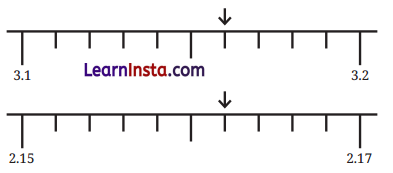
Write the decimal number at the arrow mark:
Solution:
There are 10 divisions between 3.1 and 3.2 so each division is a tenth part of \(\frac{1}{10}\), i.e., =0.01 unit. Therefore, the first division after 3.1 is 3.11 while the sixth division, marked with an arrow represents the decimal number 3.16.
There are 10 divisions between 2.15 and 2.17 so each division is a tenth part of \(\frac{2}{100}\), i.e., \(\frac{2}{1000}\)=0.002 unit. Therefore, the first division after 2.15 is 2.152, while the sixth division, marked with an arrow, represents the decimal number 2.162.
Question 3.
Shyamala bought 3 kg bananas at ₹ 30 /- per kg. She counted 35 bananas in all. She sells each banana for ₹5/-. How much profit does she make selling all the bananas?
Solution:
Shyamala bought 3 kg of bananas at ₹ 30 per kg.
So, total Cost Price =3 x 30 = ₹ 90
She counted 35 bananas in total and sells each banana for ₹5.
So, total Selling Price =35 x 5 = ₹ 175
Profit = Selling Price – Cost Price =₹ 175-₹ 90=₹ 85
Therefore, Shyamala makes a profit of ₹ 85
Question 4.
A teacher placed textbooks that are 2.5 cm thick on a bookshelf. The teacher wanted to place 80 textbooks on the shelf. The bookshelf is 160 cm long. How many books could be placed on the shelf? Was there any space left? If yes, how much?
Solution:
Bookshelf length = 160 cm
Thickness of each textbook =2.5 cm
Total space needed for 80 such text-books
= 80 x 2.5=200 cm
But the shelf is only 160 cm long, so all 80 books cannot fit.
Number of books that fit = 160 + 2.5 = 64
So, only 64 books can be placed on the shelf.
Used space = 64 x 2.5 = 160 cm
So, no space is left.
Question 5.
Fill in the following blanks appropriately:
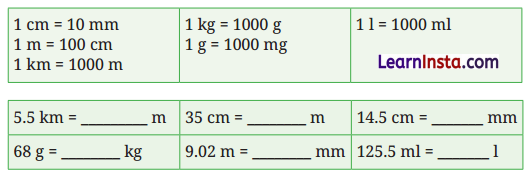
Solution:
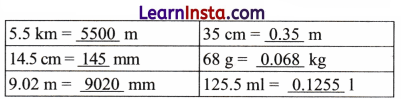
Question 6.
The following problem was set by Sridharacharya in his book, Patiganita. \(6 \frac{1}{4}\) is divided by 2 \(\frac{1}{2}\), and 60 \(\frac{1}{4}\) is divided by 3 \(\frac{1}{2}\). Tell the quotients separately.”
Can you try to solve it by converting the fractions into decimals?
Solution:
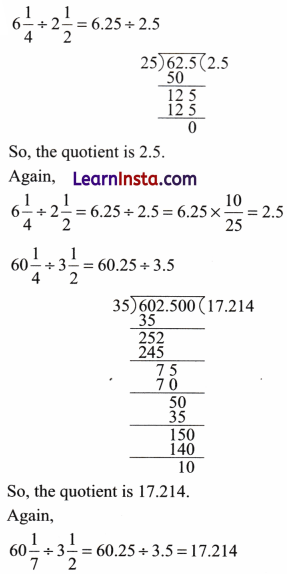
Question 7.
Fill the boxes in at least 2 different ways:
(a) x = 2.4
(b) x = 14.5
Solution:
(a) 1.2 x 2 = 2.4
0.8 x 3 = 2.4
(b) 2.9 × 5 = 14.5
1.45 × 10 = 14.5
(Answer may vary)
Question 8.
Find the following quotients given that 756 ÷ 36 = 21:
(a) 75.6 ÷ 3.6
(b) 7.56 ÷ 0.36
(c) 756 ÷ 0.36
(d) 75.6 ÷ 360
(e) 7560 ÷ 3.6
(f) 7.56 ÷ 0.36
Solution:
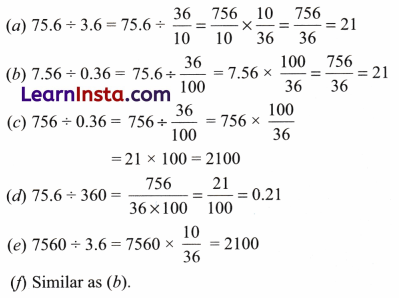
Question 9.
Find the missing cells if each cell represents a ÷ b:

Solution:

Question 10.
Using the digits 2,4, 5, 8, and 0, fill the boxes
x to get the:
(a) maximum product
(b) minimum product
(c) product greater than 150
(d) product nearest to 100
(e) product nearest to 5
Solution:
(a) The maximum product is obtained by the calculation 82.0 x 5.4 = 442.8
(b) The minimum product is obtained by the calculation 45.8 x 0.2 = 9.16
(c) To get the product greater than 150, we used the calculation 85.0 x 4.2 = 357 (Answer may vary)
(d) To get the product nearest to 100, we used the calculation 20.5 x 4.8 = 98.4 (Answer may vary)
(e) To get the product nearest to 5, we used the calculation 45.8 x 0.2 = 9.16
Question 11.
Sort the following expressions in increasing order:
(a) 245.05 × 0.942368
(b) 245.05 × 7.9682
(c) 245.05 ÷ 7.9682
(d) 245.05 ÷ 0.942368
(e) 245.05
(f) 7.9682
Solution:
(a) 245.05 × 0.942368 ≈ 231.07
(b) 245.05 × 7.9682 ≈ 1952.63
(c) 245.05 ÷ 7.9682 ≈ 30.76
(d) 245.05 ÷ 0.942368 ≈ 260.11
(e) 245.05
(f) 7.9682
Clearly, 7.9682 < 30.76 < 231.07 < 245.05 < 260.11 < 1952.63
The given expressions in increasing order:
7.9682,245.05 ÷ 7.9682,245.05 × 0.942368,245.05
245.05 ÷ 0.942368,245.05 × 7.9682
(f ) < (c) < (a) < (e) < (d) < (b)