Students can use Poorvi Book Class 7 Solutions Unit 2 Wit and Humour Chapter 4 Animals Birds and Dr Dolittle Questions and Answers as a quick reference guide.
Animals Birds and Dr Dolittle Class 7 Questions and Answers
Animals Birds and Dr Dolittle Class 7 Question Answer
NCERT Class 7 English Poorvi Chapter 4 Animals Birds and Dr Dolittle Question Answer
Animals Birds and Dr Dolittle Question Answer – Let us do these activities before we read (Page 43)
I. Do you have a pet or a domestic animal? If yes, why? If not, why not? Why do people usually spend time with a pet or domestic animal? Share your thoughts with your classmates and the teacher.
Answer:
Do it yourself.
II. You must have read stories where animals and birds talk. If you had a chance to communicate with an animal or a bird, who would you like to speak and why? Share your thoughts with your classmates and the teacher.
Answer:
Do it yourself.
III. If we closely observe the body language of animals and birds, we can understand what they want to tell us. Work in pairs and study the pictures given below. Find out what emotions these animals and birds are trying to convey. Share your observations with your classmates and the teacher.
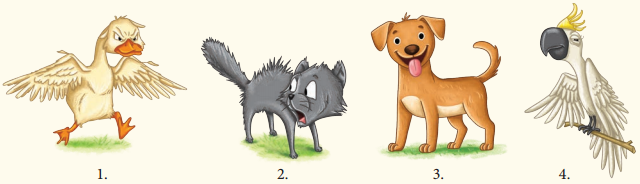
Answer:
1. Anger
2. fear
3. Curiosity
4. Disgust
Animals Birds and Dr Dolittle Class 7 Question Answer – Let us discuss (Page 46)
I. Complete the following sentence by selecting a suitable reason.
The Cat’s-food-Man suggests to Doctor Dolittle that he should become an animal doctor because he believes that Dolittle
1. earns less fee by treating human patients
2. enjoys the company of animals as they speak less
3. dislikes spending time with human patients
4. knows more about animals than the local veterinarians
Answer:
4. knows more about animals than the local veterinarians
II. Fill in the blanks by choosing the suitable option given in the brackets.
Doctor Dolittle reacts to Polynesia’s information about animal languages with both excitement and ____________ (certainty/curiosity). He rushes to___________ (write/memorise) the bird words she provides and is interested in learning more.
Answer:
curiosity; memorise

III. Do you think Doctor Dolittle would be famous as an animal doctor? If yes, why? If not, why not?
Answer:
Doctor Dolittle would certainly become a famous animal doctor because he has learnt the language of the animals so well that he could talk to them himself and understand their diseases and would cure them properly.
Class 7 English Animals Birds and Dr Dolittle Question Answer – Let us discuss (Pages 49-50)
I. What became a common sight in Puddleby after Doctor Dolittle started treating animals?
1. Humans talking to farm animals
2. Farm animals wearing glasses
3. Farm animals learning bird language
4. Birds riding atop farm animals
Answer:
2. Farm animals wearing glasses
II. 1. What challenges do you think Doctor Dolittle might face if more and more animals come to him for help?
2. How could he overcome these challenges to ensure that he provides good treatment?
Answer:
1. If more and more animals come to him for help, there would be so much crowd of sick animals that Dr. Dollitle would not be able to treat them the same day.
2. To overcome such challenges, he would call them in small number on a particular day; and the remaining animals would be called the following days.
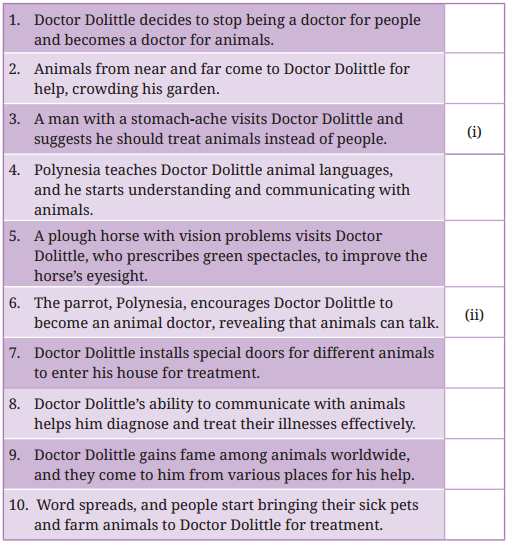
III. Arrange the following events in correct order according to the story. Two have been done for you. Share your answers with your classmates and the teacher.
Answer:
| 1. Doctor Dolittle decides to stop being a doctor for people and becomes a doctor for animals. | (iv) |
| 2. Animals from near and far come to Doctor Dolittle for help, crowding his garden. | (vii) |
| 3. A man with a stomach-ache visits Doctor Dolittle and suggests he should treat animals instead of people. | (i) |
| 4. Polynesia teaches Doctor Dolittle animal languages, and he starts understanding and communicating with animals. | (iii) |
| 5. A plough horse with vision problems visits Doctor Dolittle, who prescribes green spectacles, to improve the horse’s eyesight. | (v) |
| 6. The parrot, Polynesia, encourages Doctor Dolittle to become an animal doctor, revealing that animals can talk. | (ii) |
| 7. Doctor Dolittle installs special doors for different animals to enter his house for treatment. | (x) |
| 8. Doctor Dolittle’s ability to communicate with animals helps him diagnose and treat their illnesses effectively. | (vi) |
| 9. Doctor Dolittle gains fame among animals worldwide, and they come to him from various places for his help. | (ix) |
| 10. Word spreads, and people start bringing their sick pets and farm animals to Doctor Dolittle for treatment. | (viii) |
Animals Birds and Dr Dolittle Class 7 Questions and Answers – Let us think and reflect (Pages 50-52)
I. Read the extracts given below and answer the questions that follow.
Question 1.
“If I say, ‘Polly wants a cracker’, you understand me. But hear this: Ka-ka oi-ee, fee-fee?”
“Good Gracious!” cried the Doctor. “What does that mean?”
“That means, ‘Is the porridge hot yet?’—in bird language.”
“My! You don’t say so!” said the Doctor. “You never talked that way to me before. ”
“What would have been the good?” said Polynesia, dusting some cracker crumbs off her left wing. “You wouldn’t have understood me if I had.”
(i) Complete the sentence by choosing the correct option.
In the line “Good Gracious!” cried the Doctor, the expression
‘Good Gracious’ can be replaced by ____________ !
(a) bravo
(b) gosh
(c) alas
(d) hurray
Answer:
(a) bravo
(ii) Why had Polynesia never used bird language with the Doctor earlier?
Answer:
Polynesia had never used bird language with the doctor because she knew that Dr. Dolittle would not understand it.
(iii) Identify whether the following statement is true or false.
Polynesia had been munching on a food item while talking to Doctor Dolittle.
Answer:
true
(iv) How did Doctor Dolittle feel according to the extract?
(a) anxious
(b) surprised
(c) angry
(d) relaxed
Answer:
(b) surprised
Question 2.
“I would like a pair like yours,” said the horse— “only green. They’ll keep the Sun out of my eyes while I’m ploughing the field.”
“Certainly,” said the Doctor. “Green ones you shall have.”
“You know, the trouble is, Sir,” said the plough horse as the Doctor opened the front door to let him out—“the trouble is that anybody thinks he can doctor animals—-just because the animals don’t complain. As a matter of fact, it takes a much cleverer man to be a really good animal doctor than it does to be a good people’s doctor.”
(i) Choose a word from the extract to complete the analogy.
digging: flower bed :: ____________ : field
Answer:
ploughing
(ii) Choose the correct word to complete the sentence.
Doctor Dolittle’s attitude in the extract is
(a) respectful
(b) sentimental
(c) understanding
(d) careful
Answer:
(c) understanding
(iii) Complete the sentence with an appropriate reason.
Based on the extract, we can conclude that doctors take animals for granted because ____________
Answer:
they don’t complain
(iv) Do you agree with the concluding sentence of the extract? Why/why not?
Answer:
Yes, I agree with the concluding sentence.
Understanding and curing an animal’s disease requires to be cleverer because he/ she has to understand an animal’s disease only by reading its body expression as it cannot express its problem in words.
II. Answer the following questions.
Question 1.
How can we say that Polynesia was a good trainer of animal language?
Answer:
Polynesia was a good trainer of animal language because she was bilingual, speaking both human and animal language, and she taught Doctor Dolittle to understand animal language.
Question 2.
Explain how Doctor Dolittle gave equal and individual attention to each animal who came to him for treatment.
Answer:
By understanding the specific needs and complaints of each animal, Doctor Dolittle was able to provide effective treatments to each animal. He didn’t treat all animals the same way but rather adapted his approach based on the individual animal’s condition and language.
Question 3.
How does Doctor Dolittle’s readiness to follow the parrot’s advice highlight the importance of listening to different viewpoints?
Answer:
By listening to the parrot’s advice and translating the animal’s chirps, wliistles, woofs and meows, Dolittle demonstrated the power of truly listening to different viewpoints, even those that seem unintelligible at first.
Question 4.
Which qualities of Doctor Dolittle made him famous among the animals? Explain with evidence from the text.
Answer:
The qualities of understanding animal’s diseases by their expression and their proper treatment made Doctor Dolittle famous among animals.
In the text the sentences “All animals told their brothers and friends about Dr. Dolittle’s qualities and his big garden was nearly always crowded with animals tiying to get in to see him” clearly proves it.
Question 5.
What changes do you think would happen in the world if people suddenly gained the ability like Doctor Dolittle, to understand and communicate with animals?
Answer:
If people suddenly gained the ability like Doctor Dolittle to understand and communicate with animals, lesser and lesser animals would be killed by the people, as animals would request people to let them also live like people. They also have family and kids, like people.
Animals Birds and Dr Dolittle Question Answer Class 7 – Let us learn (Page 52-55)
I. Read the following words from the text.
Cat’s food-Man, bird language, flowerpots Are all the words that are combined to form another word written the same way?
Compound words are formed by combining two words of different parts of speech to create a new word that has an entirely new meaning. They are of three types—hyphenated (Cat’s- food-Man), open compound words (bird language) and closed compound words (flowerpots).
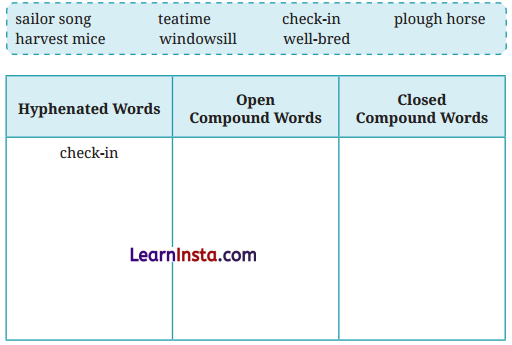
Complete the following table correctly by choosing words from the box given below. An example has been done for you.
Answer:
| Hyphenated Words | Open Compound Words | Closed Compound Words |
| well-bred | plough horse | windowsill |
| check-in | harvest mice | teatime |
| sailor song |
II. Create compound words from the table given below.

Now, complete the paragraph with suitable compound words from the table. An example has been done for you.
After being treated by Doctor Dolittle, the A. fun-loving dolphins danced playfully in his sanctuary. The B. _______________ chatter of monkeys echoed through the C. _______________, their ailments cured. D. ______________ eagles soared gracefully E. _______________ their health restored. F. _______________ among the G. _______________ chirped joyfully from the branches. All creatures were happy with Doctor Dolittle’s care.
Answer:
| A | B |
| 1. fun | (i) head |
| 2. high | (ii) birds |
| 3. never | (iii) flying |
| 4. early | (iv) loving |
| 5. song | (v) risers |
| 6. over | (vi) tops |
| 7. tree | (vii) ending |
A. fun-loving
B. tree-tops
C. never-ending jungle
D. High-flying
E. over-head
F. Song-birds
G. early-risers
III. Underline the names of animals that are hidden in the sentences given below. Clues are given within the brackets. An example has been done for you.
1. Dr. Dolittle was eating oatmeal for his breakfast, (a farm animal)
2. Old ladies began to bring him their pets, (an insect)
3. The author sees the connection between humans and animals, (a farm animal.)
4. The three baby dinosaurs are from ice age. (field animal)
5. The patients who came late didn’t know where to go. (ship of the desert)
Answer:
1. Dr. Dolittle was eating oatmeal for his breakfast, (goat – a farm animal)
2. Old ladies began to bring him their pets, (ant – an insect)
3. The author sees the connection between humans and animals, (ewe – a farm animal)
4. The three baby dinosaurs are from ice age. (mice – a field animal)
5. The patients who came late didn’t know where to go. (camel – ship of the desert)
IV. Read the following sentence from the text. Study the highlighted words.
But that stupid man over the hill never even looked at my eyes.
The highlighted words spell and read the same backwards too.
A word, phrase, or sequence that reads the same backwards as forwards is a palindrome. Some of the common palindromes include ‘Was it a car or a cat I saw?’, ‘Madam, I’m Adam’ and ‘A man, a plan, a canal—Panama’.
Read the sentences below and identify the palindrome words and sentences.
1. Step on no pets.
2. Naman saw a race car at the show.
3. Nitin speaks in Malayalam.
4. The engineer used a rotator to check the surface level.
5. The pilot relied on the radar to navigate safely.
6. Eva can I see bees in a cave?
Now, create your own palindrome and share it with your classmates and the teacher.
Answer:
The palindrome words and sentences from the given text:
1. Step on no pets. → Entire sentence
2. Naman and race car
3. Nitin and Malayalam
4. Rotator
5. Radar
6. Eva, can I see bees in a cave? → Entire sentence
Other palindrome:
Refer, deed, peep, noon He lived as a devil, eh!
We panic in a pew. Don’t nod Never a foot too far, even.
Sir, I demand, I am a maid named Iris.
V. Underline the verbs and identify the tense form in the following sentences from the text.
The verbs in 1 and 3 are in present continuous form.
The verbs in 2 and 4 are in simple present.
1. He is asking you a question.
2. Oh, there are plenty of animal doctors.
3. I am going blind in one eye.
4. But the trouble is that anybody thinks he can doctor animals.
Answer:
1. He is asking you a question. (Present Continuous)
2. Oh, there are plenty of animal doctors. (Simple Present) •
3. I am going blind in one eye. (Present Continuous)
4. … the trouble is that anybody thinks he can doctor animals. (Simple Present)
VI. Read the following sentences from the text.
- That man’s (man has) got sense.
- Can’t you see that it has stopped raining?
In the first sentence the verbs, ‘has got’ denote an action that is relevant at the time of speaking.
In the second sentence, the verbs “has stopped’ denote an action that is recently completed.
We use present perfect tense to indicate:
- a recently completed action
- an action that started in the past and is relevant even at the moment of speaking
- an action in the past where the focus is on the action and not on the time of occurrence (but relevant at the time of speaking)
Structure of Present Perfect Tense: has/have + V3 (past participle)
Fill in the blanks using the correct form of verbs (present perfect) given within brackets.
Since becoming an animal doctor, Doctor Dolittle 1 ____________ (learn) to communicate with all animals and birds. He 2 ____________ (treat) countless farm animals and pets with care. The parrot, Polynesia, 3 ____________ (teach) him bird-language, and he 4 ____________ (write) books about his adventures. Many people 5 ____________ (bring) their sick animals to his door. Over the years, Dolittle 6 ____________ (become) renowned worldwide for his unique abilities.
Answer:
1. has learned
2. has treated
3. has taught
4. has written
5. have brought
6. has become
Class 7 English Chapter 4 Question Answer – Let us listen (Page 55)
I. You will listen to an announcement. As you listen, state whether the following statement is true or false. (Refer to the NCERT textbook page-88 for transcript)
Dr. Dolittle’s new clinic presents an offer of free medicines.
Answer:
false
II. You will listen to the announcement again. As you listen, complete the detalis given below with one or two exact words you hear.
1. The new clinic is located in the town of ______________.
2. The address is 12, ______________ Lane.
3. The clinic is open Monday to Friday from ______________ a.m. to 5 p.m.
4. Special timings for ______________ are on Saturdays from 11 a.m. to 2 p.m.
5. Dr. Dolittle will ensure that animals get the ______________.
6. All animals—horses, cows, ______________, wild animals, and others are welcome.
Answer:
1. Woodstock
2. Rose
3. 9
4. birds
5. best care
6. pets
NCERT Class 7 English Poorvi Chapter 4 Question Answer – Let us speak (Pages 55-56)
Conversation between a doctor and a patient
- Read the information about the problems 1-4.
- Use the cue cards provided to conversation.
- Take turns to play parts of doctor and patient.
Problem 1: Cough and cold
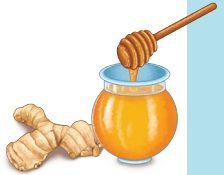
- Solution: Ginger and honey mix
- Additional Advice: Drink warm fluids and rest.
Problem 2: Dry lips

- Solution: Apply ghee
- Additional Advice: Stay hydrated and avoid wetting your lips.
Problem 3: Sore throat
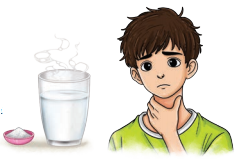
- Solution: Gargle with warm salt water.
- Additional Advice: Drink herbal teas and avoid cold drinks.
Problem 4: Fatigue

- Solution: Ensure adequate sleep and a balanced diet.
- Additional Advice: Take short walks to increase energy levels.
Cue Cards

Answer:
Do it Yourself
Class 7th English Chapter 4 Animals Birds and Dr Dolittle Question Answer – Let us Write (Page 57)
A notice is a means of formal communication for a particular group of persons. It informs them about some important event, such as an invitation to a meeting, an announcement, to give instructions, make appeals, etc.
Write a notice in about 50 words about the Annual Health Check-up for students of Grades 6-8. Remind students to collect their health check-up cards from the class teacher. Include all other necessary details about date, time, and venue.
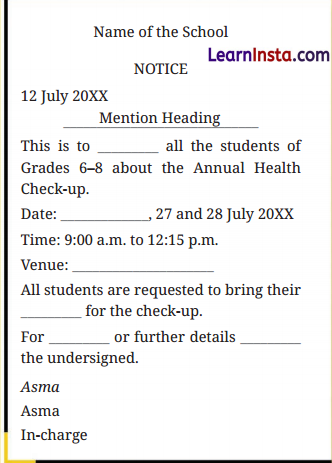
Complete the draft of the notice by using the words and phrases given in the box below.

Answer:
Name of the School
NOTICE
12 July 20XX
Annual Health Check-up for Students
This is to inform all the students of Grades 6-8 about the Annual Health Check-up.
Date: Thursday and Friday,
27 and 28 July 20XX Time: 9:00 a.m. to 12:15 p.m.
Venue: Assembly Hall
All students are requested to collect their health card from the class teacher and bring it for the check-up.
For any queries or further details, please contact the undersigned.
Asma
In-charge
Animals Birds and Dr Dolittle Class 7 NCERT Solutions – Let us Explore (Page 58)
I. The word ‘goshala’ translates to ‘cowshed’ in English. It is a Sanskrit word that is made up of the words ‘go’, which means ‘cow’, and sala, which means ‘shed’ or ‘hall’.
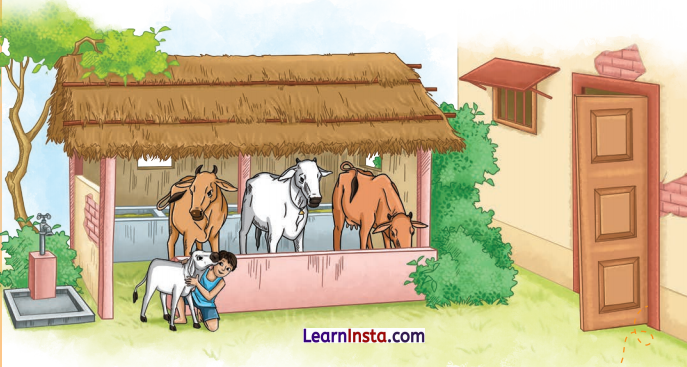
Plan a visit with the teacher to a ‘goshala’ and find out how the cows are looked after.
Answer:
A Visit to a Goshala
During your visit to a goshala, you can observe how cows are taken care of. Some’key practices that you might learn include:
- Feeding: Cows are provided with nutritious food like grass, hay, and sometimes special feed to ensure good health.
- Cleanliness: The goshala maintains a clean environment to keep the cows healthy and free from diseases.
- Healthcare: Regular health check-ups, vaccination, and treatment are provided for the cows.
- Milking Process: Observe how cows are milked in a hygienic manner, ensuring their comfort and cleanliness.
II. Ayurveda is the oldest existing medical system in India. Animals received good medicinal care in ancient India. Indian medical treatises like Charaka Samhita, Sushruta Samhita, and Harita Samhita contain references of care of animals. Find out names of different organisations that work for the welfare of animals with the help of the teacher.
Answer:
Welfare Organizations for Animals
There are several organizations that work for the welfare of animals. Some well-known ones include:
- PETA India (People for the Ethical Treatment of Animals)
- Blue Cross of India
- The Animal Welfare Board of India (AWBI)
- Wildlife SOS
- Society for the Prevention of Cruelty to Animals (SPCA)
These organizations are dedicated to the protection, rescue, and rehabilitation of animals in distress.
III. What is the best way to take care of stray and abandoned animals?
1. Provide food and water for the animal
2. Take them to an animal shelter
3. Adopt them by taking them home Give reasons for your responses.,
Answer:
Best Way to Take Care of Stray and Abandoned Animals
1. Provide food and water for the animal
Reason: Stray and abandoned animals often face difficulties finding food and water. By offering food and water, we help meet their immediate survival needs.
2. Take them to an animal shelter
Reason: Shelters provide them a safe environment, and the chance for adoption. Taking strays to shelters ensures they are looked after properly.
3. Adopt them by taking them home
Reason: Adoption gives animals a permanent and loving home, reducing the number of homeless animals and ensuring their well-being for life.