Students often prefer our concise Class 8 English Poorvi Worksheet and Class 8 English Chapter 4 A Tale of Valour: Major Somnath Sharma and the Battle of Badgam Worksheet with Answers Pdf for quick practice.
Class 8 English Chapter 4 A Tale of Valour: Major Somnath Sharma and the Battle of Badgam Worksheet with Answers
Class 8 English A Tale of Valour: Major Somnath Sharma and the Battle of Badgam Worksheet
Class 8 English Chapter 4 Worksheet – Class 8 A Tale of Valour: Major Somnath Sharma and the Battle of Badgam Worksheet
Let us do these activities before we read
I. Work in pairs. Share your answers with your classmates and teacher.
1. Why do you think bravery is celebrated in national events?
__________________________________________
2. Can you name any other national memorials in India dedicated to martyrs?
__________________________________________
3. How do such memorials help in instilling patriotism among youth?
__________________________________________
II. Work in groups of four and discuss.
1. What do you think motivates a soldier to risk their life for the country?
__________________________________________
2. If you could ask a soldier one question about their experience, what would it be and why?
__________________________________________
Let us Discuss
Arrange the following events in chronological order. The first and the last events have been marked for you. Share your answers with your classmates and teacher.
1. Major Somnath Sharma was inspired by tales from the Mahabharata narrated by his grandfather. (1)
2. He served in the Arakan Campaign during World War II.
3. He received military training at the Royal Military College, Sandhurst.
4. Pakistani infiltrators launched Operation Gulmarg to annex Kashmir.
5. Major Somnath Sharma insisted on joining his company in combat despite an injury.
6. He laid out ground panels to guide Indian air strikes.
7. He was killed by a mortar shell while helping a machine gun operator.
8. His name was engraved on the Honour Wall at the National War Memorial. (8)
Think beyond
Read the extracts and answer the questions that follow.
1. On 31 October, the D Company of the 4th Battalion of Kumaon Regiment, under the command of Major Somnath Sharma, was also flown into Srinagar. At that time, Major Somnath Sharma’s left hand was in plaster, but he insisted on being with his company while in combat. He knew
that this mission would be very challenging and told his senior officers, “I know my men better than anyone else, and if they are going into action, they are not going in without me.” These words highlighted his commitment to his men and his country.
Questions:
(i) Why did Major Somnath Sharma insist on joining his company in combat despite his injury?
(a) He wanted to disobey orders.
(b) He believed it was an easy mission.
(c) He trusted his senior officers completely.
(d) He felt responsible for his men and was deeply committed to them.
(ii) Complete the following statement with a suitable reason.
Major Somnath Sharma insisted on being with his company during combat because ___________
(iii) Select the correct option.
Assertion (A): Major Somnath Sharma went into battle even with an injured hand.
Reason (R): He was determined to fulfill his duty and remain with his men during combat.
(a) Both A and R are true, and R is the correct explanation of A.
(b) Both A and R are true, but R is not the correct explanation of A.
(c) A is true, but R is false.
(d) A is false, but R is true.
(iv) Fill in the blank with the correct word from those given in the brackets:
Despite a physical limitation, Major Somnath Sharma’s decision to join his men in battle reflected not weakness but extraordinary ___________ a quality that defines true leadership, (valour/virtue)

2. “Despite heavy casualties and his own injuries, Major Somnath Sharma displayed unparalleled bravery. He moved fearlessly through the battlefield, directing fire, filling magazines for his gunners, and encouraging his men to hold their ground.
However, as the battle progressed, D Company began running out of ammunition. When Major Somnath Sharma informed Brigade headquarters about this, he was asked to pull back. Aware of the gravity of the situation, he responded with the words, “The enemy is only 50 yards from us. We are heavily outnumbered. We are under devastating fire. I shall not withdraw an inch but will fight to the last man and the last round.”
Just a few minutes later, when he was crouched in a trench next to a machine gun operator, in order to help him load the gun, his position was hit by a mortar shell, killing him instantly.
Questions:
(i) What does the phrase ‘unparalleled bravery’ suggest about Major Somnath Sharma’s actions?
(a) He followed all battlefield instructions.
(b) He showed a level of courage that was unmatched and exceptional.
(c) He was lucky to escape without injury.
(d) He only followed orders, without taking initiative.
(ii) Complete the sentence with a suitable reason:
Major Somnath Sharma refused to withdraw even when outnumbered because ___________
(iii) Choose the correct option for the Assertion (A) and Reason (R) below:
(A): Major Somnath Sharma continued to assist his men even after being injured.
(R): He believed that true leadership meant standing with his men during the most difficult times.
(a) Both (A) and (R) are true, and (R) is the correct explanation of (A).
(b) Both (A) and (R) are true, but (R) is not the correct explanation of (A).
(c) (A) is true, but (R) is false.
(d) (A) is false, but (R) is true.
(iv) Fill in the blank with the correct word from the options in brackets:
Major Somnath Sharma was ___________ in the trench when a mortar shell struck. (crouched/standing)
II. Answer the following questions.
Question 1.
What mission was Major Somnath Sharma assigned on 3 November 1947?
__________________________________________
Question 2.
How did Major Somnath Sharma show leadership even when he was injured?
__________________________________________
Question 3.
What was Operation Gulmarg, and what was its objective?
__________________________________________
Question 4.
Why was the Badgam village strategically important?
__________________________________________
Question 5.
What message does Major Somnath Sharma’s quote “I shall not withdraw an inch…” convey?
__________________________________________
Question 6.
How did Major Somnath Sharma’s actions affect the outcome of the battle?
__________________________________________
Question 7.
Why was Major Somnath Sharma awarded the Param Vir Chakra?
__________________________________________
Question 8.
What role did air support play in the battle?
__________________________________________
Question 9.
What qualities of a true soldier are reflected in Major Somnath Sharma’s story?
__________________________________________
Question 10.
What is the legacy of Major Somnath Sharma today?
__________________________________________
Let us learn
I. Match the expressions from the text in Column 1 with the most suitable situations in Column 2.
| Column 1 | Column 2 |
| 1. Laid down his life | (i) A captain predicted that the opposing team would use a diversion. |
| 2. Visualised the attack | (ii) A freedom fighter sacrificed his life for the independence of India. |
| 3. Displayed unparalleled bravery | (iii) A coach motivated players after a tough first half. |
| 4. Encouraged his men | (iv) A firefighter saved an entire family from a burning building. |
Now, complete the following sentences using the expressions from Column 1:
A. The young soldier ___________ in the battle to protect his post.
B. Major Somnath Sharma ___________ and took quick action to counter it.
C. Despite the danger, she ___________ by rescuing people under fire.
D. The leader ___________ to stay strong during the storm.
II. Match the collective nouns in Column 1 with their meanings in Column 2.
| Column 1 | Column 2 |
| 1. convoy | (i) a group of soldiers deployed for a mission |
| 2. patrol | (ii) a small group of soldiers forming part of a larger military force |
| 3. contingent | (iii) a group of vehicles or ships travelling together for protection |
| 4. troop | (iv) a unit sent to monitor or guard an area |
Now, fill in the blanks suitably with words from Column 1 in the table.
A. ___________ of military trucks moved through the valley at dawn.
B. The commander led a ___________ to survey the hills for enemy movement.
C. A ___________ of troops was stationed at the forward base.
D. The army deployed a ___________ to support the local defence post.
III. Read the following words from the text and fill in the blanks using the correct ones:
| retreat, resist, recover |
Meaning
1. To move back or withdraw : ___________
2. To fight against or oppose forcefully : ___________
3. To return to a normal state after hardship : ___________
Now, fill in the blanks with the words given above in the box.
1. The soldiers had to ___________ under overwhelming fire.
2. Citizens were trained to ___________ any external attack.
3. After weeks of treatment, the injured soldier began to ___________.
Now, list 3 other verbs beginning with ‘re-‘ and use them in sentences:
1. Re_____________________________________________
2. Re_____________________________________________
3. Re_____________________________________________
IV. In the following pairs of words, ‘c’ is used for nouns and ‘s’ for verbs. Now, fill in the blanks using the correct word from the pair in brackets.
1. The (i) ___________ of the army planned to (ii) ___________ a new defence line, (council/counsel)
2. The scientist’s new (i) ___________ helped him (ii) ___________ a faster way to communicate. (device/devise)
3. Teachers often (i) ___________ students with thoughtful (ii) ___________ (advise/advice)
4. Every player should (i) ___________ daily to improve their (ii) ___________ (practice/practise)
V. Subject-Verb Agreement
Subject-Verb agreement means that the verb in a sentence must match the subject in number (singular or plural). A singular subject takes a singular verb, and a plural subject takes a plural verb.
Examples:
1. Ananya is playing in the park. (Singular subject, Singular verb)
2. Some children are playing in the park. (Plural subject, Plural verb)
Basic Rule:
When two or more subjects are joined by “and,” use a plural verb.
Example: John and Mary are going to the store.
When two or more subjects are joined by’or’, nor, either….or, neither…nor, the verb agrees with the subject closest to it.
Example: Neither John nor Mary is going to the store.
Neither John nor his friends are going to the store.
Collective nouns (e.g., team, class, committee) can take either singular or plural verbs depending on whether the group is acting as a single unit or as individuals.
Example: The team is playing well, (acting as a unit)
The team are arguing about the game plan, (acting as individuals)
Fill in the blanks by choosing the correct verb given in brackets.
1. The list of names ___________ displayed on the wall, (is/are)
2. The sacrifices of these soldiers ___________ remembered every year, (is/are)
3. One of the heroes ___________ buried in the valley, (was/were)
4. Neither the commander nor the soldiers ___________ aware of the sudden attack, (was/were)
5. The sounds of gunfire ___________ echoing through the hills, (was/were)
VI. Read the following passage and correct the verb errors.
A team of brave soldiers march through the forest. Their commander give them orders. A batch of reinforcements arrive later. Everyone in the unit salute with pride. The sound of battle echo loudly.
Let us Listen
Listen to the passage on bravery and national pride of Major Somnath Sharma read out by your teacher. As you listen, complete the sentences by filling in the blanks with one or two exact words or phrases you hear.
(Read the Transcript given at the end of this book Pg. No. 152)
1. Major Somnath Sharma was the first recipient of the ___________
2. The medal is awarded for bravery in the presence of the ___________
3. It was instituted in the year ___________ but applied retrospectively from August 1 5,1947.
4. The medal features the Vajra, a mythological symbol linked to ___________
5. Major Sharma’s name is engraved on the ___________ at the National War Memorial.
Let us speak
In groups of 4-5, discuss how we can show bravery and patriotism in our everyday lives. Use the sentence prompts below to organise what you speak about.
Sentence Prompts:
- I believe bravery is not only shown on the battlefield but also when we…
- A small but patriotic act we can do every day is…
- If every citizen becomes responsible in… it will make our country stronger.
- One of the bravest things I have seen someone do is…
- We can honour our soldiers by…
- Even as students, we can show courage and patriotism by…
- True patriotism means standing up for…
- Like Major Somnath Sharma, we should also learn to…
Let us write
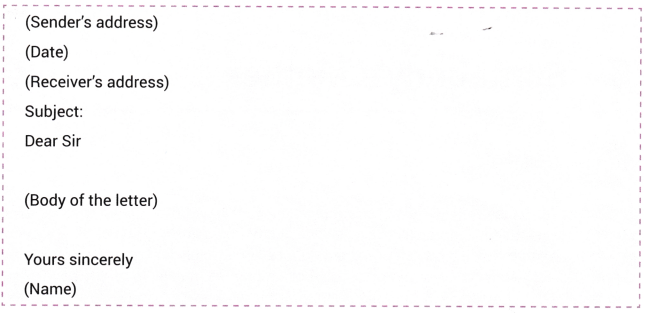
Your school plans to organise an online interactive session with a war veteran as part of your Values Education Week. Write a letter of enquiry to the Head of the Veterans’ Welfare Association in your region requesting: Availability of a speaker, preferred date and time, duration of the session, guidelines for student participation, any charges or honorarium etc.
Follow the given layout.
Let us explore
I. Apart from Major Somnath Sharma and Captain Vikram Batra, mention any other Param Vir Chakra awardee and write a short note on his bravery.
II. Find out about the Ashoka Chakra and how it differs from the Param Vir Chakra.
III. Identify a woman in the Indian Armed Forces who has achieved a historic milestone. Write a few lines about her.
IV. Explore the story of a tribal or regional hero who showed courage and fought for justice or independence.
V. List five patriotic slogans or quotes by Indian leaders or freedom fighters Mention who said each one.