Students often refer to Ganita Prakash Class 8 Solutions and Class 8 Maths Chapter 3 A Story of Numbers NCERT Solutions Question Answer to verify their answers.
NCERT Class 8 Maths Chapter 3 A Story of Numbers Solutions Question Answer
Ganita Prakash Class 8 Chapter 3 Solutions A Story of Numbers
NCERT Class 8 Maths Ganita Prakash Chapter 3 A Story of Numbers Solutions Question Answer
The Mechanism of Counting
NCERT In-Text Questions (Pages 51-53)
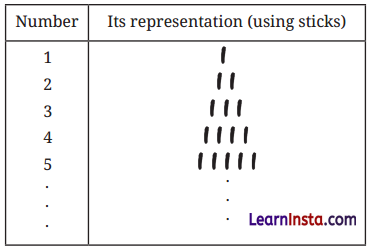
Question 1.
How will you use such sticks to answer the other two questions (Q2 and Q3)?
Solution:
To answer Q2 (Do we have fewer cows than our neighbour?), we will compare the bunch of sticks that will represent the last cow of our herd of cows with the bunch of sticks that will represent the last cow of the neighbour’s herd of cows. If or neighbour’s bunch looks bigger than ours, then we can tell that we have fewer cows than our neighbour.
And, to answer Q3 (if there are fewer, how many more cows Would we need so that we have the same number of cows as our neighbour?), we separated the number of sticks from the last collection or bunch of sticks representing number of cows in our herd from our neighbour’s collection to make his collection of sticks the same as our collection (bunch) of sticks. Therefore, the number of cows we need will be equal to the number of sticks separated.
Question 2.
How many numbers can you represent in this way using the sounds of the letters of your language?
Solution:
Do it yourself.

Question 3.
Do you see a way of extending this method to represent bigger numbers as well? How?
Solution:
Yes, by extending Table 1.
We can write 21 as XXI, 22 = XXII, …XXV = 25, …XXX = 30, XXXI = 31, …, XXXV = 35, .. .XXXIX = 39.
But here Table 1 is not able to give any clues on how to write numbers 40 onwards, as X can repeat only three times in a number (XXX).
Figure it Out (Page 54)
Question 1.
Suppose you are using the number system that uses sticks to represent numbers, as in Method 1. Without using either the number names or the numerals of the Hindu number system, give a method for adding, subtracting, multiplying, and dividing two numbers or two collections of sticks.
Solution:
Suppose we have a few sticks that represent the following numbers as follows:
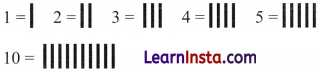
Addition of two numbers:
From the above numbers, we can observe that,
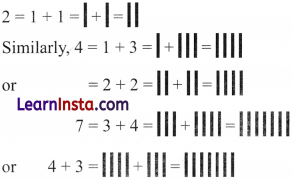
Subtraction of two numbers:
To subtract a number (subtrahend) from a number (minuend) using sticks, we cross out or break the sticks equal to the subtrahend number.
Let us take an example, subtract 3 from 8, that is 8 – 3.

Multiplication of two numbers:
Multiplication is a process of repeated addition.
Let us take an example, let us multiply 4 × 2.
Here 4 is being multiplied by 2 or we can say that 4 groups of 2 sticks are added.
4 × 2 = 2 + 2 + 2 + 2 = 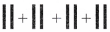
And we can make a collection of all the sticks as shown  .
.
That represents the product of 4 × 2 = 8.
Division of two numbers:
Division is a process of repeated subtraction.
Let us take an example, let us divide 10 by 2.
Let us take a collection of 10 sticks and subtract 2 (cross out or break 2 sticks) at a time till left with 0.
The number of times we cross out 2 sticks at a time will be the result.
As 10 ÷ 2
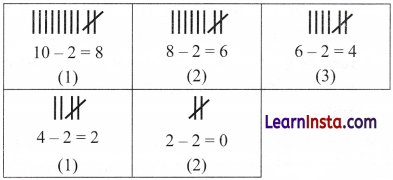
Thus, 10 ÷ 2 = 5
Question 2.
One way of extending the number system in Method 2 is by using strings with more than one letter—for example, we could use ‘aa’ for 27. How can you extend this system to represent all the numbers? There are many ways of doing it!
Solution:
In method 2, numbers have been represented by English letters as a = 1, b = 2,…, z = 26.
On extending the number system in method 2, as given:
aa = 27, we can represent numbers as ab = 28, ac = 29, …, az = 52, like a base-26 system, and every number will be mapped uniquely to a letter string.
As ba = 53, bb = 54, …, bz = 78; ca = 79, … cz = 104; and so on.
Question 3.
Try making your own number system.
Solution:
Do it yourself.
Figure it Out (Page 59)
Question 1.
Represent the following numbers in the Roman system.
(i) 1222
(ii) 2999
(iii) 302
(iv) 715
Solution:
(i) 1222 = 1000 + 100 + 100 + 10 + 10 + 2
= M + CC + XX + II
= MCCXXII
(ii) 2999 = 1000 + 1000 + 900 + 90 + 9
= MM + CM + XC + IX
= MMCMXCIX
(iii) 302 = 100 + 100 + 100 + 2
= CCC + II
= CCCII
(iv) 715 = 500 + 100 + 100 + 10 + 5
= D + CC + X + V
= DCCXV
NCERT In-Text Questions (Pages 59-60)
Example:
Try adding the following numbers without converting them to Hindu numerals:
(b) LXXXVII + LXXVIII
Solution:
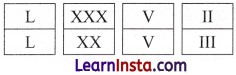
Therefore, LXXXVII + LXXVIII = CLXV.
How will you multiply two numbers given in Roman numerals, without converting them to Hindu numerals? Try to find the product of the following pairs of landmark numbers:
V × L, L × D, V × D, VII × IX.
Solution:
V × L = V times L (V means 5, i.e., 5 times L)
= L + L + L + L + L
= (L + L) + (L + L) + L
= C + C + L
= CCL
L × D = L times D (L means 50, i.e., 50 times D) = \(\overline{X X V}\)
(Since, 50 × 500 = 25000 = 10000 + 10000 + 5000 and \(\bar{X}\) = 10000, \(\bar{V}\) = 5000)
V × D = V times D (V means 5, i.e., 5 times D)
= D + D + D + D + D
= (D + D) + (D + D) + D
= MMD
VII × IX = VII times IX
= IX + IX + IX + IX + IX +IX + IX
= LXIII
(Writing large Roman numbers is complex and time-consuming, so we use Hindu-Arabic numerals. They are easier to read, write, and calculate.)
Figure it Out (Pages 60-61)
Question 1.
A group of indigenous people in a Pacific island uses different sequences of number names to count different objects. Why do you think they do this?
Solution:
They probably use different number sequences to make counting more meaningful, accurate, and culturally appropriate, depending on the type of object.
Question 2.
Consider the extension of the Gumulgal number system beyond 6 in the same way of counting by 2s. Come up with ways of performing the different arithmetic operations (+, -, ×, ÷) for numbers occurring in this system, without using Hindu numerals. Use this to evaluate the following:
(i) (ukasar-ukasar-ukasar-ukasar-urapon) + (ukasar-ukasar-ukasar-urapon)
(ii) (ukasar-ukasar-ukasar-ukasar-urapon) – (ukasar-ukasar-ukasar)
(iii) (ukasar-ukasar-ukasar-ukasar-urapon) × (ukasar-ukasar)
(iv) (ukasar-ukasar-ukasar-ukasar-ukasar-ukasar-ukasar-ukasar) ÷ (ukasar-ukasar)
Solution:
(i) Combine all ukasar: There are 4 ukasar from the first number and 3 ukasar from the second number, making a total of 7 ukasar.
Combine all urapon: There is 1 urapon from the first number and 1 urapon from the second number, making a total of 2 urapon.
So, there would be 7 ukasar and 2 urapon in the result, and 2 urapon means 1 ukasar.
Hence, the resultant would be ‘ukasar-ukasar-ukasar- ukasar-ukasar-ukasar-ukasar-ukasar’.
(ii) There are 4 ukasar in the first number and 3 ukasar in the second number, subtracting 3 ukasar from 4 ukasar, 1 ukasar is left.
So, there would be 1 ukasar and 1 urapon left in the result.
Hence, the resultant number would be ‘ukasar-urapon’.
(iii) (ukasar-ukasar-ukasar-ukasar-urapon) × (ukasar-ukasar) means we need to add (ukasar-ukasar-ukasar-ukasar-urapon) to itself (ukasar-ukasar) times, which is 4 times.
(ukasar-ukasar-ukasar-ukasar-urapon) + (ukasar-ukasar-ukasar-ukasar-urapon) + (ukasar-ukasar-ukasar-ukasar-urapon) + (ukasar-ukasar-ukasar-ukasar-urapon) = (ukasar-ukasar-ukasar-ukasar-ukasar-ukasar-ukasar-ukasar-ukasar-ukasar-ukasar-ukasar-ukasar-ukasar-ukasar-ukasar-urapon-urapon-urapon-urapon)
[16 ukasar 4 urapon or 16 ukasar and 2 ukasar = 18 ukasar (since, 2 urapon means 1 ukasar)]
Hence, the result product would be:
ukasar-ukasar-ukasar-ukasar-ukasar-ukasar-ukasar-ukasar-ukasar-ukasar-ukasar-ukasar-ukasar-ukasar-ukasar-ukasar-ukasar-ukasar
(iv) (ukasar-ukasar-ukasar-ukasar-ukasar-ukasar-ukasar- ukasar) ÷ (ukasar-ukasar) means subtracting (ukasar-ukasar) from the (ukasar-ukasar-ukasar-ukasar-ukasar-ukasar-ukasar-ukasar) till you get remainder zero.
Subtracting 1st time:
(ukasar-ukasar-ukasar-ukasar-ukasar-ukasar-ukasar-ukasar) – (ukasar-ukasar) = (ukasar-ukasar-ukasar- ukasar-ukasar-ukasar) (6 ukasar left)
Subtracting 2nd time:
(ukasar-ukasar-ukasar-ukasar-ukasar-ukasar) – (ukasar-ukasar) = (ukasar-ukasar-ukasar-ukasar) (4 ukasar left)
Subtracting 3rd time:
(ukasar-ukasar-ukasar-ukasar) – (ukasar-ukasar) = (ukasar-ukasar) (2 ukasar left)
Subtracting 4th time:
(ukasar-ukasar) – (ukasar-ukasar) = 0 ukasar left
So, by 4 times subtraction, the remainder is 0.
Hence, the quotient is 4, that is ‘ukasar-ukasar-ukasar-ukasar’.
Question 3.
Identify the features of the Hindu number system that make it efficient when compared to the Roman number system.
Solution:
The Hindu-Arabic number system (which we use today) is significantly more efficient and powerful than the Roman number system due to the following key features:
- Each digit’s value depends on its position (ones, tens, hundreds, etc.). Roman numerals have no place value, so they cannot express values compactly or support complex calculations easily.
- The Hindu system includes zero, which is essential for expressing large numbers and performing arithmetic. Romans had no symbol for zero, which made their system unsuitable for advanced math.
- Hindu numbers are shorter and easier to write (e.g., 2024 vs. MMXXIV). Roman numerals become very long for large numbers and are harder to read and write.
- Addition, subtraction, multiplication, and division can be systematically done using Hindu numerals. Roman numerals are not well-suited for calculations — even basic operations are hard without conversion.
Question 4.
Using the ideas discussed in this section, try refining the number system you might have made earlier.
Solution:
Do it yourself.
Figure it Out (Page 62)
Question 1.
Represent the following numbers in the Egyptian system:
10458, 1023, 2660, 784, 1111, 70707.
Solution:
10458 = 10000 + 100 + 100 + 100 + 100 + 10 + 10 + 10 + 10 + 10 + 8
= 
1023 = 1000 + 10 + 10 + 3 = 
2660 = 1000 + 1000 + 100 + 100 + 100 + 100 + 100 + 100 + 10 + 10 + 10 + 10 + 10 + 10
= 
784 = 100 + 100 + 100 + 100 + 100 + 100 + 100 + 10 + 10 + 10 + 10 + 10 + 10 + 10 + 10 + 4
= 
1111 = 1000 + 100 + 10 + 1 = 
70707 = 10000 + 10000 + 10000 + 10000 + 10000 + 10000 + 10000 + 100 + 100 + 100 + 100 + 100 + 100 + 100 + 7
= 
Question 2.
What numbers do these numerals stand for?
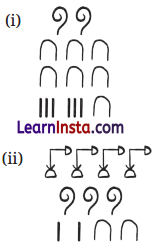
Solution:
(i)
= 2 × 100 + 7 × 10 + 6 × 1
= 200 + 70 + 6
= 276
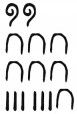
(ii)
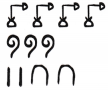
= 4 × 1000 + 3 × 100 + 2 × 10 + 2 × 2
= 4000 + 300 + 20 + 2
= 4322
Figure it Out (Page 63)
Question 1.
Write the following numbers in the above base-5 system using the symbols in Table 2:
15, 50, 137, 293, 651.
Solution:
15 = 3 × 5
= 3 × 51
= 
50 = 2 × 25
= 2 × 52
= 
137 = 125 + 10 + 2
= 53 + 2 × 51 + 2 × 50
= 
293 = 250 + 25 + 15 + 3
= 2 × 125 + 25 + 3 × 5 + 3 × 1
= 2 × 53 + 52 + 3 × 51 + 3 × 50
= 
651 = 625 + 25 + 1
= 54 + 52 + 50
= 
Question 2.
Is there a number that cannot be represented in our base-5 system above? Why or why not?
Solution:
No, there is no such number that cannot be represented in our base-5 system.
Because any number, either even or odd, can be represented in any positional number system with a base ≥ 2.
The base-5 number system is as follows:
50 = 1
51 = 5
52 = 25
53 = 125
54 = 625, so on.
So, in the base-5 system, all numbers can be represented.
For example:
3 = 3 × 50 = 
12 = 10 + 2 = 2 × 51 + 2 × 50 = 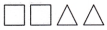
Question 3.
Compute the landmark numbers of a base-7 system. In general, what are the landmark numbers of a base-n system?
Solution:
We can get a number system by taking the base of 7, that is base-7 system by grouping 7 collections of size equal to the previous landmark number.
Let 1 be the first landmark number (1).
Group together 7 collections of size equal to the previous landmark number (1).
Its size is the second landmark number, which is 7.

Group together 7 collections of size equal to the previous landmark number (7).
Its size is the third landmark number, which is 7 × 7 = 49.
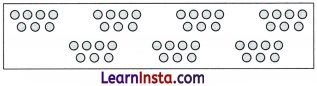
Similarly, group together 7 collections of size equal to the previous landmark number (49).
Its size is the fourth landmark number, which is 7 × 49 = 343, and so on.
Thus, we have a new number system (base-7 system)
70 = 1, 71 = 7, 72 = 49, 73 = 343, …
In general, for a base-n system, the landmark numbers will be n0 = 1, n1 = n, n2, n3,…..
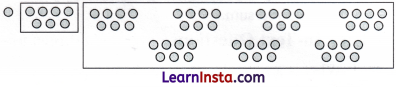
Figure it Out (Page 65)
Question 1.
Add the following Egyptian numerals:
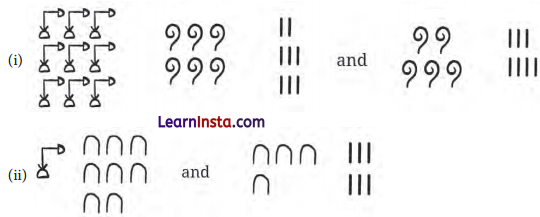
Solution:
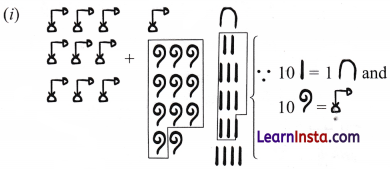
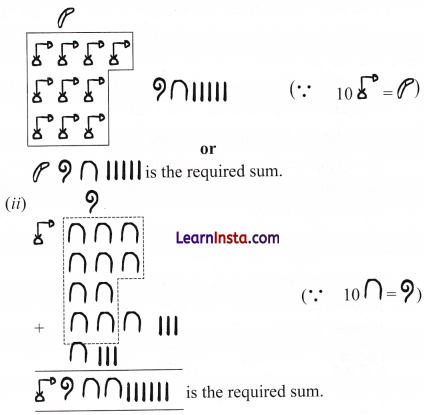
Question 2.
Add the following numerals that are in the base-5 system that we created:

Remember that in this system, 5 times a landmark number gives the next one!
Solution:
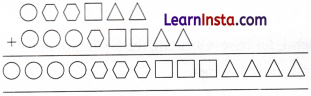
is the required sum.
NCERT In-Text Questions (Pages 66-68)
Question 1.
What is any landmark number multiplied by ∩ that is, 10? Find the following products.

Each landmark number is a power of 10, and so multiplying it by 10 increases the power by 1, which is the next landmark number.
Solution:

Question 2.
What is any landmark number multiplied by 9 (102)? Find the following products.

Solution:
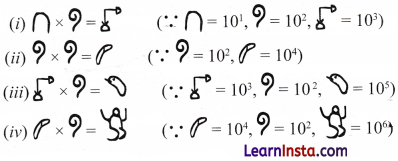
Question 3.
Find the following products.

Thus, the product of any two landmark numbers is another landmark number!
Solution:
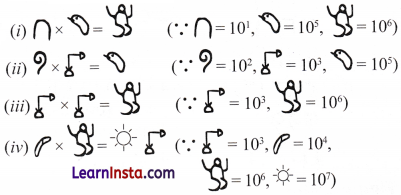
Question 4.
Does this property hold in the base-5 system that we created? Does this hold for any number system with a base?
Solution:
Do it yourself.
Question 5.
What can we conclude about the product of a number and ∩ (10) in the Egyptian system?
Solution:
If a number is multiplied by ∩ 10, the product will be 10 times the number, and the product will be another landmark number.
Question 6.
Now find the following products.

Solution:

Question 7.
What would be a simple rule to multiply a number by ∩?
Solution:
To multiply a number by ∩, repeat each symbol 10 times and then regroup if required.
Figure it Out (Pages 69-70)
Question 1.
Can there be a number whose representation in Egyptian numerals has one of the symbols occurring 10 or more times? Why not?
Solution:
No, in the Egyptian numeral system, if a symbol occurs 10 times, it is replaced by the next landmark symbol. So, no symbol is used 10 or more times in a valid representation.
Question 2.
Create your own number system of base 4, and represent numbers from 1 to 16.
Solution:
Do it yourself.
Question 3.
Give a simple rule to multiply a given number by 5 in the base-5 system that we created.
Solution:
Do it yourself.
Figure it Out (Page 73)
Question 1.
Represent the following numbers in the Mesopotamian system.
(i) 63
(ii) 132
(iii) 200
(iv) 60
(v) 3605
Solution:
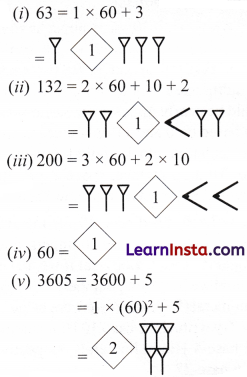
NCERT In-Text Questions (Page 73)
Question 1.
Look at the representation of 60. What will be the representation for 3,600?
Solution:
Express 3600 in base-60 according to the Mesopotamian number system.
3600 ÷ 60 = 60
60 ÷ 60 = 1
So, 3600 = 1 × 602 + 0 × 601 + 0 × 600
Thus, in Babylonian numerals, the leftmost place is 1 in the 602 place.
It would be represented as: 
NCERT In-Text Questions (Page 76)
Question 1.
Represent the following numbers using the Mayan system:
(i) 77
(ii) 100
(iii) 361
(iv) 721
Solution:
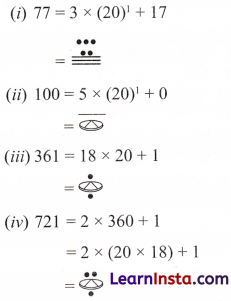
IV. The Hindu Number System
NCERT In-Text Questions (Page 78)
Question 1.
Where does the Hindu/Indian number system figure in the evolution of ideas of number representation? What are its landmark numbers? And does it use a place value system?
Solution:
The Hindu/Indian number system introduced the concept of place value and zero (0) as a number, both revolutionary ideas.
It was later transmitted to the Arab world and then to Europe, where it became known as the Hindu-Arabic numeral system.
In the system, zero (0), invented in India, allowed for accurate place value and representation of large numbers.
Its first recorded use is by the Indian mathematician Brahmagupta in the 7th century CE.
In the system, unique symbols were created for each digit (1-9), forming the base for the positional system.
The Hindu number system is a place value system, meaning the position of a digit determines its value.
It formed the basis of the decimal (base-10) system that is now used universally.
The value of a digit in a number depends on its position.
For example: In 345, the ‘3’ represents 300, not just 3.
As 345 = 3 × 100 + 4 × 10 + 5 × 1 = 3 × (102) + 4 × (101) + 5 × (100)
If the digits are rearranged, the number changes because their place (position) affects their value.
Figure it Out (Page 80)
Question 1.
Why do you think the Chinese alternated between the Zong and Heng symbols? If only the Zong symbols were to be used, how would 41 be represented? Could this numeral be interpreted in any other way if there is no significant space between two successive positions?
Solution:
The ancient Chinese number system used Zong (vertical) and Heng (horizontal) rod symbols to represent numbers in a place-value format.
These symbols were alternated at each place to make it easier to identify the position of each digit.
This alternation helped prevent confusion, especially when numbers were written closely together or lacked proper spacing.
Now, if only the Zong symbol were used, how would 41 be written?
In the Chinese system,
41 = 4 tens + 1 unit.
Using only Zong symbols, it would be written as:
4 tens → | | | |
1 unit → |
So, 41 written as: | | | | |
Without alternating directions or leaving sufficient space, it could be misunderstood. A reader might interpret it as five ones (5) or as a different value like 14.
Since a visual clue for place value is missing. So, the alternation of Zong and Heng symbols in the Chinese numeral system was an effective method to ensure that each digit’s place value was clearly identified. Without this alternation or proper spacing, a number like 41 could easily be misread.
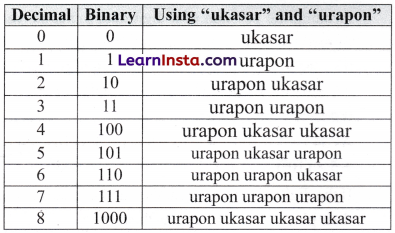
Question 2.
Form a base-2 place value system using ‘ukasar’ and ‘urapon’ as the digits. Compare this system with that of the Gumulgal’s.
Solution:
Forming a base-2 system using “ukasar” and “urapon”.
In a base-2 (binary) system, we use only two digits:
Let’s assign: ukasar = 0, urapon = 1
This system works just like the binary number system in computers.
The base-2 place value system (Binary system) Representation using ukasar and urapon.
Comparison with the Gumulgal’s Number System:
- The binary system using ukasar and urapon is a place value system, where each symbol’s position determines its value. It is efficient and scalable for large numbers.
- The traditional Gumulgal system is group-based and additive, which works well for small numbers but becomes complex and harder to manage as numbers increase.
Question 3.
Where in your daily lives, and in which professions, do the Hindu numerals, and 0, play an important role? How might our lives have been different if our number system and 0 hadn’t been invented or conceived of?
Solution:
Hindu numerals (0-9) are everywhere in our lives:
In Daily Life: Reading clocks, dates in a calendar, calculating money, measurements like, temperature, weight, distance, etc.
In Professions: Bankers/Accountants: calculating interest, taxes, budgets; Engineers/Architects: measurements, designs, construction; Scientists: experiments, data analysis, formulas; Shopkeepers: billing, inventory, change calculations; Software Developers: Programming, logic, data structures (uses binary too), etc.
If the Hindu numeral system and 0 were never invented, then the impact would be huge: without 0, we couldn’t write 100, 1000, or even 10 properly. No 0 means no simple addition, multiplication, or division, and advanced mathematics would be nearly impossible. No computers (binary system is based on 0 and 1) and other electronic devices such as calculators, clocks, digital devices, etc. could be possible. Modern science, space exploration, and engineering would not exist as we know them.
Question 4.
The ancient Indians likely used base 10 for the Hindu number system because humans have 10 fingers, and so we can use our fingers to count. But what if we had only 8 fingers? How would we be writing numbers then? What would the Hindu numerals look like if we were using base 8 instead? Base 5? Try writing the base-10 Hindu numeral 25 as base-8 and base-5 Hindu numerals, respectively. Can you write it in base-2?
Solution:
Here’s how numbers might be written in different bases, assuming the Hindu-Arabic numeral system’s concept of positional notation and digits (0, 1, 2, etc.) is still used:
Base 8 (Octal):
If humans had 8 fingers, a base-8, or octal number system might have been developed.
The digits used in base 8 would be 0, 1, 2, 3, 4, 5, 6, and 7.
When “8” is reached in base 10, it would become “10” in base 8, representing one group of eight and zero units.
To convert 25 (base 10) to base 8, repeatedly divide by 8 and record the remainders, reading them from bottom to top:
25 ÷ 8 = 3 remainder 1
3 ÷ 8 = 0 remainder 3
So, 25 (base 10) would be written as 31 (base 8).
Base 5 (Quinary):
If there were 5 fingers, a base-5, or quinary number system might have been used.
The digits used in base 5 are 0, 1, 2, 3, and 4.
The number 5 in base 10 would be written as 10 in base 5.
To convert 25 (base 10) to base 5, repeatedly divide by 5 and record the remainders, reading them from bottom to top:
25 ÷ 5 = 5 remainder 0
5 ÷ 5 = 1 remainder 0
1 ÷ 5 = 0 remainder 1
So, 25 (base 10) would be written as 100 (base 5).
Base 2 (Binary):
Computers primarily use the base-2, or binary system.
The digits used in base 2 are 0 and 1.
The numbers 2, 3, 4, etc. are represented by combinations of 0s and 1s.
To convert 25 (base 10) to base 2, divide by 2 repeatedly and record the remainders from bottom to top:
25 ÷ 2 = 12 remainder 1
12 ÷ 2 = 6 remainder 0
6 ÷ 2 = 3 remainder 0
3 ÷ 2 = 1 remainder 1
1 ÷ 2 = 0 remainder 1
So, 25 (base 10) would be written as 11001 (base 2).