Get the simplified Class 8 Maths Extra Questions Chapter 1 A Square and A Cube Class 8 Extra Questions and Answers with complete explanation.
Class 8 A Square and A Cube Extra Questions
Class 8 Maths Chapter 1 A Square and A Cube Extra Questions
Class 8 Maths Chapter 1 Extra Questions – A Square and A Cube Extra Questions Class 8
Very Short Answer Type Questions
Question 1.
Find the pairs of partner factors of 15.
Answer:
Factors of 15 are 1, 3, 5, 15.
Here, 1 × 15 = 15 and 3 × 5 = 15
(1, 15) and (3, 5) are pairs of partner factors of 15.
Question 2.
Write the first five square numbers.
Answer:
1, 4, 9, 16 and 25 are first five square numbers.
Question 3.
How many perfect squares lie between 1 and 50?
Answer:
4, 9, 16, 25, 36 and 49 are six perfect squares which lie between 1 and 50.
Question 4.
How many non-perfect squares natural numbers lie between 182 and 192?
Answer:
We know that there are 2n non-perfect square numbers between two consecutive square numbers n2 and (n + 1)2.
Here, 182 = 324 and 192 = 361 and 2n = 2 × 18
So, there are 36 non-perfect square numbers between 324 and 361.
Question 5.
Find the sum of first 4 odd natural numbers and write the number whose square it is.
Answer:
Sum of first 4 odd natural numbers is, 1 + 3 + 5 + 7 = 16.
Since, 16 = 42
Hence, 16 is a square of 4.

Question 6.
What is the 38th odd number?
Answer:
∵ nth odd number = 2n -1
∴ 38th odd number = 2 × 38 – 1 = 76 – 1 = 75
Question 7.
Check, whether 180 is a perfect square or not using prime factorisation.
Answer:
By prime fractorisation,
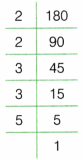
∴ 180 = 2 × 2 × 3 × 3 × 5
Here, the prime factor 5 is not in a pair, so 180 is not a perfect square.
Question 8.
How is the repeated subtraction method in dividing two numbers and finding square roots are different?
Answer:
Same number is subtracted each time in division, but in finding square root, successive odd numbers are subtracted.
Question 9.
Find the cube of the following numbers.
(i) 16
(ii) 17
(iii) 23
Answer:
(i) Given, number is 16.
Cube of 16 = 16 × 16 × 16 = 4096
(ii) Given, number is 17.
Cube of 17 = 17 × 17 × 17 = 4913
(iii) Given, number is 23.
Cube of 23 = 23 × 23 × 23 = 12167
Question 10.
Is 150 a perfect cube?
Answer:
Given, number is 150.
Now, prime factorisation of 150
150 = 2 × 3 × 5 × 5
The prime factors of 150 do not appear in group of three.
Hence, 150 is not a perfect cube.
Question 11.
Express (63) as the sum of odd numbers.
Answer:
Given, number is 63.
So, n = 6 and (n – 1) = (6 – 1) = 5
We will start with (6 × 5) + 1 = 30 + 1 = 31
So, odd numbers from 31 are 31, 33, 35, 37, 39, 41.
Now, the sum of 6 consecutive odd numbers starting from 31 = 31 + 33 + 35 + 37 + 39 + 41 = 216
Question 12.
Find the smallest number by which 256 must be multiplied to obtain a perfect cube.
Answer:
Given, number is 256.
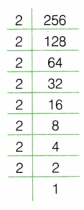
Now, prime factorisation of 256
256 = 2 × 2 × 2 × 2 × 2 × 2 × 2 × 2
Here, the prime factor 2 does not appear in a group of three.
So, to make 256 a perfect cube, we have to multiply 256 by 2.
256 × 2 = 512
⇒ (8)3 = 512
Short Answer Type Questions
Question 1.
Using prime factorisation, find the square root of 11025.
Answer:
We have, 11025
By prime factorisation,
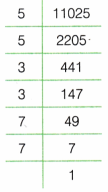
∴ 11025 = 5 × 5 × 3 × 3 × 7 × 7 or \(\sqrt{11025}\) = 5 × 3 × 7 = 105
Question 2.
Find the length of the side of a square, whose area is 729 m2.
Answer:
Let the side of the square be x m.
Given, area of the square = 729 m2
v Area of square = (Side)2 = x2
x2 = 729
⇒ x = \(\sqrt{729}\)
x = 27 m
Hence, the required side of the square is 27.
Question 3.
Show that 500 is not a perfect square.
Answer:
We have, 500 = 2 × 2 × 5 × 5 × 5
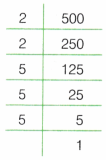
Here, by grouping into pairs of equal factors, we are left with one factor 5, which cannot be paired.
Hence, 500 is not a perfect square.
Question 4.
Find the least square number which is divisible by 3, 4, 5, 6 and 8.
Answer:
Firstly, we find out the LCM of 3, 4, 5, 6, 8
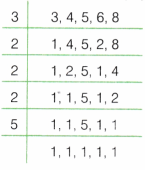
To make 3 × 2 × 2 × 2 × 5 a perfect square, we need to
multiply it with 3 × 2 × 5.
Thus, we have
3 × 2 × 2 × 2 × 5 × 3 × 2 × 5 = 120 × 30
= 3600
Question 5.
Check whether 21600 is a perfect cube or not.
Answer:
Given number is 21600.
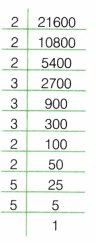
Now, prime factorisation of 21600
∴ 21600 = 2 × 2 × 2 × 3 × 3 × 3 × 2 × 2 × 5 × 5
Prime factors 2 and 5 do not form triplets
So, 21600 is not a perfect cube.
Question 6.
Find the value of 173 – 163.
Answer:
We have, 173 – 163
We know that
b3 – a3 =1 + 3ab, b > a,
where a and b are consecutive numbers.
On putting a = 16 and b = 17,
we get 173 – 163 = 1 + 3 × 16 × 17 = 817
Question 7.
Express 20683 as the sum of two cubes in two different ways.
Answer:
Two different ways are
20683 = 103 + 273 and 20683 = 193 + 243
Question 8.
What is the value of 3\(\sqrt{64}\) – \(\frac{1}{\sqrt[3]{64}}\)?
Answer:
We have 3\(\sqrt{64}\) – \(\frac{1}{\sqrt[3]{64}}\)
∵ Cube root of 64 = 3\(\sqrt{64}\) = 4 × 4 × 4 = 4
∴ 4 – \(\frac{1}{4}=\frac{15}{4}\) or 3\(\frac{3}{4}\)
Long Answer Type Questions
Question 1.
Find the square root of 324 by the method of repeated subtraction.
Answer:
Here, 324 – 1 = 323, 323 – 3 = 320
320 – 5 = 315, 315 – 7 = 308
308 – 9 = 299, 299 – 11 = 288
288 – 13 = 275, 275 – 15 = 260
260 – 17 = 243, 243 – 19 = 224
224 – 21 = 203, 203 – 23 = 180
180 – 25 = 155, 155 – 27 = 128
128 – 29 = 99, 99- 31 = 68
68 – 33 = 35, 35- 35 = 0
So, to get 0, we use 18 steps.
Hence, the square root of 324 is 18.
Question 2.
The area of a square plot is 101 \(\frac{1}{400}\) m2. Find the length of one side of the plot.
Answer:
Let length of the square plot be a then the area of square
According to the question,
Area = 101\(\frac{1}{400}\)m2
⇒ a2 = 101\(\frac{1}{400}\)
⇒ a2 = \(\frac{40401}{400}\)
a = \(\frac{201}{20}\) = 10\(\frac{1}{20}\)
Hence, length of one side of the plot is 10\(\frac{1}{20}\) m.
Question 3.
Each student of Class VIII contributed some money for a picnic. The money contributed by each student was equal to square of the total number of students. If the total collected amount was 2209 then find the total number of students.
Answer:
Given, total amount = 2209 [given]
According to the question,
Money contributed by each student
= Square of the total number of students Total number of students
= Square root of the money contributed by each student
= \(\sqrt{2209}=\sqrt{47 \times 47}\) = 47
Question 4.
During a mass drill exercise, 6250 students of different schools are arranged in rows such that the number of students in each row is equal to the number of rows.
In doing so, the instructor finds out that 9 children are left out. Find the number of children in each row of the square.
Answer:
Given, total number of students = 6250
Number of students forming a square = 6250 – 9 = 6241
Thus, 6241 students form a big square which has number of rows equal to the number of students in each row.
Let the number of students in each row be x then the number of rows will be x.
Therefore, x × x = 6241
⇒ x = \(\sqrt{6241}\) = 79
Hence, there are 79 students in each row of the square formed.
Question 5.
Is 9720 a perfect cube? If not, find the smallest number by which, it must be divided to get a perfect cube.
Answer:
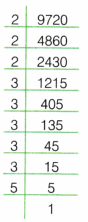
Resolving 9720 into prime factors, we get
9720 = 2 × 2 × 2 × 3 × 3 × 3 × 3 × 3 × 5
The prime factors 3 and 5 are not forming the group of triples.
So, 9720 is not a perfect cube.
In prime factorisation of 9720, two factors 3 and 5 remain ungrouped.
So, if we divide the number by 3 × 3 × 5 then the prime factorisation of the quotient will not contain 45.
∴ 9720 – 45 = 216 = (6)3
= 2 × 2 × 2 × 3 × 3 × 3
Hence, the smallest number by which 9720 must be divided to get a perfect cube is 45.
Question 6.
Find the cube root of the number 614125.
Answer:
Given number is 614125.
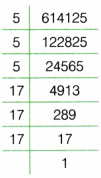
Now, prime factorisation of 614125.
∴ 3\(\sqrt{614125}\) = 5 × 5 × 5 × 17 × 17 × 17
= 5 × 17
Hence, 3\(\sqrt{614125}\) = 85
Question 7.
Evaluate \(\sqrt[3]{27}+\sqrt[3]{8}+\sqrt[3]{64}\).
Answer:
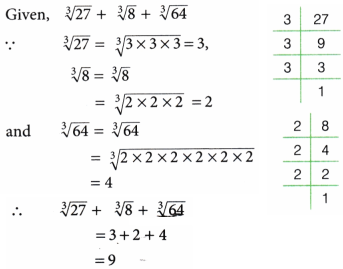
Question 8.
Difference of two numbers which are perfect cubes is 189. If the cube root of the smaller of the two numbers is 3 then find the cube root of the larger number.
Answer:
Let the cube root of the larger number be « and smaller number be b.
Then, according to the question, a3 – b3 = 189
⇒ a3 — (3)3 = 189
⇒ a3 – 27 = 189
⇒ a3 = 189 + 27
⇒ a3 = 216
⇒ a3 = 63
a = 6
[by taking cube root on both sides] Hence, the cube root of the larger number is 6.
Skill Based Questions
Question 1.
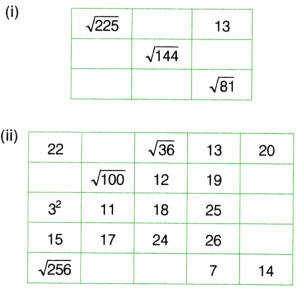
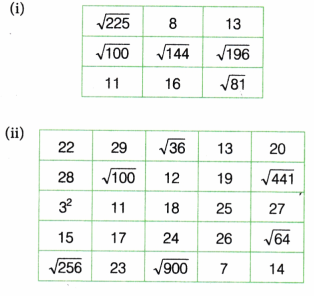
Magic Squares
A magic square is a square, with numbers arranged so that the sum of the numbers in each row, column and diagonal is the same.
Complete each magic square below.
Answer:
Case Study Based Question
Question 1.
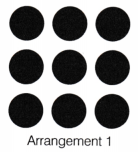
For a school performance, an equal number of students are to be arranged in each row and column. 9 Students can be arranged as shown in Arrangement 1.
(i) How many students can be added in each row and column in Arrangement 1 for 625 students?
(ii) The teachers organising the performance think that it will be difficult to arrange 625 students in one group. They think of dividing the group into two square arrangements. How many students can be there in each arrangement?
Answer:
(i) Let number of columns and rows be x.
Total number of students = 625
x × x = 625
x2 = 625
x = \(\sqrt{625}\)
x = 25
In the given arragnement, number of students in each row and column are 3.
Number of students added = 25 – 3 = 22
Hence, 22 students can be added in each row and column in given arrangement for 625 students.
(ii) Given, 625 students are to be divided into two square arrangements. This means we need to find two perfect squares that sum upto 625.
Since, 625 = 202 + 152 = 400 + 225
So, the students can be divided in two groups of 400 and 225 students.
Question 2.
We have for any positive integer x such that
(x)3 =(x) × (x) × (x) = x3
= x
Thus, the cube root of positive pefect cube is positive of the cube root of its absolute value. In other words, to find the cube root of a positive perfect cube, we find the cube root of its absolute value.
(i) The cube roots of 13824 and 175616 are
(a) 51,46
(b) 24,56
(c) 59,96
(d) None of the above
Answer:
(b) We have, two numbers are 13824 and 175616.
By prime factorisation method,
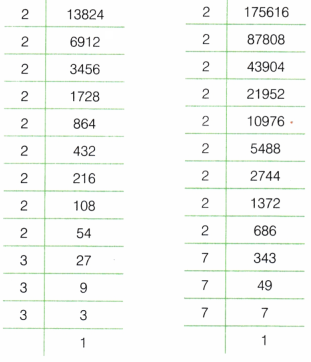
13824 = 2 × 2 × 2 × 2 × 2 × 2 × 2 × 2 × 2 × 3 × 3 × 3
⇒ \(\sqrt[3]{13824}\) = 2 × 2 × 2 × 3 = 24
and 175616 = 2 × 2 × 2 × 2 × 2 × 2 × 2 × 2 × 2 × 7 × 7 × 7
⇒ \(\sqrt[3]{175616}\) = 2 × 2 × 2 × 7 = 56
(ii) Cube root of 125 × 3375 is
(a) 57
(b) 75
(c) 56
(d) 45
Answer:
(b) We have, 125 × 3375
By prime factorisation method,
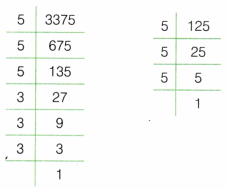
125 × 3375 = 5 × 5 × 5 × 5 × 5 × 5 × 3 × 3 × 3
⇒ \(\sqrt[3]{125 \times 3375}\) = 5 × 5 × 3
= 25 × 3= 75
(iii) If the volume of a cube is 4096 m3 then the side of the cube is
(a) 15 m
(b) 14 m
(c) 16 m
(d) 18 m
Answer:
(c) Given, volume of cube = 4096 m3
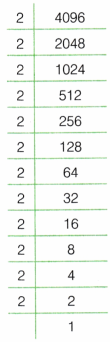
4096 = 2 × 2 × 2 × 2 × 2 × 2 × 2 × 2 × 2 × 2 × 2 × 2
⇒ \(\sqrt[3]{4096}\) = 2 × 2 × 2 × 2 = 16m
The side of cube is 16 m.