Students often prefer our concise Class 8 English Poorvi Worksheet and Class 8 English Chapter 2 A Concrete Example Worksheet with Answers Pdf for quick practice.
Class 8 English Chapter 2 A Concrete Example Worksheet with Answers
Class 8 English A Concrete Example Worksheet
Class 8 English Chapter 2 Worksheet – Class 8 A Concrete Example Worksheet
Let us do these activities before we read
I. Fill the vowel letters to name the items commonly found in a park.
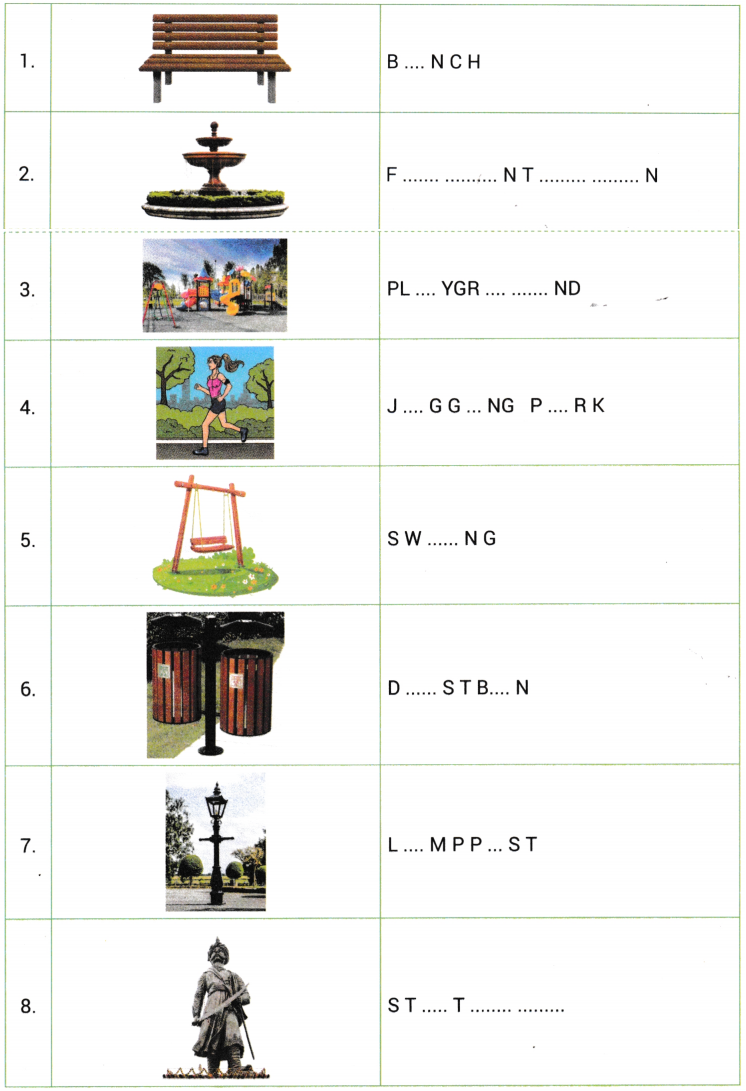
II. Imagine you have a garden. Write in five sentences how you would take care of it to maintain its overall well-being.
1. ________________________________
2. ________________________________
3. ________________________________
4. ________________________________
5. ________________________________
III. What does the title of the poem “A Concrete Example” reflect? Which two meanings does the ^ word “concrete” in the title of the poem convey?
______________________________________________________
______________________________________________________
______________________________________________________
______________________________________________________
Let us Discuss
I. Complete the summary of the poem with exact words and phrases from the poem.
The poem is about (i)”___________,” who has (ii)”___________” Her garden includes
(iii) ___________” and (iv) ___________” She (v) “___________.” that are (vi) ___________” The speaker wonders how (vii) ___________” One day, Mrs. Jones (viii) ” ___________.” They talked about (ix) ” ___________.” When the speaker asked, (x)” ___________?” she replied, (xi)”___________”
II. Select the correct option.
1. What is the structure of the poem?
(a) Free verse with no rhyme
(b) Rhyming couplets with regular rhythm
(c) Limerick format
(d) Prose poem
2. What is a central theme of the poem?
(a) The beauty of wild forests
(b) The importance of large gardens
(c) Attention to small and simple things
(d) Urban pollution
3. Which poetic device is used in the line “unless she plants them with a pin”?
(a) Simile
(b) Hyperbole
(c) Metaphor
(d) Alliteration
4. How would you describe the tone of the poem?
(a) Angry and serious
(b) Curious and light-hearted
(c) Sad and gloomy
(d) Formal and academic
5. What message does the poem convey?
(a) Always build big gardens.
(b) Don’t talk to neighbours for too long,
(c) Appreciate the small beauties in life.
(d) Stones are better than flowers.

III. Complete the following sentences by choosing the words given in the box.
real-life experiences, strong, solid, building material (cement), clear, real, concrete, abstract thoughts
The title “A Concrete Example” suggests that the poem is about showing something
(i) ___________ and specific rather than just talking in general ideas. The word “concrete” has a double meaning here. Literally, it refers to the (ii) ___________„and figuratively, it means something (iii) ___________ and easy to understand.
If the poem talks about a structure, city life, or a building-then the title might point to the physical presence of (iv) ___________ in our everyday lives. On the other hand, if the poem is trying to teach a life lesson or moral through a real-life situation, then it becomes a “concrete example” of that idea.
Overall, the title prepares the reader to expect a strong, clear image or situation that will make the poet’s messaqe more meaningful and relatable. It reflects the poet’s effort to move from (v) ___________ to (vi) ___________
IV. Pick one example of alliteration from the poem.
___________ ___________
V. A pun is a figure of speech that uses words with multiple meanings or words that sound alike but have different meanings, creating a humorous effect.
Example:
The word “concrete” has a double meaning:
- Literal: It refers to the garden’s hard stone and cement elements.
- Figurative: It means a real, clear example of something.
Find out the pun in the following lines from the poem:
1. “She plants them with a pin” : ___________
2. “You’re standing on it” : ___________
VI. A refrain is a repeated line or phrase that appears in each stanza. Identify the refrain from the poem.
Example:
“My next-door neighbour, Mrs. Jones,”
How many times has this phrase been repeated in the poem?
______________________________________________________
______________________________________________________
VII. Situational irony occurs when there is a contrast between what is expected and what actually happens.
Example:
“You’re standing on it,” she replied.
Find out more such irony used in the poem.
______________________________________________________
______________________________________________________
Think beyond
I. Read the following stanzas from the poem and answer the questions that follow.
1. My next-door neighbour, Mrs. Jones,
puts little plants between the stones
They are so delicate and small,
they don’t mean anything at all.
I can’t think how she gets them in,
unless she plants them with a pin.
Questions:
(i) What is the speaker surprised about?
(a) How big the plants are
(b) How Mrs. Jones waters the plants
(c) How she manages to plant such tiny plants
(d) Why there are no flowers in the garden
(ii) State whether the following statement is True or False.
The speaker believes the plants are large and colourful.
(iii) Why does the speaker say Mrs. Jones might plant them with a pin?
______________________________________________________
(iv) Fill in the blank by selecting the correct option from those given in the brackets.
The plants are described as “so delicate and small” emphasizing their ___________
(benefits and tiny size/fragility and tiny size) especially when compared to all the stones around them.
2. My next-door neighbour, Mrs. Jones,
once asked me round to see her stones.
We stood and talked about a flower
for quite a quarter of an hour.
“Where is this lovely thing?” I cried.
“You’re standing on it,” she replied.
Questions:
(i) How long did the speaker and Mrs. Jones talk about the flower?
(a) For five minutes
(b) For half an hour
(c) For quite a quarter of an hour
(d) For the whole afternoon
(ii) State whether the following statement is True or False.
The speaker could easily see the flower Mrs. Jones was talking about.
(iii) What was Mrs. Jones’s surprising reply when the speaker asked about the flower?
______________________________________________________
(iv) Fill in the blank by selecting the correct option from those given in the brackets.
The speaker couldn’t find the flower and expressed his ___________ (confusion/confidence)
II. Answer the following questions.
Question 1.
Describe Mrs. Jones’s garden as portrayed in the poem. What does it reveal about her personality and interests?
______________________________________________________
Question 2.
What is the speaker’s attitude towards Mrs. Jones and her garden? Support your answer with references from the poem.
______________________________________________________
Question 3.
Flow does the poet use humour and exaggeration to describe the plants and the neighbour’s gardening style?
______________________________________________________
Question 4.
What message or theme do you think the poem conveys about beauty and appreciation? Explain in your own words.
______________________________________________________
Question 5.
Explain how the poem’s title, “A Concrete Example,” is meaningful in both a literal and a figurative sense.
______________________________________________________
Let us Learn
I. Answer the following questions.
1. Which word correctly replaces the word ‘crazy’ in the poem?
(a) mad
(b) insane
(c) even
(d) uneven
2. Write a word that correctly replaces the underlines word in the following line.
We stood and talked about a flower for quite a quarter of an hour.
3. Replace the word “small” in the poem with a suitable synonym:
______________________________________________________
4. Find a synonym for “talked” as used in the line “We stood and talked about a flower.”
(a) Shouted
(b) Whispered
(c) Spoke
(d) Argued
5. Which word from the list below is a synonym for “lovely” in the line “Where is this lovely thing?”
(a) Ugly
(b) Beautiful
(c) Large
(d) Dry
II. The word ‘device’ is used in the poem for the ‘sundial’. A device can be an implement, a tool, a gadget, an appliance or an equipment. Look at the pictures and write what type of devices they are. Give one more example for each instrument shown in the pictures.’

III. Complete the table by making new words in Column 1 using the hints given in Column 2. Replace the first letter to form a valid word.
1. Starting word – bark
| Column 1 (New Word) | Column 2 (Clue) |
| (i) dark | (a) opposite of light |
| (ii) ____________ | (b) a type of small singing bird |
| (iii) ____________ | (c) a symbol or score given on a paper |
| (iv) ____________ | (d) a place to play or walk |
2. Starting word – root
| Column 1 (New Word) | Column 2 (Clue) |
| (i) ____________ | (a) opposite of light |
| (ii) ____________ | (b) a type of small singing bird |
| (iii) ____________ | (c) a symbol or score given on a paper |
| (iv) ____________ | (d) a place to play or walk |
Let us listen
I. Your teacher/friend/a family member read out a presentation about “The Magical Cactus Garden of Rajasthan”. As you listen, answer the following questions using one to three exact words from the presentation. (Read the Transcript given at the end of this book Pg. No. 151)
Question 1.
Where is the Magical Cactus Garden located?
______________________________________________________
Question 2.
What type of plants does the garden mainly showcase?
______________________________________________________
Question 3.
How is the garden divided?
______________________________________________________
Question 4.
Name one material used in decorating the garden paths.
______________________________________________________
Question 5.
Approximately how many cactus varieties are found in the garden?
______________________________________________________
Let us Speak
1. Informal Apology Situations
Take turns to apologise to a friend or family member using informal language for the following situations and respond to the apology.
(i) You lost your friend’s favourite pen.
- You say; ______________________________________________________
- Your friend replies: ______________________________________________________
(ii) You stepped on your sister’s new shoes by mistake.
- You say; ______________________________________________________
- Your sister replies; ______________________________________________________
(iii) You forgot your cousin’s birthday.
- You say; ______________________________________________________
- Your cousin replies: ______________________________________________________
(iv) You accidentally deleted your friend’s game program.
- You say: ______________________________________________________
- Your friend replies: ______________________________________________________
Useful Phrases for Informal Apologies
| Apologising | Responding |
| I’m really sorry… | That’s airight. |
| Sorry, I didn’t mean to… | No big deal. |
| Please forgive me for… | These things happen. |
| I didn’t do it on purpose. | Don’t worry about it. |
2. Formal Apology Situations
Use polite/formal language to apologise in a school setting.
Take turns and apologise and respond for the following situations.
(i) You interrupted your teacher during a presentation.
- You say; ________________________________
- Your teacher replies; ________________________________
(ii) You did not wear your school uniform for an event.
- You say; ________________________________
- Your teacher replies: ________________________________
(iii) You returned a library book late.
- You say; ________________________________
- Your librarian replies; ________________________________
(iv) You forgot to bring the science journal for submission.
- You say: ________________________________
- Your teacher replies: ________________________________
Useful Phrases for Formal Apologies
| Apologising | Responding |
| I sincerely apologise for… | I accept your apology. Please ensure you… |
| I regret not being able to… | I appreciate you taking responsibility. |
| I owe you an apology for… | I understand. Kindly don’t repeat the mistake. |
| I assure you it will not happen again. | Thank you. I hope you’ll be more careful next time. |
Let us Write
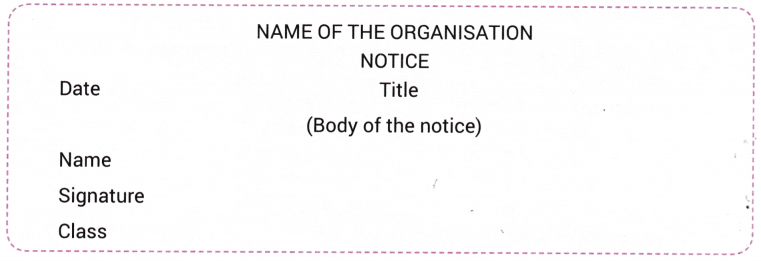
You are a member of the Eco Club of your school. Draft a notice informing students of Grades 6 to 8 about a Poster-Making Competition on “Green Cities, Clean Cities”. Include details such as date, time, venue, theme, rules, and contact person. Follow the given format.
Let us explore
I. Explore a famous garden in your state or region and answer the following questions. Example Topic: Lalbagh Botanical Garden – Bengaluru, Karnataka
1. What is the name of the garden you explored?
2. Where is it located?
3. Mention any two attractions of this garden.
4. What is the garden best known for?
5. What did you enjoy the most about the garden?
II. Make your own mini-herbarium! Follow the steps and answer the questions.
Collect leaves or flowers and preserve them between newspaper sheets for a week.
1. Name one leaf or flower you collected.
2. How did you preserve it?
3. What did you make using the dried plant material?
4. What did this activity teach you?
5. Why is a herbarium useful?
III. Read and enjoy this nature-themed poem. Then, answer the questions that follow. “Whispers in the Trees”
The leaves rustle secrets in the breeze,
The branches sway with gentle ease.
The sunbeams dance on mossy ground,
While silent roots run deep, profound.
1. What is the mood of the poem?
2. What do the “leaves rustle secrets” suggest?
3. What figure of speech is used in “sunbeams dance”?
4. What do “silent roots” symbolise?