Experts have designed these Class 9 Science Notes and Exploration Chapter 11 Reproduction How Life Continues Class 9 Notes for effective learning.
Class 9 Science Chapter 11 Reproduction How Life Continues Notes
Class 9 Science Exploration Chapter 11 Notes
Class 9 Science Chapter 11 Notes – Class 9 Reproduction How Life Continues Notes
→ Abortion: The surgical removal of an unwanted pregnancy, generally carried out within the first trimester.
→ Angiosperms: Flowering plants that use flowers as their reproductive organs.
→ Anther: The part of the stamen that produces pollen grains.
→ Asexual Reproduction: A type of reproduction involving only one parent that produces genetically identical offspring (clones).
→ Budding: A type of asexual reproduction in which a small outgrowth (bud) forms on the parent body, grows, and then separates to live independently. Seen in yeast and Hydra.
→ Cervix: The narrow passage that connects the uterus to the vagina.
→ Chromosomes: Thread-like structures present in the nucleus of a cell that carry genetic information.
→ Clone: An organism produced by asexual reproduction that is genetically identical to its parent.
→ Contraception: Methods used to prevent unwanted pregnancy. Examples: condoms, oral pills, IUDs, and surgical methods.
→ Cross-pollination: Transfer of pollen from the anther of a flower on one plant to the stigma of a flower on another plant of the same species.
→ Cutting: A method of vegetative propagation in which a stem piece with nodes is cut from a plant and planted in soil to grow into a new plant.
→ Diploid: A cell having two complete sets of chromosomes (for example, 46 chromosomes in human body cells).

→ Embryo: The early stage of development of a new individual formed by repeated (mitotic) divisions of the zygote.
→ External Fertilisation: Fertilisation that takes place outside the female body, usually in water. Seen in frogs and most fish.
→ Fertilisation: The fusion of the male gamete with the female gamete to form a zygote.
→ Foetus: The developing human from about the ninth week of pregnancy until birth.
→ Gametes: Reproductive cells (sex cells) fonned by meiosis. Male gamete is the sperm; female gamete is the egg.
→ Gametogenesis: The process of formation of gametes (sperms and eggs) in the reproductive organs by meiosis.
→ Grafting: A method in which a stem piece (scion) from one plant is joined to the rooted stem (stock) of another plant so that the two grow together.
→ Haploid: A cell having only one set of chromosomes (for example, 23 chromosomes in a human sperm or egg).
→ Implantation: The process by which the developing embryo attaches to the inner lining of the uterus, marking the start of pregnancy.
→ Internal Fertilisation: Fertilisation that takes place inside the female body. Seen in reptiles, birds, and mammals.
→ Intra-Uterine Device (IUD): A contraceptive device, such as Copper-T, placed in the uterus to prevent pregnancy.
→ In-Vitro Fertilisation (IVF): A medical technique in which an egg and a sperm are combined outside the female body in a laboratory dish; the fertilised egg is then implanted in the uterus.
→ Layering: A method in which a flexible branch is bent and its middle part is buried in soil until roots develop; the branch is then separated from the parent plant.
→ Meiosis: A special type of cell division that reduces the chromosome number to half and from a cell, four haploid cells called gametes are formed.
→ Menopause: The time of life, around age 50 in women, when the menstrual cycle stops permanently.
→ Menstruation: The shedding of the thickened uterine lining along with some blood through the vagina when the egg is not fertilised. It is also called a period.
→ Mitosis: A type of cell division in which one parent cell divides to form two daughter cells, each having the same number of chromosomes as the parent.
→ Ovaries: A pair of organs in the female reproductive system that produce eggs and female hormones.
→ Ovary: The swollen base of the pistil that contains ovules; it develops into the fruit after fertilisation.
→ Oviduct (Fallopian Tube): The tube that connects each ovary to the uterus; it is the usual site of fertilisation.
→ Ovulation: The release of a mature egg from an ovary, usually once in every menstrual cycle.
→ Ovule: A structure inside the ovary that contains the egg cell; it develops into a seed after fertilisation.
→ Petal: The coloured part of a flower that attracts pollinators.
→ Pistil: The female reproductive part of a flower, consisting of the stigma, style, and ovary.
→ Pollen Grain: A tiny grain produced in the anther that contains the male gamete of a flowering plant.
→ Pollen Tube: A thin tube that grows out of a pollen grain after it lands on a compatible stigma; it carries the male gamete to the ovule.
→ Pollination: The transfer of pollen grains from the anther to the stigma of a flower.
→ Pollinators: External agents such as wind, water, insects, and birds that help in the transfer of pollen grains.
→ Puberty: The stage of life during which the reproductive organs mature and begin producing gametes.
→ Reproduction: A biological process by which living organisms produce new individuals of the same species.
→ Scrotum: A pouch of skin that holds the testes outside the body and keeps them slightly cooler than normal body temperature.
→ Self-pollination: Transfer of pollen from the anther to the stigma of the same flower or another flower on the same plant.
→ Sepal: The outermost green whorl of a flower that protects the flower bud.
→ Sexual Reproduction: A type of reproduction involving two parents, where offspring inherits genetic characteristics from both parents.
→ Sexually Transmitted Infections (STls): Infections that spread from one person to another through sexual contact.
Examples: gonorrhoea, syphilis, herpes, HIV/AIDS.
→ Spore Formation: A type of asexual reproduction in which organisms like fungi produce large numbers of tiny spores inside a sac-like structure; each spore can germinate into a new individual.
→ Stamen: The male reproductive part of a flower, made up of a filament and an anther.
→ Stigma: The top part of the pistil that receives pollen grains; often flat or sticky.
→ Style: The thin tube of the pistil that connects the stigma to the ovary.
→ Testes: A pair of oval organs in the male reproductive system that produce sperms and male hormones.
→ Tissue Culture: A technique in which plant cells (usually from the shoot tip) are grown on artificial nutrient media to produce many healthy, genetically identical plantlets.
→ Trimester: A period of about three months. Human pregnancy is divided into three trimesters.
→ Uterus: A bag-like muscular organ in the female body in which the foetus develops during pregnancy.
→ Vas Deferens: A long tube that carries sperms from the testes towards the urethra.
→ Vegetative Propagation: A form of asexual reproduction in plants where new plants grow from the vegetative parts like roots, stems, or leaves.
→ Zygote: The first cell of a new individual, formed by the fusion of a male gamete and a female gamete.
Introduction
- Reproduction is the biological process by which living beings produce new individuals of the same species. It ensures the continuity of life on the Earth and the transfer of genetic information from one generation to the next.
- Living beings reproduce in two main ways: asexually (a single parent produces offspring that are almost exact copies of the parent) and sexually (offspring inherit a mix of characteristics from two parents).
- This mixing of characteristics may lead to small differences between parents and their young ones.
- Such differences when accumulated over many generations help living beings adapt to changing environments. Sometimes this gives rise to new kinds of species.
Asexual Reproduction
Asexual reproduction is seen in many unicellular organisms (bacteria, Amoeba, yeast) and in simple multicellular organisms (Hydra, sponge). It involves only one parent and produces genetically identical individuals.
→ How is vegetative propagation in plants helpful in agriculture?
Vegetative propagation is the asexual reproduction in plants in which new plants grow from the vegetative parts (stems, roots, or leaves).
Examples: potato and ginger (underground stems), sugarcane (stem cuttings), money plant, and Bryophyllum (leaves).
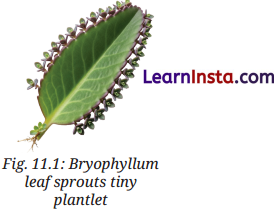
Since asexual reproduction involves only one parent, it produces genetically identical individuals to the parent and are called clone. This method of reproduction is very fast and helps organisms to increase their population quickly.
The main agricultural methods of vegetative propagation are cutting, grafting, layering, and tissue culture. These methods are widely used because they take less time, produce identical plants, and retain desirable traits of the parent, it has significantly improved agricultural and horticultural practices on a large scale.

Under Indian Council of Agricultural Research (ICAR) many Krishi Vigyan Kendras help farmers to gain vocational skills in modern grafting.
Propagation of plants by the tissue culture technique has revolutionised farming practices like in banana farming.
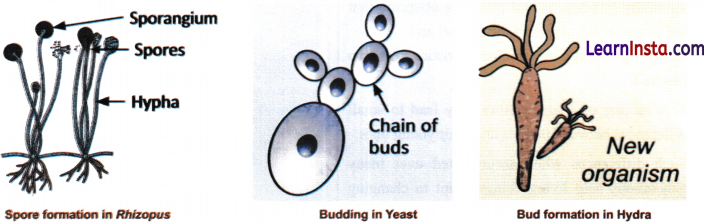
Budding is seen in yeast and Hydra. A small outgrowth (bud) forms on the parent body, grows, and separates to live independently.
Spore formation is seen in fungi like Rhizopus and Aspergillus. Millions of lightweight spores are produced inside a sac-like structure or on a swollen vesicle. They are present in the air and germinate on finding moisture and nutrients on suitable substratum.
Moulds on bread may look unpleasant but fungi benefit society greatly. Fungi grow very fast by spore formation and degrade organic wastes and pollutants. Fungi also play an important role in removal of heavy metals from industrial wastes. Many antibiotics are derived from fungi (penicillin and amoxicillin).
Main process behind asexual reproduction is mitosis, a cell division that produces two daughter cells with the same chromosome number as the parent.
Louis Pasteur’s experiments proved that new life always comes from pre-existing life. His work led to the germ theory of disease, strengthened the cell theory, and introduced food sterilisation.
Sexual Reproduction
Sexual reproduction involves two parents. Both parents contribute genetic material, leading to variations in offspring.
→ How does meiosis help create variations in sexual reproduction?
- Meiosis is a special cell division that reduces the chromosome number from diploid to haploid, producing gametes (sperms and eggs).
- Humans have 23 pairs of chromosomes (46 total). Each gamete has 23 chromosomes, so the zygote formed after fertilisation has 46 chromosomes.
- The haploid cells are used only for reproduction and are called gametes.
- In living organisms, male gametes are called sperms and female gametes are called eggs.
- In plants pollen grains contain male gametes and deliver them to an ovule which contains the female gametes.
- Random mixing of chromosomes during meiosis creates many possible combinations. This makes offsprings genetically different from their parents and also from their siblings. This variation is important for the survival and evolution of a species.
→ Sexual reproduction in flowering plants
- Flowering plants are called angiosperms. The flower is the reproductive organ.
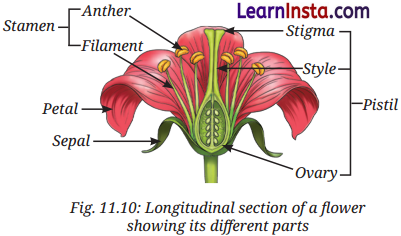
- A complete flower has four whorls: sepals (green outer covering that protects the bud), petals (coloured, attract pollinators), stamen (male: filament and anther), and pistil (female: stigma, style, ovary).
→ How does the process of pollination occur in flowers?
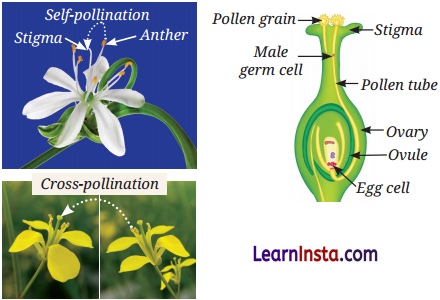
Pollination is the transfer of pollen grains from the anther to the stigma. It is of two types: self-pollination (same plant) and cross-pollination (different plant of the same species).
→ Pollination strategies and reproductive success:
- Pollinators include wind, water, insects (bees, butterflies), and birds (sunbirds, Indian white-eye).
- When the transfer of pollen occurs to the stigma of the same flower or another flower in the same plant, it is called self-pollination.
- When the pollen is transferred from the anther of a flower of one plant to the stigma of a flower of another plant of the same type, it is called cross-pollination.
→ Fertilisation and seed formation:
- After pollination, the pollen grain makes a pollen tube that grows through the style to the ovule. The male gamete formed in the pollen tube fuses with the egg cell present in the ovule to form a zygote. This is fertilisation.
- After fertilisation, the ovary develops into the fruit, and the ovule develops into the seed. Seeds are dispersed by wind, water, and animals.
When conditions like water, air and temperature are favourable, the seed germinates and grows into a new plant. - Sexual reproduction not only produces new plants but also creates variation, helping plant species survive and adapt to their environment.
- “Father of Indian Embryology”, P. Maheshwari was one of the first leading scientists in the field of embryology. He developed the technique of in-vitro fertilisation in flowering plants.
- Sexual reproduction in plants has an applied importance in plant breeding. There are several methods of plant breeding, such as selective breeding, artificial hybridisation, genetically engineered crops, and more. This has revolutionised crop production in agriculture.
Sexual Reproduction in Animals
- In aquatic animals like frogs and most fish, fertilisation is external (outside the body). A large number of eggs are laid in water, but survival is low.
- In reptiles, birds, and mammals, fertilisation is internal (inside the female body). Fewer eggs are produced, but survival is higher because the embryo is well protected.
Variations in Reproduction in Animals
- Fish, amphibians, and insects produce many eggs with a small amount of yolk. A larva hatches early and grows by feeding on organic matter. Examples: butterfly, frog.
- Reptiles and birds lay fewer eggs, each rich in yolk to nourish the embryo until it hatches.
- In mammals, the zygote grows inside the mother’s body and the young ones are fed with breast milk after birth.
Reproduction in Human Beings
→ Reproductive maturity: Human reproductive system consists of special organs.
→ What are the parts of the male reproductive system?
- Male reproductive system: Testes (produce sperm and male hormones), scrotum (holds the testes and keeps them slightly cooler), vas deferens, seminal vesicles, prostate gland, urethra, and penis.
- Glands like seminal vesicle and the prostate add fluid to nourish the sperm and help them remain active and move.
- Each sperm has a head containing genetic material and a long tail that helps it swim towards the egg.
→ What are the parts of the female reproductive system?
- Female reproductive system: Ovaries (produce eggs and female hormones), oviducts (fallopian tubes), uterus, cervix, and vagina.
- The uterus is a bag-like structure where a foetus develops.
→ How are reproductive cells made?
- Gametogenesis is the formation of gametes by meiosis. In males, millions of tiny motile sperms are formed. In females, a single large non-motile egg is formed in each cycle.
- In sexual reproduction, male and female gametes differ greatly in size, number and structure.
→ What happens when a sperm meets an egg?
- Ovulation is the release of a mature egg from an ovary, usually once a month.
- If a sperm meets the egg in the oviduct, fertilisation occurs and a zygote is formed. The zygote implants into the uterine wall, beginning pregnancy.
→ What happens when an egg is not fertilised?
- If the egg is not fertilised, the thickened uterine lining is shed through the vagina. This process is called menstruation or a period.
- Menstruation is a sign of healthy reproductive system. The menstrual cycle typically repeats every 21 to 35 days (often about 28 days) and continues from puberty until menopause (around age 50).
- A woman’s health during pregnancy plays a vital role in the baby’s growth and safety.
→ Pregnancy and childbirth:
- Pregnancy lasts about nine months and is divided into three trimesters. The developing embryo is called a foetus from about the ninth week. The uterus protects and nourishes the baby throughout this time. During childbirth, strong contractions of the muscles of the uterus help push the foetus out through the birth canal.
- After birth, a baby needs special care. Breastfeeding is essential because a mother’s milk provides complete nutrition and protects the infant from many diseases. Newborns must be kept warm, vaccinated on time and handled gently.
- Community health workers are women trained to promote hygiene, immunisation, and family planning under the National Health Mission, especially in rural areas (Accredited Social Health Activist (ASHA) workers). They offer advice on maternal care, safe deliveries and contraceptive methods.
- The father determines the sex of the baby. Females have XX chromosomes and males have XY.
- Prenatal sex determination is strictly prohibited by law in India.
→ Mother’s health during pregnancy:
Mother’s health during pregnancy is vital for the baby’s growth and safety. She should eat a balanced diet with proteins, vitamins, and minerals, go for regular medical check-ups, follow her doctor’s advice on light exercise and rest, and maintain emotional well-being with family support. This ensures healthy development and reduces risks for both mother and child.
→ What does it mean to be sexually mature?
Humans growing through adolescence become sexually mature, meaning their bodies become capable of reproduction. Sexual maturity (like the production of sperm in boys and menstrual cycles in girls) happens gradually.
→ How can unwanted pregnancies and infections be prevented?
- Contraceptive methods include condoms, oral pills, IUDs (Copper-T), and surgical methods. Abortion is the surgical removal of an unwanted pregnancy, generally only within the first trimester.
- Sexually Transmitted Infections (STIs) include gonorrhoea, syphilis, herpes, genital warts, and HIV/AIDS. Condoms help prevent both STIs and unwanted pregnancy.
- Indian scientists at the Central Drug Research Institute, Lucknow, developed the world’s first non-steroidal and non-hormonal oral contraceptive pill. Taken once weekly, it avoids side effects, and it is provided free through the National Family Planning Programme.
- In-vitro Fertilisation (IVF) is a medical technique in which an egg and a sperm are combined outside the female body, usually in a laboratory dish. The resultant fertilised egg is then implanted in the uterus to begin a possible pregnancy. A baby born through this method is commonly known as a test tube baby, although the process actually occurs in a culture dish, not in a test tube.