Experts have designed these Class 9 Science Notes and Exploration Chapter 10 Sound Waves Characteristics and Applications Class 9 Notes for effective learning.
Class 9 Science Chapter 10 Sound Waves Characteristics and Applications Notes
Class 9 Science Exploration Chapter 10 Notes
Class 9 Science Chapter 10 Notes – Class 9 Sound Waves Characteristics and Applications Notes
→ Amplitude: Maximum displacement of particles from mean position.
→Audible Range: Range of sound humans can hear (20 Hz to 20,000 Hz).
→ Compression: Region of high pressure and density in a wave.
→ Echo: Reflected sound heard after a delay.
→ Echolocation: Technique used by animals (like bats) to locate objects using reflected sound waves.
→ Frequency (υ): Number of vibrations per second (unit: Hertz, Hz).
→ Infrasound: Sound with frequency below 20 Hz.
→ Intensity: Amount of sound energy passing through unit area per second.
→ Longitudinal Wave: Wave in which particles vibrate parallel to direction of wave propagation.

→ Loudness: Sensation related to amplitude (higher amplitude → louder sound).
→ Medium: Substance through which sound travels (solid, liquid, gas).
→ Pitch: Sensation related to frequency (high frequency → high pitch).
→ Rarefaction: Region of low pressure and density.
→ Reflection: Bouncing back of sound from a surface.
→ Reverberation: Persistence of sound due to repeated reflections.
→ Speed of Sound: Distance travelled by sound per unit time.
ν = υ × λ
→ Sound: A form of energy that produces the sensation of hearing.
→ Sound Wave: A longitudinal wave produced by vibrating objects.
→ Time Period (T): Time taken for one complete vibration.
T = \(\frac{1}{v}\)
→ Tuning Fork: Instrument used to produce a sound of fixed frequency.
→ Ultrasound: Sound with frequency above 20,000 Hz.
→ Vibration: Rapid back-and-forth motion of an object.
→ Wavelength (λ): Distance between two consecutive compressions or rarefactions.
Introduction
Sound: It is a form of energy which produces the sensation of hearing in our ears. It travels in the form of longitudinal waves. It is produced due to vibration of different objects.
Production of Sound
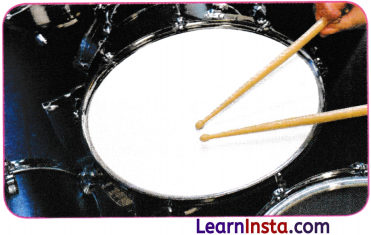
Vibration: One complete back and forth motion of vibrating body about its mean position is called an vibration.
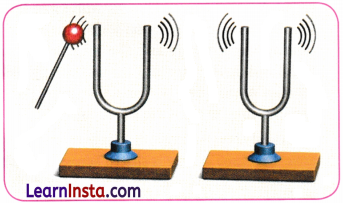
→ Tuning Fork: A tuning fork is a simple U-shaped metal bar with two prongs (or tines) and a stem, usually made of steel or aluminium. When struck on a rubber pad, the prongs vibrate rapidly and produce sound.
Propagation of Sound
Propagation of sound means the movement of sound from one place to another through a medium like air, water, or solids.
→ Sound Needs a Medium to Propagate: Sound needs a medium like air, water, or solids to travel or propagate because vibrations pass from particle to particle. The material through which sound propagates is called the medium. If there is no medium-like in outer space, which is a vacuum- there are no particles to vibrate, so sound cannot travel. That’s why astronauts in space cannot hear each other unless they use radios, because in a vacuum sound waves simply die out without a medium to carry them. In short, without a medium, sound cannot travel.
Sound Waves
A sound wave is a mechanical longitudinal wave produced by vibrating objects. It travels through a medium such as solid, liquid, or gas in the form of compressions and rarefactions.
A compression (C) is a region of high pressure where particles are packed closely together, while a rarefaction (R ) is a region of low pressure where particles are spread apart.
In a sound wave, the particles of the medium vibrate back and forth parallel to the direction of propagation of the wave, which makes it longitudinal in nature. Since sound requires a medium to travel, it cannot propagate in a vacuum. The speed of sound depends on the medium: it is fastest in solids, slower in liquids, and slowest in gases. Thus, sound waves are mechanical longitudinal waves consisting of alternating compressions and rarefactions, carrying energy forward without the actual transport of matter.
Energy of Sound Waves
When sound propagates through air, it carries energy that can make objects vibrate. For example, if grains are placed on a sheet and sound waves reach it, the sheet vibrates and the grains move. This simple demonstration shows that sound is a form of energy.
When the source of sound vibrates, it transfers energy to the surrounding medium. As the sound waves travel, the particles of the medium vibrate back and forth. Their collisions with neighboring particles pass the disturbance forward, creating alternating compressions and rarefactions. In this way, energy is transmitted through the medium without the actual transport of matter.
Graphical Representation of a Sound Wave
Graphical representation of a sound wave is shown as a curve that helps us visualize compressions and rarefactions. Although sound is a longitudinal wave, we often draw it like a transverse wave for clarity. In the graph, the crest (upward curve) represents a compression, which is a region of high pressure where particles are close together, while the trough (downward curve) represents a rarefaction, which is a region of low pressure where particles are spread apart.
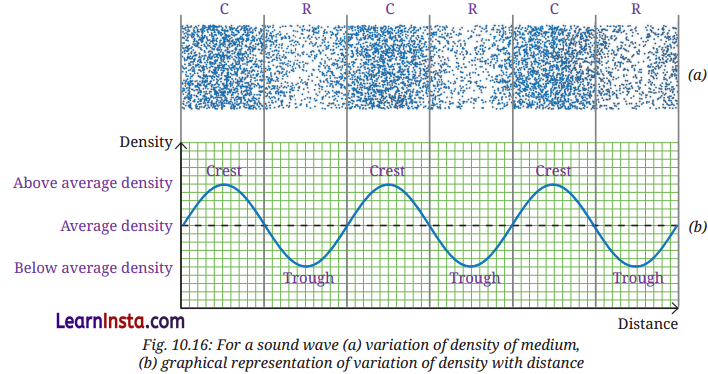
The distance between two successive compressions or two successive rarefactions is called the wavelength. The maximum displacement of the curve from the mean position is the amplitude, which determines the loudness of sound. The number of compressions or rarefactions passing a point per second is the frequency, which determines the pitch of sound. Thus, the graph clearly shows how sound waves consist of alternating compressions and rarefactions, and how their properties like wavelength, amplitude, and frequency affect the characteristics of sound.
Characteristics of a Sound Wave
→ Wavelength, Frequency and Time Period:
The distance between two consecutive crests or two consecutive troughs is called the wavelength (L) of the wave. Its SI unit is the metre (m). Another important characteristic is the frequency (υ), which tells us how often the density variations occur at a given position in the medium when a sound wave passes through. The density of the medium alternates between maximum (compression/crest) and minimum (rarefaction/trough).
One complete change from maximum to minimum and back to maximum is called one oscillation. The number of such density oscillations per unit time is the frequency of the sound wave, measured in hertz (Hz), which is equivalent to per second (s-1).
The time period (T) of a wave is the time taken for one complete density oscillation at a fixed point. Its SI unit is the second (s).
The time period and frequency are inversely related: υ = \(\frac{1}{T}\)
This means that a shorter time period corresponds to a higher frequency, and vice versa.
→ Amplitude and Intensity of the Sound Waves:
Sound travels through a medium as density oscillations in the form of compressions and rarefactions. The amplitude of a sound wave is the maximum change in density of the medium from its average value. A larger change in density means a greater amplitude. The amplitude is directly related to the energy carried by the wave – greater amplitude means more energy and hence a louder sound. When a source vibrates with more force, it transfers more energy to the surrounding particles, causing larger vibrations. The intensity of sound is defined as the amount of sound energy passing through a unit area per unit time in a direction perpendicular to the wave’s motion.
As sound travels outward, it spread over a larger area. The same energy is shared across more space, so intensity drops with distance. Louder sounds (greater amplitude) carry more energy and last longer before fading.
→ Speed of Sound:
The speed of sound is the rate at which sound waves travel through a medium. In terms of compressions and rarefactions, it is the speed at which these density disturbances move. It can also be defined as the distance travelled by a point on the wave (like a crest or trough) in unit time. For a sound wave of a given frequency, the distance between two successive compressions or rarefactions is called the wavelength (λ), and this distance is travelled in one time period (T).
Therefore, the speed of sound is given by υ = \(\frac{\lambda}{T}\)
Since frequency f = \(\frac{1}{T}\) the equation can also be written as v = υλ.
Solved Examples
Example 1.
The frequency of a sound wave is 20 Hz. Find its time period.
Solution:
Given, υ = 20 Hz
Time period, T = \(\frac{1}{υ}\)
= \(\frac{1}{20}\) s = 0.05 s.
Example 2.
If 20 waves are produced per second, what is the frequency in Hz?
Solution:
Here, frequency = \(\frac{\text { No. of waves produced }}{\text { Time taken }}\)
= \(\frac{20}{1 s}\) = 20 Hz.
Example 3.
What is the frequency of a sound wave whose time-period is 0.05 s?
Solution:
We have T = 0.05 s
∴ Frequency, υ = \(\frac{1}{T}\)
= \(\frac{1}{0.05}\)
= \(\frac{100}{5}\) = 20 Hz.
Human Perception of Sound
Human perception of sound is subjective and is described using terms like loudness and pitch, even though the physical properties of sound—such as frequency, wavelength, amplitude and speed—can be measured.
Pitch refers to how humans perceive the frequency of a sound. Sounds that are sharp or shrill, like a whistle or siren, have a high pitch, while deep sounds like thunder or an aircraft have a low pitch.
Generally, higher frequency corresponds to higher pitch and lower frequency corresponds to lower pitch, although the exact relationship is not strictly simple.
Sound waves with frequencies below 20 Hz are called infrasonic waves, and those above 20 kHz are called ultrasonic waves. Humans cannot hear these sounds, but some animals can—dogs, cats, bats, and dolphins can detect ultrasound, while elephants can detect infrasound.
Loudness is how humans perceive the amplitude of a sound wave. A sound with larger amplitude is heard as louder, while a smaller amplitude produces a softer sound. Loudness also decreases as the distance from the source increases.
In everyday use, loudness and intensity are often considered the same, but they are different. Intensity is a measurable physical quantity, whereas loudness is subjective and depends on the sensitivity of the listener’s ear.
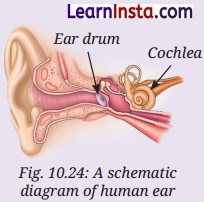
Sound makes the eardrum vibrate, tiny bones amplify it, and the cochlea turns it into signals for the brain.
Eardrum → bones → cochlea → brain
Reflection of Sound
Sound waves can bounce off surfaces like solids or liquids, and this phenomenon is called reflection of sound. Sound follows the same laws of reflection as light: the angle at which the sound wave strikes a surface (angle of incidence) is equal to the angle at which it reflects (angle of reflection), and both these directions along with the normal lie in the same plane. A common example of reflection of sound is an echo, where the sound is heard again after bouncing off a distant surface.
→ Echo:
When we shout near a mountain, cliff, or in a long corridor, we may hear our own voice again after some time. This is called an echo. It occurs when sound reflects from a hard surface and returns to the listener.
Echoes are not heard everywhere. In small rooms, reflected sound reaches the ear so quickly that it merges with the original sound and cannot be distinguished. To hear a clear echo, the time gap between the original sound and the reflected sound must be at least 0.1 s. If it is less than this, the two sounds are heard together.
Echoes are stronger from hard, smooth surfaces because they reflect sound well. Soft surfaces absorb sound, while rough surfaces scatter it, making echoes weak or unclear.
→ Reverberation:
Sometimes, sound produced in a large hall or auditorium undergoes multiple reflections from the walls, ceiling, and floor. Because of these repeated reflections, the sound continues to be heard even after the source has stopped producing it. This effect is called reverberation.
Reverberation occurs when the reflected sound waves reach the listener with very small time gaps, less than 0.05 s, so they overlap with the original sound and do not sound like separate echoes.
Ultrasonic and Infrasonic Waves, and their Applications
Sound waves whose frequencies are outside the human audible range are called infrasonic and ultrasonic waves. These waves have important applications in science, medicine, and technology. Infrasonic waves have frequencies below 20 Hz and are used in studying natural phenomena like earthquakes and volcanic eruptions, as these events produce low-frequency vibrations. Some animals like elephants also use infrasound for communication over long distances.
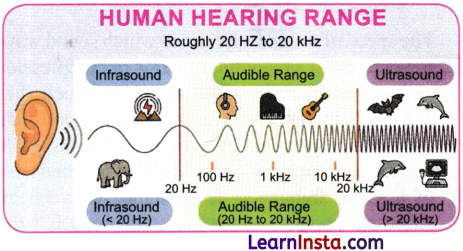
Ultrasonic waves have frequencies above 20 kHz and are widely used in medical imaging (such as ultrasound scanning), cleaning delicate instruments, and detecting cracks in metal objects. Animals like bats and dolphins use ultrasound for navigation and locating prey.
→ Echolocation: Echolocation is the ability of some animals to locate objects using reflected sound waves. Bats, which are nocturnal, emit short bursts of ultrasonic sounds. These sound waves reflect from nearby objects and return as echoes. By analyzing these echoes, bats can determine the position, distance, size, and even movement of obstacles or prey, allowing them to fly and hunt in complete darkness without colliding.
Apart from bats, animals like dolphins, whales, and some birds also use echolocation for navigation, communication, and hunting in their environment.
Humans use the same principle of echolocation in underwater exploration through SONAR (Sound Navigation and Ranging). In SONAR, ultrasonic waves are transmitted into water, and the waves reflected back from underwater objects are detected and analysed. By studying these reflected waves, we can determine the distance, direction, and speed of objects such as submarines, underwater rocks, or shipwrecks.