Teachers guide students to use Exploring Society India and Beyond Class 8 Solutions and Class 8 Social Science SST Chapter 5 Universal Franchise and India’s Electoral System Question Answer NCERT Solutions for quick learning.
Class 8 Social Science Chapter 5 Question Answer The Colonial Era in India
NCERT Class 8 Social Science Chapter 5 Universal Franchise and India’s Electoral System Questions and Answers Solutions
Universal Franchise and India’s Electoral System Class 8 Question Answer (In-Text)
The Big Questions?
Question 1.
What is universal adult franchise?
Answer:
Universal adult franchise means that every adult citizen of a country has the right to vote, regardless of their caste, religion, gender, education, or income. In India, this right is given to every citizen who is 18 years or older, as mentioned in Article 326 of the Indian Constitution.
After India became independent in 1947, the makers of our Constitution decided that all adults should have an equal say in choosing their leaders. That is why, from the very beginning, India adopted universal adult franchise as a core value of its democracy.
This was a bold and historic decision because at that time, many other countries had not given voting rights to all their citizens. For example, women in Switzerland got the right to vote only in 1971, but Indian women were allowed to vote right from 1950.

Question 2.
What is an electoral system?
Answer:
An electoral system is the way in which elections are organised and votes are counted to choose representatives. It includes the rules and steps followed during elections in a democracy. In India, elections are conducted at different levels — Lok Sabha, State Legislative Assemblies, and local bodies — all based on the principle of universal adult franchise. The Election Commission of India (ECI) manages this system. It takes care of tasks such as:
- Setting election dates
- Registering political parties
- Preparing voter lists
- Monitoring the polling process
- Using EVMs and VVPATs for voting and verification
India uses the first-past-the-post system, where the candidate who gets the highest number of votes in a constituency is declared the winner. The electoral system also includes direct elections (such as for MPs and MLAs) and indirect elections (such as for the Rajya Sabha and the President), depending on the type of representative being elected. So, the electoral system is the complete process that allows citizens to choose their leaders in a democratic and organised manner.
Question 3.
How does India’s electoral system work?
Answer:
India’s electoral system works through a well- organised and detailed process that allows citizens to elect their representatives at different levels of government – national, state, and local. The Election Commission of India (ECI) is the independent constitutional body that conducts elections in a free and fair manner. It manages elections to the Lok Sabha, Rajya Sabha, State Legislative Assemblies, and the offices of the President and Vice President of India.
Here’s how the system works:
- Voter Registration: Every adult citizen (18 years and above) must be registered in the voter list to cast their vote.
- Polling Process: On election day, voters go to polling booths, where officials verify their identity and mark their finger with ink. They then cast their vote using an Electronic Voting Machine (EVM).
- VVPAT: A Voter Verifiable Paper Audit Trail system allows voters to confirm their vote through a printed slip.
- Counting and Results: Votes are counted, and the candidate who gets the highest number of votes in a constituency is declared the winner. This is known as the first-past-the-post system.
There are direct elections for MPs and MLAs, and indirect elections for the Rajya Sabha, President, and Vice President. In indirect elections, elected representatives vote on behalf of the people.
The system also includes special measures like reserved constituencies for Scheduled Castes and Scheduled Tribes, and accessibility features such as postal voting and home voting for elderly and disabled voters (introduced in 2024 for the first time).
India’s electoral system is one of the largest in the world, and it works to make sure that every eligible citizen can participate in choosing their leaders.
Let’s Explore
Question 1.
India changed the minimum age for voting from 21 to 18 in 1988. Discuss whether this was a good move. (Page 118)
Answer:
Yes, this was a good decision. Lowering the voting age to 18 allowed young citizens to participate in elections. It helped them express their views and take responsibility in choosing leaders. Since many national issues directly affect the youth, it was right to include them early in the democratic process.
Question 2.
In 1947, India’s literacy rate was about per cent, and only about per cent among women. Some people argued that only literate citizens should be allowed to vote. Discuss in your group why the Constitution makers may have decided on universal franchise from the time of Independence itself. (Page 120)
Answer:
The Constitution makers believed that every adult Indian, regardless of literacy, should have an equal say in a democracy. They had faith in the wisdom of the ordinary people. If voting were limited only to literate people, it would have been unfair and would have excluded most of the population, especially the poor, women, and marginalised groups. Universal franchise was chosen to ensure equality, eliminate discrimination, and give every citizen an equal opportunity to choose their leaders and shape the country’s future. This decision demonstrated India’s strong commitment to justice and democracy for all, not just a select few.
Question 3.
Discuss in groups – What role do such measures play in a democracy? Do you know of anyone who benefited from these improved accessibility measures? How might they increase voter participation in your neighbourhood? How can technology assist? (Page 121)
Answer:
Do it yourself.
Question 4.
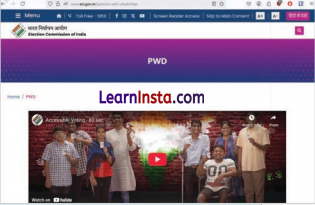
If you have access to the internet, visit the
ECI website (https://www.eci.gov.in/persons- with-disabilities). Read and identify the various interventions that the ECI has taken to facilitate voting by people with disabilities. (Page 121)
Answer:
The Election Commission of India has taken many steps to support persons with disabilities so that they can vote easily and with dignity. Some of the essential measures include:
- Home voting for elderly and disabled voters (started in 2024)
- Braille-enabled voter slips and EVMs for visually impaired voters
- Wheelchair facilities and ramps at polling stations
- Volunteers at polling booths to help persons with special needs
- Mobile apps to request support or find voter- related information
- Accessible transport to help voters reach polling stations
These efforts demonstrate that the ECI wants to ensure every voter is included, no matter what challenges they face. It helps make our democracy truly accessible and fair.
Question 5.
About 34 per cent of eligible voters did not exercise their right to vote in the 2024 elections. Why do you think this is so? What are some challenges people face in exercising their rights? Design and conduct a short survey among adults in your family and neighbourhood to answer these questions. Analyse the data and write a report with suggestions on how it may be possible to ensure everyone votes. (Page 123)
Answer:
In the 2024 general elections, even though voting is a right, about 34% of eligible voters did not vote. This could be due to several reasons like:
- Lack of interest or awareness
- Long queues at polling booths
- People being out of town on voting day
- Health issues, especially for the elderly
- Belief that their vote won’t make a difference Report Writing
Title: Why Some People Do Not Vote: A Survey Report
Introduction:
In the 2024 general elections, about 34% of eligible voters did not cast their votes. To understand why many people skip voting, I conducted a short survey among adults in my family and neighbourhood. This report presents the findings and suggests ways to improve voter participation.
Survey Method:
I spoke to 5 adults – including family members and neighbours – and asked them whether they voted in the 2024 elections and, if not, why.
Findings:
- 2 people said they were travelling and could not return in time to vote.
- 1 person had health issues and found it difficult to reach the polling booth.
- 1 person said they didn’t like any of the candidates and chose not to vote.
- 1 person voted and said that voting is both a right and a responsibility.
Analysis:
The responses show that people often skip voting due to:
- Lack of time or being away from home
- Poor health or physical limitations
- Feeling disconnected from the political choices
- Lack of awareness about the value of voting Suggestions:
To improve voter turnout, the following steps can be helpful:
- Better awareness campaigns about the importance of voting
- Expanding home voting and postal ballot options
- Making polling stations more accessible for senior citizens and persons with disabilities
- Encouraging people to learn about candidates before election day
Conclusion:
Voting is an important part of democracy. This report shows that many people want to vote but face challenges. With better facilities and awareness, more citizens will participate, making democracy stronger and more inclusive.
Question 6.
Read the below caselet and answer the following questions: Election for class representative-Grade 8, Suryodava School
It was time for the annual election of the Class Representative (Class Rep). The Class Rep would represent the class in meetings with teachers, organise events, and act as a bridge between the students and school authorities. Three students – Ahmed, Gurmat, and Ravi decided to contest for the position. The class teacher Ms. Usha, was appointed as the Election Officer to ensure the election process was fair, transparent, and followed all the necessary rules.
Here’s a brief introduction of each of the candidates: Ahmed promised to improve the cleanliness of the classrooms and the playground. Gurmat was interested in helping all her classmates learn better. She proposed creating a system of peer coaching and mutual support. Ravi wanted to make more space in their class timetable for the arts curriculum – music, theatre, and visual art – in line with the new curriculum.
Campaigning:
Ahmed put up posters, Gurmat used the noticeboard and spoke to classmates, while Ravi held a lunchtime music performance to promote his idea. As the Election Officer, Ms. Usha had to organise the elections and ensure it was conducted fairly. She explained the rules to the class, ensuring everyone understood how the secret ballot voting process would work; no one would know who voted for whom, ensuring the process was private and fair. She set up the voting booths in the corner of the classroom.
Voting day:
On election day, each student was given a ballot paper with the names of the three candidates. The students were asked to mark an ‘X’ next to the name of the candidate they wished to vote for. Ms. Usha also ensured that there was a ballot paper in braille for N eha. After all the students voted, Ms. Usha collected the ballots in a box and sealed it until the counting session. The results:
After all the 33 votes were cast, Ms. Usha called Ms Sheeba from the next class to witness the counting process. One of the ballot papers was not marked, so it was declared invalid. The results were announced: Ahmed received 8 votes, Gurmat 12 and Ravi 10. Gurmat, with the most votes, was declared the new Class Representative. She thanked her classmates and promised to fulfil her commitments. Ahmed and Ravi congratulated her and offered to support her.
(i) What are the most important aspects of the election process in this caselet?
Answer:
The class election caselet shows several key features of a fair democratic process. The election was organised properly with clear rules, equal campaigning opportunities, and the use of a secret ballot, which made the process trustworthy and unbiased.
(ii) Why was it important to have a secret ballot?
Answer:
The secret ballot was important because it allowed students to vote without pressure. Their choice remained private, which helped them vote freely and honestly. This protected the fairness of the election.
(iii) What considerations might the students have had while exercising their choice?
Answer:
While voting, students likely thought about the promises made by the candidates. They considered who could help the class the most, who was responsible, and whose ideas matched the needs of everyone.
(iv) Do you think the students have any responsibility after Gurmat was elected? If yes, what are they?
Answer:
After Gurmat was elected, students also had a role to play. They needed to cooperate with her, share their views, and help her succeed in her responsibilities. In a democracy, being a good citizen means participating both before and after elections.
(v) What was the role that Ms. Usha played? Why was it important?
Answer:
Ms. Usha, the teacher, acted as the Election Officer. She explained the rules, arranged the voting booth, conducted the counting, and even invited another teacher to witness it. Her role was important to make sure the election was conducted fairly and openly.
(vi) Why was it important for Ms. Usha to organise a braille ballot paper for Neha?
Answer:
Providing a braille ballot for Neha, a visually impaired student, was a sign of true inclusion. It allowed her to vote on her own, just like the others. This showed respect for every student and ensured that no one was left out of the democratic process.
(vii) What would happen if many students chose not to mark a preference?
Answer:
If many students had chosen not to vote or left their ballots blank, the result would not have reflected the class’s true opinion. Low participation weakens democracy, so it is important that everyone uses their right to vote and makes a clear choice.
Question 7.
Identity teachers in your school or vicinity who may have performed election duty. Invite them to your class to share their experiences. (Page 128)
Answer:
Do it yourself.
Question 8.
Look at the picture and answer the question that follow: Here are a few types of complaints that the ECI handles. (Page 131)
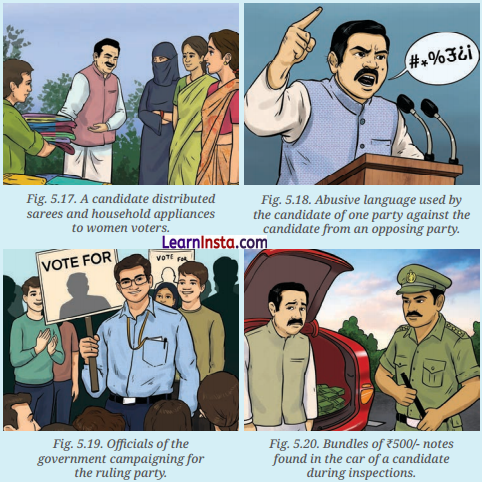
Why do you think these might be violation of the code of conduct?
Answer:
Fig. 1: A candidate distributed sarees and household appliances to women voters: This is a violation because ‘it amounts to bribing voters. Giving gifts to influence people’s votes is not allowed during elections. It goes against the principle of free and fair choice.
Fig.2 : Abusive language used by the candidate of one party against the candidate from an opposing party: Using abusive or insulting language spreads hatred and spoils the peaceful environment of elections. Candidates must behave respectfully and focus on their ideas, not personal attacks.
Fig. 3 : Officials of the government campaigning for the ruling party: Government officers must remain neutral during elections. If they support any political party while in service, it gives an unfair advantage to that party and misuses public resources.
Fig. 4: Bundles of ?500 notes found in the car of a candidate during inspections: Carrying large amounts of cash during elections raises serious doubts about trying to buy votes or bribe voters. This is illegal and reduces public trust in the election process.
Question 9.
When is the next election in the region where you are located? Is it to the state, urban local body or panchayat? (Page 132)
Answer:
Do it yourself.
Question 10.
Who are the MP and MLA/MLAs of the constituency you are located in? (A Lok Sabha constituency may have two or more assembly constituencies.) (Page 134)
Answer:
Do it yourself.
Question 11.
Which party does each of them belong to? (Page 134)
Answer:
Do it yourself.
Question 12.
What are the concerns of the MP and MLA, respectively? (Page 134)
Answer:
Do it yourself.
Think About It
Question 1.
Why do you think the above group of people is not involved in electing the President of India? Why are the common people not involved in the election of the President? (Page 1,36)
Answer:
The common people do not directly elect the President of India because the election of the President is an indirect election. The Constitution of India has given this responsibility to an Electoral College, which is made up of the elected Members of Parliament (MPs) and the elected Members of the Legislative Assemblies (MLAs) of all states and Union Territories.
This method ensures that the President, who is the head of the country, is chosen by the people’s representatives, not by a direct vote. It helps to maintain a balance between the central and state governments and reflects a sense of federal unity. Since the President mostly performs ceremonial duties and acts on the advice of the Prime Minister and Council of Ministers, the people’s voice is already represented indirectly through their elected MPs and MLAs.
Class 8 SST Chapter 5 Universal Franchise and India’s Electoral System Question Answer (Exercise)
Question 1.
Why is universal adult franchise important for a healthy democracy?
Answer:
Universal adult franchise means every adult citizen above the age of 18 has the right to vote, regardless of caste, religion, gender, education, or income. The chapter explains that this principle is a cornerstone of Indian democracy and is essential because:
- It allows people to participate in solving problems in their area.
- There is no discrimination, making every vote equal.
- It gives everyone a say in deciding what kind of future they want and who should represent them.
- It bridges social barriers and enables broad participation, which strengthens democracy by making it more inclusive and representative.
Question 2.
What is the meaning of ‘secret ballot’? Why is this important in a democracy?
Answer:
A secret ballot is a voting method in which a voter’s choices remain confidential. No one can know for whom a person has voted. The chapter illustrates this with the example of a class representative election where secret ballots ensured privacy and fairness.
This is important because:
- It reduces the chances of pressure or intimidation.
- Voters feel safe to make their choice without fear.
- It strengthens trust in the fairness of elections.
Question 3.
Give examples of direct and indirect elections.
Answer:
- Direct elections: Citizens directly elect their representatives. For example:
- Lok Sabha elections
- Elections to State Legislative Assemblies
- Panchayats and urban local bodies
- Indirect elections:
- Representatives are chosen by people who were themselves elected by the public. For example:
- Rajya Sabha (Council of States) members are elected by the elected members of State Legislative Assemblies.
- President and Vice-President of India are also elected indirectly.
Question 4.
How is the election of members to the Lok Sabha different from that to the Rajya Sabha?
Answer:
- Lok Sabha: Members are elected directly by the people from parliamentary constituencies across India (direct election).
- Rajya Sabha: Members are elected indirectly by elected members of State Legislative Assemblies using a system of proportional representation.
Question 5.
What in your view are the advantages of the EVM over paper ballots?
Answer:
According to the chapter, the advantages of Electronic Voting Machines (EVMs) include:
- Faster counting of votes and faster results.
- Elimination of invalid or wrongly marked votes.
- Reduced incidents of fraud and manipulation (e.g., ballot stuffing).
- Saves paper, making the process eco-friendlier.
- EVMs are designed with accessibility features (like braille), making voting easier for persons with disabilities.
Question 6.
Voter turnout has been declining in some urban areas of India. What could be the reasons for this trend, and what steps can be taken to encourage more people to vote?
Answer:
Possible reasons:
- Urban voters may feel their votes do not make a difference.
- Busy lifestyles or work commitments on polling days.
- Apathy or lack of trust in political candidates.
- Challenging registration or voting processes. Steps to encourage voting:
- Awareness campaigns highlighting the value of each vote.
- Making voting more accessible (mobile, online or postal voting).
- Ensuring polling stations are easily reachable and providing voter assistance.
- Election day as a public holiday or flexible voting hours.
Question 7.
Why do you think a proportion of seats in the Lok Sabha is reserved for Scheduled Castes and Scheduled Tribes? Write a short note.
Answer:
A proportion of seats (84 for SCs and 47 for STs, as per the chapter) are reserved in the Lok Sabha for Scheduled Castes and Scheduled Tribes to ensure their representation in Parliament. This promotes social justice, equality, and empowers communities historically excluded from decision-making. Reservation helps bridge historical disadvantages and ensures that their voices are considered in national law and policy-making.
Question 8.
Social media is changing the way we experience elections — from catchy campaign reels and live speeches to political debates on Instagram and Twitter. But is this strengthening democracy or confusing it? Discuss in pairs: What are the benefits, what are the challenges, and what might the future of elections be in a digital age?
Answer:
Do it yourself.
Question 9.
Visit the website https://www.indiavotes.com, and choose a parliamentary constituency election from any year and explore its results. Do the same for an assembly election in your state. (This requires online exploration. Here’s a sample way to approach it):
Answer:
Do it yourself.