Teachers guide students to use Exploring Society India and Beyond Class 7 Solutions and Class 7 Social Science SST Chapter 5 The Rise of Empires Question Answer NCERT Solutions for quick learning.
Class 7 Social Science Chapter 5 Question Answer The Rise of Empires
NCERT Class 7 Social Science Chapter 5 The Rise of Empires Questions and Answers Solutions
The Rise of Empires Class 7 Question Answer (In-Text)
The Big Questions? (Page 83)
Question 1.
What is an empire?
Answer:
An empire is a vast territory comprising smaller kingdoms, ruled by a powerful emperor. It controls through military strength, administration, and economic systems, with tributary states paying tribute. Examples include the Mauryan Empire, where regional rulers accepted the emperor’s authority while governing locally.
Question 2.
How did empires rise and shape Indian civilisation?
Answer:
Empires like Magadha and the Mauryas unified regions, boosting trade, infrastructure, and cultural exchange. They standardised laws, currencies, and weights, fostering economic growth. Ashoka’s promotion of Buddhism and welfare policies left a lasting legacy, influencing governance and societal values.

Question 3.
What factors facilitated the transition from kingdoms to empires?
Answer:
Key factors included resource-rich geography (fertile land, iron ore), strong armies, surplus agriculture, trade networks, and strategic leadership (e.g., Chandragupta Maurya and Kautilya). Economic stability and administrative systems enabled expansion and control over diverse territories.
Question 4.
What was life like from the 6th to the 2nd century BCE?
Answer:
Life featured bustling cities (e.g., Pataliputra), thriving markets, and artisan guilds. Agriculture and trade flourished, supported by rivers and roads. Society was diverse, with advancements in art (e.g., stupas), governance (edicts), and equality and justice for all under rulers like Ashoka.
Think about it
Question 1.
Why do you think Alexander wanted to rule over the entire world? What would he have gained from it? (Page 97)
Answer:
Alexander’s desire to rule over the entire world was driven by several personal and strategic reasons:
- Ambition for Legacy- He desired to surpass his father (Philip II) and become the greatest conqueror in history.
- Wealth & Resources- By controlling important trade routes like the Indus Valley, through which he/I will get access to India’s riches such as gems and spices.
- Military Glory- He believed it was his destiny, as the son of Zeus, to unite the known world and gain.
- Cultural Curiosity- He was interested in encountering new civilisations.
Question 2.
Kautilya says, A king shall increase his power by promoting the welfare of his people, for power comes from the countryside which is the source of all economic actimty. [The king] shall show special favours to those in the countryside who do things which benefit the people, such as building embankments or road bridges, beautifying milages, or helping to protect them.
Why do you think it was important to take special care of the countryside?
(Hint: Think back to what you have learnt at the beginning of this chapter) (Page 103)
Answer:
Kautilya emphasised rural welfare because:
- Agricultural surplus (enhanced by Magadha’s iron tools, funded empires through taxes and trade).
- Village stability prevented revolts (contrast Dhana Nanda’s oppressive taxes).
- Infrastructure like irrigation and roads (e.g., Mauryan highways) connected economic hubs).
- Loyal peasants provided soldiers during wars.
This philosophy appears in Ashoka’s edicts promoting rural wells/trees. The strategy recognised that sustainable power required grassroots prosperity – a principle still relevant in modern rural development programs.
Question 3.
Ashoka, in his edicts, tells the story of the Kalinga war. He could have chosen not to mention it and maintain his image as a peaceful, benevolent king for future generations. Why do you think he admitted to this destructive war?” (Page 104)
Answer:
Ashoka publicly confessed the Kalinga war to:
- Legitimise his transformation – The stark contrast between his violent past and peaceful dhamma rule made his change more credible.
- Unify the empire – Transparency built trust across diverse populations, showing he valued truth over propaganda.
- Deter rebellion – The admission served as both warning (showing his power) and an olive branch (emphasising mercy).
- Secure historical legacy – His honesty created an enduring record of moral growth, aligning with Buddhist values.
Let’s Explore
Question 1.
Empires extended over vast areas and had diverse people with differing languages, customs and cultures. How do you think the emperors made sure that they lived in harmony? Discuss in groups and share your thoughts with the class. (Page 89)
Answer:
Emperors ensured harmony by:
- Promoting shared cultural/religious practices (e.g., Ashoka’s edicts on dharma).
- Establishing uniform laws and efficient administration.
- Building infrastructure (roads, trade networks) to connect regions.
- Tolerating local customs while integrating regional elites into governance.
Question 2.
Looking at the many challenges involved in managing an empire, why should a king be so keen to expand his kingdom into an empire and become an emperor? Here are a few possible answers; see if you can think of a few more:
- An ambition to ‘rule the entire world’, a metaphor for controlling large territories and ensuring that they would be remembered for posterity;
- A wish to bring large areas under control and gain access to their resources to build economic and military strength;
- A desire for great wealth for himself and for the empire. (Page 89)
Answer:
Reasons for expansion:
- Power and legacy- Rulers sought fame and historical remembrance by controlling vast territories.
- Resource control- Expansion provided access to fertile lands, minerals, and strategic trade routes.
- Military security- Larger empires meant bigger armies and buffer zones against invasions.
- Economic growth- More territory increased tax revenue and provided monopoly over profitable trades.
Question 3.
“Warfare apart, what other methods do you think the rulers might have used to expand their empires? Pen your ideas and share them with your class.” (Page 91)
Answer:
Rulers could expand empires through:
- Diplomatic alliances – Marrying into rival royal families or forging treaties.
- Economic influence – Controlling trade routes/guilds to dominate weaker kingdoms.
- Cultural integration – Promoting shared religions/languages to unify regions.
- Propaganda – Using edicts/art (e.g., Ashoka’s pillars) to project power and legitimacy.
- Infrastructure projects – Building roads/irrigation to attract settlements and loyalty.
Question 4.
Observe the map of the trade routes. Identify geographical features that helped the traders travel across the Subcontinent. (Page 93)
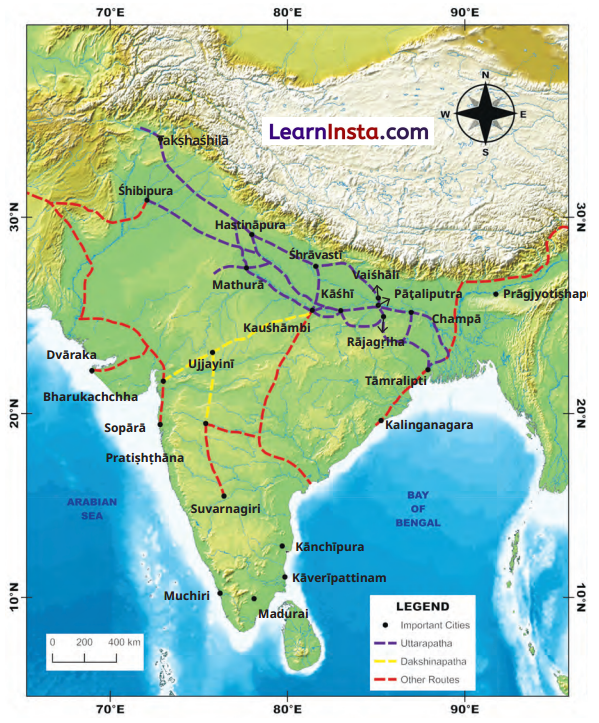
Answer:
Geographical features that helped trade in the subcontinent are:
- Rivers (the Ganga, the Son, the Narmada, etc.) – Served as natural waterways for transporting goods.
- Mountain passes (e.g., in the north¬west) – Allowed land routes to connect India with Central Asia.
- Coastal plains (Arabian Sea, Bay of Bengal) – Enabled maritime trade with distant regions.
- Forests (e.g., near Pataliputra) – Provided timber, elephants, and herbs for trade.
- Plateaus (Deccan) – Offered stable overland routes between northern and southern India.
Question 5.
What modes of transport on those roads do you think were available at the time? (Page 93)
Answer:
Several modes of transport were used on the roads, including:
Bullock Carts – For heavy goods and bulk trade (e.g., grains, timber).
- Horses – Used by messengers, soldiers, and elite travellers for speed.
- Elephants – Transported luxury items (e.g., gems, spices) and military supplies.
- Foot Caravans – Traders and pilgrims walked long distances with pack animals (donkeys, camels).
- Boats/Ships – Used for riverine and coastal trade (e.g., the Ganga, the Arabian Sea routes).
Question 6.
Take a close look at the panel given below. How many types of weapons can you identify? What different uses of iron can you make out? (Page 94)
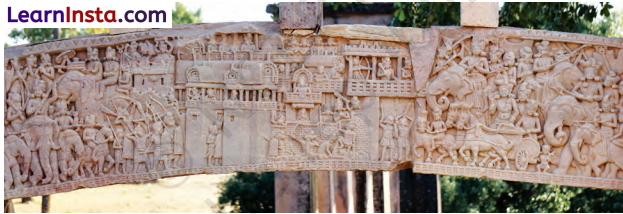
Answer:
Weapons Identified (Sanchi Stupa panel):
- Swords (likely iron) – Used in close combat.
- Spears/Lances – Used by foot soldiers, and cavalry.
- Bows and Arrows – For long-range attacks.
- Shields (iron-reinforced) – Defence against weapons.
- Siege Weapons (e.g., battering rams) – Suggested by the fortified city scene.
Uses of Iron Beyond Weapons:
- Agricultural Tools (e.g., iron ploughs) – Boosting farm surplus (mentioned in Maga- dha’s rise).
- Construction – (Nails, beams for forts/ palaces) used in structures like, Pataliputra’s wooden ramparts.
- Trade Goods – Iron ore was exported to guilds (Chapter mentions iron’s role in the economy).
Question 7.
In the left part of the panel, a parasol (chhattra) is kept over the casket containing the Buddha’s relics. Why do you think this was done? (Page 94)
Answer:
- Symbol of Royal Authority – The parasol marked the relics as sacred and under royal protection likely, linked to Ashoka’s patronage of Buddhism.
- Spiritual Protection – It signified that the Buddha’s teachings sheltered devotees, like a parasol shades from the sun.
- Honorific Ritual – This mirrored Indian traditions of honouring revered objects (e.g., stupas with umbrellas).
Question 8.
When, after the battle, Alexander asked Porus how he wished to be treated, Porus answered, *Like a King.’ Alexander then left Porus at the head of his kingdom, as satrap. With the help of your teachers, find more details on the battle between Porus and Alexander. Enact a play of this battle scene using your imagination in addition to what you have discovered.”
Answer:
Historical Context:
- The Battle of Hydaspes (326 BCE) was fought between Alexander the Great and King Porus (Puru) on the banks of the Jhelum River (Hydaspes in Greek).
- Despite Porus’s defeat, Alexander was impressed by his bravery and restored his kingdom as a satrap (governor) under Macedonian rule.
Key Details for the Play: - Porus’s Elephant Army: Porus used war elephants, which initially terrified Alexander’s forces.
- Alexander’s Tactics: He crossed the mon-soon-swollen river secretly to surprise Porus.
- Porus’s Dignity: His reply, “Like a Kirfg,” showed his pride, earning Alexander’s respect. (Students to perform the play.)
Question 9.
“Organise a group discussion in your class and compare the features of Kautilya’s idea of an empire with a modern nation.” (Page 103)
Answer:
| Feature | Kautilya’s Empire (Mauryan Era): | Modern Nation (e.g., India) |
| Governance | Rule by a king (Swami) with absolute authority. | Democratic system with elected leaders (President/PM). |
| Administration | Council of ministers (Amatya) and officials. | Bureaucracy (lAS, ¡PS) and council of ministries. |
| Law & Order | Danda (punishment system) for justice and corruption control. | Police, judiciary, and anti-corruption agencies (CBI, Lokpal). |
| Economy | Treasury (Kosha) managed taxes, trade, and resources. | Finance Ministry, RBI, and economic policies (GST, subsidies). (BharatNet, UPI) |
| Military | Standing army (Danda) for defence and expansion. | Professional armed forces (Army, Navy, Air Force). |
| Infrastructure | Roads, irrigation, and forts (Durga) for connectivity. | Highways, railways, airways, metro Welfare schemes (MNREGA, Ayushman Bharat). |
| Welfare | People ‘s happiness is king’s happiness” (Arthashastra). | Diplomatic treaties (UN, BRICS, bilateral agreements). |
| Alliances | Tributary states and allies (Mitra) . | AI, satellites, and digital governance (Aadhaar, DigiLocker). |
| Technology | Iroti tools, couriers, and manual record-keeping. | Democracy, elections and constitutional succession (PM/President). |
| Leadership Transfer | Hereditary monarchy (e.g., Chandragupta to Ashoka). | Modern Nation (e.g., India) |
Question 10.
“Ashoka details instructions on the conduct of his officials and mentions ways to ensure that they practised fairness in one of his edicts. Read the translation below and share your thoughts on whether those ways would have been successful in helping manage his empire and how.”
“By order of the Beloved of the Gods -the officers and city magistrates[…] are to be instructed thus:
[…] You are in charge of many thousands of living beings. You should gain the affection of men. All men are my children, and just as I desire for my children that they should obtain welfare and happiness both in this world and the next, the same do I desire for all men. […] You should strive to practice impartiality. […] The root of all this is to be even-tempered and not rash in your work. […] This inscription has been engraved here in order that the city magistrates should at all times see to it that men are never imprisoned or tortured without good reason. […] Andfor this purpose, I shall send out on tour every five years, an officer who is not severe or harsh; who, having investigated this matter…, shall see that they carry out my instructions.” (Page 107)
Answer:
Ashoka’s governance methods were highly effective for his time. By promoting impartiality, welfare, and regular inspections, he ensured fairness and reduced corruption. His emphasis on dhamma (moral law) fostered unity across diverse regions, while decentralised authority allowed efficient local administration. However, the system relied heavily on his personal leadership and lacked institutional safeguards, making it vulnerable after his death. While innovative, its long-term success was limited by the empire’s vastness and dependence on officials’ integrity lessons that are still relevant today.
Question 11.
Wear the hat of a historian. Look carefully at the artefacts presented on the spread on the next page (NCERT Page No 110). What conclusions can you draw about people and life during the Mauryan era?” (Page 109)|
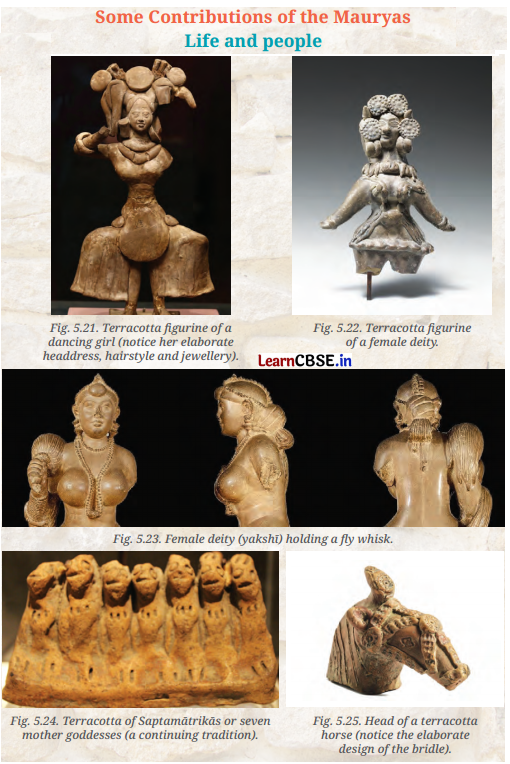
Answer:
The Mauryan artefacts reveal a sophisticated, prosperous society. The Sar- nath Lion Capital (Fig. 5.20) demonstrates advanced craftsmanship and royal symbolism. Terracotta figurines like the dancing girl (Fig. 5.21) and mother goddesses (Fig. 5.24) reflected vibrant cultural and religious life. Horse ornaments (Fig. 5.25) indicate trade and military strength. These artefacts, along with polished pillars and coins, reflect skilled guilds, urban wealth, and diverse traditions under stable imperial rule, as described in Megasthenes’ accounts and trade networtcs.
Question 12.
Notice the different symbols on the coins. Can you guess what any of the symbols in the coins below might mean?” (Page 112)

Answer:
The Mauryan punch-marked coins featured symbolic designs reflected their era:
- Animals (elephants, bulls): Represented royal power and prosperity.
- Geometric patterns: Possibly denoted , mint marks or trade guild affiliations.
- Sun/wheel motifs: Symbolised the – dharmachakra (linked to Ashoka’s Buddhist patronage).
- Archery symbols: Suggested military strength.
These coins (Figs. 5.29) facilitated trade across the empire, with standardised designs reinforcing imperial authority while accom-modating regional economic networks as mentioned in guild systems.
Don’t Miss out
Question 1.
Two of the most famed religious figures of the KfiQHR world—Siddhartha Gautama, who became known as the Buddha, and Vardhamanan, better known as Mahamra lived in the time of King Ajatashatru. Revisit their teachings in the Grade 6 textbook’s ‘India’s Cultural Roots’ chapter. (Page 94)
Answer:
The Buddha and Mahavira emerged during Magadha’s political rise (6th century BCE), offering transformative philosophies. Buddha’s Four Noble Truths and Eightfold Path addressed suffering through moderation, while Mahavlra’s Jainism emphasised extreme ahimsa (non-violence), truth, and asceticism. Both challenged Vedic rituals, and attracted merchant-class followers along trade routes. Their teachings flourished under Magadhan patronage, with Ajatashatru even consulting Buddha. This symbiotic relationship between empire and spirituality shaped India’s cultural fabric.
Question 2.
The satraps were governors of provinces of Persian and Greek empires who were left behind by the overlord (like Alexander) to manage far-off territories. These satraps had significant power and freedom despite being mere officials of the rulers. Can you guess how it was possible for them to exercise such power?” (Page 97)
Answer:
Satraps wielded autonomy due to:
- Distance: Remote provinces (like India’s northwest) required localised decision-making.
- Cultural adaptation: Adopting regional customs (e.g., marrying into local elites) stabilised rule.
- Military control: They maintained independent armies (as seen with Persian satraps).
- Economic leverage: Controlling trade routes generated independent revenue.
Alexander’s satraps like Porus exemplify this their power stemmed from balancing imperial mandates with grassroots governance, though this often led to rebellions after the overlord’s death.
Class 7 SST Chapter 5 The Rise of Empires Question Answer (Exercise)
Questions and Activities (Page 114-115)
Question 1.
What are the features of an empire, and how is it different from a kingdom? Explain.
Answer:
An empire is a vast territory ruled by an emperor, formed by conquering smaller kingdoms. Its key features include:
- A centralised government with officials managing provinces.
- A powerful army to control territories and defend borders.
- Diverse cultures united under one rule.
- Trade networks and infrastructure like roads.
A kingdom is smaller, ruling a single region with a king. Unlike empires, kingdoms:
- Have more homogeneous populations
- Lack control over multiple territories
- Depend less on complex administration
Example: The Mauiyan Empire (empire) vs. Magadha before expansion (kingdom).
Question 2.
What are some important factors for the transition from kingdoms to empires?
Answer:
Several key factors enabled the transition from small kingdoms to large empires:
- Strong Leadership – Ambitious rulers like Chandragupta Maurya and Ashoka expanded territories through conquests and alliances.
- Military Power – Advanced weapons (iron tools), war elephants, and organised armies helped defeat rivals.
- Economic Strength – Control of fertile lands (the Ganga plains), trade routes (Uttarapatha), and taxation systems provided wealth.
- Efficient Administration – Systems like Kautilya’s Arthashastra helped manage large territories.
- Infrastructure – Roads, irrigation, and communication networks unified distant regions.
Question 3.
Alexander is considered an important king in the history of the world why do you think that is so?
Answer:
Alexander the Great is considered as an important king in the history of the world because:
- Military Genius – He conquered vast territories from Greece to north-west India, creating one of the largest empires in the history. His empire was spread over three continents (Europe, Northern Africa and Asia), one of the largest in the world history.
- Cultural Exchange – His campaigns connected Greek, Persian, and Indian cultures, leading to new developments in art, science, and trade.
- Strategic Leadership – He used smart tactics, like the phalanx formation, to defeat powerful armies (e.g., King Porus in India).
- Historical Legacy – His empire inspired future rulers, and Greek historians documented his journeys, giving us valuable records of ancient civilisations.
Question 4.
In early Indian history, the Mau- ryas are considered important. State your reasons.
Answer:
The Mauryan Empire (322-185 BCE) was a golden age in Indian history due to:
- First Pan-Indian Empire – The Mauryan ruled almost the entire subcontinent (except far south), unifying diverse regions under one administration.
- Strong Governance – Chandragupta and Ashoka established efficient systems:
- Kautilya’s Arthashastra guided politics, economy, and law.
- Provincial divisions with group of councillors, ministers and high officials (like amatya) for smooth rule.
- Ashoka’s Dhamma – Promoted peace, tolerance, and public welfare through edicts (rock/pillar inscriptions).
- Economic Growth – Trade guilds (shrenis), standardised coins, and infrastructure (roads like Uttarapatha).
- Cultural Legacy – Art (e.g., Sarnath Lion Capital), Buddhism’s spread, and scientific advancements.
Example: Ashoka’s edicts remains one of the India’s earliest written records.
Question 5.
What were some of Kautilya’s key ideas? Which ones of these can you observe even today in the world around us?
Answer:
Kautilya’s Key Ideas:
Kautilya, in his Arthashastra, emphasised strong but ethical governance. He advised rulers to prioritise public welfare (“People’s happiness is the king’s happiness”), maintain a robust treasury through fair taxation, and use strategic alliances (Mitra) for national security. His ideas on administration included a spy system to prevent corruption and a well-organised military (Danda) for protection. These principles mirror modern governance, where governments balance welfare schemes with economic growth and maintain defence forces while combating corruption through agencies like the CBI.
Modern Relevance:
Today, Kautilya’s ideas remain visible in welfare policies (like free rations or healthcare), anti-corruption measures, and diplomatic relations between nations. His emphasis on rural development continues in various government social welfare schemes and programs, proving that ancient Indian political thought still guides modern systems of governance and nation-building. His blend of practical politics and moral leadership makes Arthashastra timeless.
Question 6.
What were the unusual things about Ashoka and his empire? What of that has continued to influence India and why? Write your opinion in about 250 words.
Answer:
Ashoka’s Uniqueness:
Ashoka was an extraordinary ruler who transformed after the Kalinga war, embracing peace and moral governance (dhamma). He promoted religious tolerance, built hospitals, and protected animals, showing rare compassion for an emperor of his time.
As per Ashoka’s edicts he established rest houses and drinking water facilities (Wells) at regular intervals along the main trading routes of his empire.
Besides this many fruit bearing trees were planted along such routes. He encouraged all different sects (school of thoughts at that time) to mingle together. He followed Kautilya’s teachings on governance effectively.
Lasting Influence:
His legacy continues through India’s Ashoka Chakra flag symbol, secular values, and welfare policies. The edicts he left behind still inspire modern governance and environmental protection efforts in India today.
Question 7.
Thus speaks the Beloved of the Gods, the king Piyadasi: My officers of Dhamma are busy in many matters of public benefit, they are busy among members of all sects, both ascetics and householders. I have appointed some to concern themselves with the Buddhist Order, with brahmans and Ajivika…, with the Jains…, and with various sects. There are many categories of officers with a variety of duties, but my officers of Dhamma are busy with the affairs of these and other sects.
After reading the above edict of Ashoka, do you think he was tolerant towards other religious beliefs and schools of thought? Share your opinion in the classroom.
Answer:
Yes, Ashoka was remarkably tolerant. His edict explicitly states that he appointed Dhamma officers to serve all religious groups—Buddhists, Brahmins, Jains, and Ajivikas—showing equal respect. Unlike rulers who imposed one faith, Ashoka believed in learning from every tradition. This tolerance reflects in modern India’s secularism, where all religions coexist peacefully. His approach wasn’t just political but moral, making him a pioneer of religious harmony.
Question 8.
The Brahmi script was a writing system that was widely used in ancient India. Try to learn more about this script, taking help from your teacher wherever required. Create a smallproject and Inc lude what you have learnt about Brahmi.
Answer:
Key details to include in your project:
Origin: Developed around 3rd century BCE, used in Ashoka’s edicts.
Appearance: Curved letters (e.g., for “ka”), written left-to-right
Importance:
- Basis for modern Indian scripts (Devanagari, Tamil, etc.)
- First script to decode ancient Indian inscriptions
- Legacy: Inspired scripts across Asia (Tibetan, Sinhala, etc.)
Creative Project Ideas:
- Make a poster comparing Brahmi letters to your mother tongue
- Trace Ashoka’s edicts on clay tablets
- Present a timeline of how Brahmi evolved into regional scripts
Question 9.
Suppose you had to travel from Kaushambi to Kaveripattanam in the 3rd century BCE. How would you undertake this journey, and how long would you expect it to take, with reasonable halts on the way?
Answer:
Travelling from Kaushambi to Kaveripattanam in the 3rd century BCE would have been a long and tough journey, taking a lot of time and effort.
Route & Transport:
- Kaushambi to Pataliputra (10 days): Bullock cart along the Grand Trunk Road.
- Pataliputra to Tamralipti (15 days): Boat down the Ganga River.
- Tamralipti to Kaveripattanam (20 days): Coastal ship along the Bay of Bengal.
- Total Time: Approximately 45 days including trade halts and weather delays.
Challenges:
- Monsoon delays (June-September)
- Bandit risks on land routes
- Coastal storms
Evidence:
- Mauryan trade routes (See Map on Pg. 92 map)
- Megasthenes’ accounts of travel (Page 101)