Teachers guide students to use Exploring Society India and Beyond Class 8 Solutions and Class 8 Social Science SST Chapter 6 The Parliamentary System: Legislature and Executive Question Answer NCERT Solutions for quick learning.
Class 8 Social Science Chapter 6 Question Answer The Parliamentary System: Legislature and Executive
NCERT Class 8 Social Science Chapter 6 The Parliamentary System: Legislature and Executive Questions and Answers Solutions
The Parliamentary System: Legislature and Executive Class 8 Question Answer (In-Text)
The Big Questions (Page 139)
Question 1.
What is India’s parliamentary system and how is it structured?
Answer:
India’s parliamentary system is a form of democratic governance, inspired by the British model, where the legislature (Parliament) is supreme and the executive (government) is drawn from and accountable to it.
Structure:
The Parliament of India (at the union level) comprises three components:
- The President of India
- Lok Sabha (House of the People / Lower House) – Members are directly elected by the people based on universal adult franchise.
- Rajya Sabha (Council of States / Upper House) – Members are elected indirectly by the state legislative assemblies.
This structure is called bicameral (having two chambers/houses). The Parliament is responsible for making laws, controlling the government, and representing the people’s interests. A similar parliamentary structure, with variations, exists at the state level, with Vidhan Sabha (Legislative Assembly) and, in a few states, Vidhan Parishad (Legislative Council).
Question 2.
What are the key functions of the Parliament?
Answer:
The Parliament’s key functions are:
- Constitutional Functions:
- Amending the Constitution
- Electing the President and Vice-President
- Lawmaking:
- Making laws on subjects listed in the Union and Concurrent lists
- Introducing and passing bills (draft laws) which become Acts after Presidential assent
- Executive Accountability:
- Holding the Council of Ministers (the executive) accountable
- Questioning the government (e.g., during Question Hour)
- Reviewing government actions and policies through Parliamentary Committees
- Financial Functions:
- Approving and allocating government spending (budget)
- Examining ‘Money Bills’, taxation and expenditure
- Upholding Constitutional Values:
- Protects democracy, federalism, fundamental rights, and directive principles

Question 3.
What are the roles of the legislature and the executive in India’s Parliamentary democracy?
Answer:
- Legislature (Parliament):
- • Makes the laws
- • Controls and supervises the work of the government/executive
- • Represents the will of the people
- • Ensures that the government runs within the framework of the Constitution
- Executive (Government):
- • Implements and enforces laws passed by the Parliament
- • Takes decisions on day-to-day administration
- • Executive power at the Union level is exercised by the President, the Prime Minister, and the Council of Ministers (who are also MPs)
- • The executive is answerable to the legislature, especially in the Lok Sabha
Question 4.
How are the legislature and the executive organised at the union and state levels?
Answer:
At the Union (Central) Level:
- Legislature:
- Parliament of India (President + Lok Sabha + Rajya Sabha)
- Lok Sabha: Members directly elected by the people
- Rajya Sabha: Members elected by state legislatures
- Executive:
- The President (head of state)
- The Vice President (who is also Rajya Sabha’s chaitperson)
- The Prime Minister (head of government)
- Council of Ministers (chosen from MPs of both Lok Sabha and Rajya Sabha; collectively responsible to Lok Sabha)
At the State Level:
- Legislature:
- Legislative Assembly (Vidhan Sabha): Directly elected by the people of the state
- Legislative Council (Vidhan Parishad): Exists in a few states (is the upper house, members are elected indirectly)
- Bicameral only in some states, otherwise unicameral
- Executive:
- The Governor (head of state, appointed by the President of India)
- The Chief Minister (head of the government)
- The Council of Ministers (chosen from members of the state legislature; collectively responsible to the Vidhan Sabha)
Both at Union and State levels, the executive is accountable to the legislature, ensuring that the government acts according to law and with the people’s consent.
II. Let’s Explore
Question 1.
Draw a small chart to show the process of how RTE became an act. What do you think the process would be if RTE had been tabled in the Lok Sabha? (Page 148)
Answer:
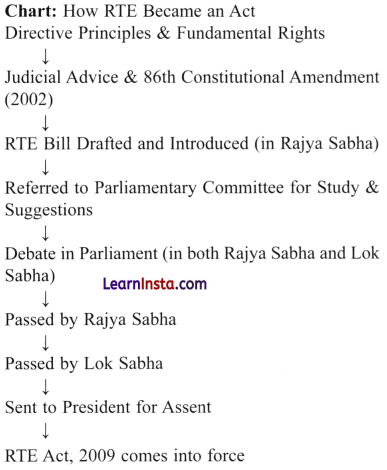
Question 2.
Given here is an extract from the report of meetings between the Standing Committee on Health and Family Welfare and the officers from the Ministry of Health and Family Welfare. Observe the screenshots above and discuss the following in small groups- Who is reporting to whom? What is the subject that has been reviewed? Identify the Committee’s recommendation. What is the government’s reply?
(Page 150)

1.2 Co-location of Ayush facilities at Primary Health Centers (PHCs), Community Health Centers (CHCs) and District Hospitals (DHs)
Recommendation:
1.2.1 The Committee, at this juncture, notices that in some states and UTs, a separate Department of Ayush has not been opened. The Committee, to boost the Ayush system andfor better coordination in Ayush Healthcare, recommends the Ministry of Ayush to impress upon and persuade the States and UTs with no separate department of Ayush to create such a department for speedy development and implementation of Ayush sector and schemes respectively.
(Para 2.13 of the Report) Action Taken:
1.2.2 Public Health is being a state subject, creation of separate Department of Ayush in the States/UTs comes under purview of respective State/UT Governments. However. Ministiy of Ayush has requested State/UT Governments in different meetings to create separate Directorates, deployment of manpower in SPMU & DPMU in the States/UTs for speedy development and implementation of NAM scheme As on date, separate Ayush Directorate is available in 24 States/UTs. (SPMU= stateproject management unit; DPMU=district project management unit) (Para 2.23 of the Report)
Answer:
The report shown in the extract has been prepared by the Standing Committee on Health and Family Welfare. This Committee is a part of the Rajya Sabha, which is one of the two houses of the Indian Parliament. The purpose of the report is to review the work of the Ministry of Health and Family Welfare and to suggest improvements for better healthcare services.
The Committee has highlighted that in some States and Union Territories (UTs), a separate Department of Ayush has not yet been created. This is seen as a problem because without a dedicated department, it becomes difficult to properly develop and manage Ayush healthcare facilities and services.
The Committee recommended that the Ministry of Ayush should persuade those States and UTs that do not have a separate Department of Ayush to create one. This would help improve coordination, and ensure faster development and implementation of Ayush-related schemes and healthcare services.
In response to the recommendation, the government explained that public health is a State subject, so the decision to create a separate Ayush Department lies with each State or UT. However, the Ministry of Ayush has held meetings and encouraged the States/UTs to take this step. As a result, 24 States and UTs have set up separate Ayush Directorates to improve the delivery of Ayush services.
Question 3.
Why do you think that Parliament keeps an eye on government expenditure? (Hint: Whose money does the government spend?) (Page 151)
Answer:
Parliament keeps an eye on government expenditure because the government spends the people’s money-that is, money collected from citizens through taxes and other sources. As representatives of the people, Members of Parliament have the responsibility to make sure this money is used wisely, honestly, and for the benefit of the country.
If the government spends the people’s money carelessly or for the wrong purposes, it can harm the nation and betray the trust of citizens. That’s why Parliament controls and checks the government’s spending, especially during budget discussions, money bills, and financial committee reviews. This process ensures accountability, transparency, and prevents misuse or wastage of public funds.
Question 4.
If the Executive is part of the Legislature, how do we say that there is separation of power? (Hint: revisit the section on legislature abowo)(Page 152)
Answer:
India follows the parliamentary system in which the executive (Prime Minister and Council of Ministers) is drawn from and is a part of the legislature (Parliament). At first glance, it looks like there is “no separation of powers’’ because the same people are in both the executive and legislative branches.
However, the Constitution does provide for a separation of powers in the following ways:
- Distinct Functions: While the executive (government) implements laws and runs the country, the legislature (Parliament) makes laws, debates national issues, and holds the government accountable. Each has its own well-defined area of work.
- Checks and Balances: The executive is answerable to the legislature. Parliament can question, scrutinize, and dismiss the government (for example, through a vote of no-confidence).
- Collective Decision-making: Even though ministers are both lawmakers and government officials, they cannot act outside the law or without Parliament’s approval (for budgets, new laws, etc.).
- Independent Judiciary: Besides, there is also a third branch – the judiciary – which is fully independent and’ can review actions of both the executive and the legislature to ensure they act within the Constitution.
Question 5.
What might happen if one of the organs – Legislature,
Executive, Judiciary- had all the power? How could it affect the rights of people? Discuss with your classmates how each organ checks the others. For example, how does the Legislature question the actions of the Executive? How does the Judiciary make sure that laws and government actions respect the Constitution? Do you think there might be ways in which the actions of the Judiciary itself are reviewed? (Pages 154-155)
Answer:
If one of the organs-Legislature, Executive, or Judiciary-had all the power, it could lead to misuse of authority and harm people’s rights. For example, if only the executive had power, it could make and enforce laws without asking anyone else, which could become unfair or even cruel. Similarly, if the legislature or judiciary had total control, there would be no one to stop them from making harmful decisions. This is why power is divided, so no one branch becomes too powerful.
Each organ of the government checks the others. The legislature, which makes laws, can question the executive through debates, question hours, and committees. It can also refuse to pass a budget or law if it disagrees with the executive’s actions. The judiciary checks both the legislature and executive by making sure their laws and actions follow the constitution. If a law breaks the rules of the constitution, the judiciary can declare it invalid.
Yes, even the judiciary’s actions can be reviewed. If a court makes a mistake, a higher court can change the decision. Also, judges must follow the constitution and cannot act outside their powers. In this way, checks and balances keep our democracy strong and protect people’s rights. Discussing this with your classmates can help you understand how important balance and fairness are in a government.
Question 6.
Can you find examples where the Judiciary has asked lawmakers to review a law? Can you find any instances when the implementation of a law has been questioned by the Judiciary? (Page 155)
Answer:
Yes, there are examples where the judiciary -has asked lawmakers to review a law. For example, in the Section 377 case, the Supreme Court asked Parliament to review and change the law related to same-sex relationships. There are also times when the judiciary questioned how a law was being used. In the Right to Food case, the Supreme Court told the government to improve how food was being given to poor people, as the law was not being followed properly.
Question 7.
What type of legislature does your state have? (Page 157)
Answer:
Do it yourself.
Question 8.
Study the data given in the following table. What conclusions can you draw about the functioning of Parliament over time? Compile data for more recent years.
| Period of Lok Sabha | Number of Sessions | Number of Sittings |
| 1st Lok Sabha (1952-1957) | 14 | 677 |
| 2nd Lok Sabha (1957-1962) | 16 | 567 |
| 10th Lok Sabha (1991-1996) | 16 | 423 |
| 13th Lok Sabha (1999-2004) | 14 | 356 |
Read the following statement of the former chairman of the Rajya Sabha, M. Venkaiah Naidu given in 2021: “ … the productivity of Rajya Sabha during 2004-14 has been about 78% and it declined to about 65% since then. Of the 11 sessions [that he presided over], four of them clocked low productivity of 6.80%, 27.30%, 28.90% and 29.55%; during the year 2018, the Rajya Sabha recorded the lowest ever productivity of 35.75% under the impact of disruptions.” What conclusions can you draw from this statement? What implications does this have for the role that the Rajya Sabha is expected to play?
(Page 158)
Answer:
The data shows that in earlier years, like the 1st and 2nd Lok Sabha, Parliament met for more days and passed more laws. Over time, the number of sitting days and laws passed has reduced, showing that Parliament is working less. From the statement by M. Venkaiah Naidu, we leam that the Rajya Sabha’s work has also reduced. Some sessions had very low productivity because of frequent disruptions.
This is a problem because the Rajya Sabha is meant to review laws and represent the states. If it doesn’t work properly, laws may not be discussed well, and this can affect good governance.
Question 9.
Take up a small group project. Compile data regarding the functioning of the legislature in your state or union territory. (Page 159)
Seek an appointment with an MLA and gather information about challenges with respect to the state legislature.
Answer:
Do it yourself.
Class 8 SST Chapter 6 The Parliamentary System: Legislature and Executive Question Answer (Exercise)
Question 1.
Find out how many representatives from your state are in each Flouse of the Parliament.
Answer:
Do it yourself.
Question 2.
What makes the Indian Parliament the “voice of the people”? Flow does it ensure that different opinions are heard?
Answer:
The Indian Parliament is called the “voice of the people” because members are directly or indirectly elected by the people. Every adult citizen has the right to vote for their Lok Sabha representative, making Parliament the true forum for people’s will.
- The Parliament ensures different opinions are heard by.
- Allowing MPs from different regions, languages, religions, and parties to participate.
- Debates, discussions, and question sessions give space to raise diverse issues.
- Translation services and interpretation in many languages enable MPs from across India to communicate and be understood (as described in the chapter).
- Parliamentary Committees include members from various political parties, ensuring multiple perspectives.
Question 3.
Why do you think the Constitution made the Executive responsible to the Legislature?
Answer:
- The Constitution made the executive responsible to the legislature because it ensures that power remains with the people.
- The executive (Prime Minister and Council of Ministers) runs the government, but since they’re drawn from Parliament and must maintain its confidence, this prevents misuse of power.
- Mechanisms like Question Hour, votes of no-confidence, and debates let MPs hold ministers accountable. This system protects democracy and keeps the government answerable to the people, as discussed in the chapter under “executive accountability.”
Question 4.
Why do you think we have chosen the system of bicameral legislature at the Union level?
Answer:
India chose a bicameral legislature (two Houses) at the Union level to:
- Balance different interests: Lok Sabha (House of the People) represents the population directly; Rajya Sabha (Council of States) gives representation to states and regions.
- Ensure careful lawmaking: Two chambers mean all laws are discussed, debated, and reviewed twice before becoming law.
- Protect federalism: Experts felt a Council of States was needed to address the needs of India’s large and diverse country.
Question 5.
Try to track the journey of a recent bill passed by Parliament. Identify in which House it was introduced. Were there major debates or disagreements? How long did it take for the bill to become a law?
Answer:
Sample Answer
Women’s Reservation Bill, 2023
- Introduced in: Lok Sabha.
- Journey: Tabled, debated, passed in Lok Sabha, then sent to Rajya Sabha and passed there, finally sent to the President for approval.
- Debates: Yes, there were major debates and support by most parties; some discussions on timing and implementation.
- Time taken: Introduced and passed in one special session, but the issue had been debated for 25 years.
- You can use government websites, news articles, and parliamentary records to find the journey for other recent bills.
Question 6.
Choose a recent law passed by Parliament. Divide into teams to role-play different parts of the process—MPs debating in Lok Sabha and Rajya Sabha, ministers answering questions, and the President giving assent. Present a short skit showing how a bill becomes a law; enact a ‘model Parliament’.
Answer:
Do it yourself.
Question 7.
The Women’s Reservation Bill, 2023, was passed with wide support. Why might it have taken over 25 years for this bill to be passed, despite being discussed for so long?
Answer:
There were deep and long-running debates over how to implement reservation for women, including:
- Concerns over reservation for different groups within women (e.g., OBC, SC, ST sub-quotas).
- Political rivalry and lack of consensus-many parties agreed in principle but disagreed on details.
- Social and regional differences on the need and timing.
- Negotiations and shifting priorities over time.
- Its eventual passage in 2023 reflects broad political and social support at this moment. The chapter shows how Parliament represents many interests, which can sometimes slow big decisions.
Question 8.
Sometimes Parliament is disrupted and does not function for the number of days it is supposed to. What impact do you think this has on the quality of laws and the trust people place in their representatives?
Answer:
Some of the impact are as follows:
- Important laws may be passed in a hurry, without enough debate or review, leading to poor-quality laws.
- MPs may not get the chance to raise the problems of their people or question the government.
- People may lose trust in Parliament and their representatives if they see that business is not conducted seriously.
- The chapter points out that regular debate and accountability are vital for democracy; disruptions weaken Parliament and the connection between people and government.
Question 9.
Can you create ‘interest’ groups among students and list questions related to any policy that you may want to ask your MP and/or your MLA? How would these questions be different if to the MP instead of MLA, and vice versa?
Answer:
Do it yourself.
Question 10.
What is the role that the Judiciary plays in Indian democracy? What could happen if we didn’t have an independent judiciary?
Answer:
- The Judiciary ensures laws and government actions are within the Constitution.
- Protects fundamental rights-people can approach the courts if their rights are violated.
- Judicial review: Courts can strike down unconstitutional laws or government actions.
- Without an independent judiciary, the government could make or enforce unjust laws at will, and citizens would have no way to challenge misuse of power. This would seriously harm democracy and the rule of law.
- The chapter discusses separation of powers and the essential role of courts in upholding constitutional values.