Students often prefer our concise Class 8 English Poorvi Worksheet and Class 8 English Chapter 8 The Magic Brush of Dreams Worksheet with Answers Pdf for quick practice.
Class 8 English Chapter 8 The Magic Brush of Dreams Worksheet with Answers
Class 8 English The Magic Brush of Dreams Worksheet
Class 8 English Chapter 8 Worksheet – Class 8 The Magic Brush of Dreams Worksheet
Let us do these activities before we read
I. Work in pairs. Discuss the following questions. Share your answers with your classmates and teacher.
1. If you had a magic brush, for what purposes would you use it?
______________________________________________
______________________________________________
2. If some powerful person forced you to use your magic brush for his/her benefit only, what would you do?
______________________________________________
______________________________________________
3. Imagine you are from a very poor family. In this condition, if you had a magic brush, would you use it for your family welfare or not?
______________________________________________
______________________________________________
II. We must show kindness towards helpless persons and animals. If you were a very rich person, how would you show kindness towards needy people?
______________________________________________
______________________________________________
III. Arrange the following words into different categories.
| sorrow, writing, soap, anger, leaf, playing, dancing, pen, eating, kindness, water, hope |
Things : __________ __________ ___________ __________
Actions : __________ __________ ___________ __________
Emotions : __________ __________ ___________ __________
Let us Discuss
I. Arrange the events in order of occurrence in the poem.
1. The man warns Gopi, “Paint not for the wealthy ones, but only for the poor.”
2. Gopi grins, rushes inside, and paints a bowl of khichdi.
3. A man bestows a magic paintbrush to Gopi.
4. Gopi returns to her village.
5. The Zamindar orders his men to lock up Gopi.
6. The Zamindar cries, “No, no, no more! I’ll leave, I’ll go away!”
7. Gopi is using a twig to draw pictures in the sand.
8. Gopi paints a river.
9. The Zamindar asks Gopi to paint a fortress, treasures, jewels and riches.
10. Gopi is questioned about gathering wild beans, rice, or mangoes.
II. Fill in the blanks by choosing the correct words from the box given below.
| essential sustenance, tool of ingenuity, everyday nourishment, selflessness |
Choosing khichdi underlines Gopi’s intention to provide (i) __________ not luxury. Gopi uses the magic brush as a (ii) __________, bypassing toil with imagination and skill. The “no beans, no rice, no mangoes” highlights Gopi’s inability to provide for her family through normal means khichdi symbolizes (iii) __________ anchored in cultural roots. Gopi refuses to obey the order of the Zamindar and thus she represents (iv) __________ and moral strength.
III. Fill in the blanks by choosing the correct option from the brackets.
1. The Zamindar’s men symbolize __________ (support/greed/generous) and oppression, on a mission to seize the brush and its power.
2. The river Gopi paints is a metaphor for the limits of __________ (skill/powerless/ authority) as even the Zamindar’s men cannot cross what is crafted by art and imagination.
IV. Give examples from the poem for the following explanations.
1. The poem reveals a direct clash between greed and integrity.
______________________________________________
2. The Zamindar abuses the authority.
______________________________________________

V. Match the phrases from the poem in Column 1 with what they symbolize in Column 2.
| Column 1 | Column 2 |
| 1. Khichdi | (i) creative power |
| 2. The Zamindar’s retreat | (ii) basic sustenance and comfort |
| 3. The brush | (iii) the victory of kindness, resourcefulness, and integrity |
VI. Identify whether the following statement is true or false.
The repeated phrase “It’s Gopi!” creates a joyful, celebratory atmosphere, contrasting sharply with the looming threat of the Zamindar’s men.
Think beyond
I. Read the extracts given below and answer the questions that follow.
1. “Go and gather wild beans, Gopi,
Go and fetch some rice.
Go and pluck the mangoes
And bring home something nice.”
Gopi sits beneath the banyan,
A twig is in her hand.
She sits there drawing pictures,
Pictures in the sand.
The winds blow by and sweeps away
The pictures in the sand.
Questions:
(i) Who is speaking these lines and to whom?
______________________________________________
(ii) Complete the following sentence appropriately.
The speaker expects Gopi to do some chores like __________
(iii) What does this scene tell us about Gopi’s state of mind?
(a) She is lost in her own thoughts and imagination.
(b) She is lost in doing the chores she was asked to do.
(iv) What does the word ‘wind’ symbolize in the second last line?
______________________________________________
2. “The bowl is full of khichdi, Gopi!”
Into the house the villagers streamed
The young and old all wish to see
The magic brush of dreams.
She paints a muffler for a farmer,
A plough for another man,
A shawl for a grandmother,
And for a girl, a fan.
Questions:
(i) Complete the following sentence appropriately.
The phrase ‘magic brush of dreams’ refers to __________
(ii) What quality/qualities of Gopi is/are reflected in these lines?
(a) kindness
(b) generosity
(c) willingness to help others
(d) all of these
(iii) Fill in the blank by selecting the correct option from those given in the brackets.
Gopi uses her magic brush for __________ (her own benefit/other’s benefit)
(iv) What does this extract show about the villagers’ attitude towards Gopi?
______________________________________________
3. Gopi bows and shakes her head.
“My lord, I can’t comply.
I swore to use this magic brush
To help the needy by.”
The Zamindar roars and stamps his foot.
He bellows to his men,
“Seize this brush and seize the girl.
Throw her in the pen!”
Questions:
(i) What does this extract reveal about Gopi’s character?
______________________________________________
(ii) How does the Zamindar react to Gopi’s statement?
(a) He becomes happy.
(b) He becomes angry.
(c) He is impressed with her statement,
(d) He becomes very sad.
(iii) What is Gopi’s promise regarding the magic brush?
______________________________________________
(iv) Fill in the blank by selecting the correct option from those given in the brackets.
The line ‘Throw her in the pen!’ suggests that the Zamindar is a __________ (cruel/fair) person.
4. Now Gopi waits inside the cell,
Upon a cold mud floor.
Until the Zamindar returns
And shouts through the door.
He holds the brush. He thunders loud,
“Paint my fortress tall!
Paint gold and rubies, emeralds bright,
And you shall leave this hall!”
Questions:
(i) How do you think Gopi feels in the cell?
______________________________________________
(ii) What does the phrase ‘shouts through the door’ suggest about the Zamindar?
(a) his fearful nature
(b) his commanding nature
(c) his helpful nature
(d) his peaceful nature
(iii) Complete the following sentence with a suitable reason.
The Zamindar wants a fortress and treasures painted because __________
(iv) What does this extract show about the Zamindar’s character?
______________________________________________
5. She paints a mighty river wide,
Its currents fast and deep.
The Zamindar and all his men
Stop short and cannot leap.
“Now should I paint a beast
To leap and chase you through?
Stop this chase or it will feast
On you, and you and you!”
Questions:
(i) What does the painting of the river symbolize?
______________________________________________
(ii) What is the mood in this part of the poem?
(a) Tense
(b) Happiness
(c) Contentment
(d) Calm
(iii) Fill in the blank by selecting the correct option from those given in the brackets.
Despite being outnumbered, Gopi boldly __________ (requests/threatens) the Zamindar and takes control of the situation.
(iv) What theme is highlighted in this extract?
______________________________________________
II. Answer the following questions.
Question 1.
Why might the villagers be happy to see her back?
______________________________________________
Question 2.
What does Gopi’s persistence in painting say about her situation?
______________________________________________
Question 3.
What mood is evoked by the combination of a warm welcome and a chase?
______________________________________________
Question 4.
What conflict might arise between Gopi’s promise and the demand of the Zamindar?
______________________________________________
Question 5.
What does the lines “The horse, she swiftly urges/Gopi leaps on and gallops fast” convey?
______________________________________________
Let us learn
I. The verb ‘stream’ has different meanings in different contexts. Match the sentences in Column 1 with their appropriate meanings in Column 2.
| Column 1 | Column 2 |
| 1. Water streamed down the windows during the storm. | (i) moved |
| 2. People streamed out of the theater when the fire alarm went off. | (ii) divide |
| 3. She streams video games on Twitch for a living. | (iii) flew |
| 4. They decided not to stream children until they reached secondary | (iv) broadcast school. |
II. Fill in the crossword. Clues have been given below. You will find the words in the poem.
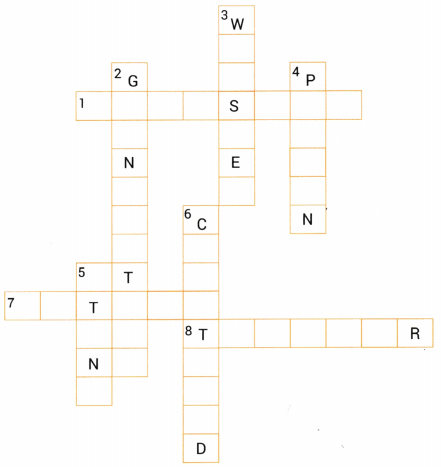
Across
1. a collection of very valuable objects
7. to come together in a group
8. the loud noise in the sky
Down
2. the mother of one of your parents
3. to speak very quietly
4. a building where criminals are kept as a punishment
5. a hard solid substance
6. an area of flat ground outside surrounded by one or more buildings
Interjections:
Interjections are words or phrases that express strong emotion. They often stand alone or are inserted into sentences to convey feelings like joy, surprise, pain, or frustration.
Some common interjections or exclamatory words:
Wow, Yay, Hooray, Yippee, Woo-hoo, Oh, Gosh, Jeepers, Egads, Ugh, Yuck, Shoot, Rats, Absolutely!, Indeed!, Totally!
III. Match the expressions in Column 1 with what emotions or reactions they convey, in Column 2.
| Column 1 | Column 2 |
| 1. Woohoo! | (i) anger |
| 2. Ah! | (ii) surprise |
| 3. Whoa! | (iii) worry |
| 4. Ugh! | (iv) frustration |
| 5. Damn! | (v) astonishment |
| 6. Aah! | (vi) appreciation |
| 7. Lovely! | (vii) delight |
| 8. Oh no! | (viii) scream of fright |
Now, create sentences using any five expressions from Column 1.
1. ______________________________________________
2. ______________________________________________
3. ______________________________________________
4. ______________________________________________
5. ______________________________________________
Let us listen
You will listen to five speakers speak about their choice of subjects. As you listen, match statements 1 -5 with speakers (i)-(v). (You may request your five friends to read out the transcript.)
(Read the Transcript at the end of this book Pg. No. 153)
| Statements | Speaker No. |
| 1. Having passionate interest in boosting the skill of problem solving. | |
| 2. Curious to have profound knowledge about human body. | |
| 3. Curious to possess in-depth knowledge of art and technology. | |
| 4. Curious to have deep knowledge about the things and incidents of past. | |
| 5. Having passionate interest in acquiring profound knowledge about different cultures. |
Let us speak
Intonation
Intonation refers to the way your voice rises and falls while speaking, adding a musical quality to your speech.
Rules:
- Falls on statements: I want to play cricket with you.
- Rises on yes/no questions: Do you want to go with me?
- Rises then falls on wh-questions: Where do you want to go?
I. Now, write 5 sentences with falling intonation and discuss them with your classmates.
1. ______________________________________________
2. ______________________________________________
3. ______________________________________________
4. ______________________________________________
5. ______________________________________________
Formal and Informal Requests
- Formal requests use polite, indirect language and follow specific structures, often in professional or official contexts.
- Informal requests are more casual and direct, typically used with friends and family.
For example;
“Will you give me your textbook?” (Informal request)
“Would you lend me your textbook, please? (Formal request)
II. Work in pairs. First, one student will make formal request and then, the next student will make informal request for the following situations. Write them below.
1. Asking a teacher for extra time
Formal Request ; ______________________________________________
Informal Request ; ______________________________________________
2. Asking a friend for a ride
Formal Request : ______________________________________________
Informal Request : ______________________________________________
3. Asking a colleague for help
Formal Request : ______________________________________________
Informal Request : ______________________________________________
Let us write
Imaginative Essay
An imaginative essay is a type of writing where you create a story or situation from your imagination. It allows you to be creative, think beyond reality, and describe events, characters, and settings that may or may not exist in real life.
1. Imagine you talked with a tiger in a zoo. Write in 80-100 words what you talked with it and how you felt by talking with a tiger.
______________________________________________
______________________________________________
______________________________________________
2. Imagine you visited the moon. Write in 80-100 words how you went there, what you observed there and how you felt.
______________________________________________
______________________________________________
______________________________________________
Let us explore
I. Harry Houdini and David Copperfield are famous magicians. Find out some information about them and write here.
______________________________________________
______________________________________________
______________________________________________
II. Read the riddles and find what they refer to.
1. I have hands but cannot clap. I tell you the time without speaking. What am I? __________
2. The more you take away from me, the bigger I get. I’m often found in the ground. What am I? __________
3. I fly without wings. I cry without eyes. Wherever I go, darkness flies. What am I? __________
4. I’m full of keys but can’t open any doors. People use me to make music. What am I? __________
5 . The more of me you take, the more you leave behind. I’m soft, yet I can be seen in the sand. What am I? __________
III. If you were in place of Gopi who got a magic brush, what objects would you have drawn? Draw three objects in the space given below.