Students can use Poorvi Book Class 8 Solutions Unit 3 Mystery and Magic Chapter 8 The Magic Brush of Dreams Questions and Answers as a quick reference guide.
The Magic Brush of Dreams Class 8 Questions and Answers
The Magic Brush of Dreams Class 8 Question Answer
NCERT Class 8 English Poorvi Chapter 8 The Magic Brush of Dreams Question Answer
The Magic Brush of Dreams Question Answer – Let us do these activities before we read. (Page 122)
I. Work in pairs. Discuss the following questions. Share your answers with your classmates and teacher.
1. Mention a magical object that you would like to have. Give a reason for your choice.
2. What would you draw for yourself, if you had a magic paint brush? Why?
3. Would you use the magic paint brush to draw for someone else? If yes, why? If no, why not?
Answer:
(Suggestive answers)
1. I would like to have a magic wand because it could make my life easier and more fun. I could finish my work quickly, fix things, and create anything I need. It would also help me do things I can only dream of, like flying or turning drawings into real things.
2. If I had a magic paint brush, I would draw a beautiful house by a river with a big garden. I would choose this because it would give me a peaceful and happy place to live, where I could relax, enjoy nature, and feel safe. It would be a home made from my own dreams.
3. Yes, I would use the magic paint brush to draw for others because it could bring joy and help to people who are struggling. By creating things, they need like food, shelter, or clothes, I could make a real difference in their lives. Using the brush for others would be a way to share kindness and make the world a better place.
II. Work in pairs. Discuss instances of acts of kindness that you have heard, read, or experienced. Share your answers with your classmates and teacher.
Answer:
I once read about neighbours who helped an elderly woman when she was ill. They cooked meals for her and looked after her home until she recovered. I also experienced kindness when a stranger found and returned my lost wallet, staying with me until I felt safe. These acts of kindness, big or small, remind us how important it is to help others and create a caring community.

III. Work in pairs and guess the meanings of the words given below and draw pictures depicting their meanings. Share with your classmates and teacher.

Now,arrange these words into diffrent categories as given below.
Things: ………………………………………………………..
………………………………………………………..
Actions: ………………………………………………………..
………………………………………………………..
Emotions: ………………………………………………………..
………………………………………………………..
Answer:
The words have been arranged into categories as follows
Things: Paintbrush, Twig, Fortress, Feast Actions: Winding, Bows, Drawing Emotions: Joy, Fear, Cold
Now, arrange these words into different categories as given below.
Answer:
Meanings of the words are:
1. Paintbrush – A tool used for painting.
2. Joy – A strong feeling of happiness.
3. Fortress – A strong building used for protection, like a castle.
4. Feast – A large meal with lots of food to celebrate something.
5. Fear – A feeling when you are scared.
6. Winding – Something that has many turns or curves.
7. Twig – A small thin branch from a tree.
8. Bows – To bend the body forward to show respect or thanks.
9. Drawing – Making pictures using a pen, pencil, or brush.
10. Cold – A low temperature that makes you feel chilly.
Students Note: Students will draw their own pictures on their own to show the meaning of each word.
The Magic Brush of Dreams Class 8 Question Answer – Let us Discuss (Pages 127-128)
I. Arrange the events in order of occurrence in the poem. The last one has been marked for you. Share your answers with your classmates and teacher.
| 1. Gopi paints a, bowl of khichdi, which becomes real and amazes the villagers. | |
| 2. The Zamindar orders Gopi to paint treasures for him. | |
| 3. Gopi is told to gather food but instead sits drawing pictures in the sand. | |
| 4. Gopi returns to the village with the Zamindar and his men chasing her. | |
| 5. The Zamindar throws Gopi into prison. | |
| 6. Gopi paints a road and a horse to escape. | |
| 7. Gopi uses the magic brush to paint useful items for the villagers. | |
| 8. Gopi paints a wide river, stopping the Zamindar and his men. | |
| 9. A man gives a magic brush to Gopi to paint only for the poor. | |
| 10. Gopi scares the Zamindar away, and celebrates with the villagers. | 10 |
Answer:
| 1. Gopi paints a, bowl of khichdi, which becomes real and amazes the villagers. | 3 |
| 2. The Zamindar orders Gopi to paint treasures for him. | 5 |
| 3. Gopi is told to gather food but instead sits drawing pictures in the sand. | 1 |
| 4. Gopi returns to the village with the Zamindar and his men chasing her. | 8 |
| 5. The Zamindar throws Gopi into prison. | 6 |
| 6. Gopi paints a road and a horse to escape. | 7 |
| 7. Gopi uses the magic brush to paint useful items for the villagers. | 4 |
| 8. Gopi paints a wide river, stopping the Zamindar and his men. | 9 |
| 9. A man gives a magic brush to Gopi to paint only for the poor. | 2 |
| 10. Gopi scares the Zamindar away, and celebrates with the villagers. | 10 |
II. Fill in the blanks by choosing the correct answer from the box given below.
| triumphant and celebratory tension and suspense playful and innocent |
The tone of the poem shifts throughout, reflcting the diffrent moods of the story. Initially, the tone is 1. _________________ as Gopi uses her imagination to draw in the sand, and later when the Zamindar enters the story, the tone shifts to one of 2. _________________. In the fial part of the poem, the tone becomes 3. _________________ as Gopi escapes, the Zamindar is defeated, and the villagers rejoice.
Answer:
The tone of the poem shifts throughout, reflecting the different moods of the story. Initially, the tone is 1. Playful and innocent as Gopi uses her imagination to draw in the sand, and later when the Zamindar enters the story, the tone shifts to one of 2. tension and suspense. In the final part of the poem, the tone becomes 3. triumphant and celebratory as Gopi escapes, the Zamindar is defeated, and the villagers rejoice.
III. Fill in the blanks by choosing the correct option from within the brackets.
1. The poem mostly follows a simple rhyme scheme, _________________, which adds a rhythmic flw. (ABCB, ABBA, ABAB)
2. This poem belongs to the _________________ poetry genre, which tells a story through verse. (descriptive, narrative or ballad, free style)
Answer:
1. The poem mostly follows a simple rhyme scheme, ABCB which adds a rhythmic flow. (ABCB, ABBA, ABAB)
2. This poem belongs to the narrative or ballad poetry genre, which tells a story through verse, (descriptive, narrative or ballad, free style)
IV. Give examples from the poem for the following explanations.
1. The poem is rich in imagery, creating clear pictures in the reader’s mind. For example, _________________.
2. What is the effect of repetition in the line— ‘On you, and you and you!’?
Answer:
1. She sits there drawing pictures, Pictures in the sand.
2. The repetition of “On you, and you and you” in this line creates a strong sense of threat and fear. It makes the danger feel immediate and personal, as if everyone is being warned.
V. Match the phrases from the poem in Column 1 with what they symbolise in Column 2.
| Column 1 | Column 2 |
| 1. The magic paint brush | (i) greed and the desire for wealth |
| 2. The grand fortress | (ii) barriers to protect Gopi from the Zamindar’s anger |
| 3. The river and the beast | (iii) the power of art and imagination to change the world |
Answer:
| Column 1 | Column 2 |
| 1. The magic paint brush | (iii) the power of art and imagination to change the world |
| 2. The grand fortress | (i) greed and the desire for wealth |
| 3. The river and the beast | (ii) barriers to protect Gopi from Zamindar’s anger |
VI. Identify whether the following statement is true or false.
While Gopi uses the magic brush to help others, the Zamindar wants to use it for personal gain. This contrast drives the moral of the story.
Answer:
True
Class 8 English The Magic Brush of Dreams Question Answer – Let us Think and Reflect (Pages 128-130)
I. Read the given extracts and answer the questions that follow.
1. But on a stone there sits a man,
A brush is in his hand.
He looks around. He calls to Gopi.
“Come here!” he whispers. “Hush!
We mustn’t let the village know
About this magic brush. ”
He slips the brush into her hand
And tells her to be sure,
“Paint not for the wealthy ones,
But only for the poor. ”
(i) Fill in the blank by selecting the correct option from those given in the brackets.
The man is whispering and telling Gopi to keep the brush a secret reflects his _________________ . (careful and secretive/ magical and delightful) nature.
Answer:
careful and secretive nature
(ii) What is the significance of the man slipping the brush into Gopi’s hand?
Answer:
The man slipping the brush into Gopi’s hand shows he trusts her to use the magic brush wisely and to help the poor.
(iii) Complete the following sentence with a suitable reason.
The most likely reason the man instructs Gopi to ‘Paint not for wealthy ones but only for the poor’ is because he _________________.
Answer:
wants to help those who need it the most and make sure the magic is used fairly
(iv) Select the most appropriate title for the extract from the two given below.
A. The Magic Brush’s Secret
B. Gopi’s Special Gift
Answer:
The Magic Brush’s Secret
2. And soon the news spreads far and wide,
Through forests, fields, and plains,
Until the Zamindar himself
Hears of these magic gains.
“I order you to paint for me,
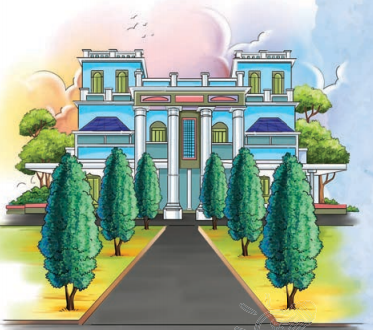
A fortress tall and grand.
Paint treasures, jewels, and riches rare,
Enough to rule this land. ”
(i) Complete the following sentence with the correct reason.
The news of Gopi’s magic brush spreads ‘through forests, fields, and plains’ because of its _________________.
Answer:
amazing and helpful powers that attract people from everywhere.
(ii) Why does the poet refer to things painted by Gopi’s paintbrush as ‘magic gains’?
Answer:
The poet refers to things painted by Gopi’s paintbrush as ‘magic gains’ because they appear real and help people by turning wishes into reality through the magic brush.
(iii) Which of the following statements given below is false? Rectify the false statement.
A. Gopi’s magic brush draws the attention of the powerful Zamindar.
B. The Zamindar requests Gopi to paint a grand fortress and jewels.
Answer:
B is false
The correct statement is: The Zamindar orders Gopi to paint a grand fortress and jewels.
(iv) What does the Zamindar’s demand for a grand fortress and jewels reveal about his character?
Answer:
The Zamindar’s demand for a grand fortress and jewels reveals that he is selfish and greedy. He wants to use the magic brush to increase his own wealth and power, without caring about others. This shows he is more interested in personal gain than helping needy people.
II. Answer the following questions.
Question 1.
Explain why Gopi made the right decision by refusing to paint for the Zamindar.
Answer:
Gopi made the right decision because the man who gave her the magic brush told her to use it only to help the poor, not the wealthy. She listened to this advice and chose to paint for those in need, rather than for the greedy Zamindar who wanted it for selfish reasons. This showed she was responsible and kind.
Question 2.
Gopi threatens to draw a beast to scare away the Zamindar. Justify her action. How would you have dealt with the situation differently?
Answer:
Gopi’s threat to draw a beast was a clever way to protect herself and the villagers from the Zamindar’s greed. It shows she is brave and smart, standing up to someone powerful. If I were in her place, I might have tried to reason with the Zamindar or find a way to explain why the brush should only be used for good.
Question 3.
What is the significance of Gopi celebrating with the villagers at the end of the poem?
Answer:
Gopi celebrating with the villagers at the end of the poem highlights the importance of community and sharing. It shows that her actions brought happiness and relief to many people, especially those who were poor and struggling. The celebration emphasises the joy that comes from helping others and working together, rather than seeking wealth or power alone. It also symbolises how kindness and care can unite people and create a sense of belonging and hope.
Question 4.
Compare Gopi’s use of the magic brush to how the Zamindar would have used it.
Answer:
Gopi uses the magic brush kindly and fairly. She paints things that poor people need, like food, clothes, and tools, to help them. Her use of the brush is selfless and aims to improve the lives of others in her community. The Zamindar, however, would use the brush just for himself, to get rich and powerful by painting big buildings and treasures. This shows Gopi is generous and caring, while the Zamindar is selfish and greedy.
Question 5.
What can be inferred about Gopi’s character based on her refusal to follow the Zamindar’s orders?
Answer:
Gopi’s refusal to follow the Zamindar’s orders shows that she is courageous and strong-willed. Even though the Zamindar is powerful, she stands firm in her beliefs and refuses to use the magic brush for selfish reasons. She also boldly threatens the Zamindar’s people to protect herself and the villagers. This shows Gopi is honest, kind, and fearless, always choosing to help needy rather than support greed or unfairness.
Question 6.
Justify the appropriateness of the title of the poem.
Answer:
The title is appropriate because the magic brush is the main focus of the poem. It represents a special power that can create real things by painting them. The story revolves around how Gopi uses this brush to help the poor and bring good to her village. The title captures the idea of magic and kindness, which are the key themes of the poem. It shows how something simple, like a brush, can make a big difference when used with a good heart.
Question 7.
If you had the magic brush, how would you use it in today’s world?
Answer:
If I had a magic brush, I would use it to help the needy and make the world a kinder, fairer place. I would begin by painting food and clean water for the poor so that no one has to suffer from hunger or thirst. Then, I would draw safe homes for the homeless, giving them warmth and comfort. I would also paint hospitals, medicines, schools, and books to ensure that everyone has access to healthcare and education. For the environment, I would create trees, clean rivers, and fresh air to help heal the planet. Most importantly, I would use the brush to spread happiness by drawing toys for children, clothes for those in need, and smiles for those who have lost hope. Like Gopi, I would never use the brush for selfish reasons but only to help others and bring positive change to the world.
The Magic Brush of Dreams Class 8 Questions and Answers – Let us learn (Pages 130-132)
I. The verb ‘draw’ has different meanings in different contexts. Match the sentences in Column 1 with their appropriate meanings in Column 2.
| Column 1 | Column 2 |
| 1. His speech drew loud applause from the audience. | (i) opened |
| 2. The event will draw huge crowds from all neighbouring places. | (ii) pulled out |
| 3. Plants draw water from the soil. | (in) got a reaction |
| 4. I reached the station when the train was drawing into the station. | (iv) attract |
| 5. The room was dark, so she drew the curtains to let the sunlight in. | (v) moving |
| 6. He drew a Diece of Daoer from the folder. | (vi) absorb |
Answer:
| Column 1 | Column 2 |
| 1. His speech drew loud applause from the audience. | (iii) got a reaction |
| 2. The event will draw huge crowds from all neighbouring places. | (iv) attract |
| 3. Plants draw water from the soil. | (vi) absorb |
| 4. I reached the station when the train was drawing into the station. | (v) moving |
| 5. The room was dark, so she drew the curtains to let the sunlight in. | (i) Opened |
| 6. He drew a Diece of Daoer from the folder. | (ii) pulled out |
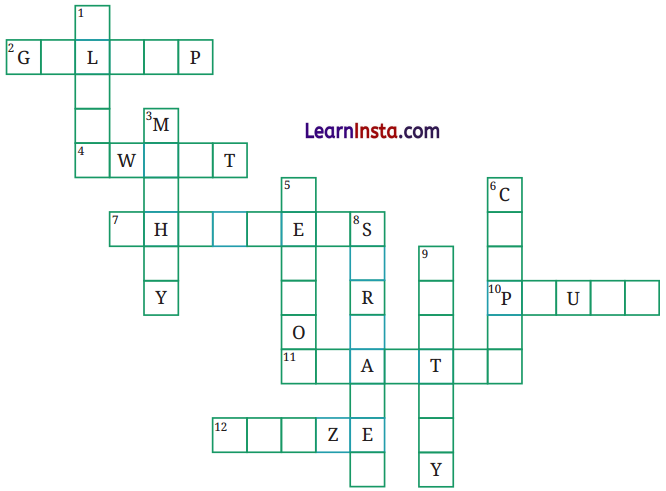
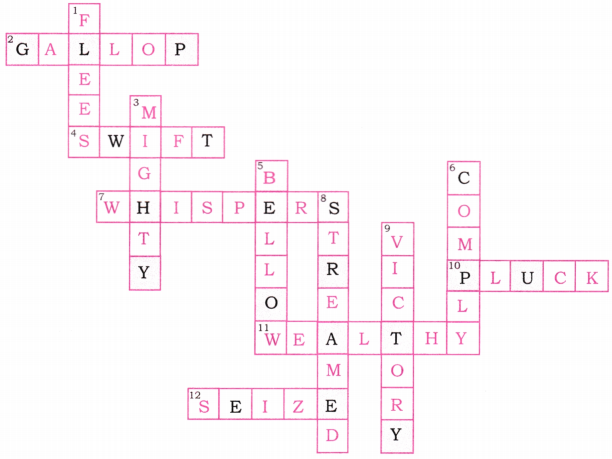
II. Fill in the crossword. Clues have been given below. You will find the words in the poem.
| Across | Down |
| 2. the fastest pace of a horse. | 1. runs away from a place |
| 4. happen fast | 3. possessing a great deal of strength or power |
| 7. speaks very softly | 5. a deep loud shout in pain or anger |
| 10. take hold of (something) and quickly remove it from its place | 6. to act according to rules |
| 11. having a lot of money; rich | 8. moved in a continuous flow in a specified direction |
| 12. take hold of something suddenly and forcibly | 9. a win after overcoming an enemy |
Answer:
III. There are certain expressions that convey a sudden feeling or reaction.
They can be used to express a variety of emotions and thoughts.
Example:… he whispers. “Hush!”
(‘Hush’ denotes the act of silencing someone) Now, match the expressions in Colum 1 with what emotions or reactions they convey, in Column 2.
Now, create sentences using any five expressions from Column 1.
| Column 1 | Column 2 |
| 1. Phew! | (i) surprise |
| 2. Eek! | (ii) pain |
| 3. Ouch! | (iii) mistake |
| 4. Yippee! | (iv) attract attention |
| 5. Whoa! | (v) relief |
| 6. Oops! | (vi) delight |
| 7. Hey! | (vii) alarm |
Answer:
Sentences using expressions from Column 1 are as follows.
1. Phew! We finally reached the top of the hill. That was a long climb!
2. Eek! There’s a mouse under the table!
3. Ouch! I just stepped on a sharp rock!
4. Yippee! We’re going on a school trip tomorrow!
5. Whoa! That was amazing!
6. Oops! I spilled water all over my homework.
7. Hey! What’s up! I need to talk to you.
| Column 1 | Column 2 |
| 1. Phew! | (v) relief |
| 2. Eek! | (vii) alarm |
| 3. Ouch! | (ii) pain |
| 4. Yippee! | (vi) delight |
| 5. Whoa! | (i) surprise |
| 6. Oops! | (iii) mistake |
| 7. Hey! | (iv) attract attention |
The Magic Brush of Dreams Question Answer Class 8 – Let us Listen(Page 132)
I. You will listen to five speakers speak about a magical power they wish for. As you listen, match statements 1-7 with speakers (i)-(ii). There are two statements you do not need. (Transcript for teacher on page 152 )
Speaker (i) : If I could have any magical power, I’d choose the ability to predict the future. Imagine being able to see profis and losses before time. I could make better savings and secure my business. Plus, I’d use it to help others make wise fiancial decisions as well.
Speaker (ii) : I think having the power to learn instantly would be amazing! Exams would be easy, and I’d have more time for activities I enjoy, like playing cricket. If I could remember everything, it would make life so much easier!
Speaker (iii) : I would want the power of fling. Imagine being able to see the world from up above clearly. I would be able to go from one place to another quickly without using any means of transport. It would be a dream come true.
Speaker (iv) : At my age, I’d love to have the power of healing. There are so many aches and pains that come with growing old, but it’s not just for me. If I could heal others too, I’d help myfamily stay healthy and happy.
Speaker (v) : If I had a magical power, I’d want control over the weather. We depend so much on the rains. With this power, I could ensure that crops always get the right amount of rain and sunshine.
| Statements | Speaker No. |
| 1. Power of healing ailments | |
| 2. Ability to end poverty in the world | |
| 3. Power to control the weather as per need | |
| 4. Ability to make wise business decisions | |
| 5. Power to predict one’s own future clearly | |
| 6. Ability to remember information quickly | |
| 7. Power to move around without using vehicles |
Answer:
| Statements | Speaker No. |
| 1. Power of healing ailments | (iv) |
| 2. Ability to end poverty in the world | ✗ |
| 3. Power to control the weather as per need | (v) |
| 4. Ability to make wise business decisions | (i) |
| 5. Power to predict one’s own future clearly | ✗ |
| 6. Ability to remember information quickly | (ii) |
| 7. Power to move around without using vehicles | (iii) |
Class 8 English Chapter 8 Question Answer – Let us Speak (Page 133)
I. Intonation is the rise and fall of the pitch of tone while speaking.
| GRAMMAR SPEAKING TIPS
Intonation refers to the rise and fall of the voice when speaking. It plays a crucial role in conveying emotions, emphasis, and meaning in spoken language. There are three main types of intonation patterns: 1. Falling Intonation – Used in statements and commands 2. Rising Intonation – Common in yes/no questions 3. Fall-Rise Intonation – Often used to express uncertainty or politeness Intonation helps listeners understand the speaker’s attitude and intention. |
II. Work in pairs. Take turns to make requests for the following formal and informal situations.
Formal requests
| Situation 1 | Situation 2 | Situation 3 |
| You request your teacher to organise a class picnic. | You request your class teacher for an extra sports period, since you missed it last week. | You request your Activity in charge teacher to include you in the upcoming inter-school event. |
Informal requests
| Situation 1 | Situation 2 | Situation 3 |
| You request your sibling to help you with the completion of your project. | You request your mother to enroll you in a dance class. | You request your cousin to come over to spend the weekend with you. |
Formal Informal
| Formal | Informal |
|
|
Answer:
Students to do as directed.
NCERT Class 8 English Poorvi Chapter 8 Question Answer – Let us Write (Pages 134-135)
I. Imaginative essay is a type of creative writing where the writers use their imagination. An imaginative essay can be based on real-life events, observation, or experiences. It is usually a descriptive piece or a personal reflection.
Read the sample of an imaginative essay.
My Life as EcoFlash
Imagine an ordinary 13-year-old student who is also a secret superhero protecting the environment. That’s my life as EcoFlash! By day, I’m Meenu, an ordinary Grade 8 student. By evening, I use my powers to keep my neighbourhood green and clean.
As EcoFlash, I have the ability to grow plants, purify water, and clean polluted air with a wave of my hand. I wear a green suit with a glowing leaf symbol and carry a small seed pouch that holds magic seeds to restore damaged areas. My mission is to fight pollution, save trees, and educate people about taking care of our planet. My friends wonder why I’m always carrying a plant in my bag or why my shoes are muddy, but I can never tell them the truth.
Once, my little brother saw me turning a garbage dump into a beautiful garden and almost spilled my secret to our parents. I had to convince him it was a magic trick!
Being EcoFlash is not just about powers but also responsibility. Every time I see clean streets, blooming flwers, and children playing in green parks, I feel proud. I know that even small changes can make a big diffrence, and that’s what keeps me going.

|
GOLDEN WRITING TIPS An imaginative essay is a type of creative writing that allows the writer to explore ideas beyond reality, using their imagination to craft a compelling story or scenario. Unlike factual essays, imaginative essays often involve fictional elements, fantasy, or hypothetical situations. They can be based on real- life experiences but are enhanced with creativity, vivid descriptions, and unique perspectives. For practice, refer page No. 345 in Writing Section under the heading Imaginative Essay. |
II. Complete the given checklist based on your observations and understanding of what an imaginative essay includes. Share the answers with your classmates and teacher.
1. Title — A relevant title
2. Introduction
- Captivating opening sentence to catch the reader’s attention
- Clear statement of the setting, situation, or main idea
- Establishes the tone (e.g., playful, serious, and adventurous)
- Introduces the narrator briefl (if applicable)
3. Setting and Context
- Description of the setting to create a mental picture
- Clear time frame (past, present, or future)
- Brief explanation of any unique or imaginative elements (e.g., powers, fantasy world)
4. Characters
- Main character introduced with unique traits
- Supporting characters briefl described (if relevant)
5. Central Idea
- Clear focus on a single powerful idea or narrative
- Logical flw of events, even if the story involves imagination or fantasy
6. Language and Style
- Use of sensory details (sight, sound, touch, smell, and taste) to enhance the narrative
- Creative metaphors or similes to enrich descriptions
7. Resolution
- Key turning point or moment of realisation
- Resolution of the main idea
- Clear takeaway message
8. Conclusion
- Ends on a reflctive or thought-provoking note
- Summarises the main message or leaves the reader with a strong final impression
III. Write an imaginative essay on any one of the following.
Question 1.
Imagine you were a scarf that flew away from a clothesline. Describe the places you travelled to and how you came back. Also write about what you thought was the most valuable experience.
Answer:
My Adventure as a Flying Scarf
One sunny afternoon, I was hanging on the clothesline, enjoying the breeze. Suddenly, a strong wind blew me off the line, and I started flying through the air. At first, I felt scared, but then I began to enjoy the ride as I was carried away by the wind.
I first flew over a busy street, looking down at the people walking quickly and the cars moving fast. I wished I could stop and say hello, but the wind carried me farther. Next, I passed over a park where children were playing. They looked up and smiled at me as I floated by, which made me feel happy.
After that, the wind took me over a peaceful countryside. The fields were full of flowers, and the air was fresh and calm. I felt relaxed and at peace as I floated along. Finally, the wind began to slow down, and I gently landed in a quiet garden near a pond. I rested there for a while, enjoying the calmness around me. Soon, a kind woman saw me, picked me up and took me home. She washed me and hung me back on the clothesline.
Looking back on my adventure, I realised that I had learned something important. Life can take us to unexpected places, and we may not always be in control. But we can enjoy the journey and learn from the changes we go through. No matter where life takes us, there is always something good to find along the way.
Question 2.
Imagine you stumbled upon a magical book in the library. The book transported you to a different time period. Describe your experience and an important learning.
Answer:
The Time-Travelling Magical Book
One quiet afternoon, I was browsing the dusty shelves of our old school library. Most books looked ordinary, but one stood out. It had a shimmering golden cover with swirling patterns, and the title read “The Doorway of Time.”
Curious, I opened it — and everything around me spun like a whirlwind. When I opened my eyes, I was no longer in the library.
I found myself standing in a bustling marketplace, surrounded by people in robes and sandals. The air smelled of fresh bread and spices, and the buildings were made of stone and wood. A man nearby shouted, “Welcome to ancient Egypt!” I was stunned. Somehow, the book had taken me to the past!
As I walked through the narrow lanes, I saw pyramids in the distance. I met a young boy named Khemu, who invited me to his home. He told me stories about building the pyramids and studying the stars. People used simple tools and worked hard, yet they were happy and proud of what they built. I helped Khemu carry water from the Nile and tasted strange but delicious food his mother cooked.
Suddenly, the book in my pocket began to glow. It pulled me into another whirlwind, and I landed in a completely different place — a futuristic city! There were flying cars, robots teaching in classrooms, and gardens on top of buildings. A friendly robot guided me around and showed how people used technology to solve problems like pollution and hunger.
After a while, the book glowed again and brought me back to the library. The whole adventure had lasted only a few minutes in real time, but I had experienced centuries of history and the future.
Looking back, I realised something important: every time period has its own strengths and struggles. People in the past used teamwork and wisdom, while those in the future used innovation and care for the planet. No matter the era, learning, kindness, and curiosity connect us all.
The magical book is back on the shelf, waiting for its next reader. But I now know that the greatest adventures come not just from reading, but from understanding and learning from the past, present, and future.
Class 8th English Chapter 8 The Magic Brush of Dreams Question Answer – Let us Explore (Page 136)
I. Have you heard of India’s famous magician, P. C. Sorcar Sr.? He is known as one of the ‘World’s Greatest Magician’ and performed live magic shows in front of audiences and on television, internationally.

He was awarded Padma Shri on 26 January 1964 for his contribution to the world of magic.
II. Words can also play tricks. Read the riddles about things that seem to be unreal and find what they refer to.
1. I can fill a room, but I take up no space. I’m often heard, but never seen. What am I?
2. The more you take, the more you leave behind. What am I?
3. I have cities but no houses, I have forests but no trees. What am I?
4. I’m tall when I’m young and short when I’m old, in a dark room, my story is told.
Answer:
1. Air
2. Footsteps
3. Map
4. Candle
III. You are asked to create a magical object. What object would you create? Make a drawing with all its details and mention its special quality on the same sheet. Put up the sheet on the display board.
Answer:
(Suggestive Answer)
I would create a Magic Crystal. This small, deep blue crystal has the power to heal both physical and emotional wounds. When placed near an injury, it speeds up healing and reduces pain. It also brings calm and peace, helping to ease stress and sadness. To use it, simply hold the crystal and focus on the area that needs healing. After use, it recharges under the moonlight. While it can’t heal severe injuries instantly, it helps promote recovery and emotional balance.