Teachers guide students to use Exploring Society India and Beyond Class 7 Solutions and Class 7 Social Science SST Chapter 7 The Gupta Era An Age of Tireless Creativity Question Answer NCERT Solutions for quick learning.
Class 7 Social Science Chapter 7 Question Answer The Gupta Era An Age of Tireless Creativity
NCERT Class 7 Social Science Chapter 7 The Gupta Era An Age of Tireless Creativity Questions and Answers Solutions
The Gupta Era An Age of Tireless Creativity Class 7 Question Answer (In-Text)
The Big Questions? (Page 145)
Question 1.
Who were the Guptas? Why is the Gupta period sometimes called the ‘classical age’ in Indian history?
Answer:
The Gupta Empire ruled India from AD 320 to AD 540.
Important rulers during this period included:
Chandragupta I (320 – 335 CE)
Samudragupta (335/336-375 CE)
Chandragupta II (376 – 413/415 CE)
Kumaragupta I (415 – 455 CE)
Skandagupta (455 – 467 CE)
The Gupta period is often referred as the ‘classical age’ of Indian history because:
- It was remarkable for all-round development in administration, art, culture, econorqy, medicine, literature, education and astronomy.
- The famous universities of Taxila and Nalanda located near Rawalpindi and in Bihar respectively, flourished during this time.
- The temple of Bhitrigaon in Kanpur, Bhitari temple in Ghazipur, and Deogarh temple in Jhansi are examples of fine architecture.
- Aryabhata, a famous astronomer and mathematician, along with Varahamihira, were eminent astronomers. Charaka and Sushruta were excellent scholars of Ayurveda.
- The ‘Iron Pillar’ in New Delhi is the proof of high-level metallurgy due to its high quality iron.
- Highly talented poets during that period were Kalidasa and Harisena. Sanskrit literature flourished with Kalidasa’s works and many major Puranas.
- Besides this, many of the major Puranas were compiled or coded during this period. Thus, it was the ‘classical age’ or the Golden Period of Indian history.

Question 2.
What was happening in the rest of the subcontinent at this time?
Answer:
- During the Gupta Period, the rest of the subcontinent witnessed the rise of regional powers and the continued influence of Buddhism and Jainism.
- In southern dynasties such as the Pallavas and Cholas emerged and contributed to regional art, architecture trade and culture.
Question 3.
Who were some great figures of this period, and why do their stories matter today?
Answer:
The Gupta Age, witnessed a flourishing culture and knowledge, with many great figures. Among the most notable were Kalidasa, a celebrated poet and dramatist, Aryabhata, a pioneering mathematician and astronomer, and Varahamihira, known for his contributions to astronomy and astrology. Their achievements continue to resonate today because they showcase the intellectual and artistic brilliance of the era, and their works have had lasting impacts on science, literature, and culture.
Let’s Explore
Question 1.
In the Grade 6 chapter ‘Timeline and Sources of History’, we listed multiple sources that help us understand the past. Compile a list of the sources we haw referred to so far in the chapter. What did we learn from each source? (Page 151)
Answer:
| List of the sources | Things we learned |
| 1. Iron pillar of Qutub Minar (in Fig. 7.3) | The pillar was erected during the reign of Chandragupta II, a ruler of the Gupta dynasty. It weighs six tons and was probably erected first in front of the Udayagiri caves (Madhya Pradesh) and later brought to Delhi. It was dedicated to Lord Vishnu, and its inscriptions celebrate the king’s achievements. |
| 2. Gold coin featuring King Chandragupta I with his queen,Kumaradevi; on the reverse side, a seated goddess identified as Lakkhmi. (in Fig. 7.4) | This gold coin shows evidence of the king’s prosperity, political authority, and religious beliefs. He was a worshipper of Lord Vishnu and Goddess Lakhsmi. |
| 3. Prayaga Prashasti, pillar inscription at Prayagraj by the court poet of Samudragupta, Chandragupta II’ father | It informs us that the King Samudragupta believed in the idea of The United Earth’. He fought and defeated many kingdoms. The king supported art, learning and trade. |
| 4. In Fig. 7.6, a seated Samudragupta, playing the veena; on the reverse side, goddess Lakshml is shown. | The king supported the art and worshipped Goddess Lakshmi, the goddess of prosperity and wealth. |
| 5. In Fig. 7.7, the coin shows the sacrificial horse of the ashvamedha yajna one side, and the queen holding a chauri on the other. | This shows that ambitious kings sometimes performed the ashvamedha yajna to build mighty empires and leave a legacy for the successors. Such a significant event was commemorated by minting special coins. |
| 6. Some literary sources – such as, The Vishnu Purana. | It provides descriptive information about rulers, kingdoms and the people. It specifies the key regions of the empire: the Gupta dynasty ruled over Anuganga (the Middle-Gangetic Basin), Prayaga (present-day Prayagraj), Saketa (Ayodhya), and Magadha (Bihar) and all the surrounding regions. |
Question 2.
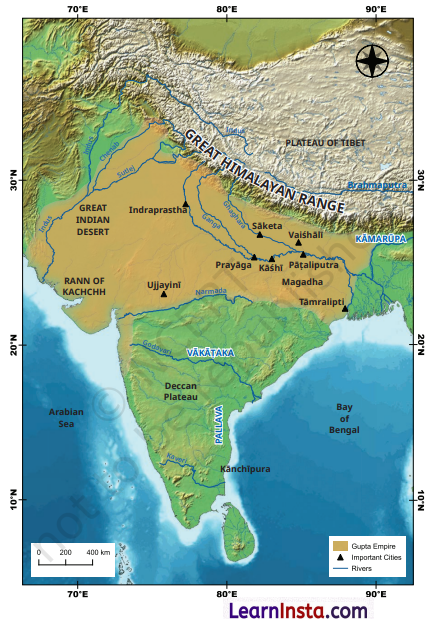
Take a political map of India and locate the present-day states and Union territories where the Guptas ruled (see Fig. 7.8). Mark these states on the map and count how many you found. Then, compare your findings with your friends to see if everyone got the same number or discovered something different! (Page 151)
Answer:
The present-day states and Union Territories where the Guptas ruled include:
Punjab, Haryana, Rajasthan, Delhi, Uttar Pradesh, Gujarat, Madhya Pradesh, Bihar, Jharkhand, and West Bengal.
The Union Territories include Chandigarh, Dadra and Nagar Haveli and Daman and Diu, and Jammu and Kashmir.
Question 3.
Below is an excerpt from his travelogue, where he records his observations of the society in the Gupta era. (Page 153)
The people are numerous and happy [ … ] they have no need to register house holds or attend to officials. [ … ] Those who farm royal land pay a portion of their grain. [… ] The king’s guards and attendants have salaries [ … ] The cities are the greatest in the Middle Kingdom [i.e. the Gangeticplains], and the inhabitants are rich, prosperous, and practice kindness and righteousness. Heads of Vaishya families [i.e. merchants or traders] establish houses for charity and medicines [ … ] the poor, orphans and the sick are cared for [ … ] doctors provide treatment, and the needy receive food and medicines. [… ] The city has many wealthy Vaishya elders and foreign merchants, with beautiful homes […] The lanes are kept in good order.
– A Record of Buddhistic Kingdoms (AD 399-414) (Translated by J. Legge)
Read the excerpt from Faxian given above and identify the key features of the society he describes. Write down your observations and compare your notes with your friends—you might be surprised to see how differently oth¬ers interpret the same text! (Page 153)
Answer:
From the excerpts of Faxian’s travelogue, the main features of the society he described are as follows:
- People were generally happy as they don’t have to attend any officials and register their households.
- Salaries were given to the King’s staff like guards, attendants and others.
- In the middle kingdom, people in cities were rich, prosperous and kind.
- Many Vaishya family heads and merchants did charity for poor, orphans and sick people by providing food, medicines and treatment.
- The City had beautiful home in well ordered lanes built by wealthy Vaishya and foreign merchants.
Question 4.
Observe the painting of Prabhavati Gupta sitting in her court (Fig. 7.10). Take note of the details-her attire, posture, the people around her, and the setting of the court. What do these elements tell you about her life, role, and the time she lived in? Discuss your observations in groups and share your insights with the class.

Answer:
The daughter of Samudragupta became the caretaker queen of her two sons after her husband, the prince of Vataka Kingdom, died. As queen, she sits in her court with her son. Her posture shows that she is a kind and righteous queen who makes fair judgements. People have come to her with their problems hoping for a fair judgement. She managed the kingdom as a regent ruler besides raising her children.
Question 5.
Let’s join Bhavisha and Dhruv – with their time machine in the time of the Guptas. You are getting an opportunity to ‘ meet Aryabhata and Varahamihira-what would you ask them? Divide the class into two groups and create a series of questions for an interview with them. (Page 159)
Answer:
Let’s go back to the Gupta era with Bhavisha and Dhruv to meet two great minds- Aryabhata and Varahamihira-for a special interview!
Questions for Aryabhata:
- Bhavisha: Sir Aryabhata, what inspired you to write the Aryabhatlya at the age of 23?
- Dhruv: How did you discover that the Earth rotates on its axis when most people believed that Sun rotate around Earth.
- Bhavisha: What made you think of using the number zero, and how did you explain it to others?
- Dhruv: Your calculation of n (pi) was incredibly accurate for your time—how did you achieve that?
- Bhavisha: What was your biggest challenge while studying the stars and planets without modern instruments?
- Dhruv: Do you believe math can explain everything in the universe?
- Bhavisha: What message would you like to give to today’s students of science and math?
Questions for Varahamihira:
- Bhavisha: Respected Varahamihira, how did you manage to master so many subjects—from astronomy to astrology to architecture?
- Dhruv: What inspired you to write the Brihat Samhita, which includes science, nature, and daily life?
- Bhavisha: How did you balance scientific thinking with traditional beliefs and astrology?
- Dhruv: What role did observation and experience play in your studies?
- Bhavisha: Which of your discoveries do you think had the most impact on people’s lives?
- Dhruv: What would you say to future generations who want to understand the world as you did?
Question 6.
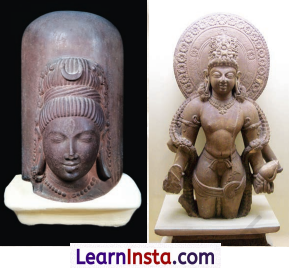
Take a close look at the samples of Gupta sculptures shown in Fig 7.15.1. and 7.15.2. By looking at the attributes, can you guess which deities are depicted here? Write your observations in the space provided and share your thoughts during the class discussion! (Page 160)
Answer:
The first sculpture, depicted in figure 7.15.1, is of Lord Shiva. On his forehead, the third eye is visible. His hair is tied up in the shape of a jata. On his jata, we can see the Ardha Chandra (crescent moon). The face of Shiva is carved on a stone Shiva Linga. The second sculpture, depicted in Figure 7.15.2, is of Lord Vishnu. His four hands are visible, holding a shankha (conch), chakra (discus), gada (mace), and padma (lotus). A serpent-like structure of Shesh Nag can be seen around him. A stone halo is visible at the back of his head.
Question 1.
Why do you think kings chose to proclaim their achievements in the form of inscriptions? (Page 150)

Answer:
The Kings chose to proclaim their achievements in the form of inscriptions to ensure their legacy lasts for upcoming generations. Inscriptions carved on stone or metal helped them immortalise their deeds, showing their power and authority. By placing these inscriptions in public spaces, like temples, they could also connect their rule to divine favour and legitimacy. These inscriptions served as official records, documenting victories, laws, and important events. They also helped inspire loyalty among their subjects and remind people of the king’s strength. Ultimately, it was a way for kings to secure their place in history and show their importance to both their people and future generations.
Class 7 SST Chapter 7 The Gupta Era An Age of Tireless Creativity Question Answer (Exercise)
Questions and Activities (Page 165-166)
Question 1.
Imagine you receive a letter from someone living in the Gupta Empire. The letter starts like this:
“Greetings from Pataliputra! Life here is mbrant and full of excitement. Just yesterday, I witnessed …” Complete the letter with a short paragraph (250-300 words) describing life in the Gupta Empire.
Answer:
Greetings from Pataliputra! Life here is vibrant and full of excitement. Just yesterday, I witnessed a grand festival dedicated to Lord Vishnu. The streets were alive with music and chanting, while temples were beautifully decorated with flowers and incense. Dancers performed stories from our ancient epics, and artisans displayed their finest work, from intricate sculptures to colourful textiles.
The city is a marvel, with well-planned streets, bustling markets, and public spaces that encourage trade and socialising. Merchants from distant lands bring spices, textiles, and gems, while we export cotton and ivory. It’s a prosperous time, and even the poor have access to hospitals and rest houses.
Intellectual life is thriving too. Scholars and scientists are highly respected, and just yesterday, I attended a lecture on astronomy where the movements of the stars were explained with impressive accuracy. Life in Pataliputra is a perfect blend of culture, spirituality, and progress, and I feel fortunate to live in such a golden age.
I hope to hear from you soon. Until then, may you be blessed with peace and prosperity.
With warm regards,
Samiksha
Question 2.
Which Gupta ruler was also known as the ‘Vikramaditya’?
Answer:
Chandragupta II is known as Vikramaditya.
Question 3.
“Periods of peace support the development of various aspects of sociocultural life, literature, and the development of science and technology.’ Examine this statement in the light of the Gupta empire.
Answer:
The Gupta Empire, which ruled from the 4th to the 6th century CE, is known as the “Golden Age of India” due to its long period of peace and prosperity. This peaceful time created the ideal environment for the growth of sociocultural life, literature, science, and technology. People were free from frequent wars, which allowed them to focus on education, art, and innovation. Great scholars like Aryabhata made remarkable progress in mathematics and astronomy, while Varahamihira contributed to science and astrology.
Sanskrit literature flourished, with Kalidasa producing famous plays and poems. Temples and sculptures reflected the artistic skills of the time. Trade and agriculture also developed, helping the economy grow. The peace during the Gupta rule gave people the freedom to think, create, and explore new ideas. As a result, this period saw outstanding achievements in many fields, showing how peace supports overall progress in society.
Question 4.
Recreate a scene from a Gupta ruler’s court.
Write a short script, assign roles like – the king, ministers, and scholars, and enact a role play to bring the Gupta era to life!
Answer:
Here’s a short and fun classroom role-play script set in the court of Chandragupta II, one of the most famous rulers of the Gupta Empire. You can adapt it for your classmates and keep it lively and educational!
Scene: The Court of Chandragupta II (Vikramaditya)
Setting: A royal court with the king seated on a grand throne. Ministers, scholars, and guards stand around. The atmosphere is peaceful and scholarly.
Characters & Roles:
- King Chandragupta II (Vikramaditya) – Wise and generous ruler
- Minister Hariaena – The king’s chief advisor and court poet
- Aryabhata – Renowned mathematician and astronomer
- Kalidasa – Great poet and playwright
- Court Guard – Announces visitors
- Scholar 1 & Scholar 2 – Present knowledge and inventions
- Audience/Court Members – Optional roles for extra students
Script:
- Court Guard (bowing): Your Majesty, welcome to another glorious day in your prosperous court!
- King Chandragupta II: Thank you, loyal guard. Let knowledge and wisdom shine in our kingdom today. Who seeks an audience?
- Court Guard: Great scholars have come to present their work, my lord.
- Minister Harisena: Your Majesty, may I present the brilliant mathematician, Aryabhata.
- Aryabhata (bowing): Greetings, Your Majesty. I bring you knowledge of the stars and numbers. I have written the Aiyabhatlya, where I explain that the Earth rotates on its axis and calculate the value of n.
- King: Impressive! Your work will guide future generations.
- Minister Harisena: Now presenting Kalidasa, our gifted poet.
- Kalidasa (with a scroll): My King, I humbly share verses from my new play Abhijnanashakuntalam. It celebrates love, nature, and the power of destiny.
King (smiling): Your words are like music, Kalidasa. They enrich the soul of our empire.
- Scholar 1: I am studying plants and medicine, Your Majesty. Ayurveda is growing under your patronage.
- Scholar 2: And I am developing new methods in architecture and town planning, inspired by your vision.
- King: This is the power of peace and wisdom! May our Gupta Empire continue to be the light of learning for the world.
- All (bowing): Long live Maharaj Vikramaditya!
Question 5.
Match the Columns.
| Column A | Column B |
| Kanchipuram | Known for vibrant cave paintings that depict the Jataka tales. |
| Ujjayini | Famous for rock-cut caves featuring intricate carvings of Hindu deities, especially Vishnu. |
| Udayagiri | Capital of the Guptas. |
| Ajanta | Known as ‘a city of a thousand temples’. |
| Pataliputra | A prominent centre of learning in ancient India. |
Answer:
| Column A | Column B |
| (1) Kanchipuram | (d) Known as ‘a city of a thousand temples’. |
| (2) Ujjayini | (e) A prominent centre of learning in ancient India. |
| (3) Udayagiri | (b) Famous for rock-cut caves featuring intricate carvings of Hindu deities, especially Vishnu. |
| (4) Ajanta | (a) Known for vibrant cave paintings that depict the Jataka tales. |
| (5) Pataliputra | (c) Capital of the Guptas. |
Question 6.
Who were the Pallavas and where did they rule?
Answer:
The Pallavas were an important dynasty in South India that ruled between the 3rd and 9th centuries CE. They governed parts of present-day Tamil Nadu, Karnataka, Telangana and Andhra Pradesh. Their capital was Kanchipuram, which became a major centre of learning, art, and architecture. The Pallavas are especially known for their rock- cut temples at Mahabalipuram.
Question 7.
Organise an exploration trip with your teachers to a nearby historical site, museum, or heritage building. After the trip, write a detailed report describing your experience. Include key observations about the site’s historical significance, the architecture, artefacts, and any interesting facts you learned during the msit. Reflect on how the trip enhanced your understanding of history.
Answer:
Report on Visit to the Iron Pillar (Gupta Period Monument)
Date: 25.09.2025
Place: Qutub Minar, Mehrauli, Delhi
Last week, I visited the Qutub Minar with my family, and the most interesting structure I saw there was the Iron Pillar. It is a very old and unique monument from the Gupta period, which is known as the “Golden Age” of Indian history. The pillar is more than 1,600 years old and is a remarkable example of the scientific and artistic achievements of ancient India.
The 6-tonne Iron Pillar was built during the reign of Chandragupta II, one of the greatest rulers of the Gupta dynasty. It is made of iron and stands approximately 7 metres tall. What makes it especially notable is that it has not rusted, even after so many centuries. This demonstrates how advanced metallurgy was during the Gupta period. There is an ancient Sanskrit inscription on the pillar, written in Brahmi script. It states that the pillar was erected in honour of Lord Vishnu and also praises a great king, believed to be Chandragupta II. The pillar is beautifully crafted and reflects the high level of skill possessed by the metalworkers of that time.
Although the Iron Pillar is now located within the Qutub Complex, it belongs to a much earlier time than the Qutub Minar. It was probably brought to this complex from Udayagiri caves in Madhya Pradesh, a few centuries before. Seeing it made me feel proud of our country’s rich historical heritage. It reminded me of how intelligent and technically skilled the people of ancient India were during the Gupta period. I thoroughly enjoyed learning about the Iron Pillar and the Gupta dynasty. It was an educational and enjoyable trip, and I hope to visit more such historical sites in the future. ‘