Experts have designed these Class 9 Maths Notes and Chapter 12 Quadrilaterals Class 9 Ganita Manjari Notes for effective learning.
Class 9 Maths Chapter 12 Quadrilaterals Notes
Class 9 Maths Ganita Manjari Chapter 12 Notes
Ganita Manjari Class 9 Chapter 12 Notes
Quadrilateral:
For four distinct points A, B, C, and D in a plane with no three collinear, the quadrilateral ABCD is a collection of all points on segments AB, BC, CD, DA provided every point other than A, B, C, and D lies on exactly one of these four segments.
- A quadrilateral is convex when all of its internal angles are less than 180°, or equivalently, when its diagonals intersect.
- The following converse statements about parallelograms are true:
- If the opposite sides of a 4-gon are equal, then it is a parallelogram.
- If the opposite angles of a 4-gon are equal, then it is a parallelogram.
- If the diagonals of a 4-gon bisect each other, then it is a parallelogram.
- If a pair of opposite sides of a 4-gon are equal and parallel, then it is a parallelogram.
- The Midpoint Theorem: the line joining the two midpoints of any two sides of a triangle is parallel to the third side and has half the length of the third side.
- A Converse to the Midpoint Theorem: the line passing through the midpoint of a side of a triangle and parallel to a second side bisects the third side.
- Medians of a triangle are concurrent and the point of concurrence, called the centroid, divides each median in a 2 : 1 ratio.
- The 4-gon formed by joining, the midpoints of a given 4-gon is always a parallelogram.
- The plane can be tiled with any given 4-gon.
Quadrilateral
A quadrilateral is a figure formed by four distinct points in a plane joined by four line segments such that every point other than the vertices lies on exactly one of these segments.
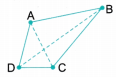
Important Terms
| Term | Meaning | Example |
| Vertices | The four comer points of a quadrilateral | A, B, C, D |
| Sides | The four line segments forming the quadrilateral | AB, BC, CD, DA |
| Angles | The four angles formed by pair of sides of a quadrilateral | ZA, ZB, ZC, ZD |
| Diagonals | Line segments joining opposite vertices | AC and BD |
| Adjacent vertices | Vertices having a common side | A, B; B, C; C, D* D, A |
| Adjacent sides | Sides having a common vertex | AB, BC; BC, CD; CD, DA; DA, AB |
| Opposite sides | Sides without a common vertex | AB, CD; BC, AD |
| Opposite angles | Angles without a common side | ZA, ZC; ZB, ZD |
Classification of Quadrilaterals (4-Gons)
Convex Quadrilateral: A quadrilateral is convex if all its internal angles are less than 180° and diagonals intersect within the interior [Fig. (i)].
Non-convex Quadrilateral: A quadrilateral is non-convex if an internal angle is greater than 180°. Its diagonals do not intersect internally [Fig. (ii)].
Self-Intersecting Quadrilateral: Two non-adjacent sides cross each other [Fig. (iii)].
Non-Planar (Skew) Quadrilateral: Vertices do not all lie in a single plane [Fig. (iv)].

Figures having 4 vertices and 4 sides
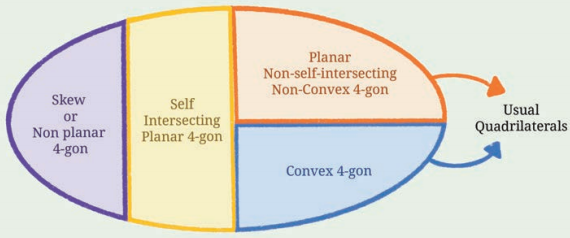
Venn Diagram Representation
Parallelograms
A parallelogram is a quadrilateral whose opposite sides are parallel.
Theorems Based on Parallelograms
Theorem 1:
(a) The opposite sides of a parallelogram are equal.
(b) The opposite angles of a parallelogram are equal. .
(c) The diagonals of a parallelogram bisect each other.
Given: ABCD is a parallelogram.
Therefore, AB ∥ CD and AD ∥ BC
(a) To Prove: Opposite sides of a parallelogram are equal, i.e., AB = CD and AD = BC.
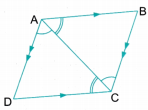
Construction: Draw diagonal AC.
Proof: In parallelogram ABCD, AB ∥ CD and AD ∥ BC
Consider ΔABC and ΔCDA
Since AB ∥ CD, ∠BAC = ∠DCA
Since AD ∥ BC, ∠BCA = ∠DAC
Also, AC = AC
Therefore, ΔABC ≅ ΔCDA
Hence, AB = CD and AD = BC
Thus, the opposite sides of a parallelogram are equal.
(b) To Prove: Opposite angles of a parallelogram are equal, i.e., ∠A = ∠C and ∠B = ∠D.
Proof: ΔABC ≅ ΔCDA (Proved above)
Therefore, ∠B = ∠D (CPCT)
Also, ∠BAC + ∠DAC = ∠DCA + ∠BCA
⇒ ∠A = ∠C
Thus, opposite angles of a parallelogram are equal.
(c) To Prove: The diagonals of a parallelogram bisect each other, i.e., AO = OC and BO = OD, where diagonals AC and BD intersect at O.
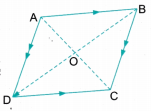
Construction: Draw diagonals AC and BD, intersecting at O.
Proof: In ΔAOB and ΔCOD,
∠ABO = ∠CDO . (Alternate interior angles)
∠BAO = ∠DCO (Alternate interior angles)
AB = CD (Proved in part (a))
Therefore, ΔAOB ≅ ΔCOD (By ASA congruence)
Hence, AO = OC and BO = OD (CPCT)
Thus, the diagonals of a parallelogram bisect each other.
Hence, all three properties of a parallelogram are proved.
Converse of Theorems
Theorem 2: A quadrilateral is a parallelogram, if its opposite sides are equal. Let ABCD be a quadrilateral such that AB = DC and AD = BC.
Then, ABCD is a parallelogram.
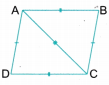
Theorem 3: A quadrilateral is a parallelogram, if its opposite angles are equal. Let ABCD be a quadrilateral such that ∠A = ∠C and ∠B = ∠D.
Then, ABCD is a parallelogram.
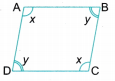
Theorem 4: A quadrilateral is a parallelogram, if its diagonals bisect each other. Let ABCD be a quadrilateral whose diagonals AC and BD intersect each other at E, such that AE = EC and BE = ED, ABCD is a parallelogram.
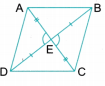
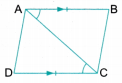
Theorem 5: A quadrilateral is a parallelogram, if one pair of opposite sides is equal and parallel. Let ABCD be a quadrilateral such that AB ∥ DC and AB = DC. Then, ABCD is a parallelogram.
Applications of Parallelograms
Parallelograms are used in:
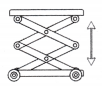
Mechanical linkages
Parallelogram linkages are used in lifting machines, such as scissor lifts, to keep the platform horizontal while moving up or down.
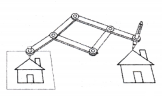
Pantographs
A pantograph uses parallelograms to copy and enlarge or reduce a drawing while keeping the same shape.
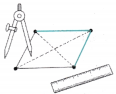
Geometry constructions
Parallelograms are commonly used in geometrical constructions to create parallel lines, equal lengths and other geometric figures.
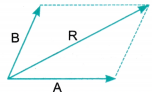
Combining physical quantities such as forces
The parallelogram law of vectors is used to find the resultant of two forces acting at a point.
Theorem 6: Midpoint Theorem
The segment joining the midpoints of two sides of a triangle is parallel to the third side and has half the length Proof: We have ΔABC in which D and E are the midpoints of AB and AC respectively.
Let us join DE and produce it. Draw CF ∥ BA to meet DE (produced) in F.
We have to prove that DE = \(\frac{1}{2}\)BC and DE ∥ BC.
Now, in ΔAED and ΔCEF, we have
AE = CE [Given]
∠AED = ∠CEF [Vertically opposite angles]
∠DAE = ∠FCE [∵ AB ∥ CF and AC is a transversal]
∴ ΔAED ≅ ΔCEF [ASA ceriteria]
⇒ Their corresponding parts are equal.
⇒ AD = CF and DE = EF
But
AD = BD [∵ D is midpoint of AB]
⇒ BD = CF
Also, BD ∥ CF [By construction]
∴ DF = BC and DF ∥ BC
⇒ \(\frac{1}{2}\)(DF) = \(\frac{1}{2}\)(BC) and DE ∥BC
⇒ DF = \(\frac{1}{2}\)BC and DE ∥BC [∵ DE = DF]
Hence, the line segment joining the midpoints of any two sides of a triangle is parallel to the third side and equal to half of it.
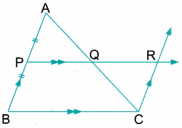
Theorem 7: Converse of the Midpoint Theorem
The line drawn through the midpoint of one side of a triangle and parallel to another side bisects the third side (and the resulting segment has half the length of the parallel side).
Theorem 8: Centroid Theorem
The three medians of a triangle pass through a common point called the centroid. The centroid divides each median in the ratio 2:1, where the longer part connects to the vertex.
Proof: Let ABC be a triangle. Let AD, BE and CF be the three medians of the triangle intersecting at point G.
To prove: AG : GD = 2:1= BG : GE
Construction: Find the midpoints of segment AG and BG, and label them P and Q, respectively. Join P to Q, Q to D, D to E, and E to P to form quadrilateral PQDE.
Proof: In ∆ABC, E is the midpoint of AC and D is the midpoint of BC. By the Midpoint Theorem,
DE ∥ AB and DE = \(\frac{1}{2}\)AB …(1)
In ∆ABG, P is the midpoint of AG and Q is the midpoint of BG. By the Midpoint Theorem,
PQ ∥ AB and PQ = \(\frac{1}{2}\)AB …(2)
From equations (1) and (2),
PQ ∥ DE and PQ = DE By Theorem 5, PQDE is a parallelogram.
The diagonals of PQDE are PD and QE, and they intersect at G.
By Theorem 1(c), PG = GD and QG = GE
From construction, P is the midpoint of AG, AP = PG
AP = PG = GD,
AG = AP + PG = 2GD ⇒ AG : GD = 2 : 1
Similarly, since Q is the midpoint of BG,
BQ = QG = GE
BG = BQ + QG = 2GE ⇒ BG : GE = 2 : 1
Theorem 9 (Midpoint Theorem for Quadrilaterals): The midpoints of the four sides of a quadrilateral are the vertices of a parallelogram. This is called the Varignon parallelogram of the original quadrilateral.
Proof: Let ∆BCD be a quadrilateral.
Let P, Q, R and S be the midpoints of AB, BC, CD, and DA respectively.
Join the diagonal AC.
In ∆ABC, P and Q are the midpoints of AB and BC respectively.
Therefore, by the Midpoint Theorem,
PQ ∥ AC and PQ = \(\frac{1}{2}\) AC …(1)
In ∆ADC, S and R are the midpoints of AD and DC.
Therefore, by the Midpoint Theorem,
SR ∥ AC and SR = \(\frac{1}{2}\) AC : …(2)
Hence, from (1) and (2) PQ ∥ SR and PQ = SR
Therefore, one pair of opposite sides of quadrilateral PQRS is equal and parallel.
By Theorem 5, PQRS is a parallelogram.
Hence, the midpoints of the four sides of a quadrilateral form a parallelogram, known as the Varignon parallelogram.
Tiling the Plane Using Any Quadrilateral.(4-Gon)
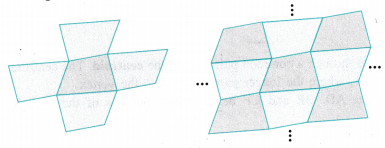
A plane can be tiled using any quadrilateral by arranging copies without gaps or overlaps. The chapter explains rotation-based methods and the role of the Varignon parallelogram in understanding such tilings.
Start with two copies of SOME, one exactly above the other. Rotate the top copy by 180° around the midpoint of OM. The rotated copy aligns with the original copy perfectly along the shared edge OM.
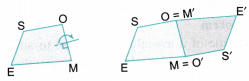
Now, repeat this procedure at each edge of every copy and extend as shown below:
1. The sum of four angles of a quadrilateral is 360°.
2. The quadrilateral formed by joining the midpoint of the sides of a quadrilateral in order is a parallelogram.
Common Errors
| Errors | Corrections |
| (i) Using incorrect fact that the diagonals of all the parallelograms are congruent. | (i) The diagonals of a parallelogram are only congruent when its all the angles are equal (for example, a square and a rectangle.) |
| (ii) Incorrectly interpreting that the arrows marked on the sides of a quadrilateral show congruent segments. | (ii) Arrows marked on the sides of a quadrilateral show parallel segments not congruent segments. |
| (iii) Incorrectly classifying the parallelograms. | (iii) Practice with classification of quadrilaterals to understand and remember all the properties of a quadrilateral. |
| (iv) Incorrectly interpreting that diagonals of a rectangle bisect each other at right angles. | (iv) Diagonals of a rectangle bisect each other but not at right angles. Diagonals of a rhombus and a square bisect each other at right angles. |
Class 9 Quadrilaterals Notes
Quadrilateral
A plane figure bounded by four line segments is called quadrilateral.
Properties:
- It has four sides.
- It has four vertices or comers.
- It has two diagonals.
- The sum of four interior angles is equal to 360°.

In quadrilateral ABCD, AB, BC, CD and DA are sides; AC and BD are diagonals and
∠ABC + ∠BCD + ∠CDA + ∠DAB = 360°.
Types of Quadrilaterals
1. Parallelogram: A quadrilateral whose each pair of opposite sides are parallel.
- AB || DC
- AD || BC

2. Rectangle: A parallelogram whose one angle is 90°. Diagonals are equal.

3. Rhombus: A parallelogram whose adjacent sides are equal.
Note: Diagonal bisect each other at 90°.

4. Square: A rectangle whose adjacent sides are equal (four sides are equal). Diagonal bisect each other at 90°.

5. Trapezium: A quadrilateral whose one pair of opposite sides are parallel. AB || DC

6. Kite: It has two pair of adjacent sides that are equal in length but opposite sides are unequal.

Note:
- One of the diagonal bisects the other at right angle.
- One pair of opposite angles are equal.
Properties of a Parallelogram
- Opposite sides are equal.
e.g., AB = DC and AD = BC - Consecutive angles are supplementary.
e.g., ∠A + ∠D = 180° - Diagonals of parallelogram bisect each other.
- Diagonal divide it into two congruent triangles. A B

Theorem 8.1: A diagonal of a parallelogram divides it into two congruent triangles.
Theorem 8,2: In a parallelogram, opposite sides are equal.
Theorem 8.3: If each pair of opposite sides of a quadrilateral is equal, then it is a parallelogram.
Theorem 8.4: In a parallelogram, opposite angles are equal.
Theorem 8.5: If in a quadrilateral, each pair of opposite angles of a quadrilateral is equal then it is a parallelogram.
Theorem 8.6: The diagonals of a parallelogram bisect each other.
Theorem 8.7: If the diagonals of quadrilateral bisect each other, then it is a parallelogram.
Theorem 8.8: A quadrilateral is a parallelogram if a pair of opposite sides is equal and parallel.
Mid-point Theorem
Theorem 8.9: The line segment joining the mid-points of two sides of a triangle is parallel to the third.
Given: A triangle ABC, E and F are mid-points of sides AB and AC respectively.
i.e., AE = EB and AF = FC
To Prove:
(i) EF || BC
(ii) EF = \(\frac{1}{2}\) BC
Construction: Draw a line through C parallel to AB and extend EF which intersect at D.

Proof: (i) In AAEF and ACDF,
AF = CF (F is the mid-point of AC)
∠AFE = ∠CFD (Vertically opposite angles)
∠EAF = ∠DCF (Alternate interior angles)
∴ ΔAEF = ΔCDF (by ASA congruency)
∴ AE = CD (by CPCT)
and BE = CD (AE = BE)
EF = FD (by CPCT);
Hence, BCDE is a parallelogram.
ED || BC )
∴ EF || BC
(ii) BCDE is a parallelogram.
DE = BC
EF + FD = BC
2EF = BC
EF=\(\frac{1}{2}\)BC
Converse of Mid-Point Theorem
Theorem 8.10: The line drawn through the mid-point of one side of a triangle, parallel to another side bisects the third side. ‘
Given: ΔABC in which E is the mid point of AB.
EF || BC
To Prove: AF = FC
Construction: Draw CD || AB and extend EF which intersect at D.
Proof: EF || BC
∴ ED || BC
AB || CD
⇒ BE || CD
∴ BCDE is a parallelogram.

Now in ΔAEF and ΔCDF, ∠AFE = ∠CFD (Vertically opposite angles)
∠EAF = ∠DCF (Alternate interior angles)
AE = CD (BE = AE opposite side of a parallelogram and BE = CD
∴ AAEF ≅ ACDF (by AAS congruency)
Hence AF = FC (by CPCT)