Students rely on Class 8 Science Extra Questions and Class 8th Curiosity Chapter 6 Pressure, Winds, Storms, and Cyclones Important Extra Question Answer to improve their grades.
Class 8 Science Chapter 6 Pressure, Winds, Storms, and Cyclones Extra Questions
Class 8 Science Chapter 6 Extra Questions on Pressure, Winds, Storms, and Cyclones
Pressure, Winds, Storms, and Cyclones Class 8 Very Short Question Answer
Question 1.
What do you mean by pressure?
Answer:
The force acting on a unit area of a surface is called pressure.

Question 2.
How can we increase the pressure by exerting same force?
Answer:
To increase pressure, we should exert the same force on a smaller area.
Question 3.
Do liquids also exert pressure on the walls of containers?
Answer:
Yes, liquids exert pressure on the walls of the containers.
Question 4.
What is atmosphere?
Answer:
The envelop of air surrounding the Earth is called atmosphere.
Question 5.
How far does the atmosphere extend above Earth’s surface?
Answer:
The atmosphere extends up to many kilometres above the Earth’s surface.
Question 6.
What happens if an inflated balloon is left open?
Answer:
The air escapes from the balloon.
Question 7.
Define a cyclone.
Answer:
A cyclone is a large storm that form over warm ocean water.
Question 8.
What is storm?
Answer:A storm is a strong wind accompanied by rain.
Question 9.
Which crop benefits from local thunderstorms in Karnataka?
Answer:
Coffee plants benefit from local thunderstorms in Karnataka.
Question 10.
Why does air flow between the two balloons stop after some time?
Answer:
Air flow stops when the air pressure in both balloons becomes equal.
Pressure, Winds, Storms, and Cyclones Class 8 Short Question Answer
Question 1.
We observe that the wheels of buses and trucks are heavier than the wheels of cars or scooters. Why?
Answer:
Buses and trucks are heavy, so they need to exert less pressure on the ground to avoid sinking. Pressure decreases as the area of contact increases, so their tyres are made broader to spread the weight over a larger area. In contrast, cars and scooters are lighter and have narrower tyres to maintain better grip on the road.
Question 2.
What is the use of a lightning conductor?
Answer:
A lightning conductor safely transfers electric charges from a building to the ground to protect it from lightning.
Question 3.
Why are we not crushed by atmospheric pressure?
Answer:
Because the pressure inside our bodies balances the atmospheric pressure from outside.
Question 4.
How can we protect ourselves during cyclones?
Answer:
We should stay updated on weather reports and warning issued by the Indian Meteorological Department (IMD), keep an emergency kit ready, and move to a cyclone shelter during a cyclone.
Pressure, Winds, Storms, and Cyclones Class 8 Long Question Answer
Question 1.
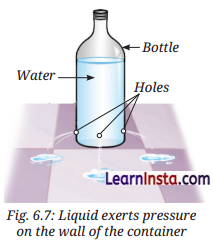
Explain that liquids exert equal pressure at the same depth.
Answer:
Take an empty plastic bottle -and make three holes at the same height near its bottom. Fill the bottle with water. You will observe that the streams of water coming out of all three holes fall at the same distance from the bottle. This shows that liquids exert equal pressure at the same depth.
Question 2.
What are the impacts of a cyclone?
Answer:
Cyclones cause widespread destruction, especially in coastal areas. Strong winds push ocean water towards the shore, creating a storm surge that floods land and damages homes, roads, and crops. Heavy rainfall can lead to river floods and landslides. Cyclones can contaminate drinking water, destroy farmland due to saltwater, and lead to long power outages.
Trees and debris may block roads, delaying rescue operations. Even after weakening over land, cyclones leave behind long-lasting damage. For example, Cyclone Amphan in 2020 had wind speeds reaching up to 270km/ h and caused severe damage to infrastructure, homes, and livelihoods in the affected regions.
Question 3.
Prove that the pressure exerted by water at the bottom of the container depends on the height of its column.
Answer:
Take two pipes of the same length but different diameters and attach rubber balloons at one end of each. Clamp the pipes and fill them with water to the same height.
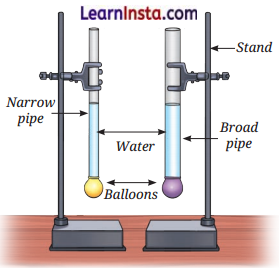
We observe that both balloons bulge equally, even though the weight of water is different due to the varying diameters. This proves that the pressure at the bottom depends only on the height of the water column.
Pressure, Winds, Storms, and Cyclones Class 8 Skill-Based Questions
Question 1.
Observe the following figure and answer these questions:
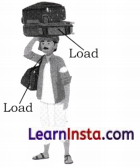
(i) What do you see in the picture?
(ii) How many loads is the man carrying?
(iii) Why does the man keep a cloth under the load on his head?
Answer:
(i) The picture shows a man carrying heavy load.
(ii) The man is carrying two loads, one on his head and one on his shoulder.
(iii) The man places a round piece of cloth on his head to increase the area of contact between the load and his head. This reduces the pressure on his head and makes it more comfortable to carry.
Question 2.
Observe the following figure and answer the following questions:
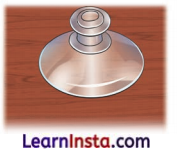
(i) What do you see in the picture? Why does it stick to the surface?
(ii) Why is it difficult to pull it off from the surface?
Answer:
(i) It is a rubber sucker. It sticks to the surface because the air pressure outside the sucker is higher than the pressure inside it.
(ii) It is difficult to pull the sucker off because we need to overcome the greater external air pressure acting on it.
Pressure, Winds, Storms, and Cyclones Class 8 Quiz Questions
Question 1.
What is used to protect buildings from lightning?
Answer:
Lightning conductor
Question 2.
What kind of area is formed when warm air rises?
Answer:
Low-pressure area.
Question 3.
What causes the internal pressure in our body that balances the atmospheric pressure?
Answer:
The movement of fluids and gases in the tissues and organs of the body
Question 4.
The pressure on a 15 cm x 15cm area is almost equal to the weight of an object of which mass?
Answer:
225 kg
Question 5.
What is the practical unit of air pressure?
Answer:
Millibar (mb)
Question 6.
What cause lightning?
Answer:
Collision of opposite charges within a cloud or between clouds and ground.
Question 7.
Why does air moves from an inflated balloon to an uninflated balloon?
Answer:
Because the pressure in inflated balloon is higher than in the uninflated balloon.
Question 8.
Why does a balloon inflate when air is blown into it?
Answer:
Air inside the balloon exerts pressure on its walls.
Question 9.
Why are dams made broader at the base?
Answer:
To bear more water pressure at the bottom.
Question 10.
Why are the edges of knives made sharp?
Answer:
To apply more pressure with less force and cut easily.
Pressure, Winds, Storms, and Cyclones Class 8 Case Based Questions
Question 1.
During a thunderstorm, Priya noticed strong winds blowing, accompanied by lightning and heavy rainfall. She saw tree branches swaying and some rooftops being damaged. She recalled her teacher’s advice and stayed indoors, away from electric appliances.
I. What kind of storm was Priya experiencing?
II. Why should electric appliances not be used during lightning?
III. Suggest one safety measure Priya followed.
OR
What signs of damage did Priya observe during the thunderstorm?
Answer:
I. A thunderstorm with lightning and strong winds.
II. Because lightning can cause strong electric flow that can damage appliances or give electric shocks.
III. She stayed indoors and avoided using electric appliances.
OR
Priya saw tree branches swaying and some rooftops being damaged due to the strong winds.
Question 2.
Ravi visited his village during summer. In the evening, he felt a cool breeze coming from the sea. His uncle told him this happens daily and is known as a sea breeze. In the morning, the direction of the breeze was opposite.
I. What causes the sea breeze?
II. Why does air move from land to sea in the evening?
III. What property of warm and cold air is responsible for this breeze?
OR
How does the movement of air in sea and land breezes help maintain temperature balance?
Answer:
I. The difference in air pressure between the land and sea causes the sea breeze.
II. In the evening, the land cools faster than the sea. The air above the sea remains warmer and rises, so cooler air from the land moves to the sea. This movement of air is called a land breeze.
III. Warm air is lighter and rises, while cold air is heavier and moves to take its place.
OR
The movement of air helps in transferring heat between land and sea, which balances the temperature by bringing cooler air to warmer regions.
Pressure, Winds, Storms, and Cyclones Extra Questions for Practice
Multiple Choice Questions
Question 1.
How many hectopascals make up 1 pascal?
(a) 0.01 hPa
(b) 0.1 hPa
(c) 1 hPa
(d) 10 hPa
Question 2.
What causes a sea breeze to blow during the daytime?
(a) The sea warms up faster than the land
(b) A high-pressure area forms over the land
(c) The land becomes hotter, creating a low-pressure area
(d) The land remains cooler than the sea
Question 3.
A school bag with broad straps feels lighter because the straps
(a) increase the area, reducing pressure
(b) increase pressure on shoulders
(c) decrease the weight of the bag
(d) make the bag look bigger
Question 4.
Read the given statements and select the correct option.
Assertion (A): Water flows out of holes in all directions from a bottle.
Reason (R): Liquids exert pressure only at the bottom of the container.
(a) Both A and R are true and R is the correct explanation of A
(b) Both A and R are true but R is not the correct explanation of A
(c) A is true but R is false.
(d) A is false but R is true.
Question 5.
Match the items in Column A to those in Column B:
Column A — Column B
(i) Thunderstorm — (p) Wind blowing from sea to land during the day
(ii) Lightning conductor — (q) Wind blowing from land to sea during the night
(iii) Eye of a cyclone — (r) Meeting of (positive) and (negative) charges
(iv) Sea breeze — (s) Calm area at the centre of the cyclone
(v) Land breeze — (t) Protect houses
(a) (i)-(r),(ii)-(t),(iii)-(s),(iv)-(p),(v)-(q)
(b) (i)-(r), (ii)-(s), (iii)-(t), (iv)-(q), (v)-(p)
(c) (i)-(q),(ii)-(r),(iii)-(t),(iv)-(s),(v)-(p)
(d) (i)-(t),(ii)-(s),(iii)-(t),(iv)-(p),(v)-(q)
Very Short Answer Type Questions
Question 1.
Name any two gases present in atmospheric air.
Question 2.
What is atmospheric pressure?
Question 3.
What is the local name of thunderstorms in Assam?
Question 4.
Name a cyclone that occurred in 2020 and had very high wind speed.
Question 5.
What causes land and sea breeze?
Short Answer Type-I Questions
Question 1.
Why does water spurt out like a fountain from leaking pipes?
Question 2.
How does lightning occur in clouds?
Question 3.
Why is it easier to lift a bucket filled with water using a broad handle rather than a narrow one?
Question 4.
Why are water tanks placed at a height?
Question 5.
Why does air come out of a punctured bicycle tube?
Short Answer Type-II Questions
Question 1.
A wooden box weighing 600 N rests on the floor. If the bottom surface area of the box in contact with the floor is 1.5 m2 calculate the pressure exerted by the box on the floor.
Question 2.
Define sea breeze and land breeze.
Question 3.
Why is it advised to keep doors and windows open during storms?
Question 4.
What causes wind circulation and how are clouds formed in this process?
Question 5.
What are the effects of a cyclone?
Long Answer Type Questions
Question 1.
How can you save yourself from lightning?
Question 2.
What happens when you blow air between two hanging balloons? Explain the reason for your observation.
Question 3.
What is a cyclone? Explain how it forms and what happens when it reaches land.
Suggested Projects And Activities
Question 1.
Make a chart with two columns to compare thunderstorms in coastal and inland regions of India. Observe which area experiences more thunderstorms and find out the reason. Talk to elders in your family or neighbourhood to know how they recognise signs of an approaching thunderstorm and what safety measures they follow.
Question 2.
Take a blown-up balloon and place a lightweight piece of paper flat on a table. Hold the balloon close to the paper without touching it. Blow air quickly into the narrow space between the balloon and the paper. Observe what happens to the paper and write your observation and conclusion in your notebook.