Class 6 Maths Chapter 6 Perimeter and Area Notes
Class 6 Maths Chapter 6 Notes – Class 6 Perimeter and Area Notes
Perimeter
The distance covered along the boundary forming a closed figure when you go around the figure once is called the perimeter.
Thus, we can calculate the perimeter of a plane figure (i.e. polygon) by calculating the sum of measurements of all its sides.
The perimeter of a polygon = The sum of the lengths of its all sides.
The unit of perimeter is the same as that of length.
Example:

In fig. (i), perimeter of ∆ABC = AB + BC + CA
In fig. (ii), perimeter of pentagon ABCDE = AB + BC + CD + DE + EA

Example 1.
Find the perimeter of the given figures.

Solution:
(i) Perimeter of the figure ABCDEF = Sum of the measurements of all sides
= AB + BC + CD + DE + EF + FA
= 100 + 120 + 90 + 45 + 60 + 80
= 495 m
Hence, the perimeter of the given figure is 495 m.
(ii) Perimeter of the figure ABCDEF = Sum of the measurements of all sides
= AB + BC + CD + DE + EF + FA
= 5 + 5 + 5 + 5 + 5 + 5
= 30 cm
Hence, the perimeter of the given figure is 30 cm.
Perimeter of a Rectangle
The perimeter of a rectangle is the total distance covered by its boundaries or the sides. In other words, the sum of the measurements of all four sides of a rectangle is called the perimeter of a rectangle.
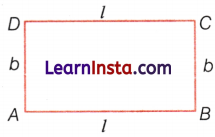
The perimeter of a rectangle ABCD = Sum of the length of its sides
= AB + BC + CD + DA
= AB + BC + AB + BC [∵ opposite sides are equal, CD = AB and DA = BC]
= 2(AB + BC)
= 2(l + b)
where, l = Length of the rectangle and b = Breadth of the rectangle
Hence, the perimeter of a rectangle is 2(l + b).
While calculating the perimeter of a rectangle, we must express the length and breadth in the same unit.
Example 2.
Consider a rectangle ABCD whose length and breadth are 10 cm and 4 cm, respectively. What is its perimeter?
Solution:
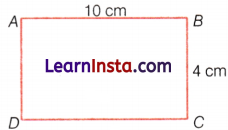
The perimeter of the rectangle = Sum of the length of its four sides
= AB + BC + CD + DA
= AB + BC + AB + BC
[∵ opposite sides of a rectangle are always equal. So, AB = CD and AD = BC]
= 2 × AB + 2 × BC
= 2(AB + BC)
= 2 × (10 + 4)
= 2 × 14
= 28 cm
Hence, the perimeter of rectangle ABCD is 28 cm.
Example 3.
Find the perimeter of a rectangle whose length and breadth are 250 cm and 2 m, respectively.
Solution:
Given, the length of the rectangle = 250 cm
and breadth of the rectangle = 2 m
= 2 × 100 cm [∵ 1 m = 100 cm]
= 200 cm
∴ Perimeter of the rectangle = 2 × (Length + Breadth)
= 2 × (250 + 200)
= 2 × 450
= 900 cm
Hence, the perimeter of the given rectangle is 900 cm.
Example 4.
Rohan wants to put a lace border all around a rectangular table covering 5 m long and 3 m wide. Find the length of the lace required by Rohan.
Solution:
Given, the length of the rectangular table cover = 5 m
and breadth of the rectangular table cover = 3 m
∴ Perimeter of the rectangular table cover = 2 × (Length + Breadth)
= 2 × (5 + 3)
= 2 × 8
= 16 m
Hence, the length of the lace required is 16 m.
Example 5.
If the perimeter of a rectangle is 200 cm and the length is 75 cm, then find its breadth.
Solution:
Given, the perimeter of the rectangle = 200 cm
and length of the rectangle = 75 cm
∴ Perimeter of the rectangle = 2 × (Length + Breadth)
⇒ 200 = 2 (75 + Breadth)
⇒ Breadth + 75 = \(\frac{200}{2}\)
⇒ Breadth = 100 – 75 = 25 cm
Hence, the breadth of the rectangle is 25 cm.
Example 6.
An athlete takes 10 rounds of a rectangular field which is 30 m long and 20 m wide. Find the total distance covered by him.
Solution:
Given, the length of rectangular field (l) = 30 m
and breadth of rectangular field (b) = 20 m

Total distance covered by the athlete in one round = Perimeter of field (rectangle)
= 2(l + b)
= 2(30 + 20)
= 100 m
Since the distance covered in one round = 100 m
So, the distance covered in 10 rounds = 10 × 100 = 1000 m
Example 7.
A man has a rectangular piece of land of length and breadth of 340 m and 260 m, respectively. If each side is to be fenced with 4 rounds of wires, then what will be the length of wire needed?
Solution:
Given, the length of a rectangular piece of land = 340 m
and breadth of the rectangular piece of land = 260 m
Now, perimeter of the field = 2 × (Length + Breadth)
= 2 × (340 + 260)
= 2 × 600
= 1200 m
∵ Each side is to be fenced with 4 rounds of wire.
∴ Total length of the wire required = 4 × 1200 = 4800 m
Perimeter of Square
The perimeter of a square is the total length covered by its boundary. Since all the sides of a square are equal.
Therefore, the perimeter of the square will be 4 times its side.
The perimeter of a square = 4 × Length of a side
So, we can say that the perimeter of a square is quadruple the length of its side.
Example 8.
Consider a square ABCD of side 5 cm. What is its perimeter?
Solution:
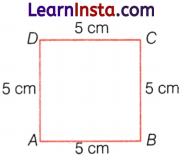
Perimeter of a square ABCD = AB +BC +CD + DA
= AB + AB + AB + AB
= 4AB [∵ AB = BC = CD = AD]
= 4 × 5
= 20 cm
Example 9.
Find the distance travelled by Soniya, if she takes three rounds of a square park of side 60 m.
Solution:
Given, the length of the side of the square park = 60 cm
The perimeter of a square park = 4 × Length of a side
= 4 × 60
= 240 m
Distance covered in one round = 240 m
Distance covered in three rounds = 3 × 240 = 720 m
Example 10.
Mohan runs 5 times around a rectangular park with a length of 140 m and a breadth of 90 m while Sohan runs 6 times around a square park of side 80 m. Who covers more distance and by how much?
Solution:
Distance covered by Mohan in one round = Perimeter of the rectangular park
= 2 × (Length + Breadth)
= 2 × (140 + 90)
= 2 × 230
= 460 m
∴ Distance covered by Mohan is 5 rounds = 5 × 460 = 2300 m
Distance covered by Sohan in one round = Perimeter of the square park
= 4 × Length of a side
= 4 × 80
= 320 m
∴ Distance covered by Sohan in 6 rounds = 6 × 320 = 1920 m
Difference in the distance covered = 2300 – 1920 = 380 m
Hence, Mohan covers more distance by 380 m.
Perimeter of a Triangle
The perimeter of a triangle is the total length covered by all three sides.
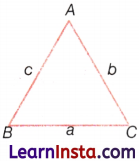
Perimeter of a triangle = Sum of the lengths of its three sides.
Perimeter of ∆ABC = a + b + c
Example 11.
Consider a triangle having three given sides of length 8 cm, 10 cm, and 14 cm. Find its perimeter.
Solution:
Let a triangle ABC whose sides are AB = 10 cm, BC = 8 cm, and AC = 14 cm.

Perimeter of ∆ABC = AB + BC + CA
= 10 + 8 + 14
= 32 cm
Perimeter of a Regular Polygon
All closed figures that have all sides and all angles equal are called regular polygons.
If a regular polygon has n sides, then
Perimeter = n × Length of a side
where, n = Number of sides
Example:
(i) Perimeter of a regular pentagon = 5 × Length of one side = 5a
(ii) Perimeter of a regular hexagon = 6 × Length of one side = 6a
Example 12.
Find the perimeter of a regular hexagon with each side measuring 4 cm.
Solution:
The given regular hexagon has 6 sides, each with a length of 4 cm.
∴ Perimeter of the regular hexagon = 6 × 4 = 24 cm
Example 13.
The perimeter of a regular hexagon is 30 cm. How long is its one side?
Solution:
Given, the perimeter of a regular hexagon = 30 cm
∴ The perimeter of a regular hexagon = 6 × Length of a side
⇒ 30 = 6 × Length of a side
⇒ Length of a side = \(\frac{30}{6}\) = 5 cm
Hence, the length of each side of a regular hexagon is 5 cm.
Perimeter of an Equilateral Triangle
We know that for any triangle its perimeter is the sum of all three sides. In an equilateral triangle, all three sides are equal.
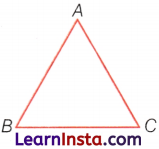
∴ Perimeter of an equilateral ΔABC = AB + BC + CA = 3AB [∵ AB = BC = CA]
Hence, the perimeter of an equilateral triangle = 3 × Length of a side of the triangle.
Example 14.
If one side of an equilateral triangle is 8 cm, then find its perimeter.
Solution:
The perimeter of an equilateral triangle = 3 × Length of a side
[∵ In an equilateral triangle, all sides are equal, so the length of each side will be 8 cm]
= 3 × 8
= 24 cm
Hence, the perimeter of an equilateral triangle is 24 cm.
Example 15.
How many equilateral triangles of side 4 cm long can be formed with a strip of wire of length 84 cm?
Solution:
Given, the side of the equilateral triangle = 4 cm
∴ The perimeter of the equilateral triangle = 3 × Length of a side of the triangle
= 3 × 4
= 12 cm
Now, number of equilateral triangles, formed = \(\frac{Total length of wire}{Perimeter of triangle}\)
= \(\frac{84}{12}\)
= 7
Hence, the required number of equilateral triangles is 7.
Split and Rejoin
A rectangular paper chit of dimensions 12 cm x 8 cm is cut as shown into two equal pieces.

These two pieces are joined in different ways.

The above arrangement figure has a perimeter of 56 cm.
Example 16.
Arrange the two figures from the figures given below to form a figure with a perimeter of 24 cm.
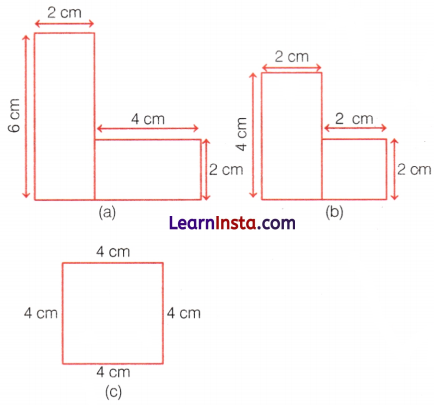
Solution:
On arranging the figures (a) and (c), we get

Which has a perimeter of 24 cm.
Example Problems
Question 1.
Find the perimeter of each of the following figures.
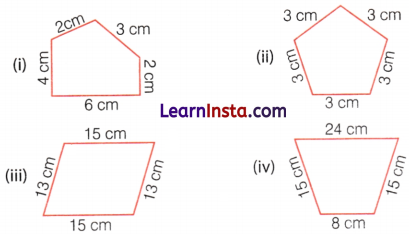
Answer:
(i) 17 cm
(ii) 15 cm
(iii) 56 cm
(iv) 62 cm
Question 2.
Find the perimeter of a rectangle whose length is 40 cm and width is 30 cm.
Answer:
140 cm
Question 3.
A box-top measures 3 m 50 cm by 2 m 25 cm. Find the perimeter of the box top.
Answer:
11.5 m
Question 4.
If the perimeter of a rectangle is 120 cm and the width is 25 cm, then find its length.
Answer:
35 cm
Question 5.
A rectangular park of length 300 m and breadth 150 m is to be fenced with two rows of wires. What is the length of the wire needed?
Answer:
1800 m
Question 6.
Find the perimeter of a regular pentagon with each side measuring 6 m.
Answer:
30 m
Question 7.
The perimeter of a regular hexagon is 120 cm. How long is it on each side?
Answer:
20 cm
Question 8.
Find the side of the square whose perimeter is 32 m.
Answer:
8 m
Question 9.
A piece of wire is 12 cm long. What will be the length of each side, if the wire is used to form
(i) a regular hexagon?
(ii) an equilateral triangle?
Answer:
(i) 2 cm
(ii) 4 cm
Question 10.
Anuj runs four times around a square park of side 40 m while Suraj runs six times around an equilateral triangle-shaped park of side 60 m. Who covers the more distance and by how much?
Answer:
Suraj covers a distance of 440 m.
Question 11.
Radhika runs around a rectangular park with a length of 100 m and a breadth of 75 m, while Monika runs around a square park of side 80 m. Who covers the less distance and by how much?
Answer:
Monika covers less distance by 30 m.
Question 12.
Find the perimeter of each of the following shapes.
(i) A triangle with sides 6 cm, 7 cm and 8 cm.
(ii) An equilateral triangle with a side 7 cm.
(iii) An isosceles triangle with equal sides 6 cm each and a third side 4 cm.
Answer:
(i) 21 cm
(ii) 21 cm
(iii) 16 cm
Question 13.
Two sides of a triangle are 8 cm and 10 cm. The perimeter of the triangle is 30 cm. Find its third side.
Answer:
12 cm
Question 14.
How many equilateral triangles of side 2 cm long can be formed with a wooden strip of length 60 cm?
Answer:
10
Question 15.
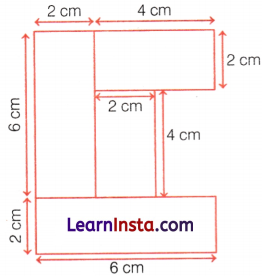
Arrange the two figures from the figures given below to form a figure with a perimeter of 30 cm.

Answer:
Join figure (a) and (c) as
Area
The total amount of surface enclosed by a closed figure is called its area.
Area of a Rectangle
Let the length of the rectangle be l and the breadth be b.
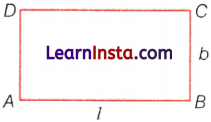
∴ Area of rectangle (A) = Length × Breadth = l × b
Using this formula, l = \(\frac{A}{b}\) or b = \(\frac{A}{l}\)
The length and breadth of a rectangle must be in the same units.
Example 1.
Find the area of a rectangle whose length and breadth are 12 cm and 4 cm, respectively.
Solution:
Given, the length of the rectangle (l) = 12 cm
and breadth of the rectangle (b) = 4 cm
∴ Area of rectangle = l × b
= 12 × 4
= 48 cm
Hence, the area of the rectangle is 48 cm2
Example 2.
The floor is 8 m long and 6 m wide. Find the area of the floor.
Solution:
Length of the floor = 8 m
Width of the floor = 6 m
∵ The floor is rectangular type.
∴ The area of the floor = Length × Width
= 8 m × 6 m
= 48 m2
Example 3.
Find the area in square meters of a piece of land 6 m 75 cm wide and 8 m long.
Solution:
Length of the piece of land = 8 m
The breadth of the piece of land = 6 m 75 cm
= 6 + 0.75 [∵ 1 m = 100 cm]
= 6.75 m
∴ Area of the piece of land = Length × Breadth
= 8 × 6.75
= 54 m2
Example 4.
What is the cost of painting a wall 500 cm long and 300 cm wide at the rate of ₹ 13 per hundred sq cm?
Solution:
Given, the length of a wall = 500 cm
and breadth of a wall = 300 cm
∴ Area of the wall = Length × Breadth
= 500 × 300
= 150000 cm2
∵ Cost of painting per 100 cm2 = ₹ 13
∴ Cost of 1 cm2 = ₹ \(\frac{13}{100}\)
Now, cost of 150000 cm2 = 150000 × \(\frac{13}{100}\) = ₹ 19500
Hence, the required cost is ₹ 19500.
Example 5.
Meena wants to cover the floor of a rectangular hail 9 m wide and 7 m long with square tiles. If each square tile is of side 1.5 m, then find the number of tiles required to cover the floor of the room.
Solution:
Given, the length of the rectangular hall = 7 m
and breadth of the rectangular hall = 9 m
Area of the floor of the rectangular hall = Length × Breadth
= 7 × 9
= 63 m2
Area of one square tile = Side × Side
= 1.5 × 1.5
= 2.25 m2
Now, the number of required tiles = \(\frac{Area of the floor}{Area of one tile}\)
= \(\frac{63}{2.25}\)
= 28 tiles
Hence, 28 tiles are required to cover the floor of the room.
Example 6.
By splitting the following figures into rectangles. Find their areas (all measures are given in meters)
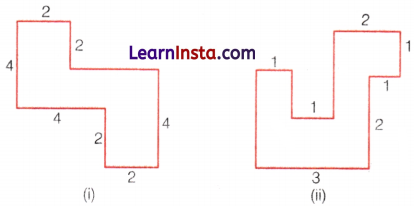
Solution:
(i) Let the given figure be divided into rectangles A, B, and C. Their length and breadth are written on the figure.

For rectangle A,
Length = 4 m and breadth = 2 m
Now, the area of rectangle A = Length × Breadth
= 4 × 2
= 8 m2
For rectangle B,
Length = 2 + 2 = 4 m and breadth = 2 m
Area of rectangle B = Length × Breadth
= 4 × 2
= 8 m2
For rectangle C,
Length = Breadth = 2 m
Area of rectangle C = Length × Breadth
= 2 × 2
= 4 m2
Now, the total area of the given figure = Area of rectangle A + Area of rectangle B + Area of rectangle C
= 8 m2 + 8 m2 + 4 m2
= 20 m2
(ii) Let the given figure be divided into rectangles A, B, C, and D, and their length and breadth are written on the figure.

For Rectangle A, length = 2 m, breadth = 1 m
The area of rectangle A = 2 m × 1 m = 2 m2
For Rectangle B, length =1 m, breadth = 1 m
The area of rectangle B = 1 m × 1 m = 1 m2
For Rectangle C, length = 2 m and breadth = 1 m
The area of rectangle C = 2 m × 1 m = 2 m2
For Rectangle D, length = 2 m and breadth = 1 m
The area of rectangle D = 2 m × 1 m = 2 m2
Hence, the total area of the given figure = Sum of the areas of all four rectangles
= 2 m2 + 1 m2 + 2 m2 + 2 m2
= 7 m2
Area of Square
A four-sided polygon whose all sides are equal and each angle is a right angle is called a square.
∴ Area of a square = Side × Side = (Side)2
Example 7.
Find the area of a square whose side is 6 cm.
Solution:
Given, side = 6 cm
∴ Area of a square = Side × Side
= 6 × 6
= 36 cm2
Hence, the area of the square is 36 cm2
Example 8.
The perimeter of a square field is 60 m. Find its area.
Solution:
Given, the perimeter of a square field = 60 m
We know that the perimeter of a square = 4 × Side
∴ Side of a square = \(\frac{Perimeter}{4}\)
= \(\frac{60}{4}\)
= 15 m
Now, the area of the square field = Side × Side
= 15 × 15
= 225 m2
Hence, the required area is 225 m2
Example 9.
What will happen to the area of a square, if its sides are doubled?
Solution:
Let the side of a square = a cm
∴ Area of the square = a × a = a2 cm2 …….(i)
Now, when the sides of the square doubled.
Then, the side of the square = 2a cm
∴ Area of the square = 2a × 2a = 4a2 cm2 ………..(ii)
On comparing Equations (i) and (ii), we can see, that if the sides of a square are doubled, then its area becomes 4 times.
Example 10.
The floor is 10 m long and 8 m wide. A square carpet of side 6 m is laid on the floor. Find the area of the floor that is not carpeted.
Solution:
Length of the floor = 10 m
Width of the floor = 8 m
Area of the floor = Length × Width
= 10 m × 8 m
= 80 sq m
Length of the square carpet = 6 m
Area of the carpet = Length × Length
= 6 m × 6 m
= 36 sq. m
Hence, the area of the floor laid with carpet is 36 sq. m.
Therefore, the area of the floor that is not carpeted = Area of the floor – Area of the floor laid with carpet
= 80 sq m – 36 sq m
= 44 sq m
Thus, the area of the floor that is not carpeted is 44 sq m.
Example 11.
Four square flower beds, each of side 8 m are in four corners on a piece of land 20 m long and 15 m wide. Find the area of the remaining part of the land.
Solution:
Length of the land (l) = 20 m
Width of the land (w) = 15 m
Area of whole land = l × w
= 20 × 15
= 300 sq m
The side length of each of the four square flower beds is 8 m.
∴ Area of one flower bed = 8 m × 8 m = 64 sq m
Hence, the area of the four flower bed = 4 × 64 sq m = 256 sq m
Therefore, the area of the remaining part of the land = Area of the complete land – The area of all four flower beds
= 300 sq m – 256 sq m
= 44 sq m
Area of any Closed Figure
We know that the amount of surface enclosed by a closed figure is called its area.
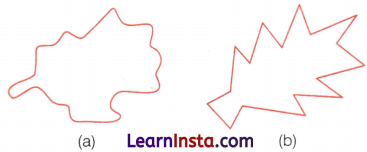
Look at the above figures and identify which one of them has a large area. We can estimate the area of any simple closed shape by using a sheet of squared paper or graph paper where every square measures 1 unit × 1 unit or 1 square unit.
To calculate the area of a figure using a square paper, the following conventions are adopted.
- The area of one full small square of the squared or graph paper is taken as 1 sq. unit.
- Ignore portions of the area that are less than half a square.
- If more than half of a square is in a region, just count it as one square.
- If exactly half the square is counted, take its area as \(\frac{1}{2}\) sq unit.
The area of one full square is taken as 1 sq unit. If it is a centimeter square sheet, then the area of one full square will be 1 cm2.
Example 12.
Find the area of the figure shown below.
(consider area of each square = 1 cm2)
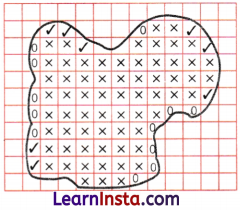
Solution:
Area of a square = 1 cm2
Area of figure = Number of (✗) squares + Number of (✓) squares + \(\frac{1}{2}\) Number of (0) squares
= 65 + 8 + \(\frac{1}{2}\) × 12
= 65 + 8 + 6
= 79 cm2
[since, ✗ and ✓ squares are covered fully by the figure and 0 square are covered half]
Hence, the area of the square is 79 cm2.
Example 13.
Draw any circle on a graph sheet. Count the squares and use them to estimate the area of the circular region.
Solution:
First, make a circle of any suitable radius, on the graph paper. Then, count full, half, and more than half or less than half squares coming under the circle.
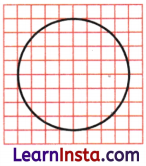
In the figure, fully filled squares = 32
Half filled squares = 0
More than half-filled squares = 20
∴ Total area = 32 × 1 + 0 × \(\frac{1}{2}\) + 20 × 1
= 32 + 0 + 20
= 52 sq units
Example 14.
By counting squares, estimate the area of the given figure.

Solution:
Let the area of one square = 1 cm2
In the figure, Fully filled squares = 21
Half filled squares = 0
More than half-filled squares = 20
∴ Total area = 21 × 1 + 0 × \(\frac{1}{2}\) + 20 × 1
= 21 + 0 + 20
= 41 cm2
Area of a Triangle
To find the area of a triangle: We draw a rectangle on a piece of paper and drawn one of its diagonals. Cut the rectangle along that diagonal and get two triangles.
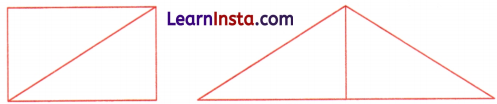
Check, whether the two triangles overlap each other exactly. Now, we see in above figures, that the area of a rectangle is equal to the area of both triangles. Thus, we can say, that if a rectangle is cut in two pieces by its diagonal, then the sum of areas of formed both triangles is equal to the area of a rectangle.
Example 15.
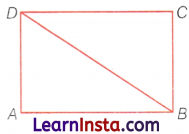
In the figure given below ABCD is a rectangle of area 120 sq. ft. Find the area of ∆BAD.
Solution:
Given the area of rectangle ABCD = 120 sq. ft
Here, BD is the diagonal of the rectangle ABCD.
∵ A diagonal divides a rectangle into two equal pieces.
So, the area of ∆BAD = Half of the area of rectangle ABCD
= \(\frac{1}{2}\) × 120
= 60 sq. ft
Example 16.
Look at the figure given below and answer the following questions.
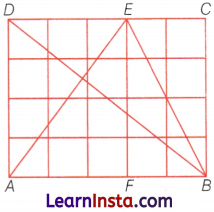
(i) Try to find out the area of triangle BAD.
(ii) Find the area of ∆ABE.
Solution:
(i) Here, the number of small squares in rectangle ABCD = 20
And where one small square is cut in two pieces and shows two triangles (small).
Thus, on observing the figure, we see that DB is diagonal that divides the rectangle ABCD in two equal pieces.
Thus, the area of triangle BAD is half of the area of the rectangle ABCD.
(ii) By observing the given figure, we get
Area of ∆ABE = Area of ∆AEF + Area of ∆BEF
Here, the area of ∆AEF = Half of the area of the rectangle AFED
and the area of ∆BEF = Half of the area of rectangle BFEC
Hence, the area of triangle ABE = \(\frac{1}{2}\) × Area of rectangle AFED + \(\frac{1}{2}\) × Area of rectangle BFEC
= \(\frac{1}{2}\) × Area of rectangle ABCD.
Example Problems
Question 1.
Find the area of the rectangles whose sides are
(i) 7 cm and 9 cm
(ii) 16 m and 19 m
(iii) 11 m and 15 m
(iv) 4 m and 2 m 80 cm
Answer:
(i) 63 cm2
(ii) 304 m2
(iii) 165 m2
(iv) 11.2 m2
Question 2.
The length and breadth of the four rectangles are as given below.
(i) 5 m and 7 m
(ii) 11 m and 13 m
(iii) 13 m and 5 m
(iv) 6 m and 16 m
Which one has the largest area and which one has the smallest?
Answer:
(i) has the smallest area
(ii) has the largest area
Question 3.
If the area of a rectangle is 600 m2 and the length is 30 m, then find its width.
Answer:
20 m
Question 4.
The area of a rectangular carpet, 20 m long, is 180 m2. Find the width of the carpet.
Answer:
9 m
Question 5.
A rectangular field measures 5 m by 7 m 50 cm. Find its area in square meters.
Answer:
37.5 m2
Question 6.
A floor is 6 m long and 5 m wide. How many tiles whose length and breadth are 10 cm and 6 cm, respectively are needed to cover the floor?
Answer:
5000
Question 7.
A room is 6 m long and 4 m wide. How many square meters of carpet is needed to cover the floor of the room?
Answer:
24 m2
Question 8.
A rectangular floor is 7 m long and 6 m wide. A square carpet of sides 5 m is laid on the floor. Find the area of the floor that is not carpeted.
Answer:
17 m2
Question 9.
A rectangular plot of land has dimensions of 15 m × 10 m. There are five square flower beds in the plot of sides 5 m. Find the area of the remaining plot.
Answer:
25 m2
Question 10.
Find the area of squares whose sides are
(i) 5 cm
(ii) 14 m
(iii) 9 m
(iv) 11 cm
Answer:
(i) 25 cm2
(ii) 196 m2
(iii) 81 m2
(iv) 121 cm2
Question 11.
The perimeter of a square field is 40 m. Find its area.
Answer:
100 m2
Question 12.
What will happen to the area of a rectangle, if length and width are doubled?
Answer:
4 times the original area
Question 13.
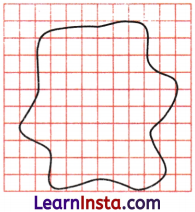
Find the area of the given figure.
(assume the area of 1 small square = 1 sq. unit).
Answer:
75 sq. units
Question 14.
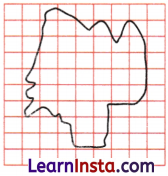
By counting squares, estimate the area of the given figure.
Answer:
39 sq. units
Question 15.
Trace shapes of leaves, flower petals, and some other such objects on graph paper. Count tne square and use them to estimate the area.
Answer:
Do yourself.
Question 16.
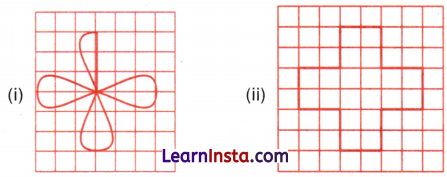
Estimate the area of the following figures. (use 1 small square has 1 sq unit area).
Answer:
(i) 14 sq. units
(ii) 20 sq. units
Question 17.
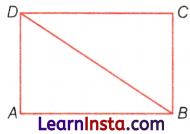
In the figure given below ABCD is a rectangle. If the area of rectangle ABCD is 1080 sq m, then find the area of ΔBDC.
Answer:
540 sq. m
Question 18.
Look at the figure given below and answer the following questions.
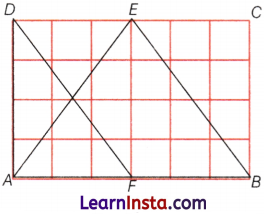
(i) If the area of rectangle ABCD is 120 sq m. Then, find the area of ΔAEB.
(ii) If the area of rectangle ABCD is 120 sq m. Then, find the area of ΔFAD.
(iii) Is it true that the area of triangle AFE is equal to the area of triangle FAD?
Answer:
(i) 60 sq. m
(ii) 30 sq. m
(iii) Yes
→ A plane closed figure has a region and its boundary. The distance around a simple closed figure or the total length of the boundary of a simple closed figure is called its perimeter.
→ The portion of the surface enclosed or bound by the boundary of a plane closed figure is called its region.
→ The measure of the surface enclosed by a closed figure is called its area.
→ Area of a closed shape can be estimated (or even determined exactly) by breaking it up into unit squares, or into more general shapes like rectangles and triangles whose areas can be calculated.
→ Rectilinear figures having all sides and angles equal are called regular closed figures or regular polygons.
→ The distance around the outside of a simple closed figure is called its perimeter.
→ The perimeter of a polygon is the sum of the lengths of all its sides.
→ The perimeter of a rectangle is twice the sum of its length and width.
The perimeter of a rectangle = 2 × [length + breadth].
→ The perimeter of a square is four times the length of any one of its sides.
Perimeter of a square = 4 × length of its side.
→ The perimeter of a triangle is the sum of the lengths of its all three sides.
→ Perimeter of an equilateral triangle = 3 × length of a side.
→ The area of a closed figure is the measure of the region enclosed by the figure.
→ Area is generally measured in square units, e.g., sq. m, sq. cm, etc.
→ The area of a rectangle is the product of its length and width.
Area of a rectangle = length × breadth.
→ The area of a square is the length of any one of its sides multiplied by itself.
Area of a square = side × side.
→ Two closed figures can have the same area with different perimeters, or the same perimeter with different areas.
→ The area of a triangle is half of the area of the rectangle made on the same base and same height.