Get the simplified Class 7 Maths Extra Questions Chapter 5 Parallel and Intersecting Lines Class 7 Extra Questions and Answers with complete explanation.
Class 7 Parallel and Intersecting Lines Extra Questions
Class 7 Maths Chapter 5 Parallel and Intersecting Lines Extra Questions
Class 7 Maths Chapter 5 Extra Questions
Question 1.
Here, some line segments are given below.
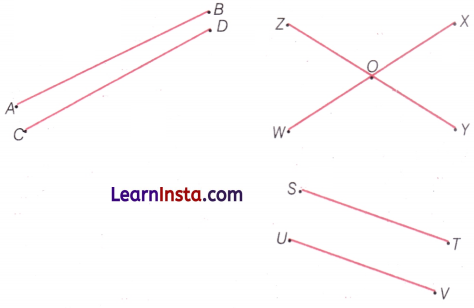
(i) Are the line segments A B and C D likely to meet if they are extended?
(ii) Are line segments ST and UV likely to meet if they are extended?
(iii) Are the line segments Z Y and W X intersecting? If yes then write the name of point of intersection.
Answer:
(i) Yes, line segments A B and C D are not parallel, so they are likely to meet if they are extended.
(ii) No, line segments S T and U V are parallel, so they are not likely to meet if extended.
(iii) Yes, the line segments Z Y and W X are intersecting and ‘ O ‘ is the point of intersection.

Question 2.
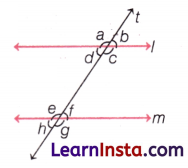
In the given figure, identify
(i) the pairs of corresponding angles.
(ii) the pairs of alternate interior angles.
(iii) the pairs of cointerior angles on the same side of the transversal.
Answer:
(i) Pairs of corresponding angles are ∠a and ∠e ; ∠b and ∠f ; ∠c and ∠g ; ∠d and ∠h.
(ii) Pairs of alternate interior angles are ∠c and ∠e; ∠d and ∠f.
(iii) Pairs of cointerior angles on the same side of the transversal are ∠d and ∠e ; ∠c and ∠f.
Question 3.
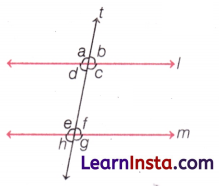
Which property is used in each of the following statements?
(i) If I and m are parallel lines, then ∠b = ∠f.
(ii) If I and m are parallel lines, then
∠c = ∠e.
(iii) If ∠c+∠f = 180°, then I and m are parallel lines.
Answer:
(i) We have, l and m are parallel lines, then ∠b = ∠f. If a transversal intersects two parallel lines, then the corresponding angles are equal.
∴ In this statement, property of corresponding angles is used.
(ii) We have, l and m are parallel lines, then ∠c = ∠e. If a transversal intersects two parallel lines, then the alternate interior angles are equal.
∴ In this statement, property of alternate interior angles is used.
(iii) We have, ∠c + ∠f = 180°, then l and m are parallel lines. If a transversal intersects two parallel lines, then sum of the interior angles on the same side of the transversal is equal to 180°.
Question 4.
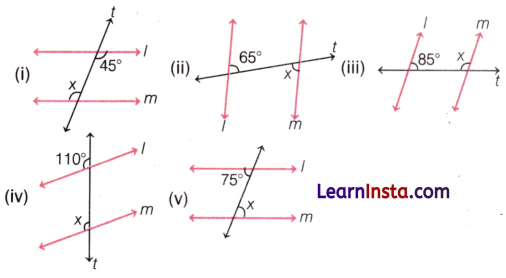
Find the value of x in each of the following figures if I and m are parallel lines and t is a transversal.
Answer:
(i) Given, l and m are parallel lines and t is a transversal.
∴ ∠x = 45° [alternate interior angles]
(ii) Given, l and m are parallel lines and t is a transversal.
∴ ∠x = 65° [alternate interior angles]
(iii) Given, l and m are parallel lines and t is a transversal.
We know that the sum of pair of interior angles on the same sides of the transversal is equal to 180°.
∴ 85° + ∠x = 180°
→ ∠x = 180°-85°
→ ∠x = 95°
(iv) Given, l and m are parallel lines and t is a transversal.
∴ ∠x = 110° [pair of corresponding angles]
(v) Given, l and m are parallel lines and t is a transversal.
∴ ∠x = 75° [pair of alternate interior angles]
Question 5.
In the below figure, if / and m are parallel lines, then find the unknown angles.

Answer:
Given, l and m are parallel lines and t is a transversal.
∠a + 135° = 180° [by linear pair]
→ ∠a = 180°-135° = 45°
∴ ∠a = ∠b = 45° [vertically opposite angles]
Now, ∠a = ∠c = 45° [corresponding angles]
∠c = ∠d = 45° [vertically opposite angles]
∠f = 135° [corresponding angles]
∠f = ∠e = 135° [vertically opposite angles]
Hence, ∠a = 45°, ∠b = 45°, ∠c = 45°, ∠d = 45° ∠e = 135° and ∠f = 135°.
Question 6.
Find the value of x in each of the following If I and m are parallel lines.

Answer:
(i) We have, l and m are parallel lines and t is a transversal.
∴ ∠a = ∠x [alternate interior angles]
Now, ∠a + 130° = 180° [by linear pair]
→ ∠a = 180° – 130°
→ ∠a = 50°
∴ ∠x = 50°
Hence, the required value of x is 50°.
(ii) Here, l and m are parallel lines and a is a transversal.
∴ ∠x = 120° [corresponding angles]
Hence, the required value of x is 120°.
Question 7.
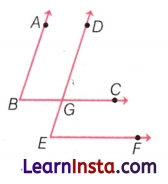
In the given figure, the arms of two angles are parallel. If ∠ABC = 60°, then find the value of the following
(i) ∠DGC
(ii) ∠DE
Answer:
(i) Given, ∠A C = 60°
Since, AB and DE are parallel lines and B C is a transversal.
∴ ∠DGC = ∠ABC = 60° [corresponding angles]
Hence, the value of ∠DGC is 60°.
(ii) Since, BC and E F are parallel lines and DE is a transversal.
∴ ∠DEF = ∠DGC = 60° [corresponding angles]
Hence, the value of ∠DEF is 60°.
Question 8.
In the adjacent figure, line l is parallel to line m and line t is a transversal. Then, find the values of ∠x and ∠y.

Answer:
Since, lines l and m are parallel to each other, where line t intersect the lines l and m.
So, 36° and ∠x are alternate interior angles.
→ ∠x = 36°
Also, ∠x and ∠y are corresponding angles.
→ ∠y = 36°
Question 9.
In the following figure, find the value of x, if the lines I and m are parallel and line t is a transversal to lines I and m.

Answer:
Since, lines l and m are parallel to each other, where line t is intersecting both these lines at the points O and M, respectively.
So, ∠OMA and ∠BME are vertically opposite angles.
So, ∠OMA = 42°
Also, ∠OMA and ∠x are pair of cointerior angles on the same side of the transversal.
So, ∠x +∠OMA = 180°
→ ∠x = 180° – 42° = 138°
Question 10.
In given figure, line segment AB is parallel to CD and AD is parallel to BC. If ∠DAC is 70° and ∠ADC is 65°. What are the measures of ∠CAB, ∠ABC and ∠BCD ?

Answer:
Since, A B and CD are parallel lines and AD is a transversal of these two lines.
∴ ∠ADC + ∠DAB = 180° [cointerior angles]
→ 65°+∠DAB = 180°
→ ∠DAB = 180° – 65° = 115°
Now, ∠D A B = ∠DAC +∠CAB
→ 115° = 70°+∠CAB
→ ∠CAB = 115°-70° = 45°
and ∠ADC + ∠BCD = 180°
[cointerior angles]
→ 65°+∠BCD = 180°
→ ∠BCD = 180° – 65° = 115°
Similarly, ∠ABC = 65°