Students can use Our Wondrous World Class 5 Solutions Chapter 5 Our Vibrant Country Class 5 Questions and Answers as a quick reference guide.
Class 5 EVS Chapter 5 Our Vibrant Country Question Answer
Our Vibrant Country Class 5 EVS Question Answer
Our Wondrous World Class 5 EVS Chapter 5 Question Answer – Class 5 EVS Our Vibrant Country Question Answer
Write (Pages 76-78)
Question 1.
What special events or activities take place at your school on the occasion of Republic Day?
Answer:
At our school, we celebrate Republic Day with many special activities. We gather around the flagpole early in the morning, and our head teacher unfurls the National Flag while we clap and cheer. We sing the National Anthem together with pride. Sometimes, we have speeches about Republic Day, perform cultural dances, or march in a small parade. We also decorate the school with flowers and tricolour flags.

Question 2.
We sing the National Anthem together on this day! Can you name some rivers and mountain ranges mentioned in the National Anthem? Fill in the table given below.
Answer:
| Rivers | Mountain Ranges |
| Ganga | Himalayas |
| Yamuna | Vindhya |
The National Anthem mentions rivers like Ganga and Yamuna. It also names mountain ranges like the Himalayas and Vindhya. These are important natural features of India that make us proud.
Question 3.
On Republic Day, which activities would you like to participate in?
Answer:
(Suggested answer) I would love to participate in singing the National Anthem because it makes me feel proud of India. I also want to join the school parade to march with my friends. Performing a traditional dance or helping decorate the flagpole with flowers would be fun too. These activities help us celebrate Republic Day with joy.
Question 4.
Have you ever watched the Republic Day parade in Delhi on television? What did you like the most about it?
Answer:
(Suggested answer) Yes, I have watched the Republic Day parade in Delhi on television. I liked the tableaux the most because they show the culture, traditions, and special things from different states of India. The fighter jets flying in the sky and the colourful cultural dances were also very exciting to watch.
Activity 1 (Page 78)
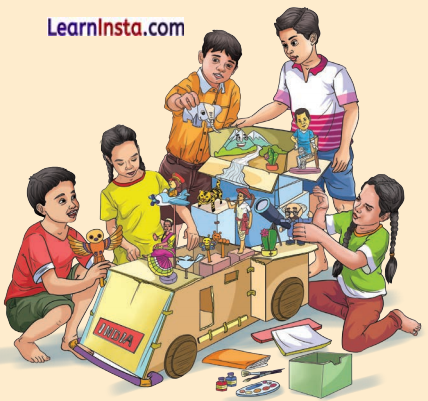
Discuss and list down the various items of your state tableau. Make a poster or a model of it.
Ans.
- State Name: Kerala
- Items in Tableau: Kathakali dancer, houseboat, coconut tree, spice plants like cardamom, and an elephant.
- Colours Used: Green, blue, yellow, and red.
- Slogan: “God’s Own Country – Kerala!”
- Fun Fact: Kerala is famous for its beautiful backwaters and Ayurvedic treatments.
Note: Students should create a poster or model based on their state, showing items like traditional dress, crops, or monuments.
Write (Page 79)
Question 1.
What events take place at your school on the Independence Day?
Answer:
On Independence Day, our school organises many events. We gather around the flagpole, and the flag is hoisted by our principal. We sing the National Anthem and patriotic songs. There are speeches about our freedom fighters, and some students perform dances or skits. We also plant trees or hold a cleanliness drive to celebrate the event.
Activity 2 (Page 79)
Write down five rules that are followed at your school. If you were to make one new rule, what would it be?
Answer:
Five Rules Followed at School:
- Come to school on time every day.
- Wear the school uniform neatly.
- Keep classrooms and playgrounds clean.
- Respect teachers and classmates.
- Do homework and classwork regularly.
New Rule: Every student should plant one tree in the school garden each year to make the school greener and help the environment.
Activity 3 (Page 80)
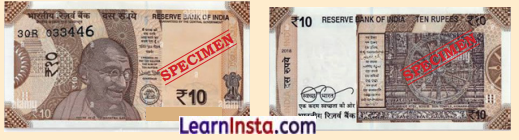
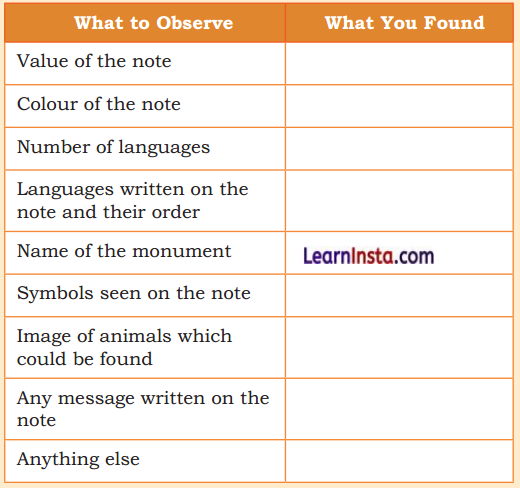
Take any Indian currency note and observe it carefully. Then, fill in the table below.
Answer:
| What to Observe | What You Found (Example for ₹100 note) |
| Value of the note | ₹100 |
| Colour of the note | Lavender (purple) |
| Number of languages | 15 |
| Languages written on the note and their order | Assamese, Bengali, Gujarati, Kannada, Kashmiri, Konkani, Malayalam, Marathi, Nepali, Odia, Punjabi, Sanskrit, Tamil, Telugu and Urdu |
| Name of the monument | Rani ki Vav |
| Symbols seen on the note | Swachh Bharat spectacles, Ashoka Chakra |
| Image of animals which could be found | None |
| Any message written on the note | Swachh Bharat Abhiyan |
| Anything else | Mahatma Gandhi’s image, raised prints |
Note: Answers may vary depending on the currency note observed (e.g., ₹10, ₹20, ₹50, ₹200 and ₹500).
Activity 4 (Page 82)
Design an emblem for your school. Think of the message you want to convey by using symbols, words, shapes and colours to make it special.
Answer:
- Drawing: A book with a tree growing out of it, surrounded by a circle of stars.
- Description: My school emblem has a book to show learning, a tree for growth, and stars for bright future. The colours are green for nature, blue for knowledge, and yellow for hope. It shows that our school helps us grow strong and wise.
Write (Page 83)
Read the riddles given below and guess the national symbols of India:
| I wear orange with black stripes bold, I walk in the forest, deep and old. With a mighty roar, I rule the land, Guess who I am, strong and grand? |
I dance in the rain in the morning light, With green and blue feathers bright. With a crown upon my head, I stand so tall, It is a joy to watch when I move my tail. |
| National animal of India | National bird of India |
Answer:
National Animal of India – Royal Bengal Tiger
National Bird of India – Peacock
Discuss (Page 83)
If we had to choose a national fruit for our country, which one would you suggest? Tell us why.
Answer:
(Suggested answer) I would suggest the mango as India’s national fruit. It grows in many states and is loved by everyone. Mangoes come in different varieties like Alphonso and Dasheri, showing India’s diversity. It is sweet and juicy, just like our vibrant country.
Find Out (Page 83)
States also have some symbols. With the help of your teacher, find out the following symbols of your state.
Answer:
(Example for Kerala):
- State animal: Elephant
- State bird: Great Hornbill
- State tree: Coconut Tree
- State flower: Golden Shower (Kanikkonna)
Note: Students should find symbols for their own state with teacher’s help.
Draw (Page 84)
Spot a tree, bird, animal, flower, or object near your school. Choose one as your school symbol. Draw it and write one line on why it can be your school’s symbol.
Answer:
(Suggested answer):
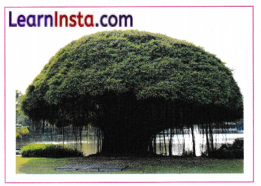
- Drawing: A banyan tree.
- Reason: The banyan tree can be our school symbol because it gives shade and shows strength, just like our school that helps us grow strong.
Activity 5 (Pages 84-85)
Question 1.
Find out about the languages spoken by students in your class and name them.
Answer:
(Suggested answer) Languages spoken by students in our Class are: Hindi, Tamil, Bengali, Malayalam and Telugu.
Question 2.
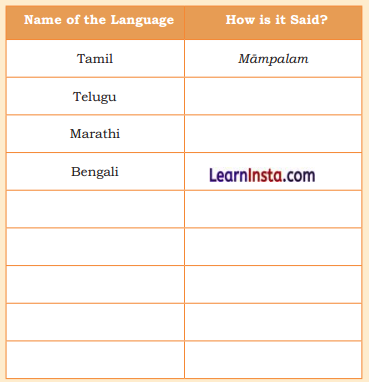
Pick a specific word (for example, mango) and have fun learning what it is called in different languages.
Answer:
| Name of the Language | How is it Said? |
| Tamil | Mampalam |
| Telegu | Mamidi Pandu |
| Marathi | Aamba |
| Bengali | Aam |
| Hindi | Aam |
Diversity Everywhere (Pages 86-87)
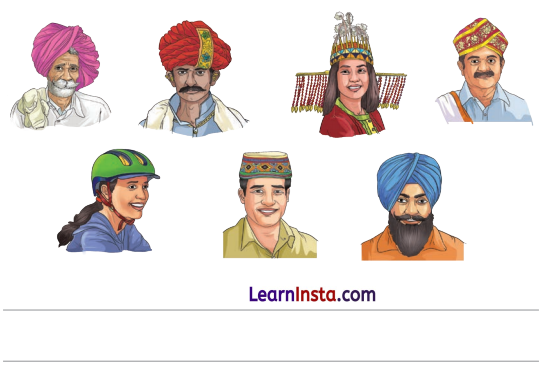
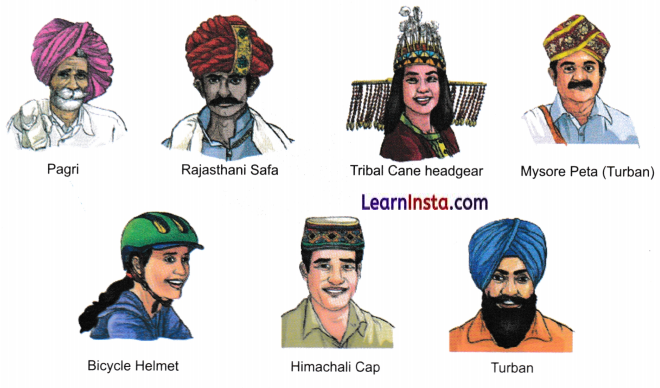
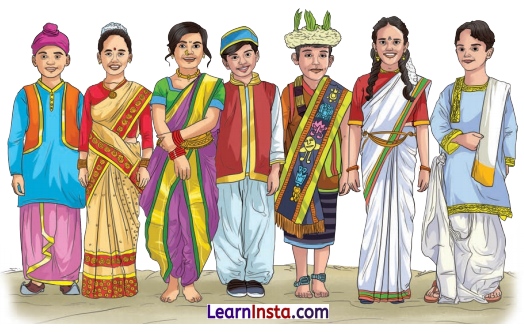
How many headgears can you name?
Answer:
Activity 6 (Page 87)
– In small groups, take a dupatta or scarf and help each other make a traditional headgear.
– Create a headgear or cap using waste materials.
Answer:
(Suggested answer):
- Traditional Headgear: We used a dupatta to make a Rajasthani pagri by folding and wrapping it around the head. It looked colourful and showed tradition.
- Waste Material Headgear: We made a cap using old newspapers, taped together in a cone shape, and decorated it with bottle caps. It was fun and protected us from the sun.
Activity 7 (Page 89)
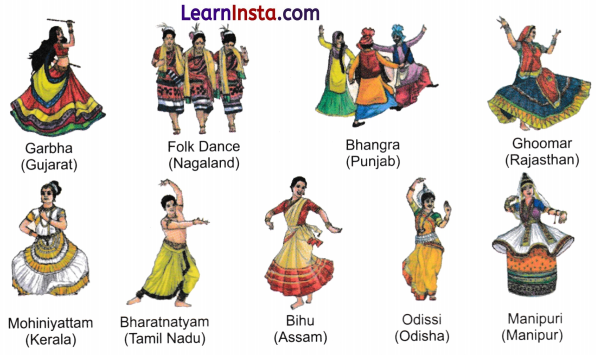
Under your teacher’s guidance, identify and mark the states on the map of India where these dance forms originated.
Write (Page 89)
Question 1.
What are some traditional Indian musical instruments that you know of?
Answer:
Traditional Indian Musical Instruments:
- Mridangam (used in Carnatic music)
- Sitar (used in Hindustani music)
- Shehnai (used in Hindustani music)
- Tabla (used in Hindustani music)
- Flute (used in many types of music)
Question 2.
Try to make a musical instrument from locally available materials.
Answer:
(Suggested answer): Make a rattle using a small plastic bottle filled with dried beans. Seal the cap with tape and tie two sticks as handles with rubber bands. Decorate it with colourful paper to look like a festival instrument. When it is shaked, it will make a rattling sound like a maraca.
Let us reflect (Pages 91-93)
Question 1.
If you could learn one more Indian language, which one would you select and why?
Answer:
(Suggested answer): I would choose to learn Tamil because it is an ancient language with beautiful songs and stories. My friend speaks Tamil, and I want to talk to her in her language. Learning Tamil will help me understand South Indian culture better. It will also make me feel closer to India’s diversity. I think it will be fun to learn new words and write in a different script.
Question 2.
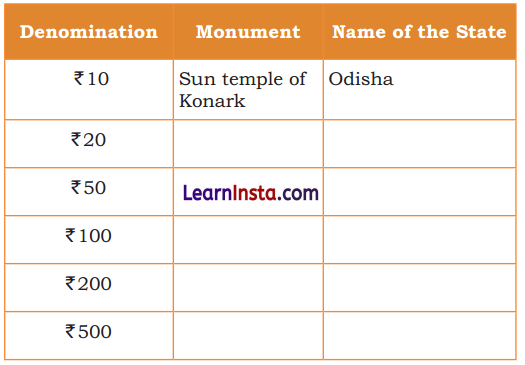
Which monuments do you see in different currency notes? Make a table.
Answer:
The monuments that can be seen in different currency notes are as follows.
| Denomination | Monument | Name of the State |
| ₹ 10 | Sun Temple of Konark | Odisha |
| ₹ 20 | Ellora Caves | Maharashtra |
| ₹ 50 | Hampi | Karnataka |
| ₹ 100 | Rani ki Vav | Gujarat |
| ₹ 200 | Sanchi Stupa | Madhya Pradesh |
| ₹ 500 | Red Fort | Delhi |
Question 3.
Identify the currency symbol of India among the images shown below (the clue is in our currency note). Which other country’s currency symbol can you identify?

Answer:
India’s Currency Symbol: ₹ (Rupee symbol, found on all Indian currency notes).
Other Country’s Currency Symbol (Example):
- €: EURO (European Union Countries)
- $: US DOLLAR
- ₽: RUSSIAN RUBLE (RUB)
- Ұ: CHINESE YUAN
- ¥: JAPANESE YEN
- £: POUND STERLING (UK)
- £: This symbol could not be identified.
Question 4.
Which animals do you see in a ₹10 note?
Answer:
On a ₹10 note, there are images of a rhinoceros, an elephant, and a tiger.
Question 5.
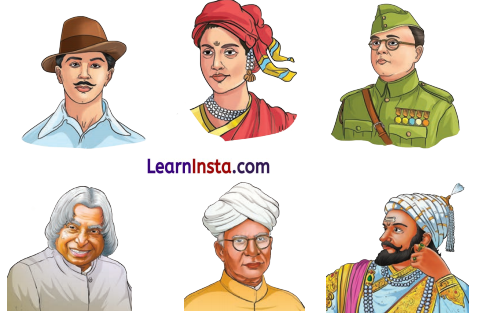
You must have seen pictures of a few great people of India in your school or any other place. Identify the names of these great men and women shown below, and write a few lines about their contributions.
Answer:
I have seen pictures of great people in my school and other places, and I can identify the six great men and women listed below, along with their contributions to India.
1. Bhagat Singh: Bhagat Singh was a brave freedom fighter who worked to free India from British rule. He was very young but fearless, inspiring others with his courage. He wrote articles and threw non-harmful bombs in the British assembly to protest against unfair laws. Bhagat Singh gave his life for India’s freedom, teaching us to stand up for justice. His bravery makes him a hero for all Indians.
2. Rani Lakshmi Bai: Rani Lakshmi Bai, the Queen of Jhansi, was a fearless warrior who fought against the British in 1857. She led her army on horseback, showing great strength and bravery, even when the odds were against her. Known as the “Rani of Jhansi,” she protected her people and inspired women to be strong. Her courage during the First War of Independence makes her a symbol of India’s fight for freedom.
3. Subhas Chandra Bose: Subhas Chandra Bose, also called Netaji, was a bold leader who worked to make India free from British rule. He formed the Indian National Army (INA) to fight for freedom and led soldiers with the slogan “Give me blood, and I will give you freedom.” Netaji’s determination and leadership inspired many Indians to join the freedom struggle. His efforts showed us the power of unity and bravery in fighting for our country.
4. APJ Abdul Kalam: Dr. APJ Abdul Kalam was a brilliant scientist and President of India, known as the “Missile Man” for his work on India’s rockets and missiles. He helped make India strong in science and defence by working on projects like Agni and Prithvi missiles. As President, he visited schools and inspired students to dream big and work hard. His books, like Wings of Fire, motivate young people to believe in themselves and contribute to India’s future.
5. Dr. Sarvepalli Radhakrishnan: Dr. Sarvepalli Radhakrishnan was a great teacher, philosopher, and India’s second President. He loved education and believed in teaching values like kindness and wisdom. His birthday, September 5, is celebrated as Teachers’ Day in India because he respected teachers so much. As President, he worked to make India a better place, and his ideas about learning inspire us to study hard and be good citizens.
6. Chhatrapati Shivaji: Chhatrapati Shivaji Maharaj was a brave Maratha king who founded the Maratha Empire in western India. He fought against powerful rulers to protect his people and their culture, using clever strategies in battles. Shivaji built strong forts, like Raigad, and treated everyone fairly, no matter their religion. His courage and leadership make him a great hero, showing us how to be strong and just.
Note to the Teacher:
Encourage students to share what they admire about these personalities to connect with the chapter’s theme of pride in India’s heritage.
Question 6.
Group activity: Find out from your elders about people, who have contributed to the nation from your locality or state, and share what you learnt in the classroom.
Answer:
(Suggested answer): I spoke to my grandmother about a freedom fighter from our town, Bhagat Singh (from Punjab). He fought bravely for India’s freedom and inspired young people to stand against injustice. He wrote books and gave speeches to spread the message of freedom. I learned that he was very young and brave. He sacrificed his life for freedom of India. Sharing this in class made me proud of my state.
Question 7.
Project: Cultural Fair
Celebrate the vibrant diversity of India, where every state tells its own colourful story.
- Divide the class into different groups.
- Assign each group a different state of India.
- Each group will explore their assigned state and prepare a presentation covering – traditional dress, popular food, festivals, languages, dance or music.
Answer:
(Suggested answer):
- State Assigned: Assam
- Presentation:
- Traditional Dress: Women wear Mekhela Chador, and men wear Dhoti-Kurta.
- Popular Food: Assam tea, Pitha (rice cakes).
- Festivals: Bihu (harvest festival).
- Dance: Bihu dance.
- Poster: Showed a Bihu dancer, tea gardens, and the Brahmaputra River.
- Unique Features: Assam is famous for its tea and the one-horned rhinoceros.
- Similarities/Common Values: Like other states, Assam celebrates festivals with dance and food, showing unity in diversity.
You may also prepare posters, cut outs, etc., on the assigned state.
– Set up a cultural fair in the class. Each group can set up their own state booth. Students will take turns and visit other booths, and learn about each state.
Answer:
Students to do it themselves.
After the fair, gather all the students in a circle and discuss:
- What are the unique features you found in each state?
- What are the similarities or common values you found?
Answer:
(Suggested answer):
- Unique Features: Tamil Nadu has Bharatanatyam dance and temple carvings. Punjab has Bhangra dance and golden fields of wheat. Assam is known for tea gardens and Bihu. Rajasthan has colourful turbans and desert forts. Each state has its own special culture.
- Similarities/Common Values: All states celebrate festivals with joy, share food, and respect traditions. People in every state love music and dance. We all work together to keep India strong and united.