Each of our Ganita Prakash Class 7 Worksheet and Class 7 Maths Chapter 6 Number Play Worksheet with Answers Pdf focuses on conceptual clarity.
Class 7 Maths Chapter 6 Number Play Worksheet with Answers Pdf
Number Play Class 7 Maths Worksheet
Class 7 Maths Chapter 6 Worksheet with Answers – Class 7 Number Play Worksheet
Tick (✓) for the correct option
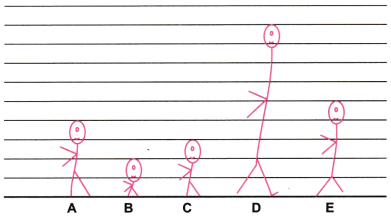
Five girls, A, B, C, D, and E are standing in a line facing left.
Question 1.
A calls the number
(a) 0
(b) 1
(c) 2
(d) 3
Question 2.
B calls the number
(a) 0
(b) 1
(c) 2
(d) 3
Question 3.
D calls the number
(a) 0
(b) 1
(c) 2
(d) 3
Question 4.
If B and C exchange positions, then B will call
(a) 0
(b) 1
(c) 2
(d) 3
Question 5.
The parity of which of the following will be even
(a) 236 + 101
(b) 201 + 301 + 401
(e) 99 + 100
(d) 1001 + 9999

Question 6.
The parity of which of the following will be odd
(a) 234+ 128
(b) 301+623
(e) 1024 + 120 + 23
(d) 102 + 302 + 108
Question 7.
The parity of which of the following will be even
(a) 99 × 10
(b) 24 × 36
(e) 11 × 13 × 17
(d) None of these
Question 8.
The parity of which of the following will be odd
(a) 107 × 309 × 11
(b) 207 × 145 × 32
(c) 92 × 98 × 100
(d) None of these
Question 9.
Which of the following always has even parity?
(a) 2n + 3
(b) 3n + 2
(c) 4n – 2
(d) 5n + 1
Question 10.
Which of the following always has odd parity?
(a) 2n + 3
(b) n + 2
(c) 3n – 2
(d) 5n + 3
Question 11.
Which of the following has either odd or even parity?
(a) 2n + 4
(b) 5n + 4
(c) 6 + 2n
(d) 2n
Question 12.
The expression 2n + a will have odd parity if the value of‘a’ is
(a) 2
(b) 4
(c) 11
(d) 0
Question 13.
How many different magic squares can be made using the numbers 1-9?
(a) 1
(b) 20
(c) 36
(d) 8
Question 14.
Which of the following cannot be the magic sum of a magic square?
(a) 33
(b) 27
(c) 99
(d) 20
Question 15.
Which of the following group of numbers cannot be used to make a magic square?
(a) 100 – 108
(b) 10, 12, 14, …………, 26
(c) 5, 10, 15, …. , 45
(d) 1, 2, 4, 7, 11, 16, 22, 29, 38
Question 16.
Which of the following is not a number in the Virahahka sequence?
(a) 13
(b) 31
(c) 34
(d) 36
Question 17.
The next two numbers in the sequence: 1, 2, 3. 5……. . are
(a) 13 and 20
(b) 12 and 21
(c) 12 and 20
(d) 13 and 21
Question 18.
Two consecutive numbers numbers are in the Virahahka sequence are 55 and 89. The two previous
(a) 21 and 34
(b) 23 and 34
(c) 21 and 33
(d) 20 and 34
Question 19.
The next term of the Virahahka-Fibonacci series: 1, 2, 3, 5, 8, 13, 21, 34, … is
(a) 52
(b) 53
(c) 54
(d) 55
Question 20.
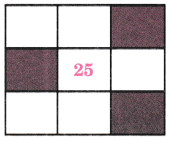
In the given magic square, what will be the total of each side?
(a) 50
(b) 65
(c) 75
(d) 100
Assertion-Reason Questions
In questions 1 – 5, a statement of Assertion (A) is followed by a statement of Reason (R). Choose the correct option.
Question 1.
Assertion (A) : The sum of five odd numbers is always odd.
Reason (R) : Adding an odd number with odd numbers always results in an odd number.
(а) Both (A) and (R) are true, and (R) is the correct explanation of (A).
(b) Both (A) and (R) are true, but (R) is not the correct explanation of (A).
(c) (A) is true, but (R) is false.
(d) (A) is false, but (R) is true.
Question 2.
Assertion (A) : It is possible to make a 3 x 3 magic square using the numbers 1 to 9 such that all rows, columns and diagonals add up to 15.
Reason (R) : A magic square uses only even numbers to achieve equal sums.
(a) Both (A) and (R) are true, and (R) is the correct explanation of (A).
(ft) Both (A) and (R) are true, but (R) is not the correct explanation of (A).
(c) (A) is true, but (R) is false. id) (A) is false, but (R) is true.
Question 3.
Assertion (A) : The 100th odd number is 199.
Reason (R) : The nth odd number is given by the formula 2n-l.
(a) Both (A) and (R) are true, and (R) is the correct explanation of (A).
(b) Both (A) and (R) are true, but (R) is not the correct explanation of (A).
(c) (A) is true, but (R) is false.
(d) (A) is false, but (R) is true.
Question 4.
Assertion (A) : There are 34 rhythms of 8 beats using short (1 beat) and long (2 beat) syllables.
Reason (R) : The number of rhythms follows the Virahanka-Fibonacci sequence.
(a) Both (A) and (R) are true, and (R) is the correct explanation of (A).
(b) Both (A) and (R) are true, but (R) is not the correct explanation of (A).
(c) (A) is true, but (R) is false.
(d) (A) is false, but (R) is true.
Question 5.
Assertion (A) : The sum of two odd numbers is always even.
Reason (R) : Each odd number has an unpaired 1, and two such Is make a pair.
(а) Both (A) and (R) are true, and (R) is the correct explanation of (A).
(b) Both (A) and (R) are true, but (R) is not the correct explanation of (A).
(c) (A) is true, but (R) is false.
(d) (A) is false, but (R) is true.
Question 6.
Assertion (A): The sum of two even numbers is always an even number.
Reason (R): The product of an even number and any number is always an even number.
In the given question, a statement of Assertion is followed by a statement of Reason. Choose the correct option as:
(a) Both A and R are true and R is the correct explanation of A.
(b) Both A and R are true but R is not the correct explanation of A.
(c) A is true but R is false.
(d) A is false but R is true.
Fill in the blanks
Four boys A, B, C and D are standing in a line facing left. Each boy calls out the number of boys in front of him who are taller than him.
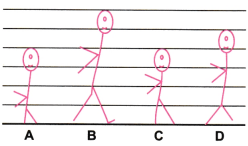
1. A will call ___________ .
2. If A is taller than B, then B will call _____________ .
3. If C is shorter than A but taller than B, then B calls ______ .
4. If D is the tallest, he will call _____________ .
5. The parity of sum of three even numbers is _________ .
6. The parity of the difference of two odd numbers is ______.
7. The parity of the product of three odd numbers is ______.
8. The parity of the product of two odd and one even number is ______
9. The parity of the expression 4n + 6 is ______.
10. The parity of the expression 3n + 7 is ______.
11. The parity of the expression 6n + 3 is ______.
12. The hundredth even number is ______.
13. By adding the three terms of any row, column or diagonal we get the ______ of the square.
14. Row sum in a magic square is 45. Then the column sum is ______
15. The magic number of a magic square is 18. Then the centremost number is ______
16. Parity of the 89th term in the Virahahka sequence is ______
17. In the Virahahka sequence, from third term onwards, the pattern of parity is ______
18. In the Virahahka sequence, 17th term is even. The next even term is the ______ term.
19. The sum of two odd numbers is always ______.
20. The sum of an even and an odd number is always ______.
21. The product of an even and an odd number is always ______.
Write (T) for true or (F) for false for the given statements
For each of the following statements, decide if it is Always True, Sometimes True, or Never True. Provide your reasoning.
1. If a person has the number “1”, they are the second tallest in the group.
2. If the second tallest person says “1”, they must be the shortest.
3. The person who says the number “2” is always in the second position in line. _______
4. If someone is in the middle of the line, they can say any number except “O”. _____________
5. The person in the last position always has the largest number. ____________
6. What is the smallest possible number in a group of 6 people? ___________
7. The parity of 1 + 2 + 3 + ………. + 10 is even.
8. The parity of 2 + 4 + 6 + 10 + ……………. + 20 is even.
9. The parity of 1 × 2× 3 × ………….. × 12 is odd.
10. The parity of 1 × 3 × 5 × 7 × …. × 99 is odd.
11. The expression 4m – 1 always gives odd numbers.
12. All even numbers can be expressed as 6j — 4.
13. Both expressions 2p + 1 and 2q -1 describe all odd numbers.
14. The expression 2f -+ 3 gives both even and odd numbers.
15. In a magic square sum along both diagonals may or may not be same.
16. Is it not possible to get a magic square by filling nine non-consecutive numbers?
17. The magic sum is always a multiple of 3.
18. 100th term in the Virahahka sequence is positive.
19. The first term in Virahahka sequence is 0.
20. The number 7 is written as sum of 1’s and 2’s(7 = 1 + 1 + 1 + 2 + 2 etc.) This can be done in 21 different ways.
Very Short Answer Type Questions
Question 1.
In the given picture, five boys, A, B, C, D, and E, are standing in a line facing left. Each boy calls out the number of boys in front of him who are taller than him.
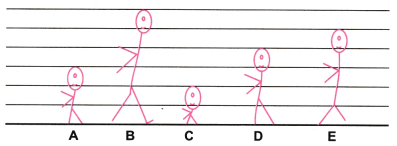
What numbers did each boy call?
Solution:
________________________________
________________________________
________________________________
Question 2.
Five girls, A, B, C, D, and E are standing in a line facing left. Each girl calls out the number of girls in front of her who are taller than her. They speak out the numbers 0, 1, 0, 1, 4. Draw a picture for it.
Solution:
________________________________
________________________________
________________________________
Question 3.
A light bulb is ON. Its switch was toggled 200 times. Will the bulb be on or off? Why?
Solution:
________________________________
________________________________
________________________________
Question 4.
Two cousins, Mona and Sona, were born exactly one year apart. Today is their birthday. Mona exclaims that the sum of their ages is 23. Is this possible? Explain.
Solution:
________________________________
________________________________
________________________________
Question 5.
A leaf from a book has fallen out. The pages are numbered. Tina finds out that the sum of the numbers on the two pages is 100. Is this possible? Explain.
Solution:
________________________________
________________________________
________________________________
Question 6.
What is the parity of the sum of the numbers from 1 to 75?
Solution:
________________________________
________________________________
________________________________
Question 7.
Check the parity of the following expressions: 3n + 2
Solution:
________________________________
________________________________
________________________________
Question 8.
Write an expression that always has (a) even parity (6) odd parity
Solution:
________________________________
________________________________
________________________________
Question 9.
Write an expression that could have either odd or even parity.
Solution:
________________________________
________________________________
________________________________
Question 10.
Give the expression to list all (a) even numbers (b) odd numbers
Solution:
________________________________
________________________________
________________________________
Question 11.
Create a magic square using the numbers 2 – 10. Add 2 to each number and check if you again get a magic square.
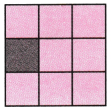
Solution:
________________________________
________________________________
________________________________
Question 12.
Create a magic square using the numbers 2, 4, 6, 8, ,18. Subtract 3 from each number and check if you again get a magic square.
Solution:
________________________________
________________________________
________________________________
Question 13.
Create a magic square using the numbers 3-11. Use this magic square to obtain a magic square with the central term as 0.
Solution:
________________________________
________________________________
________________________________
Question 14.
Give the expression to list all (a) even numbers (b) odd numbers
Solution:
________________________________
________________________________
________________________________
Question 15.
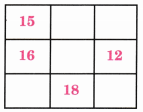
Using this given generalised form, find a magic square if the central number is 10.
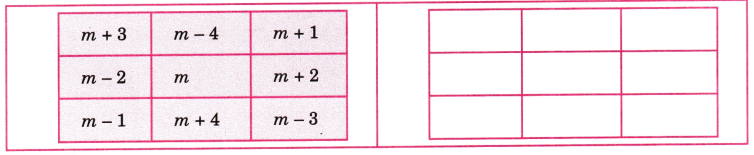
What will be the magic number of the new magic square?
Solution:
________________________________
________________________________
________________________________
Question 16.
Using this given generalised form, find a magic square with magic number 18.
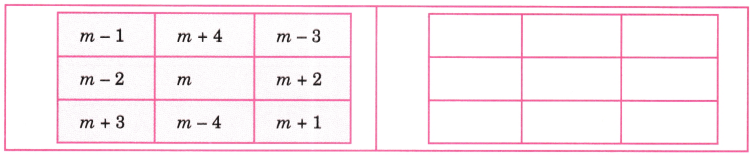
What will be the magic number of the new magic square?
Solution:
________________________________
________________________________
________________________________
Question 17.
Kavita has to give ₹ 60 to a vendor. She has notes of ₹ 10 and ? 20 only. She can pay in a variety of ways. (4 notes of? 10 and 1 note of? 20 etc.) If she gives one note at a time, in how many ways can she pay?
Solution:
________________________________
________________________________
________________________________
Question 18.
Give the working rule to find the parity of any term of Virahanka sequence.
Solution:
________________________________
________________________________
________________________________
Question 19.
Check the parity of the following terms in the Virahanka sequence
(a) 90th term
(b) 106th term
(c) 200th term
Solution:
________________________________
________________________________
________________________________
Question 20.
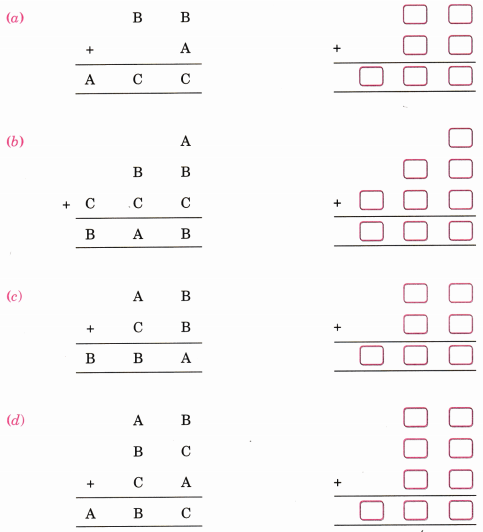
Solve these cryptarithms:
Question 21.
Create a magic square using 9 non-consecutive numbers whose magic sum is 18.

Solution:
________________________________
________________________________
________________________________
Question 22.
A lamp is ON. Ravi toggles its switch 23 times. Will the lamp be lighted or not? Why?
Solution:
________________________________
________________________________
________________________________
Question 23.
Prerna was living on the first floor of an apartment. The first floor can be reached by walking up a staircase consisting of 7 steps. Prerna usually climbs up by taking either 1 step each time or a maximum of 2 steps at a time. In how many ways can Prerna reach her floor?
Solution:
________________________________
________________________________
________________________________
Question 24.
Find the number sequence formed when the given arrangements are changed as mentioned below.
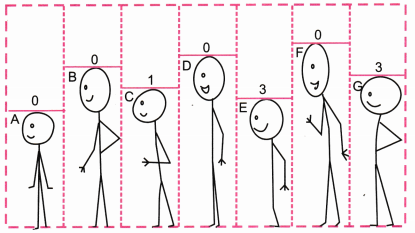
(a) BFECDAG
(b) FBCEADG
(c) FDGBCEA
Solution:
________________________________
________________________________
________________________________
Question 25.
Find out the parity for the product of two (a) odd numbers and (b) even numbers.
Solution:
________________________________
________________________________
________________________________
Question 26.
Find the parity of the number of small squares in grids of the given dimensions without calculating the product.
(a) 23 × 19
(b) 62 × 26
(c) 124 × 271
Solution:
________________________________
________________________________
________________________________
Question 27.
Create a magic square whose magic sum is 51.
Solution:
________________________________
________________________________
________________________________
Question 28.
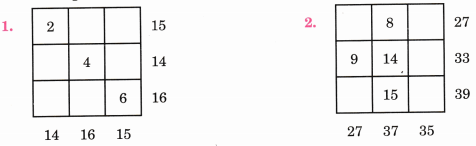
Fill in the grids below:
Solution:
________________________________
________________________________
________________________________
Question 29.
What is the parity of the sum of numbers from 1 to 200?
Solution:
________________________________
________________________________
________________________________
Short Answer Type Questions
Question 1.
Fill in the grid below with numbers 1-9, without repeating. Find the row and column sums. Verify that the sum of column sums and the sum of row sums is 45.

Solution:
________________________________
________________________________
________________________________
Question 2.
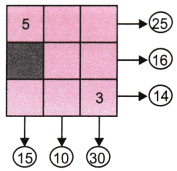
Fill in the grid below with numbers 1-9, without repeating and matching the row and column sums.
Solution:
________________________________
________________________________
________________________________
Question 3.
Check if a solution to the grid is possible. Give reason.

Solution:
________________________________
________________________________
________________________________
Question 4.
Fill in the grid below with numbers 2 – 10, without repeating. Find the row and column sums. Find the sum of column sums and the sum of row sums. Check if they are equal.

Solution:
________________________________
________________________________
________________________________
Question 5.
Find the values of the letters in each of the following and give reasons for the steps involved.
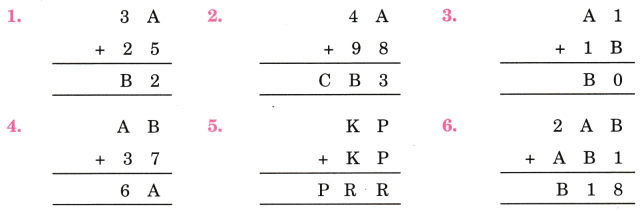
Solution:
________________________________
________________________________
________________________________
Case Based Questions
I. Ram was playing with number cards. He wanted to place 5 cards such that their total sum equals 30. After several attempts, he realized all the cards had odd numbers, and he started wondering if his goal was possible.
Question 1.
If you add 5 odd numbers together, what type of number will you always get?
(a) Even
(b) Odd
(c) Prime
(d) Composite
Question 2.
Can Ram make the total 30 using 5 odd number cards?
(a) Yes, always
(6) Yes, only if the cards are 1, 3, 5, 7, 14 J
(c) No, it’s impossible
(d) Only if one card is even
Question 3.
What is the parity (evenness or oddness) of the sum of any two odd numbers?
(a) Always even
(b) Always odd
(c) Always prime
(d) Can’t be determined
Question 4.
Ram changes the task to use 3 even and 2 odd numbers. What can be the parity of the sum now?
(aj Always odd
(b) Always even
(c) Could be either
(d) Always zero
II. It In a poetry class, Pooja discovered the Virahanka-Fibonacci numbers, which help count possible rhythm patterns using short syllables (1 beat) and long syllables (2 beats). Her teacher asked: “How many rhythms are possible with 8 beats?”
Question 1.
What is the 8th number in the Virahanka-Fibonacci sequence?
(a) 21
(b) 34
(c) 55
(d) 89
Question 2.
Which rule generates the Virahanka-Fibonacci sequence?
(a) Multiply previous term by 2
(b) Square the previous term
(c) Add two previous terms
(d) Alternate odd and even
Question 3.
What will be the 9th number in the sequence?
(a) 55
(b) 89
(c) 144
(d) 21
Question 4.
If a rhythm starts with a long syllable (2 beats), how many beats remain for a total of 8?
(a) 7
(b) 5
(c) 6
(d) 8
Number Puzzle
Below you will find a set of magic number puzzles. Fill in the blanks to solve the puzzle for the given magic sum:
(a) The magic sum is 27

(b) The magic sum is 42