Nature’s Treasures Class 6 Questions and Answers NCERT Solutions
Class 6 Science Chapter 11 Nature’s Treasures Question Answer
Let Us Enhance Our Learning
Question 1.
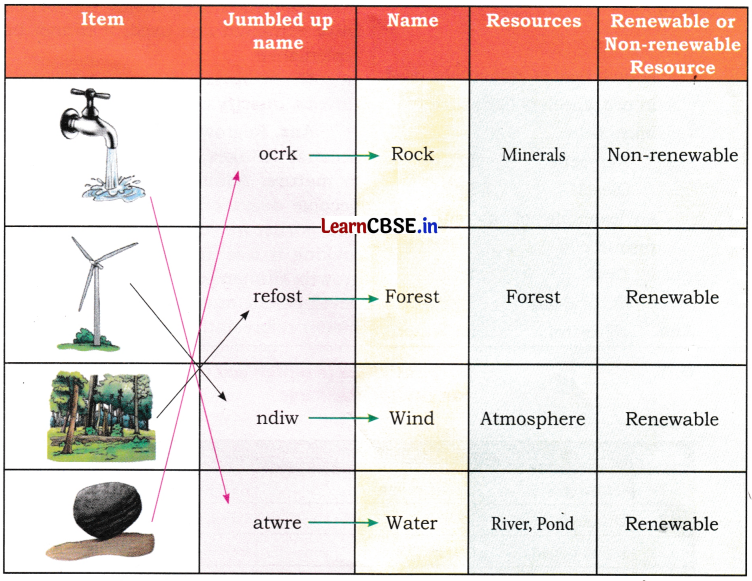
Figure shows items related to natural resources. Match them with their jumbled up names. Make another table and write the names of these resources. Classify these resources as renewable or non-renewable.

Answer:
Question 2.
State whether the following statements are True (T) or False (F). If False, correct them.
(i) Nature has all the resources to meet human needs.
Answer:
True
(ii) Machines are a resource found in nature.
Answer:
False;
Machines are a resource created by human beings.
(iii) Natural gas is a non-renewable resource.
Answer:
True
(iv) Air is a renewable resource.
Answer:
True

Question 3.
Fill in the blanks using the most appropriate option-
(i) A fuel that is commonly used in two wheelers like scooters or bikes is. _____.
(a) Kerosene
(b) Petrol
(c) Diesel
(d) LPG
Answer:
(b) Petrol
(ii) An example of a renewable resource is ______.
(a) Coal
(b) Water
(c) Natural gas
(d) Petrol
Answer:
(b) Water
Question 4.
Classify the following as renewable or non¬renewable resources—coal, natural gas, forests and minerals.
Answer:
Renewable resources: Forests Non-renewable resources: Coal, natural gas and minerals
Question 5.
Why do we say that petroleum is a non-renewable resource?
Answer:
Petroleum is considered a non-renewable resource because it takes millions of years to form from the remains of microorganisms and plants that get buried deep inside the Earth. Once extracted and used, it cannot be replenished.
Question 6.
It is difficult to regrow forests. Justify this statement.
Answer:
Regrowing forests is difficult because it takes many years for trees to mature. Additionally, the soil may become degraded, losing its nutrients and structure due to deforestation, making it less suitable for new plant growth. Human activities such as urban development and agriculture can also hinder reforestation efforts.
Question 7.
Make a list of five daily activities in which you use natural resources. Suggest ways by which you can reduce their use.
Answer:
Five daily activities where we use natural resources are: brushing teeth, washing clothes, cooking, driving vehicles using petrol and using paper.
The ways by which we can reduce the use of natural resources are: use of solar energy like solar cookers, use of public transport, using electric vehicles, using digital documents instead of papers etc.
Question 8.
List four activities that are possible due to the presence of air.
Answer:
Activities that are possible due to the presence of air:
- Breathing
- Flying kites
- Inflating tyres and balloons
- Drying clothes
Question 9.
How can you contribute towards enhancing the green cover of your locality? Make a list of actions to be taken.
Answer:
List of actions to be taken
(i) Encourage neighbours to grow plants in their gardens.
(ii) Collaborate with local schools to create green initiatives.
(iii) Advocate for the protection of existing trees and green spaces.
(iv) Participate in community tree planting drives.
(v) Plant trees in local parks and open spaces.
Question 10.
In the given illustration, we see that food is being cooked

Answer the following questions-
(i) What type of energy is being used for cooking.
(ii) Name one benefit and one drawback of using this type of energy for cooking.
Answer:
(i) The type of energy being used for cooking in the given illustration is solar energy.
(ii) Benefit
Environmentally Friendly: Solar energy is a renewable and clean source of energy that does not produce pollution or greenhouse gases during use, making it environmentally friendly. Drawback
Dependence on Weather: Solar cooking is highly dependent on weather conditions. It requires sunlight, so it cannot be used during cloudy days or at night, which limits its reliability and convenience.
Question 11.
Cutting down trees on a large scale impacts the quality of the soil. Why do you think it is so?
Answer:
Trees help keep the soil in place with their roots. When trees are removed, the soil can wash away easily during rain, leading to soil erosion. Also, trees add nutrients to the soil through their fallen leaves, which decompose and enrich the soil. Without trees, the soil may lose these important nutrients.
Question 12.
Explain two ways in which human activities pollute the air. Propose one action which can help in reducing air pollution.
Answer:
We use automobiles to travel and fossil fuels are used as a source of energy. Burning of fossil fuels in automobiles releases harmful smoke and gases which cause air pollution. Another cause of air pollution is burning of leaves, trash, and other materials. On burning, these materials also release harmful gases in the air and cause air pollution. Carpooling and public transit are excellent ways to reduce air pollution. No-fuel options like walking and biking are also good options to reduce air pollution.
Question 13.
A family uses solar panels to generate electricity, a gas stove to cook food and a windmill for pumping water from a well. What would happen if there were no sunlight for a week?
Answer:
If there were no sunlight for a week, the solar panels would not be able to generate electricity, leading the family to rely on alternative sources of power. Additionally, the growth of plants would be affected due to the lack of sunlight for photosynthesis.
Question 14.
Fill up the blanks using the following terms: (fossil fuels, forest, air, petroleum, coal, water and non-renewable resource)
Answer:

Question 15.
There is an increasing demand of trees to meet the requirements of industries and for housing. Therefore, trees are being felled. Is it justifled? Discuss and prepare a brief report.
Answer:
Report
Introduction Trees are very important for our environment. They provide us with clean air, shade, and many other benefits. However, there is a growing demand for trees to meet the needs of industries and for housing. This means more trees are being cut down, which can cause problems.
Problems Caused by Cutting Down of Trees
- Loss of homes: Animals lose their homes when trees are cut.
- Soil Erosion: Without tree roots to hold the soil in place, it can wash away easily by rain, leading to erosion.
- Climate Change: Trees help absorb carbon dioxide and produce oxygen. Cutting them down can increase the amount of carbon dioxide in the air, contributing to global warming, which in turn causes climate change.
- Less oxygen: Fewer trees mean less oxygen for humans and animals to breathe.
Is It Justified?
While it is important to meet the needs of people, it is also crucial to balance this with the conservation of trees.
What Can We Do?
(a) Plant More Trees: Replanting trees can help replace those that have been cut down.
(b) Use Resources Wisely: Reduce, reuse, and recycle materinis, like paper and wood, to lower the need for new trees.
(c) Choose alternative materials for housing and industrial need, where ever possible.
Conclusion : While there is a demand for trees to meet the requirements of industries and housing, it is important to ensure that this is done in a way that protects our environment. By planting more trees and using resources wisely, we can help in balancing human needs with the conservation of natural resources.
Question 16.
Propose a plan to use less water in your school. What steps would you take to. make this plan happen and how would it help the environment?
Answer:
Water is an important natural resource. We should always try to conserve it. We can take following actions to conserve water in our school:
- We should fill our drinking water cup half. If required, we can take more.
- We should close taps properly after use.
- We can reduce the wastage of water by not flushing the toilet unnecessarily.
- Water used for washing hands can be reused for watering plants.
- We can get the leaky taps and pipes fixed.
- We can set up roof-top rainwater harvesting in the school.