Students revise important topics using Class 8 SST Extra Questions and Class 8th SST Chapter 1 Natural Resources and Their Use Important Extra Question Answer before exams.
Class 8 SST Chapter 1 Natural Resources and Their Use Extra Questions
NCERT Class 8 Social Science Chapter 1 Extra Questions on Natural Resources and Their Use
Natural Resources and Their Use Class 8 Very Short Question Answer
Question 1.
What are natural resources?
Answer:
Natural resources are materials found in nature that are used by humans for various needs. These include water, air, minerals, forests, and soil.
Question 2.
What is meant by sustainable use of resources?
Answer:
Sustainable use means using resources wisely so that they are available for future generations. It includes conservation and responsible consumption.
Question 3.
What does ecosystem service mean?
Answer:
It refers to the benefits humans get from natural processes like clean air, water, and pollination.
Question 4.
What is the meaning of ‘regeneration’?
Answer:
Regeneration is nature’s ability to create new life and restore ecological balance.

Question 5.
What does the term ‘restoration’ refer to?
Answer:
The process of returning damaged ecosystems to their original healthy state.
Question 6.
What is an ecosystem service provided by forests?
Answer:
Forests purify air and enrich soil. They also help in maintaining the oxygen-carbon dioxide balance.
Question 7.
Mention any two traditional practices that help in resource conservation.
Answer:
Sacred groves and water harvesting are traditional practices. They protect forests and ensure water availability.
Question 8.
Mention one non-material way people respect nature.
Answer:
Offering water to the sun during Arghyam rituals.
Question 9.
What is overexploitation of resources?
Answer:
Overexploitation refers to using resources faster than they can be replenished. This can lead to scarcity and environmental damage.
Natural Resources and Their Use Class 8 Short Question Answer
Question 1.
How do resources become useful to humans?
Answer:
Resources become useful when they fulfill human needs or wants. This depends on technology, economic feasibility, and cultural acceptability. For example, water becomes useful when it is available for drinking or irrigation.
Question 2.
Differentiate between renewable and non-renewable resources.
Answer:
Renewable resources are naturally replenished over time, like sunlight and wind. Non-renewable resources, such as coal and oil, take millions of years to form. Overuse of non-renewable resources can lead to depletion.
Question 3.
What are ecosystem services? Give examples.
Answer:
Ecosystem services are benefits humans receive from nature, like clean air, water purification, and pollination. Forests, for example, provide oxygen and improve soil fertility. These services support life and well-being.
Question 4.
What is the importance of categorising natural resources?
Answer:
Categorisation helps us understand and manage resources effectively. It allows us to group similar resources under useful labels like “renewable” or “non-renewable,” “essential for life,” or “sources for energy.” This simplifies communication and helps in policy-making, conservation, and education. Categorisation also reveals relationships between resource use and sustainability.
Question 5.
Explain the impact of human activity on natural cycles.
Answer:
Human actions like deforestation and pollution disrupt natural cycles. For example, clearing forests disturbs the carbon and oxygen cycles. This can lead to climate change and biodiversity loss.
Question 6.
What is the relationship between ecosystem functions and ecosystem services?
Answer:
Ecosystem functions refer to how nature operates— like trees producing oxygen or forests preventing soil erosion. Ecosystem services are the benefits humans derive from these functions. For example, rainfall and water filtration in forests benefit nearby human settlements. Recognising these services helps in valuing and conserving ecosystems.
Question 7.
What does the term ‘resource curse’ mean?
Answer:
The ‘resource curse’ implies that countries rich in natural resources may experience slower economic development. This happens when economies depend heavily on exporting raw materials without building local industries. It also results in inequality, corruption, and displacement. India has avoided it by investing in development and value-added industries.
Question 8.
How do traditional ecological practices help in conservation?
Answer:
Traditional ecological wisdom includes practices like refraining from fishing during spawning seasons or protecting sacred groves from exploitation. These methods preserve biodiversity and maintain nature’s cycles. They reflect local knowledge passed down generations. Such cultural observances are vital informal conservation systems.
Question 9.
What is meant by restoration and regeneration in nature?
Answer:
Restoration is the process of helping damaged ecosystems recover to a healthy state. Regeneration refers to nature’s ability to create new life and conditions for growth. For example, planting trees in deforested lands encourages various life forms to return. Both are essential processes for ecosystem sustainability.
Question 10.
What is meant by restorative ecosystems?
Answer:
Restorative ecosystems heal themselves over time. For instance, after a forest fire, new plants grow from the soil. This natural regeneration helps balance ecosystems.
Question 11.
Describe the implications of uneven distribution of natural resources.
Answer:
Unequal distribution of natural resources leads to disparities in development, trade, and international conflict. It influences where people settle and where industries grow. Nations rich in certain resources gain strategic economic power, but it can also cause resource-based conflicts. Equitable sharing and diplomatic agreements are therefore essential.
Natural Resources and Their Use Class 8 Long Question Answer
Question 1.
Discuss the categories of natural resources based on their use and provide relevant examples.
Answer:
Natural resources can be categorised into three main groups based on usage: essential for life, sources for materials, and sources for energy. Essential resources include air, water, and soil-basic needs for human survival. Material resources are those used to produce goods and structures, such as timber, stone, and minerals. Energy resources power our homes, vehicles, and industries – examples include coal, petroleum, sunlight, and wind. Categorising resources based on usage helps societies plan for sustainability and conservation. Each category has its own challenges concerning sustainable extraction and environmental impact.
Question 2.
Explain the concept of renewable and non – renewable resources. Give reasons for their sustainable use.
Answer:
Renewable resources regenerate naturally – like wind, solar energy, and timber-and can theoretically be used indefinitely if managed properly. Non-renewable resources such as fossil fuels and metals are finite, as they form over millions of years. Overexploitation of renewables can convert them into non-renewable states; for instance, over-logging can destroy forests permanently. Responsible use of both types is essential to maintain ecological balance and intergenerational equity. Advances in technology can improve efficiency, but conservation measures and awareness are essential as well. Transitioning to renewables also reduces dependence on polluting and exhaustible resources.
Question 3.
What are ecosystem services? Why are they important for sustainability?
Answer:
Ecosystem services are nature’s contributions to human well-being, like air purification, climate regulation, pollination, and nutrient recycling. They .maintain ecological balance and support life. Without these services, food production, health, and climate stability would suffer, making sustainability impossible.
Question 4.
How can resource use be made sustainable in modem society?
Answer:
Sustainable resource use involves minimizing waste, recycling materials, and using renewable resources. It includes promoting awareness, using efficient technologies, and implementing laws to conserve nature. Sustainable practices ensure future generations have access to essential resources.
Question 5.
How does human intervention disrupt nature’s regenerative cycles? Provide examples.
Answer:
Human activities like deforestation, industrialisation, and pollution disrupt natural cycles of restoration and regeneration. For instance, cutting down forests faster than they can regrow leads to habitat destruction and loss of biodiversity. Industrial waste dumped in rivers can poison aquatic life, interrupting water purification cycles. Urban expansion replaces wetlands that naturally store rainwater, increasing flood risk. Melting glaciers due to climate change threaten river systems fed by them. Sustainable development practices and conservation efforts are required to restore these cycles.
Question 6.
Describe ecosystem functions and services and their importance to humaft well-being.
Answer:
Ecosystem functions are processes carried out by nature, such as photosynthesis, pollination, and water filtration. When these benefit humans, they become ecosystem services. For example, forests function to prevent erosion, and this protects our farms and homes. Pollinating insects help food production, thus supporting agricultural economies. Clean air and water, generated by ecological functions, greatly influence public health. Understanding this interconnectedness helps promote preservation rather than exploitation
for short-term gains.
Question 7.
Discuss the ‘resource curse’ and how India’s approach differs.
Answer:
The ‘resource curse’ refers to the paradox where resource-rich countries underperform economically and socially. Resources like oil and minerals often attract external exploitation, corruption, and displacement of locals. Many such nations struggle to create diversified economies. India has managed to avoid this largely by investing in its own industries and infrastructure and focusing on education and innovation. Its balanced development model enables both exploitation and regeneration. Still, there’s room to strengthen equitable and environmentally responsible extraction.
Natural Resources and Their Use Class 8 Source Based Questions
Question 1.
Read the below sources and answer the questions that follow:
Vrikshayurveda is an ancient Indian botanical science that focuses on the study and care of plants and trees. The term comes from Sanskrit, with vrik$ha meaning tree and Ayurveda meaning the science oflife or health. This traditional knowledge svstem dates back several millennia and was lormalised in texts such as Surapala’s Vrikshayurveda around the 10th century CE.
It has elaborate recommendations on the specific plants to be grown on different soil types, and provides intricate methods for seed collection^ preservation, and pre-planting treatments. Irrigation techniques are elaborately described, with recommendations varying according to plant species, growth stage, and seasonal conditions.
It specifies pest management strategies through natural repellents and plants that should be grown together. This form of sustainable agriculture promotes practices like crop rotation and mixed cropping to maintain soil health. Vrikshayurveda also offers advice on proper methods of ploughing soil so as to retain soil moisture as well as facilitate the growth of living organisms in the soil like fungi, bacteria and earthworms.
(i) What is Vrikshayurveda and what are its main areas of focus?
Answer:
Vrikshayurveda is an ancient Indian science that focuses on the study and care of plants and trees. It provides detailed guidance on soil selection, plant care, seed treatment, irrigation, and pest management.
(ii) How does Vrikshayurveda promote sustainable agriculture?
Answer:
It recommends practices like crop rotation and mixed cropping to maintain soil health and biodiversity. These methods help sustain agriculture and conserve the ecosystem.
(iii) What natural methods does Vrikshayurveda suggest for managing pests and supporting soil life?
Answer:
Vrikshayurveda suggests using natural repellents and companion planting for pest control. It also advises proper ploughing techniques to retain soil moisture and support living organisms in the soil.
Question 2.
Natural materials are all that we have to meet our needs and wants. Even all the man-made things are made from natural materials. Timber, cotton, silk, wool, metals, sand, clay, stone, coal, petroleum and water – all are from nature. Today, humans also extract minerals from the sea, energy from the sun, and food from plants. All these are natural resources. Nothing can be created out of nothing – all things come from nature.
(i) What is the origin of all man-made materials?
Answer:
All man-made things are created from natural materials. This includes metals, wood, sand, and even energy. Nature is the ultimate source of everything we use.
(ii) How do humans obtain resources from nature today?
Answer:
Humans extract minerals from the sea and energy from the sun. We also grow food using soil, water, and sunlight. These practices show our dependence on natural systems.
(iii) Why can we not create something from nothing?
Answer:
Everything we produce comes from pre-existing natural resources. Human technology only transforms thes,e materi-als. This makes nature essential for all creation.
Question 3.
India and France launched the International Alliance for Solar Energy (1ASE) in 2015 – a coalition of sunshine-rich countries committed to harnessing solar power. The alliance focuses on countries blessed with abundant sunlight throughout the year. India has helped channel billions of dollars into solar projects across developing nations, sharing technical expertise and creating affordable financing options. The Bhadla Solar Park is a symbol of India’s solar ambitions, demonstrating how a country can transition from traditional energy sources to renewable alternatives. For Indians, this alliance represents both environmental responsibility and economic opportunity.
(i) In which year did India and France launch the International Alliance for Solar Energy (IASE)?
Answer:
India and France launched the IASE in 2015.
(ii) What does the Bhadla Solar Park symbolize for India?
Answer:
The Bhadla Solar Park symbolizes India’s solar ambitions and its transition to renewable energy sources.
(iii) How has India supported solar projects in developing nations through the alliance?
Answer:
India has provided financial support, technical expertise, and created affordable financing options for solar projects in developing countries.
Natural Resources and Their Use Class 8 Picture Based Questions
Look at the picture and answer the questions that follow.
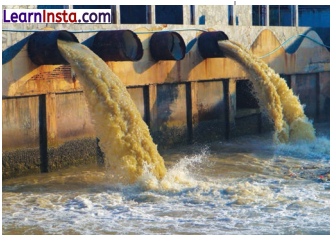
(i) What environmental issue is depicted in the image?
Answer:
Pollution caused by untreated industrial, waste discharge.
(ii) How does it impact natural cycles?
Answer:
It disrupts nature’s ability to regenerate, making rivers uninhabitable.
(iii) What solution can be applied to this problem?
Answer:
Proper waste treatment, sustainable industrial practices, and regulation enforcement.
Natural Resources and Their Use Class 8 Map-based Questions
On the political map of India, locate the following minerals:
(i) Coal-Korba and Talcher
(ii) Oil-Kalol and Ankleshwar
(iii) Iron ore-Chikkamagaluru and Tumkur
(iv) Bauxite-Koraput and Katni
Answer:

Class 8 Natural Resources and Their Use Extra Questions for Practice
I. Multiple Choice Questions
Question 1.
What makes an element of nature a resource?
(a) Its beauty
(b) Its existence
(c) Its use by humans
(d) Its location
Question 2.
Which of these is a renewable resource?
(a) Coal
(b) Petroleum
(c) Solar energy
(d) Gold
Question 3.
Natural gas is primarily used for:
(a) Decoration
(b) Fuel and energy
(c) Water purification
(d) Tree plantation
Question 4.
What is essential for life on Earth?
(a) Marble
(b) Coal
(c) Air and water
(d) Petroleum
Question 5.
Assertion (A): Improper use of chemical fertilizers and pesticides has led to the degradation of soil in many parts of India.
Reason (R): Traditional farming practices used natural methods like cow dung, mulching, and multi-cropping, which helped maintain soil health and fertility.
Options:
(a) Both (A) and (R) are true and (R) is the correct explanation of (A).
(b) Both (A) and (R) are true but (R) is not the correct explanation of (A).
(c) (A) is true but (R) is wrong.
(d) (A) is false but (R) is correct.
II. Very Short Answer Type Questions
Question 1.
Why is solar energy considered a clean resource?
Question 2.
What are sacred groves?
Question 3.
What do you mean by the term ‘biotic resource’?
Question 4.
Why is soil an important resource?
Question 5.
What is the major cause of deforestation?
III. Short Answer Type Questions
Question 1.
How does deforestation affect natural resources?
Question 2.
Why is waste minimization essential in resource management?
Question 3.
Give examples of energy resources and their uses.
Question 4.
What are the benefits of forests to humans and nature?
Question 5.
What role does water play as a natural resource?
IV. Long Answer Type Questions
Question 1.
What challenges arise from overuse of non-renewable resources?
Question 2.
Describe the benefits of using renewable energy sources.
Question 3.
How does nature recycle itself, and what can humans learn from it?
Question 4.
Explain how sacred groves contribute to biodiversity conservation.
Question 5.
Why is it important to integrate cultural knowledge in environmental conservation?