Students can use Poorvi Book Class 8 Solutions Unit 5 Science and Curiosity Chapter 14 Magnifying Glass Questions and Answers as a quick reference guide.
Magnifying Glass Class 8 Questions and Answers
Magnifying Glass Class 8 Question Answer
NCERT Class 8 English Poorvi Chapter 14 Magnifying Glass Question Answer
Magnifying Glass Question Answer – Let us do these activities before we read. (Page 222)
I. Work in pairs. Answer the questions that follow the pictures given below. Share your answers with your classmates and teacher.
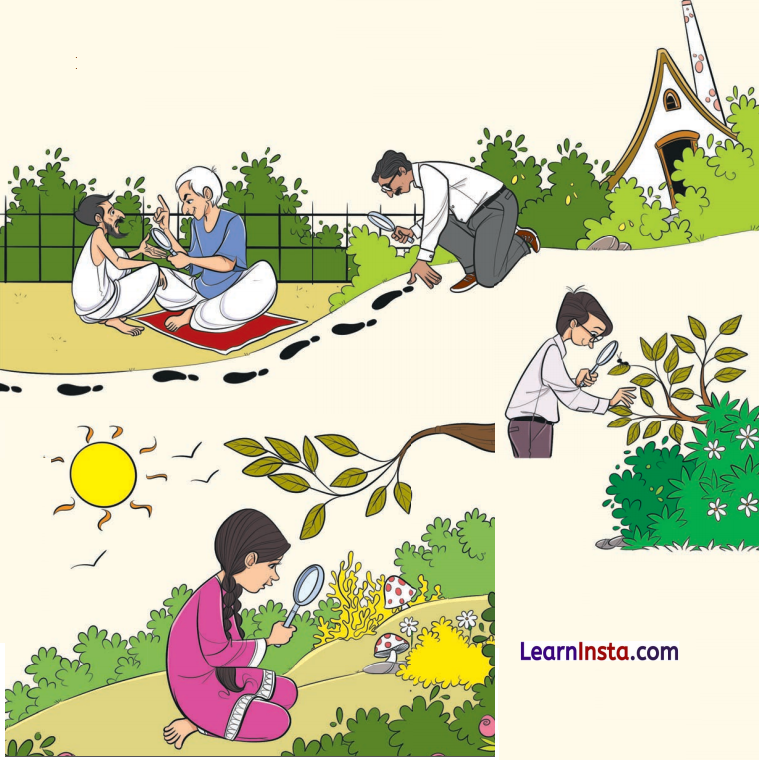
1. What is common in all these pictures?
Answer:
All pictures show people using a magnifying glass to observe small objects closely.
2. Select the pictures you are familiar with.
Answer:
I am familiar with all the pictures shown here, i.e., an astrologer using the magnifying lense to read the lives on the palm of his client, a detective observing minute details of footprints, a scientist observing the leaves for deep study and a young girl using the magnifying glass to observe a mushroom.
3. Why do you think the people in the pictures need to use a magnifying glass?
Answer:
Yes, they need to use the magnifying glass to know the minute details of the objects or things.
4. What other instruments magnify objects?
Answer:
Microscopes, telescopes, and binoculars are the other objects that magnify objects.

II. If you have a magnifying glass, what would you like to use it for and why? Share your answers with your classmates and teacher.
Answer:
(Answers may vary) I would use it to observe insects to see their tiny wings and eyes because it’s exciting to discover hidden details in nature.
Magnifying Glass Class 8 Question Answer – Let us discuss (Pages 223-224)
I. Complete the summary of the poem given below with suitable words from the poem.
The poem describes the magic of seeing the world through a 1. __________. It reveals how tiny things like 2. __________ and 3. __________ can appear vast and complex. Even a 4. __________ of water can seem like a hive of 5. __________. The poet is impressed at how the spider spins its 6. __________ from its 7. __________. The poem ends with the idea that, through lenses, the 8. __________ could seem within reach.
Answer:
The poem describes the magic of seeing the world through a 1. magnifying glass. It reveals how tiny things like 2. chalk and 3. moss can appear vast and complex. Even a 4. drop of water can seem like a hive of 5. bees. The poet is impressed at how the spider spins its 6. web-silk from its 7. spinnerets. The poem ends with the idea that, through lenses, the 8. moon could seem within reach.
II. Fill in the blanks by choosing the correct answer from the brackets.
1. The main idea of the poem is the transformative power of __________ (wonders in nature/close observation) through the magnifying glass.
2. The tone of the poem is __________ . (wonder and curiosity/peaceful and emotional)
3. The poem has __________ stanzas with __________ lines in each stanza. Hence, it is a quatrain. (four; six/six; four)
4. The rhyme scheme of the poem is __________. (ABCD; ABCB)
Answer:
1. The main idea of the poem is the transformative power of close observation (wonders in nature/close observation) through the magnifying glass.
2. The tone of the poem is wonder and curiosity, (wonder and curiosity/ peaceful and emotional)
3. The poem has six; stanzas with four lines in each stanza. Hence, it is a quatrain, (four; six/six; four)
4. The rhyme scheme of the poem is ABCB. (ABCD; ABCB)
III. Pick examples from the poem for the following poetic devices.
1. Simile
2. Alliteration
3. Metaphor
Answer:
1. “A drop of water like hive of bees”
2. “woven web-silk”
3. “Magic talk” (implying the magnifying glass speaks through its revelations)
IV. The. poem is rich in visual imagery, painting vivid pictures of small, everyday things magnified into something grand.
1. In the line, ‘A myriad shells show in a scrap of chalk’, the magnifying glass reveals ______________________.
2. In the line, ‘A forest—flowers and trees’ the poet uses the imagery of nature to emphasise ______________________.
Answer:
1. In the line, A myriad shells show in a scrap of chalk’, the magnifying glass reveals intricate patterns and hidden structures within the chalk.
2. In the line, A forest—flowers and trees’ the poet uses the imagery of nature to emphasise the vastness and complexity of an inch of moss when magnified.
V. Complete the following sentences with a reason.
1. The poet uses exclamation marks in lines, ‘The tigerish claws he has!’, ‘With all those eyes!’ and ‘In an afternoon!’ because it ______________________.
2. In the phrase, ‘Magic talk’ the poet uses personification to describe the magnifying glass because it ______________________.
3. Each stanza follows a repetitive pattern of introducing a small or ordinary object and then describing the extraordinary details revealed through magnification. This is because it supports the theme of __________ as the speaker reveals ____________.
4. In the final stanza the poet shifts from small, everyday objects being magnified to a celestial body like moon because __________.
Answer:
1. The poet uses exclamation marks in lines, The tigerish claws he has!’, With all those eyes!’ and ‘In an afternoon!’ because it conveys excitement and amazement at the magnified observations.
2. In the phrase, ‘Magic talk’ the poet uses personification to describe the magnifying glass because it suggests the glass has a magical ability to reveal hidden wonders, as if it speaks.
3. Each stanza follows a repetitive pattern of introducing a small or ordinary object and then describing the extraordinary details revealed through magnification. This is because it supports the theme of close observation as the speaker reveals the hidden beauty in everyday things.
4. In the final stanza the poet shifts from small, everyday objects being magnified to a celestial body like moon because it shows the limitless potential of magnification to explore both the micro and macro worlds.
Class 8 English Magnifying Glass Question Answer – Let us Think and reflect (Pages 224-225)
I. Read the given extracts and answer the questions that follow.
With this round glass
I can make Magic talk—
A myriad shells show
In a scrap of chalk;
Of but an inch of moss
A forest—flowers and trees;
(i) Identify whether the following statement is true or false.
The poet uses his magical powers to make the round glass powerful.
Answer:
False.
Reason:
The poet metaphorically describes the magnifying glass as magical because it reveals hidden wonders, not because of actual magical powers.
(ii) Select the line from the extract that expresses the presence of intricate patterns iii ordinary objects.
Answer:
“A myriad shells show in a scrap of chalk.”
(iii) What does the comparison of ‘an inch of moss’ to a ‘forest’ suggest about the speaker’s view of the world through the magnifying glass?
Answer:
It suggests the speaker sees the world as full of hidden complexity and beauty, where even a small piece of moss becomes a vast forest when magnified.
(iv) How does the poet feel about the ability of the magnifying glass to reveal hidden wonders?
A. Satisfied
B. Fascinated
C. Grateful
D. Determined
Answer:
B. Fascinated
II. Answer the following questions. (Page 225)
Question 1.
What is the significance of the spider in the poem?
Answer:
The spider shows how amazing nature is. When seen through a magnifying glass, its web-spinning and fierce claws reveal the beauty and skill in even tiny creatures.
Question 2.
How might the speaker’s view of the natural world change if there was no use of a magnifying glass?
Answer:
Without a magnifying glass, the speaker might see the natural world as ordinary, missing the intricate details and hidden wonders like shells in chalk or a forest in moss.
Question 3.
Why does the poem end with the idea of the moon being within reach?
Answer:
The poem ends with the moon to show that a magnifying glass can make faraway things, like the moon, seem close, connecting small and big wonders.
Question 4.
What is the speaker’s attitude towards nature and the act of observation?
Answer:
The speaker is curious and amazed by nature. They love looking closely to find hidden beauty in small things, like a spider’s web or moss.
Question 5.
Which is your favourite part of the poem? Why?
Answer:
My favourite part is “A drop of water Like hive of bees” because it shows how a tiny drop looks like a busy world when magnified, making me curious.
Magnifying Glass Class 8 Questions and Answers – Let us Learn (Pages 225-226)
I. Fill in the blanks in the sentences with the words given in the box below.
| woven myriad deft stumble surpass marvellous |
With his 1. ____________ description, the author has written the story beautifully 2. ____________with fascinating details. When you read the story, you will surely enjoy the 3. ____________storytelling technique that attracts all kinds of readers. What makes the story interesting is the superb way of describing the 4. ____________emotions and feelings of the characters. The reader will 5. ____________upon the unexpected twists and turns that 6. ____________ all our understanding and make us wonder at the narrative power of the author.
Answer:
With his 1. deft description, the author has written the story beautifully 2. woven with fascinating details. When you read the story, you will surely enjoy the 3. marvellous storytelling technique that attracts all kinds of readers. What makes the story interesting is the superb way of describing the 4. myriad emotions and feelings of the characters. The reader will 5. stumble upon the unexpected twists and turns that 6. surpass all our understanding and make us wonder at the narrative power of the author.
II. The collective noun ‘a hive of bees’ is used in the poem. Match the phrases in Column 1 with suitable words in Column 2 to make collective nouns.
| Column 1 | Column 2 |
| 1. a swarm of | (i) ships |
| 2. a constellation of | (ii) soldiers |
| 3. a grove of | (iii) dancers |
| 4. a troupe of | (iv) locusts |
| 5. a battalion of | (v) trees |
| 6. a fleet of | (vi) stars |
Answer:
| Column 1 | Column 2 |
| 1. a swarm of | (iv) locusts |
| 2. a constellation of | (vi) stars |
| 3. a grove of | (v) trees |
| 4. a troupe of | (iii) dancers |
| 5. a battalion of | (ii) soldiers |
| 6. a fleet of | (i) ships |
III. The poet uses the expression ‘eyeing the moon’ in the poem. Match the idiomatic expressions with ‘eye’ given in Column 1 with their meanings in Column 2. You may refer to a dictionary.
| Column 1 | Column 2 |
| 1. apple of one’s eye | (i) watch something or someone closely |
| 2. in the blink of an eye | (ii) act as if you do not see or notice |
| 3. keep an eye on something or somebody | (iii) something that happens very quickly |
| 4. turn a blind eye | (iv) an overall look at something |
| 5. see eye to eye | (v) a person who is very precious or important |
| 6. bird’s eye view | (vi) agree with each other |
Answer:
| Column 1 | Column 2 |
| 1. apple of one’s eye | (v) a person who is very precious or important |
| 2. in the blink of an eye | (iii) something that happens very quickly |
| 3. keep an eye on something or somebody | (i) watch something or someone closely |
| 4. turn a blind eye | (ii) act as if you do not see or notice |
| 5. see eye to eye | (vi) agree with each other |
| 6. bird’s eye view | (iv) an overall look at something |
IV. The poet uses the adjective form ‘tigerish’ in the poem by adding the suffix -‘ish’ to the noun ‘tiger’. In the same way, we can make adjectives by adding the suffix -‘ish’ to some nouns.
Choose the nouns to which you can add the suffix -‘ish’ to make adjectives.

Answer:
The nouns to which the suffix -‘ish’ can be added to make adjectives are:
- girl → girlish
- boy → boyish
- moon → moonish (less common but possible in poetic contexts)
Explanation:
The suffix -‘ish’ is typically added to nouns to form adjectives indicating resemblance or quality (e.g., “tigerish” means like a tiger). “Girlish” and “boyish” are standard adjectives meaning like a girl or boy. “Moonish” is rare but can mean resembling the moon in poetic use. Other nouns (glass, book, silk, water, scrap) do not form standard adjectives with -‘ish’ (e.g., “glassish” or “waterish” are not used in English language).
Magnifying Glass Question Answer Class 8 – Let us listen (Page 227)
I. You will listen to a conversation between a father and daughter about lesser- known Indian inventions. As you listen, mark the four true statements from (1H6) given below. (Transcript for teacher on page 250)
Daughter :Papa, everyone talks about how yoga and the concept of zero came from India, but I recently found out there are so many more inventions that people don’t really know about!
Father : Oh really? Like what?
Daughter : Well, did you know that radio broadcasting has roots in India? We usually credit Marconi, but Jagadish Chandra Bose, a Bengali scientist, actually conducted an experiment using microwaves before Marconi.
Father :Wow, I didn’t know that! That’s incredible. I can recollect something about fire optics.
Daughter :Yes! You’re absolutely right Papa. Can you imagine life without fibre optics? No fast internet, no clear communication… And guess what? It was pioneered by Narinder Kapany, an Indian physicist from Punjab. He’s called the ‘father of fibre optics.’
Father :That’s something I use every day, but I just had an idea that the origins were in India. What about fun things? Any of those that you’ve found out about?
Daughter :Yes indeed! You’ll love this one—Snakes and Ladders! It was actually invented as a game to teach children values, with ladders representing virtues and snakes representing evil. It wasn’t just a board game like we think today. It had a spiritual meaning in ancient times.
Father :So even that simple game had such deep roots. Let me tell you about one that I just remembered.
Daughter : Of course! I’d love to know.
Father :Well, the USB port, something we rely on all the time to connect devices, was invented by Ajay Bhatt. He’s an Indian-born engineer who helped revolutionise the way we use technology.
Daughter :That’s amazing. USB is such a basic part of life now. It’s hard to imagine a time without it.
Father :That’s incredible. And all this from India. I definitely learned a lot from this conversation.
Adapted from— https://www.bbc.co.uk/programmes/articles/5rnsYs1QcPB7CsyjzvTcmjf/7-surprising-things-india-has-given-the-world
| 1. The father is surprised by the fact that India was involved in the invention of radio broadcasting and fibre optics. | |
| 2. The daughter appears indifferent when learning the origins of the USB port. | |
| 3. The father shows little interest in the information about the origin of snakes and ladders. | |
| 4. The father was simply confirming all the facts shared by the daughter. | |
| 5. The daughter expresses pride and admiration for India’s role in global inventions. | |
| 6. The daughter is excited as she shares new discoveries about India’s contributions with her father. |

Answer:
1. True: The father says, “Wow, I didn’t know that!” about radio broadcasting and “That’s something I use every day, but I just had an idea that the origins were in India” about fibre optics, showing surprise.
2. False: The daughter does not appear indifferent; she says, “That’s amazing” about the USB port, showing interest.
3. True: While he does respond, his reaction is much quieter compared to when he hears about scientific inventions. He just says, “So even that simple game had such deep roots,” showing only slight interest.
4. False: The father does not just confirm facts; he expresses surprise, asks questions, and shares his own fact about the USB port.
5. True: The daughter’s admiration for India is clear through her excited tone and phrases like “That’s amazing” and “Can you imagine life without fibre optics?” She proudly highlights Indian contributions, showing respect for inventors like Narinder Kapany and taking pride in India’s global impact.
6. True: She is clearly excited during the conversation. She starts the topic with energy, shares facts eagerly, and reacts positively to her father’s interest.
Class 8 English Chapter 14 Question Answer – Let us Speak (Page 228)
I. When pronouncing /v/ and /f/, the lower lip 7 lightly touches the edge of the upper teeth. Air flows through the small gap, creating a soft friction sound.
Note the difference between /v/ and / f/. When we pronounce words with /v/ sound, there is a vibration, whereas /f/ sound has no vibration. Both the sounds can occur in the beginning, middle, or at the end of words.
Read these words aloud with the help of your teacher.
- beginning sound /f/: forest flowers from
- middle sound/f/: deft afternoon
- end sound/f/: of itself
- beginning sound /v/: vase valour victory
- middle sound/v/: woven even marvellous ,
- end sound /v/: hive
Answer:
Students to do as directed.
II. If you could travel to space, which planet would you like to visit? Why? What preparations would you like to make? Speak about any five things that you would like to take along.
Answer:
(Suggestive answer) I would visit Mars because it’s like Earth and might have signs of life. I’d train for space travel, learn about Mars, and stay fit.
Five things that I would like to take along are: oxygen tank, space suit, food, camera, notebook.
III. If you could invent something, what would you like to invent and how? Give reasons for the choice of your invention. Speak about your wonder invention.
Answer:
(Suggestive Answer) I’d invent a magnifying glass that shows images on a screen. It would help everyone see tiny things clearly. I’d use strong lenses and a digital display as it will make learning fun.
NCERT Class 8 English Poorvi Chapter 14 Question Answer – Let us Write (Page 229)
I. In a conversation, we communicate through dialogues. While writing a conversation, we need to ensure that the dialogues are engaging and serve a purpose.
Points to remember:
- Mention where, when, and with whom the conversation is taking place.
- Identify the word choice and tone—formal or informal.
- Include key information, points of agreement and disagreement, etc.
- Use words in brackets to express emotions or actions, such as (joyfully) (sits down).
- You may use filler words like Uff, Er…, Ugh, etc.
Deepa and Asma, members of the Science Club have a conversation to take a decision about making a model for an upcoming Science Fair. Create this conversation between Deepa and Asma.
You may begin the conversation like this.
DEEPA: Hi Asma! Our Science teacher mentioned that you have a wonderful idea for the Science Fair project.
ASMA : (hesitatingly) Yes, I do. But I’m not sure if it is good enough.
DEEPA: (encouragingly) Don’t worry…
Answer:
Place : School science lab, after class, 3 PM.
Tone : Informal and encouraging.
DEEPA: Hi Asma! Our teacher said you have a cool idea for the Science Fair.
ASMA : (nervously) Yeah, but I’m not sure it’s good enough.
DEEPA: (smiling) Come on, tell me! I bet it’s awesome.
ASMA : Okay, I thought we could make a model of a magnifying glass to show how it makes tiny things look big, like in our poem.
DEEPA: That’s great! We could show leaves or bugs up close.
ASMA : (excited) Yes! But, um, how do we make it fun for everyone?
DEEPA: Maybe we add a screen to show the magnified pictures. Kids would love it!
ASMA: (nodding) That sounds cool, but is it hard to make?
DEEPA: Not if we get help from our teacher. Let’s plan it tonight!
ASMA: (happily) Deal! Let’s make it the best project ever.
Class 8th English Chapter 14 Magnifying Glass Question Answer – Let us Explore (Pages 229-232)
I. Children with low vision may benefit from different types of visual aids, such as magnifying spectacles, stand magnifiers, hand¬held magnifiers, and telescopes. Magnifying spectacles are used for reading, threading a needle or doing other close-up tasks. Stand magnifiers rest above the object and are hands-free and help to keep the magnifying lens at a proper distance. Hand-held magnifiers with and without built-in lights, are usually smaller and lighter to move over printed material. They can be moved more easily. Telescopes are used to see objects or signs far away. Some telescopes can even be attached to eyeglasses.
Answer:
No questions asked.
II. Did you know that telescopes also use lenses?
1. The largest telescope in India for studying celestial objects is located in the district of Nainital, Uttarakhand. Commissioned in 2016, it is maintained and operated by ARIES (Āryabhaṭa Research Institute of Observational Sciences).
2. The Indian Astronomical Observatory (IAO) is a high-altitude astronomy station located in Hanle, Ladakh, India. It is situated at an elevation of 4,500 meters (14,764 ft), and supports optical, infrared, and gamma-ray telescopes.
3. The largest, most powerful, and most complex telescope ever launched into space is the James Webb Space Telescope. NASA launched it on, 25 December 2021. It orbits the Sun at a distance of 1.5 million kilometres from Earth. To learn more, visit the link below.
4. The Mauna Kea Observatory, astronomical observatory in Hawaii, US, that has become one of the most important in the world because of its outstanding observational conditions. The Mauna Kea Observatory is operated by the University of Hawaii and lies at an elevation of 4,205 metres (13,796 feet) atop the peak of Mauna Kea, a dormant
volcano on north-central Hawaii island. The summit hosts a worldrenowned collection of astronomical research facilities and large telescope observatories, including the Keck Observatory and Subaru Telescope, for optical, infrared, and submillimeter astronomy.
The observatories are set up here because of Mauna Kea’s high elevation, dry environment, and stable airflow that make it a prime location for astronomical observation. The focus is scientific research across the electromagnetic spectrum.
Public Access: The Onizuka Center for International Astronomy provides visitor information and exhibits about the mountain and its observatories, and offers guided tours of the summit.
Find out more about them from the internet and discuss with your science teacher and classmates.
Answer:
Students to read the text from NCERT textbook page 230 and may scan the QR Code to learn more about NASA.
III. Read about ancient Indian scholars.
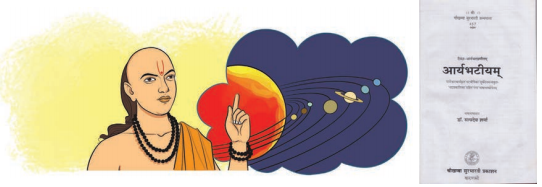
1. One of the eminent astronomers of the ancient India was Āryabhaṭa. His work Āryabhaṭiyam, laid the groundwork for various astronomers to develop in subsequent centuries and continues to be an important work even today. Āryabhaṭa proposed a heliocentric model of the solar system centuries before Copernicus. He also gave a scientific explanation of lunar and solar eclipses.
2. Varāmihira, the sixth-century CE astronomer, philosopher, and mathematician wrote the astronomical treatise Pañchasiddhāntika (Fine Treatises), a compendium of Greek, Egyptian, Roman, and Indian astronomy.

3. The tenth-century CE mathematician-astronomer Bhaskaracharya II contributed significantly to the advancement of astronomical concepts. His works Siddhantasiromaṇi and Karaṇakutuhala, include compiled data on planetary positions, conjunctions, and eclipses.
https://indianculture.gov.in/timeless-trends/unveiling-cosmos-journey-throughhistory-astronomy-india

Answer:
Students to read the text and more information Scan QR code

IV. Jantar Mantar in New Delhi is an astronomical observatory. It has large-scale astronomical instruments designed for precise calculations and measurements of celestial movements. It was built in 1724 by Maharaja Sawai Jai Singh II. The observatory is a UNESCO World Heritage Site. Five such observatories were built by Jai Singh II, the other four are located in Ujjain, Mathura, Varanasi, and Jaipur.
Answer:
Students to read the text from NCERT textbook page 232.
