These Class 7 Science Curiosity Worksheet and Class 7 Science Chapter 11 Light Shadows and Reflections Worksheet with Answers are excellent for board exam practice.
Class 7 Science Chapter 11 Light Shadows and Reflections Worksheet
Class 7 Light Shadows and Reflections Worksheet
Worksheet On Light Shadows and Reflections Class 7 – Light Shadows and Reflections Worksheet Class 7
A. Multiple-Choice Questions
Question 1.
Which of the following is an example of a luminous object?
(a) Moon
(b) Flashlight
(c) Book
(d) Rock
Question 2.
Which of the following is a key advantage of using Light Emitting Diode (LED) lamps over traditional lamps?
(a) LED lamps consume more power.
(b) LED lamps are less bright than traditional lamps.
(c) LED lamps last longer and consume less power.
(d) LED lamps are harmful to the environment.
Question 3.
A faint shadow is formed when light
(a) passes through a transparent object.
(b) It is blocked by an opaque object.
(c) passes through a translucent object.
(d) passes through an opaque object.

Question 4.
This question consists of an Assertion (A) and a Reason (R). Read the Assertion and Reason and choose the appropriate answer.
Assertion (A): A kaleidoscope shows multiple beautiful patterns.
Reason (R): Multiple reflections occur inside a kaleidoscope due to mirrors are arranged in a triangular form.
(a) Both A and R are true, and R is the correct explanation of A.
(b) Both A and R are true, but R is not the correct explanation of A.
(c) A is true but R is false.
(d) A is false, but R is true.
Question 5.
This question consists of an Assertion (A) and a Reason (R). Read the Assertion and Reason and choose the appropriate answer.
Assertion (A): Shadows are formed when an opaque object blocks the path of light.
Reason (R): Light travels in straight lines, and when an object obstructs it, the area behind the object becomes dark, forming a shadow.
(a) Both A and R are true, and R is the correct explanation of A.
(b) Both A and R are true, but R is not the correct explanation of A.
(c) A is true but R is false.
(d) A is false, but R is true.
B. State True (T) or False (F).
1. We can see objects clearly through transparent objects.
2. Changing the colour of an opaque object changes the colour of its shadow.
3. Opaque objects allow light to pass through them completely.
4. A plane mirror forms a laterally inverted image.
5. The image formed by a pinhole camera is upright.
C. Fill in the blanks.
1. The Sun is the main ________________ of natural light on Earth.
2. Light travels in a ________________ line in all directions.
3. ________________ materials allow light to pass through them partially.
4. ________________ is a traditional art form that uses light and shadows to tell stories.
5. The change in direction of light by a mirror is called ________________
D. Assign one word to the following terms.
1. A mirror image where left appears right. ________________
2. Objects that do not emit their light. ________________
3. Object used in submarines and tanks to see outside their bunkers. ________________
4. Shadow play from Andhra Pradesh. ________________
5. Insects that glow naturally at night. ________________
E. Match the Columns.
Question 1.
Match the pictures given in Column I with the terms given in Column II.

Question 2.
Match the terms given in Column I with their correct descriptions given in Column II.
| Column I | Column II |
| (i) Aranmula Kannadi | (a) Forms an inverted image on a screen |
| (ii) Plane mirror | (b) Travels in a straight line |
| (iii) Pinhole camera | (c) A unique metal surface mirror in Kerala |
| (iv) Light | (d) The image formed is erect and laterally inverted |
Wonder Why?
A. Give a reason for the following.
Question 1.
Imagine you are holding your hand in front of a torch. Why does the size of your hand’s shadow change when you move your hand closer or farther from the torch?
____________________________________________________________
____________________________________________________________
Question 2.
How does lateral inversion affect the reading of words like “AMBULANCE” in rear-view mirrors?
____________________________________________________________
____________________________________________________________
Question 3.
When you raise your left hand in front of a mirror, why does it appear as though your right hand is raised in the image?
____________________________________________________________
____________________________________________________________
Question 4.
You look through a kaleidoscope and see new patterns every time you rotate it. Why do the patterns change even though the objects inside remain the same?
____________________________________________________________
____________________________________________________________
Question 5.
A pen is held at different distances in front of a plane mirror. Does the image size change? What does this tell you about images in plane mirrors?
____________________________________________________________
____________________________________________________________
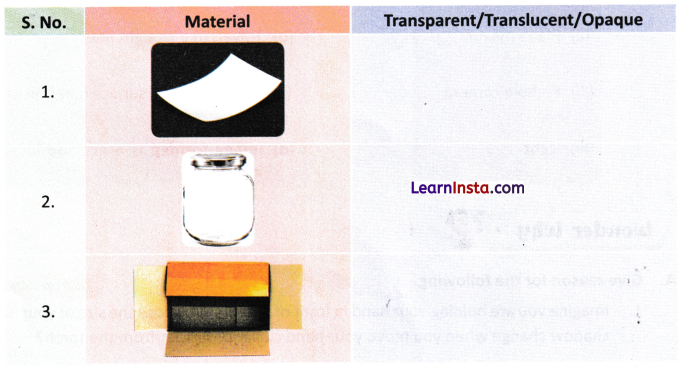
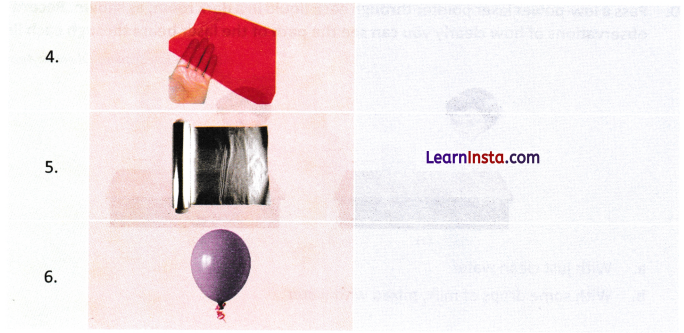
B. Shine a torch through different materials such as tracing paper, a glass jar, a cardboard box, a plastic sheet, aluminium foil, and a coloured balloon. Observe and record which materials let light pass through completely, partially, or not at all. Classify each as transparent, translucent, or opaque in the following table.
C. Read the following statements and decide whether it is correct or incorrect. If a statement is incorrect, rewrite it correctly in the space provided.
D. Pass a low-power laser pointer through each liquid in a dark room, as shown. Record your observations of how you can see the path of the laser beam through each liquid.
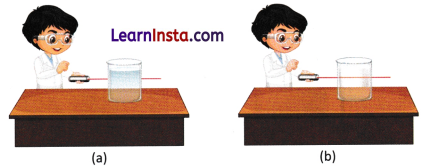
(a) With just clean water
(b) With some drops of milk, mixed with water
____________________________________________________________
____________________________________________________________
____________________________________________________________
____________________________________________________________
Learn By Doing
A. Use an opaque object (For example, a cardboard) and place it at different distances from a torch while keeping the screen fixed. Observe how the shadow changes in size and sharpness. Write your conclusion with reasons in the space below.
____________________________________________________________
____________________________________________________________
____________________________________________________________
____________________________________________________________
____________________________________________________________
B. Take two cardboard boxes, cut open one side of each. Make a small hole in the larger box and cover the smaller box’s opening with tracing paper. Slide the smaller box inside, focus on a distant object in sunlight, and observe the image on the tracing paper. Write your observations and conclusion in the space given below.
____________________________________________________________
____________________________________________________________
____________________________________________________________
____________________________________________________________
____________________________________________________________
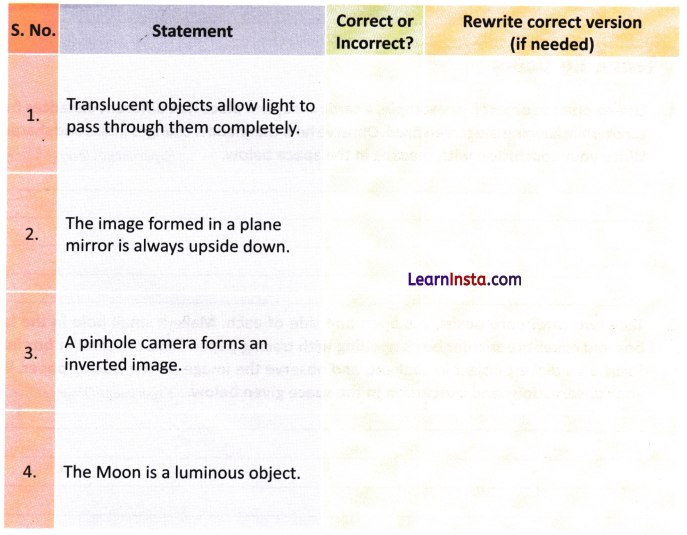
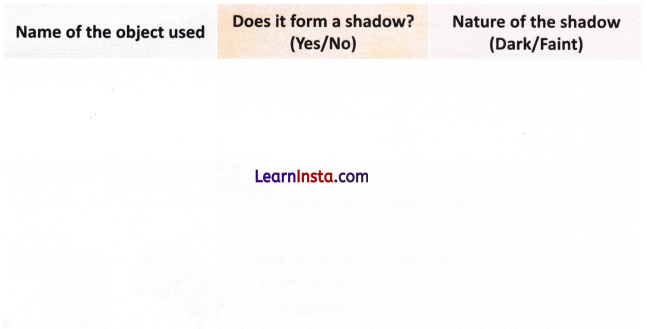
C. Observe the formation of a shadow with the different materials using a source of light and a screen in a dark room. Record your observations in the table provided.
Materials Required: A torch, a cardboard sheet, a ball, a glass jar, paper, etc., a white wall or screen
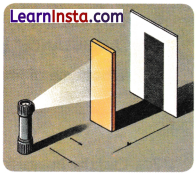
Steps to follow:
- Switch off or dim the lights in the room.
- Hold the cardboard sheet between the torch and the wall or screen.
- Switch on the torch and direct its light toward the cardboard.
- Observe the wall or screen for the formation of a shadow.
D. Take a flat mirror outside on a sunny day. Tilt it to reflect sunlight onto a nearby wall. Observe how the bright spot moves as you tilt the mirror. What do you conclude from your observation? Write your observation and conclusion in the space provided.
____________________________________________________________
____________________________________________________________
____________________________________________________________
____________________________________________________________
Explore With Curiosity
A. Read the paragraph and answer the following questions.
A plane mirror forms an erect image of the same size as the object placed in front of it. The image appears as far behind the mirror as the object is in front. It cannot be captured on a screen, and lateral inversion occurs, where left and right appear reversed. This explains why “AMBULANCE” is written in reverse on emergency vehicles.
Question 1.
What type of image is formed by a plane mirror?
____________________________________________________________
____________________________________________________________
Question 2.
Can the image formed by a plane mirror be captured on a screen?
____________________________________________________________
____________________________________________________________
Question 3.
What is lateral inversion? Explain with an example.
____________________________________________________________
____________________________________________________________
Question 4.
Why is “AMBULANCE” written in reverse on ambulances?
____________________________________________________________
____________________________________________________________
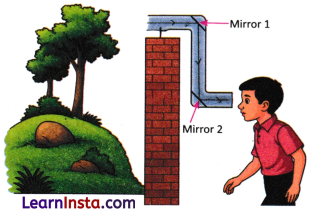
B. You are inside a submarine and want to see what is happening above the water without coming out. You decide to use a periscope. Can you explain how a periscope works and where else it can be used?
____________________________________________________________
____________________________________________________________
____________________________________________________________
____________________________________________________________
____________________________________________________________
C. You are making a kaleidoscope using mirrors and colourful beads. After completing it, you notice beautiful patterns every time you turn it. Can you explain how the kaleidoscope forms these patterns and where such patterns are useful?
____________________________________________________________
____________________________________________________________
____________________________________________________________
____________________________________________________________
____________________________________________________________
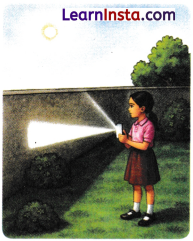
D. Look at the given pictures and answer the following questions.
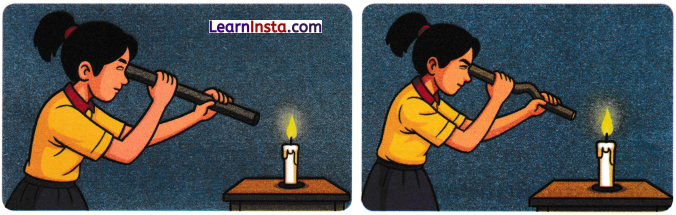
Question 1.
What property of light is being observed in the given picture?
____________________________________________________________
____________________________________________________________
Question 2.
Write the steps to perform this activity.
____________________________________________________________
____________________________________________________________
____________________________________________________________
____________________________________________________________
Question 3.
What happens when the pipe is bent?
____________________________________________________________
____________________________________________________________
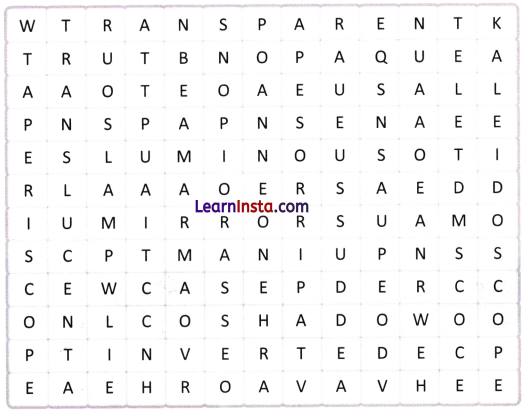
Word Puzzle
Find ten words related to the chapter in the word search puzzle.
Activities
A. Ask your grandparents if they saw fireflies in their childhood. If yes, ask where they used to appear and what has changed in that place. Create a drawing showing a night scene with fireflies in a natural environment.
B. Shine a torch through a coloured glass or plastic bottle cap and observe the shadow on a white sheet. Try different colours and note how the colour of the shadow changes. Record which colours make the shadow darker or lighter.
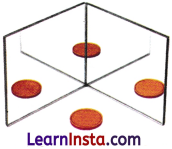
C. Place two small mirrors at an angle and place a coin between them. Slowly change the angle and count how many images you see. Try with 90°, 60°, and 45° angles. Record how the number of images changes.
D. Hold a small mirror and look into it to see a reflection of a tall object, like a cupboard or a ceiling fan. Notice how even a small mirror can show the whole object. Explain how this is possible.