These Class 8 Science Curiosity Worksheet and Class 8 Science Chapter 10 Light: Mirrors and Lenses Worksheet with Answers are excellent for board exam practice.
Class 8 Science Chapter 10 Light: Mirrors and Lenses Worksheet
Class 8 Light: Mirrors and Lenses Worksheet
Worksheet On Light: Mirrors and Lenses Class 8 – Light: Mirrors and Lenses Worksheet Class 8
Let’s Begin
Multiple Choice Questions
Question 1.
Which of the following always forms an erect and diminished image?
(a) Plane mirror
(b) Concave mirror
(c) Convex mirror
(d) Convex lens
Question 2.
Which mirror is used by a dentist to see a large image of teeth?
(a) Concave
(b) Plane
(c) Convex
(d) None of these
Question 3.
In which case is lateral inversion observed?
(a) Concave mirror only
(b) Plane mirror only
(c) Convex lens
(d) All types of mirrors
Question 4.
Which type of mirror causes parallel rays of light to converge after reflection?
(a) Convex mirror
(b) Concave mirror
(c) Plane mirror
(d) None to these
Question 5.
Bhaskara II is best known for his contributions to
(a) Cooking techniques
(b) Ancient warfare
(c) Mathematics and astronomy
(d) Music and dance.

Question 6.
This question consists of an Assertion (A) and a Reason (R). Read the Assertion and Reason and choose the appropriate answer.
Assertion (A): Convex mirrors are used as a vehicle’s side mirrors.
Reason (R): Convex mirrors provide a wider field of view.
(a) Both A and R are true and R is the correct explanation of A.
(b) Both A and R are true but R is not the correct explanation of A.
(c) A is true but R is false.
(d) A is false but R is true.
Question 7.
This question consists of an Assertion (A) and a Reason (R). Read the Assertion and Reason and choose the appropriate answer.
Assertion (A): The angle of incidence is always equal to the angle of reflection.
Reason (R): This law applies to both plane and spherical mirrors.
(a) Both A and R are true and R is the correct explanation of A.
(b) Both A and R are true but R is not the correct explanation of A.
(c) A is true but R is false.
(d) A is false but R is true.
B. State True (T) or False (F).
1. Solar concentrators use mirrors and lenses to focus sunlight into one small spot.
2. A concave lens is also known as converging lens.
3. A plane mirror can focus parallel beams of light to a single point.
4. A lens which is thicker at the edges and thinner at the middle is called a convex lens.
5. In a concave mirror, the image is erect and enlarged when the object is close.
C. Fill in the blanks.
1. A ___________ mirror curves inward like a spoon.
2. A spherical mirror resembles a part of an imaginary ___________ sphere.
3. A lens that diverges light is a ___________ lens.
4. The path along which light travels is called a ___________ of light.
5. The reflective coating used in spherical mirrors is typically a thin layer of ___________.
D. Assign one word to the following terms.
1. A surface that reflects light and forms images. ___________
2. A type of mirror used in stores to monitor activity to deter theft. ___________
3. The angle between the incident ray and the normal. ___________
4. A lens used to read small print by enlarging letters. ___________
5. The ray of light that comes back from the mirror. ___________
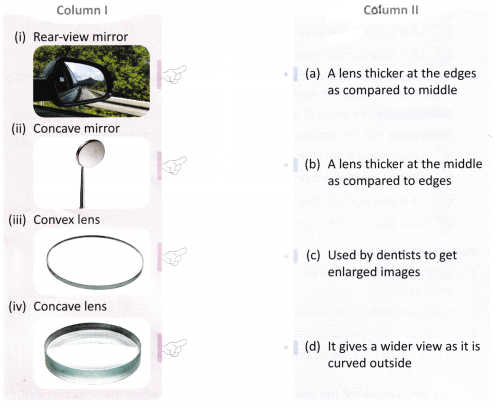
E. Match the pictures given in Column I with the correct explanations given in Column II.
Wonder Why?
A. Read the paragraph and answer the following questions.
Rahul performs an activity with a mirror in bright sunlight. He holds the mirror in his hand and places a small piece of paper at some distance in front of the mirror. Then he moves the mirror slowly until he saw a small, bright spot of light on the paper. After a few seconds, Rahul saw that paper starts to turn brown and also started to burn slightly.

Question 1.
What type of mirror is used in this activity?
__________________________________
__________________________________
Question 2.
Why can we not use any mirror other than above mentioned mirror here?
__________________________________
__________________________________
Question 3.
Why does the paper able to burn during the experiment?
__________________________________
__________________________________
Question 4.
Name one application of this concept.
__________________________________
__________________________________
Question 5.
Can we perform this activity with the help of convex lens? Give reason.
__________________________________
__________________________________
B. Give reasons for the following.
1. The reflected ray disappears when the sheet of paper is bent.
__________________________________
__________________________________
2. A concave mirror is called a converging mirror.
__________________________________
__________________________________
3. When we look at our face on the inner side of a shiny spoon, it appears upside down, but not on the outer side.
__________________________________
__________________________________
4. The image of a pencil placed behind a glass tumbler changes shape after adding water.
__________________________________
__________________________________
5. A reading glass cannot be made from a concave lens.
__________________________________
__________________________________
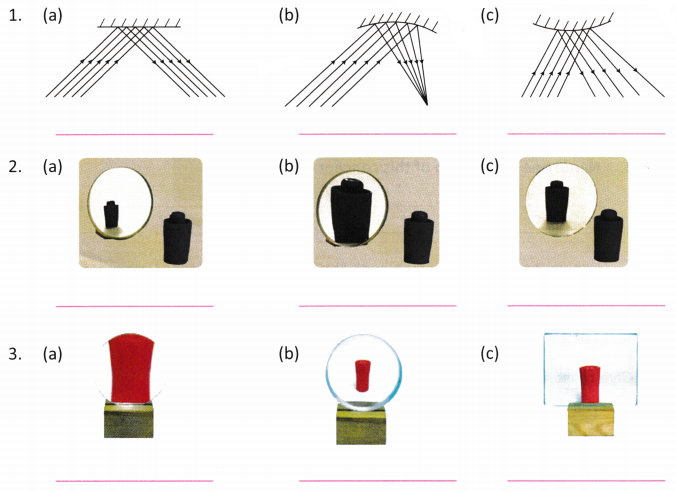
C. Observe the images carefully and write the name of the type of mirror/lens/glass used in each case.
Learn By Doing
A. Label the ray diagram given below.

Measure the angle of reflection for different angles of incidence (starting at 30° and increasing by 5° each time, up to 45°). Record the values in the given table.
| Angle of incidence (i) | Angle of reflection (r) |
| 1. | |
| 2. | |
| 3. | |
| 4. |
Draw the ray diagram for S. No. 4 showing the incident ray (i = 45°) and reflected ray (r = 45°).

B. Place a drop of water on a transparent plastic sheet or ziplock bag. Keep it over a printed wor(d) Explain the effect of a water drop on the appearance Of printed words placed beneath it.

__________________________________
__________________________________
C. Complete the following ray diagrams.

Explore With Curiosity
A. As Arjun sat in the car, he glanced at the side mirror and noticed a line written on it: “Objects in mirror are closer than they appear.” He asked his father why this warning is given only on the side mirror and not on the front mirror. Explain.

__________________________________
__________________________________
__________________________________
B. A light is incident on the two different planes mirrors. In both cases, the angle between the incident ray (i) and the normal (N) is the same as the angle between the reflected ray (f) and the normal (N). Observe/Explore
Which of the two cases correctly follows the law of reflection? Justify your answer.

__________________________________
__________________________________
__________________________________
C. You shine a torch through a comb slit on a mirror. As you change th^.angle of the torch, the reflected light also moves.

1. Can you explain why the reflected ray changes direction every time you move the incident ray?
__________________________________
__________________________________
__________________________________
2. What does this prove about how light behaves?
__________________________________
__________________________________
__________________________________
D. There are four different cases (a, b,c, and d) where light rays incident on a plane mirror at different angles. Draw a normal in each case and measure the angle of incidence (i) and angle of reflection (r) with the help of an protractor in the space given below.

Word Puzzle
Find ten words related to this chapter in the given word search puzzle.

Suggested Activities
A. With the help of an adult, consult an eye specialist to know about the lenses used for different vision defects. Also, inquire if a single lens can combine two corrections and name that lens. Record your findings and share them with your classmates.
B. Design a simple solar cooker that could be used at your home or school using a solar concentrator. Prepare a short report describing its working, materials used, and how ¡t saves energy and protects the environment. Include a sketch or diagram of your design and present it in class. Take the help of Internet, if needed.
C. Make a simple plane mirror using cardboard and aluminium foil at home. Record whether the image is clear or blurry. Observe your reflection and note how ¡t compares with a real mirror. Write your findings on the importance of a smooth, shiny surface for reflection. Share your findings with your classmates.
