Experts have designed these Class 8 Science Notes Chapter 10 Light: Mirrors and Lenses Class 8 Notes for effective learning.
Class 8 Science Chapter 10 Light: Mirrors and Lenses Notes
Class 8 Light: Mirrors and Lenses Notes
Class 8 Science Chapter 10 Notes – Light: Mirrors and Lenses Notes Class 8
→ Mirror: It is a shiny surface which reflects almost all the light that fall on it.
→ Spherical Mirror: A common type of curved mirror that looks like a part of a hollow glass sphere. These mirrors have reflecting surfaces that may be curved inwards or outwards are called spherical mirrors. For example, a shiny metallic spoon.

→ Two Main Types of Spherical Mirrors:
- Concave Mirror: A spherical mirror with a reflecting surface that curves inwards is known as a concave mirror.
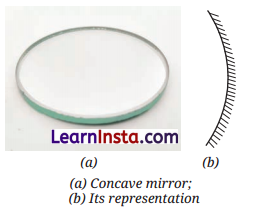
- Light: Mirrors and Lenses Class 8 Notes Science Chapter 10
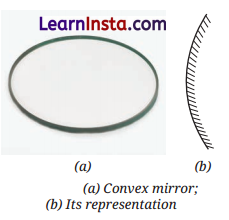
→ In the representation of both the mirrors, the non-reflecting surface of the mirror is shown as shaded.
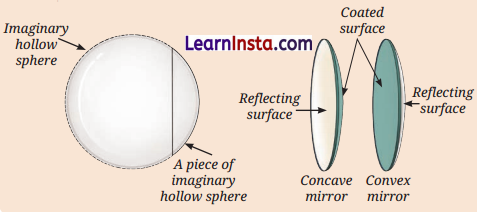
→ Making of Spherical Mirrors: The shape of a spherical mirror is such that it can be thought of a part of an imaginary hollow sphere. Spherical mirror are not made by slicing a hollow glass sphere, they are created by grinding and polishing a flat glass piece into a curved surface. After all of this, if a reflective coating of a thin layer of aluminium is applied on the outer curved surface, it forms a concave mirror where as if the coating is applied on the inner curved surface, it forms a convex mirror.
→ Characteristics of Image Formed by a Concave Mirror: In a concave mirror, when an object is placed close to the mirror, the image formed is erect and enlarged than the object in actual size. But as the object is gradually moved farther away from the mirror, the image becomes inverted. At first, the image appears larger, but it gradually becomes smaller as the object is moved farther away.
→ Characteristics of Image Formed by a Convex Mirror: In a convex mirror, the image formed is always upright and diminished. As the object moves farther from the convex mirror, the image remains erect but size of the image reduces slightly.
→ Plane Mirror and Lateral Inversion: A plane mirror is different than spherical mirror. A plane mirror always forms an erect image of the same size as the object. However all the three mirrors (concave, convex and plane) show the characteristic of lateral inversion.
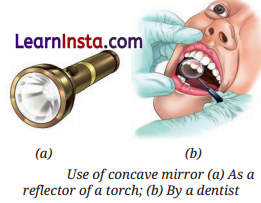
→ Uses of Concave and Convex Mirrors: Concave mirrors are used as reflectors in torches, headlights of cars and scooters. The majority of modern telescopes use curved mirrors to reflect light, and the main mirror used is usually a large concave mirror. They are also used by dentists to get an enlarged and clear view of teeth during check-ups.
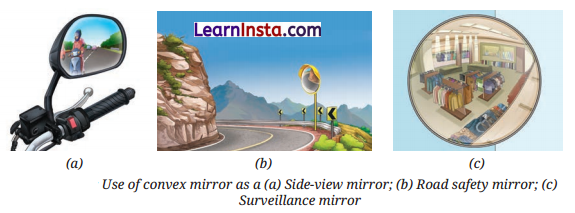
→ Convex mirrors are used as side-view mirrors of scooters and rear view mirrors of cars to see the traffic behind. They always form an erect image that is smaller than the actual vehicles. As the convex mirror is curved outside, it provides a much wider area of the road behind. These mirrors are also installed at road intersections or sharp bends to provide drivers from both sides the visibility of the other side and prevent accidents. They are also used in big stores to monitor large areas and reduce thefts.
→ Light: It is represented by straight lines with arrows, or rays. Rays indicate the path along which light travels.
→ Types of Rays of Light:
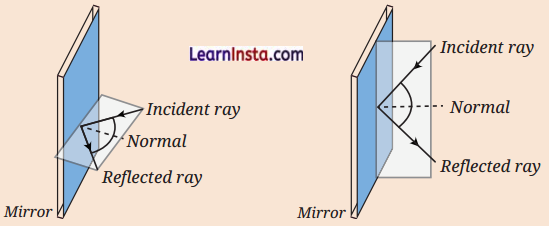
- Incident Ray: The ray of light that falls on the surface of a mirror is called incident ray.
- Reflected Ray: The ray of light that bounces back from the surface of a mirror is called reflected ray.
→ Normal: When the incident ray strikes the mirror, from that point draw a line making an angle of 90°c to the line representing the mirror. This line is known as the normal to the reflecting surface at the point of incidence, O.
→ Angle of Incidence and Angle of Reflection: The angle formed between the normal and the incident ray is called the angle of incidence (i), while the angle between the normal and the reflected ray is called the angle of reflection (r).

→ Laws of Reflection:
- The angle of incidence (i) is equal to the angle of reflection (r).
- The incident ray, the normal to the mirror at the point of incidence, and the reflected ray, all lie in the same plane.
→ The laws of reflection are valid for all kinds of mirrors – plane and spherical.
→ When parallel rays fall on a plane mirror, they reflect parallel rays. In a concave mirror, they converge, and in a convex mirror, they diverge. This happens due to the curved surface of spherical mirrors, even though all rays follow the laws of reflection.

→ Converging Sunlight on Paper Using a Concave Mirror: When the sunlight is directed on a piece of paper with the reflecting surface of a concave mirror, a bright spot appears on the paper. This happens because sunlight reflects from the concave mirror, which converges all the reflected rays to a single point. This focused light produces enough heat at that point to ignite the paper.
→ Solar Concentrators: Devices which concentrate sunlight into a small area, using mirrors and lenses, are called solar concentrators. The concentrated sunlight is used to heat a liquid to produce steam. This steam is further used to generate electricity or for providing heat for various purposes, such as large scale cooking or for solar furnaces. Solar furnaces are even used for melting steel.
→ A curved water drop acts like a simple lens and makes the letters beneath it appear larger. This is similar to how a magnifying glass enlarges small text for easier reading.
→ Lens: It is a piece of transparent material, usually made from glass or plastic, that has curved surfaces. Lenses can be convex or concave.
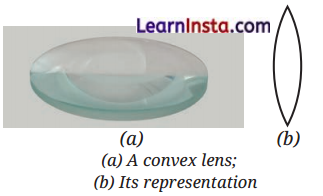
(i) Convex Lens: A lens that is thicker at the middle than at the edges is called a convex lens.
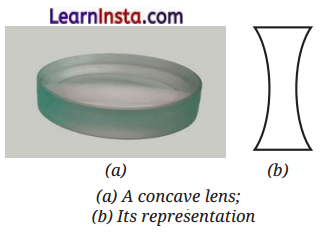
(ii) Concave Lens: A lens that is thicker at the edges than at the middle is called a concave lens.
→ Lenses are designed to allow light to pass through them, and we see things through a lens rather than in a lens.
→ Changes in Objects seen through Lenses: When an object is placed behind a convex lens, at a small distance from it and seen through the lens, it appears erect and enlarged. As the distance between the object and the convex lens increases, the object appears inverted. It is initially enlarged in size and then diminishes in size. When an object is placed behind a concave lens, the image always appears erect and diminished, though its size slightly changes with distance.
→ Converging or Diverging of Lenses: The convex lens converges the multiple parallel light beams that fall on it at a point, whereas the concave lens diverges the multiple parallel light beams that fall on it. A convex lens is also known as a converging lens, while a concave lens is referred to as a diverging lens. A convex lens, unlike a convex mirror, is a converging lens that focuses sunlight to a point, generating enough heat to burn paper.
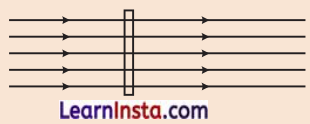
Parallel beams of light fall upon the thin glass plate

Parallel beams of light fall upon the convex lens
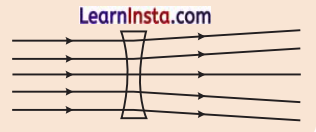
Parallel beams of light fall upon the concave lens
→ Uses of Lens: Lenses are not only used in eyeglasses that people wear to help them see clearly but also used in telescopes, cameras and microscopes.
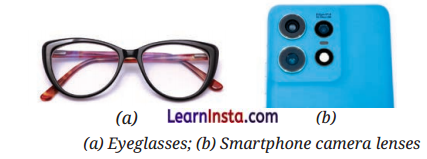
→ Even our eye has a convex lens inside it that changes its shape to help us see objects both near and far.