Students can use Poorvi Book Class 8 Solutions Unit 4 Environment Chapter 11 Harvest Hymn Questions and Answers as a quick reference guide.
Harvest Hymn Class 8 Questions and Answers
Harvest Hymn Class 8 Question Answer
NCERT Class 8 English Poorvi Chapter 11 Harvest Hymn Question Answer
Harvest Hymn Question Answer – Let us do these activities before we read. (Page 173)
I. Work in pairs and share your responses with your classmates and teacher.
Question 1.
India celebrates many harvest festivals. When is the harvest festival celebrated in your region and how is it celebrated?
Answer:
In my region, Maharashtra, the harvest festival is celebrated as Makar Sankranti.
Makar Sankranti is celebrated in other states as well; however, the name differs in each place. In Gujarat, it is known as Uttarayan. In Delhi, it is simply called Makar Sankranti. In Uttar Pradesh, it is known as Khichdi. In Tamil Nadu, it is celebrated as Pongal, and in Punjab, it is called Lohri. People cook traditional food, wear new clothes, decorate their homes, and thank nature for a good harvest. Special prayers are offered to the Sun God (Surya), and folk dances and songs are performed.
Question 2.
A hymn refers to a song of praise.
(i) To whom do we offer a hymn?
(ii) When and where do we sing a hymn?
(iii) Why do we offer it?
Answer:
(i) We offer a hymn to God or divine powers to express devotion and gratitude.
(ii) Hymns are sung during prayers in temples, churches, or at special festivals and religious gatherings.
(iii) We offer a hymn to show respect, thankfulness, and praise for the blessings we receive.
II. Some poets and authors use words that are no longer a part of common usage. Such words are called archaic words.
Work in pairs. Read the sentences given below. Match the underlined archaic words in Column 1 with their meanings in Column 2. Share your answers with your classmates and teacher.
‘Thou art my friend, and I trust thee. Thy kindness is great, and everything that is mine is thine.’
| Column 1 | Column 2 |
| 1. thou | (i) yours |
| 2. art | (ii) you (object) |
| 3. thee | (iv) you (object) |
| 4. thy | (iv) are |
| 5. thine | (v) your |
Answer:
| Column 1 | Column 2 |
| 1. thou | (iii) you (object) |
| 2. art | (iv) are |
| 3. thee | (ii) you (object) |
| 4. thy | (v) your |
| 5. thine | (i) yours |
Explanation:
“Thou art my friend, and I trust thee. Thy kindness is great, and everything that is mine is thine.”
“You are my friend, and I trust you. Your kindness is great, and everything that is mine is yours.”

III. Work in pairs. Read the paragraph and select the correct meaning for each underlined word from the options given below. Share your answers with your classmates and teacher.
Under the golden 1. radiance of the evening sun, the villagers gathered to pay 2. tribute to their 3. cherished elder, who had dedicated his life to their well-being. His wise 4. counsel had guided generations, steering them through challenges. Known for his 5. munificent spirit, he never hesitated to share his resources generously.
1 radiance : (i) glow (ii) brilliance
2. tribute : (i) respect (ii) gratitude
3. cherished : (i) preserved (ii) loved
4. counsel : (i) advice (ii) decision
5. munificent : (i) rich (ii) generous
Answer:
1. radiance (i) glow
2. tribute (i) respect
3. cherished (ii) loved
4. counsel (i) advice
5 munificent (ii) generous
Harvest Hymn Class 8 Question Answer – Let us Discuss (Pages 176-177)
I. Write the stanza number for the main idea of each stanza given below.
Share your answers with your classmates and teacher.
| 1. The speakers recognise the lord’s kindness and praise him for nourishing the field. | |
| 2. The speakers praise the generosity of the creator of the universe who ensures a rich harvest. | |
| 3. The speakers devote their lives and work as a mark of respect to the lord and seek his support, wisdom, and care. | |
| 4. The speakers pay homage to the Earth and appreciate her role in supporting life, by dedicating their harvest. |
Answer:
| 1. The speakers recognise the lord’s kindness and praise him for nourishing the field. | Stanza 1 (Men’s Voices – praise to Surya) |
| 2. The speakers praise the generosity of the creator of the universe who ensures a rich harvest. | Stanza 2 (Men’s Voices – praise to Varuna) |
| 3. The speakers devote their lives and work as a mark of respect to the lord and seek his support, wisdom, and care. | Stanza 4 (All Voices – tribute and prayer to the Lord of the Universe) |
| 4. The speakers pay homage to the Earth and appreciate her role in supporting life, by dedicating their harvest. | Stanza 3 (Women’s Voices – praise to Mother Earth/ Prithvi) |
II. Fill in the blanks by choosing the appropriate words or phrases from within the brackets.
1. The setting of the poem is a rural landscape, possibly during a __________________________ (harvest/religious) festival.
2. The tone of the poem is respectful and celebratory because it praises ___________________ (the men and women/ nature and the Lord) with deep respect and gratitude.
3. In the line ‘Thou art our Hands and our Heart and our Home’, the letter ‘h’ is capitalised in ‘Hands’, ‘Heart’ and ‘Home’ because ___________________. (it represents the hard work of farmers/God resides in them)
Answer:
1. The setting of the poem is a rural landscape, possibly during a harvest (harvest/religious) festival.
2. The tone of the poem is respectful and celebratory because it praises nature and the Lord (the men and women/nature and the Lord) with deep respect and gratitude.
3. In the line ‘Thou art our Hands and our Heart and our Home’, the letter ‘h’ is capitalised in ‘Hands’, Heart’ and ‘Home’ because God resides in them, (it represents the hard work of farmers/God resides in them)
III. Identify the poetic device used in the following lines from the poem.
- Bright and munificent lord of the mom!
- We bring thee our lives and our labours for tribute.
Answer:
1. Alliteration (repetition of the ‘m’ sound in “munificent” and “morn”.
2. Alliteration (repetition of the “1’ sound in “lives” and “labours”)
IV. Match the lines from the poem in Column 1 with their expressions in Column 2. Choose the appropriate poetic device from the box given below and write in Column 3.
| imagery alliteration simile metaphor personification |
| Column 1 | Column 2 | Column 3 |
| 1. sweet and omnipotent mother | (i) creates a clear description of the scene and appeals to the senses | |
| 2. The wealth of our valleys, new-garnered and ripe | (ii) implied comparison of growth and reaping with beginning and end of all life | |
| 3. Thou art the Seed and the Scythe | (iii) the earth is being given human-like qualities |
Answer:
| Column 1 | Column 2 | Column 3 |
| 1. sweet and omnipotent mother | (i) creates a clear description of the scene and appeals to the senses | Personification |
| 2. The wealth of our valleys, new-garnered and ripe | (ii) implied comparison of growth and reaping with beginning and end of all life | Imagery |
| 3. Thou art the Seed and the Scythe | (iii) the earth is being given human-like qualities | Metaphor |
V. Certain words or phrases are repeated in the same line of the poem.
For example, The gold of our fields and the gold of our fruit;
Find more such repetitions from the poem. What is the poet’s purpose of using repetition in the poem?
Answer:
Other repetition from the poem:
“Thine is the bounty that prospered our sowing,
Thine is the bounty that nurtured our corn.”
Purpose of repetition: The poet uses repetition to:
- Emphasise gratitude and devotion.
- Highlight the importance of divine blessings in every stage of the harvest.
- Create a musical and rhythmic effect in the poem.
VI. The poem uses symbolism to convey deeper meanings. Match the symbols in Column 1 with the meanings they convey in Column 2.
| Column 1 | Column 2 |
| 1. Prithvi (the Earth) | (i) light, energy, life— representing the giver of warmth and prosperity |
| 2. Surya (the Sun) | (ii) mercy and nourishment—crucial for agriculture and sustenance |
| 3. Varuna (Rain) | (iii) fertile land, motherhood, nurturing— the source of all life |
Answer:
| Column 1 | Column 2 |
| 1. Prithvi (the Earth) | (iii) fertile land, motherhood, nurturing— the source of all life |
| 2. Surya (the Sun) | (i) light, energy, life— representing the giver of warmth and prosperity |
| 3. Varuna (Rain) | (ii) mercy and nourishment—crucial for agriculture and sustenance |
Class 8 English Harvest Hymn Question Answer – Let us Think and Reflect (Pages 178-179)
I. Read the given extracts and answer the questions that follow.
1. We bring thee our songs and our garlands for tribute,
The gold of our fields and the gold of our fruit;
O giver of mellowing radiance, we hail thee,
We praise thee, O Surya, with cymbal and flute.
(i) What does the act of bringing songs and garlands as tribute suggest about the people’s relationship with the divine?
A: They fear the gods and wish to calm them in any way possible.
B They have a deep sense of reverence and gratitude towards the divine.
C They are forced to perform rituals without understanding the divine.
D They depend on the gods for their daily needs and activities.
Answer:
B. They have a deep sense of reverence and gratitude towards the divine.
(ii) Complete the following sentence suitably.
The word ‘gold’ in the phrases ‘the gold of our fields’ and ‘the gold of our fruit’ symbolises _________.
Answer:
the rich and valuable harvest provided by nature.
(iii) How does the description ‘O giver of mellowing radiance’ help us understand Surya’s role in the harvest?
Answer:
It shows that Sutya (the Sun) gently gives warmth and light, which helps crops ripen and grow, and is essential for a successful harvest.
(iv) Fill in the blank by selecting the correct option from those given in the brackets.
The use of cymbal and flute signifies _________ . (joy and celebration/meditation and worship)
Answer:
joy and celebration.
2. All Voices:
Lord of the Universe, Lord of our being,
Father eternal, ineffable Om!
Thou art the Seed and the Scythe of our harvests,
Thou art our Hands and our Heart and our Home.


(i) In the phrase ‘Lord of our being, ‘what does the word *being’ most likely refer to?
A. Our physical body
B. Our entire existence
C. Our spiritual practices
D. Our earthly possessions
Answer:
B. Our entire existence
(ii) Identify whether the following statement is true or false.
The imagery of ‘the Seed and the Scythe’ symbolises the divine’s role as both the beginning (creation) and the end (harvest) of the agricultural cycle.
Answer:
True
(iii) Identify the phrases from the extract that mean the following:
A. The divine as a timeless, everlasting presence
B. Beyond human comprehension or description
Answer:
The phrases from the extract that mean the following are:
A. Father eternal
B. Ineffable Om
(iv) How do we know that these lines from the extract are spoken as a chorus?
Answer:
Because the stanza is introduced with the words “All Voices”, it indicates that everyone speaks or sings together, like in a chorus.
II. Answer the following questions.
Question 1.
Why do the farmers hail the God of rain?
Answer:
The farmers hail Varuna, the God of rain, because rain is essential for nourishing crops and ensuring a rich and successful harvest.
Question 2.
What is being referred to as Wealth of our valleys’? Why?
Answer:
The Wealth of our valleys’ refers to the ripe crops and abundant harvest. It is called “wealth” because it brings food, prosperity, and joy to the farming communities.
Question 3.
State one reason why the women refer to the Earth as a ‘source of manifold gladness’.
Answer:
The Earth is called a ‘source of manifold gladness’ because it nurtures life, provides crops, and supports many forms of happiness through its fertility and beauty.
Question 4.
Why does everyone in the poem offer their ‘labours for tribute’?
Answer:
They offer their hard work as a mark of devotion and gratitude to the divine powers (like Surya, Varuna, and Prithvi) who helped them achieve a good harvest.
Question 5.
Why has the poet presented the poem as voices of men, women, and all voices?
Answer:
The poet uses different voices to represent the unity of the entire community—men, women, and all people—coming together in gratitude and celebration of nature’s blessings.
Question 6.
How does the poet create the joyous atmosphere of rural India at harvesting time?
Answer:
The poet uses joyful language, musical imagery (like cymbals and flutes), and vivid descriptions of golden fields and offerings to create a festive and thankful atmosphere, typical of rural India during harvest.
Question 7.
Why is the poem presented as a hymn?
Answer:
The poem is a hymn because it is a song of praise dedicated to natural and divine forces—the Sun (Surya), Rain (Varuna), and Earth (Prithvi)—that make the harvest possible.
Harvest Hymn Class 8 Questions and Answers – Let us learn (Pages 179-181)
I. Match the pictures of the farming implements given in Column 1 with their use given in Column 2. Then, fill in the blanks in Column 3 to complete the name of the implement
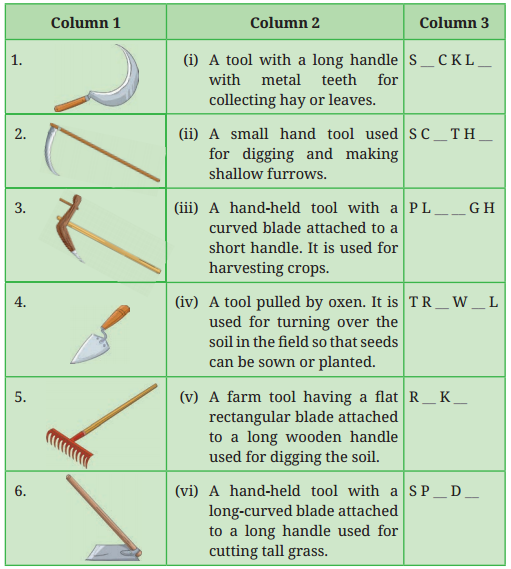
Answer:
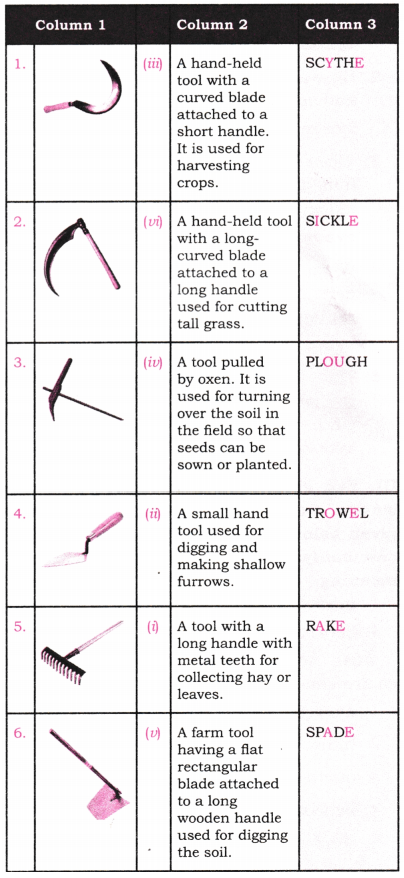
II. Choose the correct synonyms for the underlined words in the given sentences from the box below. Circle the words or phrases in the sentences that helped you to infer the meanings. One example has been done for you.
| generous help brightness indescribable kind |
1. The king was benefient to the poor because he took good care of them.
synonym: kind
2. He was munifient towards the needy and donated a lot for their health care.
synonym: ____________________
3. When he lost his job, all his friends gave him succour by supporting him with money.
synonym: ____________________
4. When the sun’s rays came into the dark room, the whole room was full of radiance.
synonym: ____________________
5. The little girl was speechless with ineffable joy when she got her birthday gift from her aunt.
synonym: ____________________
Answer:
1. The king was beneficent to the poor because he took good care of them,
synonym: kind
2. He was munificent towards the needy and donated a lot for their health care,
synonym: generous
3. When he lost his job, all his friends gave him succour by supporting him with money.
synonym: help
4. When the sun’s rays came into the dark room, the whole room was full of radiance.
synonym: brightness
5. The little girl was speechless with ineffable joy when she got her birthday gift from her aunt.
synonym: indescribable
III. You have learnt about some archaic words. Some more archaic words are given below. Refer to a dictionary to find commonly used words which are similar in meaning.
1. morrow
2. hither
3. quoth
4. betwixt
5. yonder
Answer:
Archaic words and their modern equivalents:
1. morrow → tomorrow or the next day
2. hither → here or to this place
3. quoth → said
4. betwixt → between
5. yonder → over there or at some distance
Harvest Hymn Question Answer Class 8 – Let us Listen (Pages 181-182)
I. Listen to the talk about paddy cultivation. As you listen, number the events in the correct order in which they happen. (Transcript for teacher on page 203)
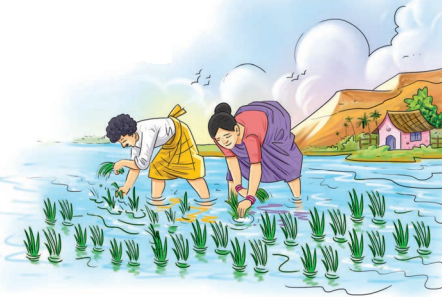
1. Transplanting of seedlings
2. Ploughing of soil
3. Threshing of grains
4. Puddling of land
5. Harvesting of paddy
6. Irrigating the fild
7. Milling of rice
Answer:
1. Transplanting of seedlings [4]
2. Ploughing of soil [1]
3. Threshing of grains [6]
4. Puddling of land [2]
5. Harvesting of paddy [5]
6. Irrigating the field [3]
7. Milling of rice [7]
II. Now, listen to the talk again. As you listen, choose the correct option to answer the questions that follow.
1. What is the main step in preparing the soil for cultivation of rice?
(i) Ploughing the soil
(ii) Clearing the soil
(iii) Puddling the soil
Answer:
(i) Ploughing the soil
2. How long does it take for rice seeds to grow into seedlings before being transplanted?
(i) 2-3 weeks
(ii) 4-5 weeks
(iii) 6-7 weeks
Answer:
(ii) 4-5 weeks
3. Why is drying rice grains important after threshing?
(i) To get rice seeds for plantation
(ii) To separate the rice grains easily
(iii) To store the rice grains for longer
Answer:
(iii) To store, the rice grains for longer
Class 8 English Chapter 11 Question Answer – Let us Speak (Pages 182-183)
I. In English, some letters are not pronounced in certain words. For example, in words like , ‘knowledge’, and ‘know’, the first letter ‘k’ is not pronounced. Let us look at a few more such examples.
In the words given below the letter ‘n’ is silent when it appears with
‘m’ at the end of the word, hymn, column, autumn, solemn
Now, say these words aloud.
In the words given below the letter V is silent when it appears with ‘m’.
womb, tomb, bomb, climb, comb
Now, say these words aloud.
Answer:
Students, do as directed.
II. In our country, harvest is celebrated with the preparation of delicious dishes. Work in groups and make a presentation on any popular dish made during the harvest festival in your region. Use the prompts given in the box to make your presentation. Make sure that all the members share their views.
Include the following:
- What is the dish called? Is it known by any other name in other parts of India?
- What ingredients are used to make the dish?
- How is the dish prepared?
- How is the dish served?
- What does the dish taste like?
- What is the special ritual related to the preparation of this dish?
- Describe any special memory associated with the preparation of this dish.
| Column 1 | Column 2 |
| Greet the audience | Good morning to all of you gathered here… |
| Introduce the members of your group and your topic | Todav we. And are here to tell you about… |
| Explain the structure of your presentation |
|
| Speak about the first point | Let’s begin by… I’d like to start by… |
| Describe the details |
|
| Conclude your presentation | In conclusion, I’d like to say… To summarise… |
| Thank the audience | Thank you for listening. Thank you for your attention. |
Answer:
Harvest Festival Dish Presentation – Uttar Pradesh (Dish: Makar Sankranti Khichdi)
Good morning to all of you gathered here.
Today we, Priya, Aman, and Isha are here to tell you about a special harvest festival dish from Uttar Pradesh called Khichdi, which is traditionally made on Makar Sankranti.
We will start off with what the dish is and where it is eaten.
Following this, we will move on to the ingre¬dients and preparation.
Next, we will talk about how it is served and what it tastes like.
Finally, well share any rituals and memories related to the dish.
Let’s begin by talking about the dish Khichdi. It is a mix of rice and lentils, known for being both simple and healthy. In some parts of India, it is also called “Sankranti Khichdi” or “til-gur khichdi” when eaten with sesame sweets.
Now well move on to the ingredients.
Ingredients include:
- Rice
- Split moong dal (yellow lentils)
- Ghee (clarified butter)
- Spices (cumin, black pepper, turmeric)
- Salt
- Optional vegetables like peas or potatoes Next, let’s see how it is prepared.
- First, rice and dal are washed and soaked.
- Then they are cooked together with water, salt, and spices in a pressure cooker.
- Ghee is added at the end for aroma and flavour.
Now, well tell you how the dish is served.
- Khichdi is served hot with curd, pickle, papad, or ghee on top.
- Sometimes til laddoos (sesame balls) are eaten along with it.
Let’s now consider what it tastes like.
It is mild, warm, and comforting – perfect for the winter festival.
Some rituals associated with it include:
- On Makar Sankranti, people in Uttar Pradesh distribute khichdi, til (sesame), jaggery, and blankets to the poor.
- Making khichdi on this day is considered auspicious and holy.
- Every year, our family gathers to make a big pot of khichdi and distribute food to people outside the temple. It brings joy and togetherness.
In conclusion, we would like to say that Khichdi is more than just food—it is a part of our tradition, celebration, and sharing.
Thank you for listening and being so attentive.
NCERT Class 8 English Poorvi Chapter 11 Question Answer – Let us Write (Pages 183 – 184)
Creative slogans are used to spread a message to cap¬ture the reader’s attention. Some examples are given below:
- Education is the Key, Unlock Your Destiny!
- Protect the Environment Today for a Better Tomorrow
- Learn, Grow, Succeed
- Go Green by Keeping the Planet Clean
Your school wishes to express gratitude to the farmers who play an important role in providing us the food on our plates. Draft a creative slogan to be put up on the school notice board.
Remember to
- focus on the main idea to be expressed
- use simple language
- be concise—express yourself in a few words
You may write the slogan on a chart paper and decorate it.
Answer:
(Suggestive Answers)
Here are a few slogans that students can use for their notice board.
1. “No Farmer, No Food — Salute the Real Heroes of the Nation!”
2. “From Soil to Plate, Thank a Farmer for Every Bite!”
3. “They Sow, We Grow — Respect the Hands that Feed Us.”
4. “Rain or Shine, Farmers Never Decline — Thank You!”
5. “Fields of Gold, Hearts of Green — Thank You to all the Farmers.”
Class 8th English Chapter 11 Harvest Hymn Question Answer – Let us Explore (Page 184)
I. Millets are a varied group of small-seeded grasses. They have more fibre and minerals than other cereals. Millets have been a part of the Indian cuisine for years. They have been rediscovered worldwide as superfoods.
1. Read the information on Pearl Millet given below.
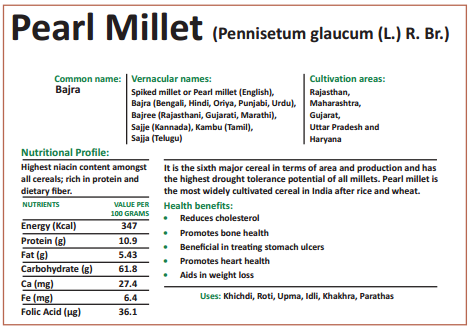
Scan the QR Code to know more about other kinds of millets.

2. Work in groups of four and do the following activities.
(i) Find out if millets are a part of your cuisine.
(ii) Find recipes with millets and compile them into a booklet.
(iii) Create a recipe of your choice.
Answer:
(Suggestive Answers)
(i) Yes, In our region (Uttar Pradesh), millet— especially Bajra (Pearl Millet)—is eaten during winters. Bajra roti is commonly served with jaggery and ghee, or with green leafy vegetables.
(ii) These are some recipes with millet (for booklet).
Bajra Khichdi
- Ingredients: Bajra, yellow moong dal, salt, turmeric, ghee, cumin.
- Method: Soak bajra overnight. Cook with dal, turmeric, and salt in a pressure cooker. Add ghee and cumin for flavour.
Bajra Roti
- Ingredients: Bajra flour, warm water, pinch of salt.
- Method: Knead into soft dough, roll gently, cook on tawa. Serve hot with butter or jaggery
Bajra Upma
- Ingredients: Bajra grains, mustard seeds, onions, chillies, vegetables.
- Method: Roast bajra, saute spices and veggies, add water, and cook till soft.
(iii) I have chosen to make a delicious and healthy Bajra Pancake, a perfect blend of taste and nutrition.
- Ingredients: Bajra flour, mashed banana, milk, jaggery, cardamom.
- Method: Mix all ingredients into a batter. Pour on tawa and cook like pancakes. Serve with honey or dry fruits!
II. Songs related to harvest season form a part of our culture and heritage. Talk to the elders in your house and learn a song sung on a harvest festival. Share it with your classmates and teacher. Then, compile all the songs to create a songbook with the help of teacher.
Answer:
Students may consult their elders and grandparents and write their own answer.