Students often refer to Class 7 Ganita Prakash Solutions and NCERT Class 7 Maths Part 2 Chapter 1 Geometric Twins Question Answer Solutions to verify their answers.
Class 7 Maths Ganita Prakash Part 2 Chapter 1 Solutions
Ganita Prakash Class 7 Chapter 1 Solutions Geometric Twins
Class 7 Maths Ganita Prakash Part 2 Chapter 1 Geometric Twins Solutions Question Answer
1.1 Geometric Twins
Figure it Out (Pages 3-4)
Question 1.
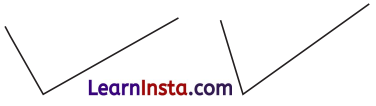
Check if the two figures are congruent.
Solution:
To check if the two figures are congruent, compare the size, shape, and orientation of the figures:
- The two given shapes appear to be of the same shape and orientation.
- The two shapes do not have the same measure. Therefore, they are not congruent.

Question 2.
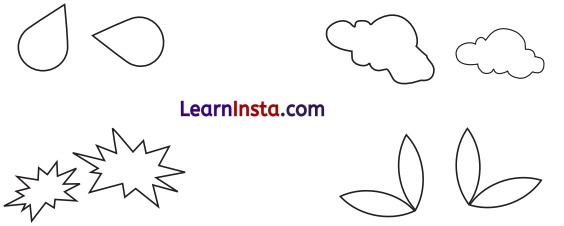
Circle the pairs that appear congruent.
Solution:
For this task, we need to identify pairs of shapes that are identical in size and shape.
Figure (a): The two teardrop shapes are congruent because they are identical in size and shape.

Figure (b): The two cloud shapes are not congruent because they have different size and shape.

Figure (c): The two explosion bubbles are not congruent because they are different in size.

Figure (d): The two leaf shapes are congruent because they are identical in size and shape.

Question 3.
What measurements would you take to create a figure congruent to a given:
(a) Circle
(b) Rectangle
Using this, state how would you check if two—
(a) Circles are congruent?
(b) Rectangles are congruent?
Solution:
(a) Circle: To create a figure congruent to a given circle, the key measurement is the radius. If we measure the radius of the given circle and use the same value for the radius, we will create a congruent circle.
Circles are congruent: To check if two circles are congruent, measure the radius of each circle. If the radii of both circles are the same, the circles are congruent.
(b) Rectangle: To create a figure congruent to a given rectangle, the key measurements are the length and width. These two measurements must match the length and width of the given rectangle for the new rectangle to be congruent.
Rectangles are congruent: To check if two rectangles are congruent, measure the length and width of each rectangle. If both the length and width of the two rectangles are the same, the rectangles are congruent.
Question 4.
How would we check if two figures like the one below are congruent?

Use this to identify whether each of the following pairs are congruent.

Solution:
To check if two figures like the one shown are congruent we need to verify that the measure of angles and the lengths of the arms (sides) of both the figures are the same. If the angles are equal and the two arms are of the same length, then the two shapes are congruent.
Based on this,
in pair (a) the two shapes are congruent because they have the same angles and the same lengths of sides,
in pair (b) the shapes are congruent because they have the same angles and the same lengths of sides.
1.2 Congruence of Triangles (Pages 4-5)
Meera and Rabia …. paper and replicated.
What do you think they can do?
Solution :
Meera and Rabia can scale down the triangle by measuring its sides and angles, then drawing a smaller version on paper. Later, they can use a stencil or template to trace the shape or use a ruler and protractor to replicate the triangle with accurate measurements.
Measuring the Sidelengths (Page 5)
Can certain ……. congruent to this one.
Do you agree with Meera?
Solution:
Yes, I agree with Meera. To replicate the triangle, knowing the side lengths of all the sides is sufficient. If the side lengths of one triangle are equal to corresponding side length of another triangle, then the triangle will be congruent, as all the angles will adjust accordingly. Therefore, the angles do not need to be measured in this case.
Instead of the lengths being 40 cm, 60 cm, and 80 cm, suppose the sidelengths had been 4 cm, 6 cm, and 8 cm (this triangle can fit on our page).
Is this information sufficient to replicate the triangle with the same size and shape? If yes, can you do so?
Solution:
Yes, this information is sufficient to replicate the triangle with the same size and shape.
Given the sidelengths of 4 cm, 6 cm, and 8 cm, we can construct the triangle by following these steps:
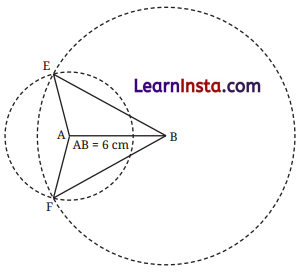
- Start by drawing a line segment of length 6 cm.
- Use a compass to draw a circle with a radius of 4cm from one endpoint of the segment.
- From the other endpoint, draw a circle with a radius of 8 cm.
- The intersection points of the circles will determine the position of the third vertex of the triangle.
- Connect the third vertex to the end-points of the 6cm line segment to complete the triangle.
This method will result in a triangle congruent to the one with the given sidelengths.
Conventions to Express Congruence (Page 8)
Identify the correct correspondence of vertices and express the congruence between the two triangles.
Solution:
The correct correspondence of vertices is A ↔ C, B ↔ D, and D ↔ B.
Therefore, the correct congruence relation is:
ΔABD ≅ ΔCDB
This correspondence ensures that the matching sides and angles (AB = CD, BD = BD, and AD = CB) align correctly, satisfying the SSS condition for congruence.
Figure it Out (Pages 8-9)
Question 1.
Suppose ΔHEN is congruent toΔBIG. List all the other correct ways of expressing this congruence.
Solution:
In the figure,
- H ↔ B, E ↔ I,
N ↔ G (Corresponding vertices) - HE = BI, EN = IG, HN = BG (Corresponding sides)
- ∠H = ∠B, ∠E = ∠I, ∠N = ∠G
The congruence of AHEN and ABIG can be expressed in 5 more ways as follows:
ΔHNE = ΔBGI, ΔNEH ≅ ΔGIB
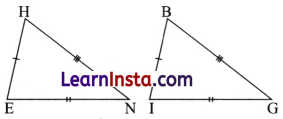
ΔEHN ≅ ΔIBG, ΔENH ≅ ΔIGB, ΔNHE ≅ ΔGBI
ΔHEN ≅ ΔBIG (Given)
Question 2.
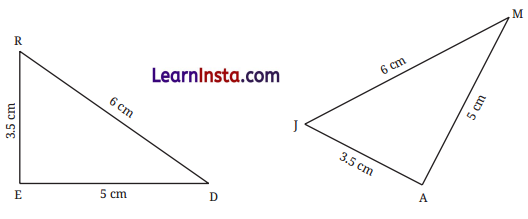
Determine whether the triangles are congruent. If yes, express the congruence.
Solution:
Let us examine the given triangles:
- Triangle 1 (ΔRED) has sidelengths of 3.5 cm, 5 cm, and 6 cm.
- Triangle 2 (ΔJAM) has sidelengths of 3.5 cm, 5 cm, and 6 cm as well.
Since both triangles have the same sidelengths, they are congruent by SSS (Side-Side-Side) congruence condition. We can express the congruence as:
- R ↔ J, E ↔ A, D ↔ M
- RE = JA, RD = JM, ED = AM
- ΔRED ≅ ΔJAM
Question 3.
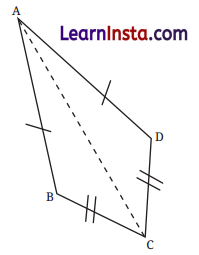
In the figure below, AB = AD, CB = CD.
Can you identify any pair of congruent triangles? If yes, explain why they are congruent.
Does AC divide ∠BAD and ∠BCD into two equal parts? Give reasons.
Solution:
In the given figure, triangles ABC and ADC are congruent because:
- AB= AD (Given)
- AC is a common side (Shared between both triangles)
- CB = CD (Given)
By the SSS (Side-Side-Side) congruence condition, ΔABC ≅ ΔADC.
⇒ ∠ABC = ∠ADC, ∠BCA= ∠DCA and ∠CAB = ∠CAD
Yes, AC divides ∠BAD and ∠BCD into two equal parts because ΔABC ~ ΔADC and the corresponding angles at A and C are equal in both triangles, which means AC acts as an angle bisector for both angles.
Question 4.
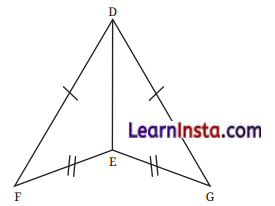
In the figure below, are ΔDFE and ΔGED congruent to each other? It is given that DF = DG and FE = GE.
Solution:
No, in ΔDFE and ΔGED
- DF = DG (Given)
- FE = GE (Given)
- DE is a common side (Shared between both triangles) By the SSS (Side-Side-Side) congruence condition, ΔDFE = ΔDGE but this does not show that ΔDFE and ΔGED are congruent.
Measuring Two Sides and the Included Angle (Page 10)
Construct a triangle having the measurements AB = 6 cm, AC = 5 cm and ∠A = 30°
Solution:
Steps of construction:
- Draw a line segment AB = 6 cm.
- At point A, make an angle of 30°.
- On arm AT, mark point C, such that AC = 5 cm.
- Join B and C to form ΔABC.
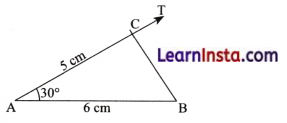
Thus, ΔABC is the required triangle obtained.
Figure it Out (Pages 13-14)
Question 1.
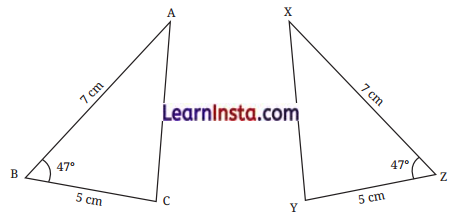
Identify whether the triangles below are congruent. What conditions did you use to establish their congruence? Express the congruence.
Answer:
In the given triangle ABC and XYZ:
- AB = XZ = 7 cm
- BC = ZY = 5 cm
- ∠ABC = ∠XZY = 47°
Since two sides and the included angle of ΔABC are equal to the corresponding sides and included angle of ΔXZY, we can conclude that the triangles are congruent using the SAS (Side-Angle-Angle) congruence condition. Thus, AABC ≅ ΔXZY.
Question 2.
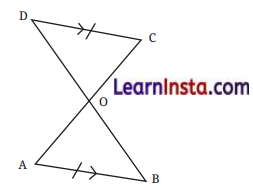
Given that CD and AB are parallel, and AB = CD, what are the other equal parts in this figure? (Hint:
When the lines are parallel, the alternate angles are equal. Are the two resulting triangles congruent?
If so, express the congruence.)
Solution:
Given AB and CD are parallel, and lines AC and BD are transversals, so alternate interior angles are equal. Thus,
- ∠CAB = ∠DCA (Alternate interior angles)
- ∠ABD = ∠CDB (Alternate interior angles)
- AB = CD (Given)
Thus, the two triangles, ∠AOB and ∠COD, are congruent by the ASA (Angle-Side-Angle) congruence condition. That is, ∠AOB = ∠COD.
The other parts equal in this figure are: OC = OA, OD = OB, ∠AOB = ∠COD.
Question 3.
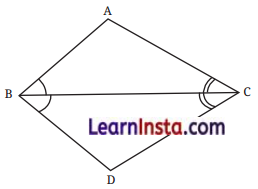
Given that ∠ABC = ∠DBC and ∠ACB = ∠DCB, show that ∠BAC = ∠BDC. Are the two triangles congruent?
Solution:
Given, ∠ABC = ∠DBC and ∠ACB = ∠DCB …(i)
We know that the sum of angles of a triangle is 180°. So, in triangles ABC and DBC,
∠ABC +∠ACB + ∠BAC = 180° = ∠DBC + ∠DCB + ∠BDC
So,∠BAC = ∠BDC [Using eq. (i)]
Additionally, the side BC is common in triangle ABC and DBC.
Using the ASA (Angle-Side-Angle) congruence condition, the two triangles, ΔABC and ΔDBC, are congruent. Thus, ΔABC ≅ ΔDBC.
Question 4.
Identify the equal parts in the following figure, given that ∠ABD = ∠DCA and ∠ACB = ∠DBC.
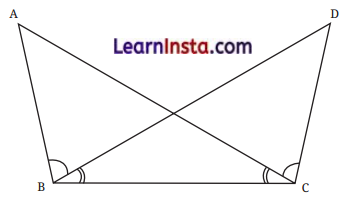
∠ABD = ∠DCA (Given)……….(i)
∠ACB = ∠DBC (Given)……….(ii)
Now, ∠ABC = ∠ABD + ∠DBC
⇒ ∠ABC = ∠DCA + ∠DBC …(iii) [Using (i)] and ∠DCB = ∠DCA + ∠ACB
⇒∠DCB = ∠DCA + ∠DBC …(iv) [Using (ii)]
From (iii) and (iv),
∠ABC = ∠DCB
BC = CB (Common side)
Thus, ΔACB ≅ ΔDBC. (By ASA congruence condition)
Thus, the equal parts in the given figure are:
- AB = CD
- AC = DB
- ∠A= ∠D
- ∠B = ∠C
Measuring Two Sides in a Right Triangle (Page 16)
ΔABC and ΔXYZ are right-angled triangles such that BC = YZ = 4 cm, ∠B = ∠Y = 90° and AC = XZ = 5cm. Are they congruent?
Solution:
We are given two right- angled triangles:
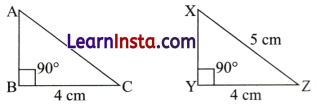
In ΔABC and ΔXYZ,
- BC = YZ = 4 cm (Given)
- AC = XZ = 5 cm (Hypotenuse)
- ∠B = ∠Y = 90°
By the RHS (Right-angle-Hypotenuse-Side) congruence condition,
AC = XZ = 5 cm (Given)
ΔABC ≅ ΔXYZ
1.3 Angles of Isosceles and Equilateral Triangles (Page 18)
Can you use this fact to find ∠B and ∠C?
Solution:
In an isosceles triangle, it has been proved that the angles opposite to equal sides are equal.
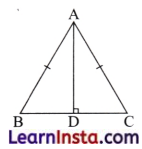
In ΔABC, AB = AC (Given)
So, ∠B = ∠C …(i)
No, ∠A = 80° (Given)
By angle, sum property,
∠A+∠B + ∠C= 180°
⇒ 80° + ∠B + ∠B = 180° [Using (i)]
⇒ 2∠B = 100°
∴ ∠B = \(\frac{100^{\circ}}{2}\) = 50
∠B = ∠C = 50°
Angles in an Equilateral Triangle (Pages 18-19)
Verify this by construction.
Solution:
To verify that in an equilateral triangle, where all sides are equal all angles are 60°,tfollow these step-by-step instructions:
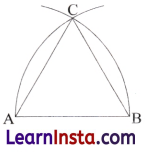
- Use the ruler to draw a line segment of any length. This will be one side of the equilateral triangle. Label the endpoints of the line as points A and B.
- Place the compass tip at A, and adjust the compass width to the length of the line segment AB. This is the length of one side of your equilateral triangle.
- Keeping the compass at point A, draw an arc above the line segment AB.
- Without changing the compass width, place the compass tip at B and draw a similar arc above AB.
- The two arcs intersect at a point above the line segment AB. Label this point as C.
- Use the ruler to join the points A to C and B to C.
- Now, we have an equilateral triangle ABC where the sides AB, AC, and BC are all equal.
- For verification of angles, when we measure the angles with a protractor, we find that measure of each angle is 60°.
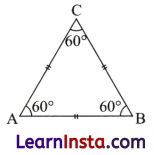
Figure it Out (Pages 20 – 21)
Question 1.
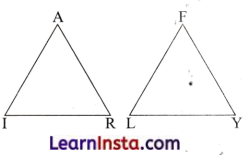
ΔAIR ≅ ΔFLY. Identify the corresponding vertices, sides and angles.
Solution:
Given, ΔAIR ≅ ΔFLY, and we know that the corresponding parts of the triangles are congruent. Here is how we can identify them:
Corresponding vertices:
- A↔F
- I↔L
- R↔Y
Corresponding sides:
- AI↔FL
- IR ↔ LY
- AR↔FY
Corresponding angles:
- ∠A ↔ ∠F
- ∠I ↔ ∠L
- ∠R ↔ ∠Y
Question 2.
Each of the following cases contains certain measurements taken from two triangles. Identify the pairs in which the triangles are congruent to each other, with reason. Express the congruence whenever they are congruent.
(a) AB = DE
BC = EF
CA = DF
(b) AB = EF
∠A=∠E
AC = ED
(c) AB=DF
∠B=∠D=90°
AC=FE
(d) A=D
∠B=∠E
AC=DF
(e) AB =DF
∠B=∠F
AC=DE
Solution:
(a) Given, AB = DE, BC = EF, CA = DF

By the SSS (Side-Side-Side) condition, if all three pairs of corresponding sides of two triangles are equal, the triangles are congruent. So, ΔABC ≅ ΔDEF.
(b) Given, AB = EF, ∠A = ∠E, AC = ED
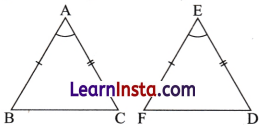
By the SAS (Side-Angle-Side) condition, if two sides and the included angle between them are equal in two triangles, the triangles are congruent.
So, ΔBAC ≅ ΔFED.
(c) Given, AB = DF, ZB = ZD = 90°, AC = FE
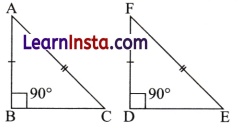
By the RHS (Right-Hypotenuse-Side) condition, if one side and hypotenuse of two right-angled triangles are equal, the triangles are congruent.
So, ΔABC = ΔFDE.
(d) Given, ∠A = ∠D, ∠B = ∠E, AC = DF
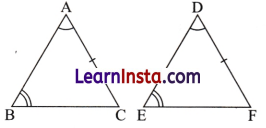
By the AAS (Angle-Angle-Side) condition, if two angles and a non-included side are equal, the triangles are congruent. So, ΔABC ≅ ΔDEF.
(e) AB = DF, ∠B = ∠F, AC = DE
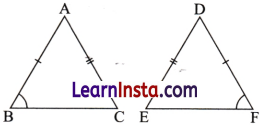
The given measurements correspond to the Side-Side-Angle (SSA) condition, which is not a valid congruence condition.
Therefore, ΔABC and ΔDEF are not necessarily congruent.
Question 3.
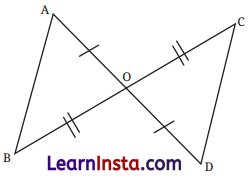
It is given that OB=OC and OA=OD. Show that AB is parallel to CD.
[Hint: AD is a transversal for these two lines. Are there any equal alternate angles?]
Solution:
We have OA = OD and OB = OC
Since ∠AOB and ∠DOC are vertically opposite angles, they are equal.
Therefore, ∠AOB = ∠DOC
By the Side-Angle-Side (SAS) congruence condition, ΔAOB = ΔDOC.
Therefore, ∠OAB = ∠ODC
Corresponding parts of congruent triangles are equal. The line segment AD is a transversal intersecting the lines AB and CD.
Since the alternate interior angles, ∠DAB (=∠OAB) and ∠ADC (=∠ODC) are equal, the lines AB and CD must be parallel.
Question 4.
ABCD is a square. Show that ΔABC = ΔADC. Is ΔABC also congruent to ΔCDA?
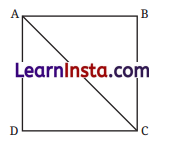
Give more examples of two triangles where one triangle is congruent to the other in two different ways, as in the case above. Can you give an example of two triangles where one is congruent to the other in six different ways?
Solution:
Since ABCD is a square, so
- AB = BC = CD = DA (All sides are equal in a square)
- ∠ABC = ∠ADC = 90° (All angles of a square are right angles).
In ΔABC and ΔADC,
- AB = AD (Equal sides of the square)
- ∠ABC = ∠ADC (Right angle)
- BC = DC (Equal sides of the square)
Thus, ΔABC ≅ ΔADC by SAS (Side-Angle-Side) condition. We can show this by SSS congruence rule also
- Yes, ΔABC is congruent to ΔCDA since all three corresponding sides are equal
i.e, AB = CD, BC = DA, AC = CA (common side). - Yes, suppose ΔABC and ΔPQR are isosceles right-angled triangles such that ΔABC ≅ ΔPQR, then we also have ΔABC = ΔRQP.
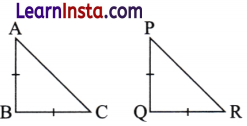
- Yes, suppose ΔABC and ΔXYZ are two equilateral triangles such that ΔABC ≅ ΔXYZ, then we have
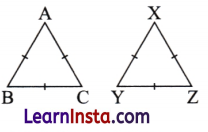
ΔABC ≅ XZY, ΔABC ≅ ΔYXZ,
ΔABC ≅ YZX, ΔABC ≅ ΔZXY, ΔABC ≅ ΔZYX.
Question 5.
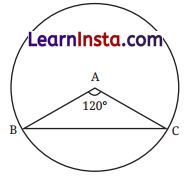
Find ∠B and ∠C, if A is the centre of the circle.
Solution:
We are given that ∠BAC = 120°.
A is the centre of the circle and AB and AC are radii of the circle. Therefore, AB = AC. This means that ΔABC is an isosceles triangle. Therefore, ∠B = ∠C.
The sum of all angles in a triangle is 180 °
⇒ ∠A + ∠B + ∠C = 180°
⇒ 120° + ∠B + ∠C = 180°
⇒ 2∠B = 60° (∵ ∠B = ∠C)
⇒ ∠B = 30° = ∠C
Question 6.
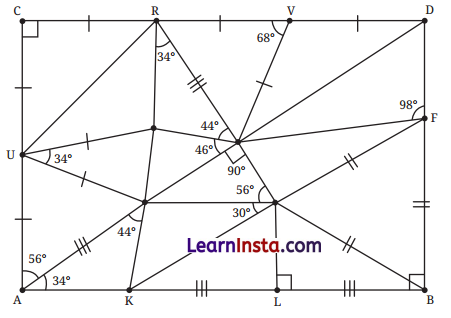
Find the missing angles. As per the convention that we have been following, all line segments marked with a single ‘|’ are equal to each other and those marked with a double ‘|’ are equal to each other, etc.
Solution:
We can find the missing angles using angle sum property of a triangle, and the properties of isosceles, equilateral and right triangles as follows: