Get the simplified Class 8 Maths Extra Questions Part 2 Chapter 4 Exploring Some Geometric Themes Class 8 Extra Questions and Answers with complete explanation.
Class 8 Exploring Some Geometric Themes Extra Questions
Class 8 Maths Chapter 4 Exploring Some Geometric Themes Extra Questions
Exploring Some Geometric Themes Extra Questions Class 8
Very Short Answer Type Questions
Question 1.
In Sierpinski carpet, if Step 1 has 1 hole, how many total holes will be there at Step 2?
Answer:
We know that the total number of holes,
Hn+1 = Hn + Rn
and the total number of remaining squares, Rn = 8”
Hence, the total number of holes
H1+1 = H1 + R1
⇒ H2 = 1 + 8 = 9 holes
Question 2.
In Sierpinski gasket, if the initial triangle area is 16 sq units, what is the area of the central triangle removed in Step 1?
Answer:
If the initial triangle area is 16 sq units.
Since, the removed central triangle is \(\frac{1}{4}\) of the original area.
The area of the central triangle removed in Step 1
= \(\frac{1}{4}\) × 16 = 4 sq units
Question 3.
In Koch Snowflake, if the original triangle has 3 sides, how many sides the shape have after Step 1?
Answer:
Since, the total number of sides in step n = 3 × 4n
∴ The total number of sides after Step 1 = 3 × 41 = 12
Question 4.
Write the number of faces, edges and vertices in the solids given below.
(i) Cube
Answer:
The number of faces in cube = 6
The number of edges in cube =12 The number of vertices in cube = 8
(ii) Triangular pyramid
Answer:
The number of faces in triangular pyramid = 4
The number of edges in triangular pyramid = 6
The number of vertices in triangular pyramid = 4
Question 5.
Define the net of a solid.
Answer:
A net is a skeleton outline in 2D, which when folded results in a 3D-shape.

Question 6.
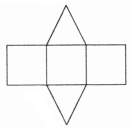
How many squares and triangles are in the net of triangular prism?
Answer:
In a triangular prism, the total number of squares is 3
Question 7.
How many triangles are there in the net of triangular pyramid?
Answer:
The number of triangles in the net of triangular pyramid is 4.

Question 8.
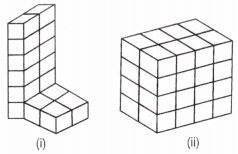
Count the number of cubes in the following figures.
Answer:
Here, the number of cubes in fig. (i) is 16 and the number of cubes in fig. (ii) is 32.
Question 9.
To find the shortest distance between two opposite corners on the surface of a solid, why is it necessary to use a 2D “net”?
Answer:
The shortest distance between two points on a flat plane is a straight line. By unfolding a 3D-object into a 2D net, we can apply the Pythagorean theorem to find that straight line distance across the faces.
Short Answer Type Questions
Question 1.
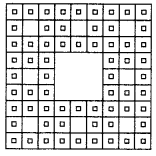
Describe the step-by-step construction of the Sierpinski carpet starting from Step 0.
Answer:
Step 0 The base shape begins with a solid square.

Step 1 Divide the square into a 3 × 3 grid of 9 equal smaller squares. Remove the central square. We are left with 8 smaller solid squares surrounding one central hole.

Step 2 Apply the same process to each of the 8 remaining smaller squares from Step 1. Divide each into 9 even smaller squares and remove the middle one from each.
Now, we have 8 × 8 = 64, they square and 1 + 8 = 9 holes of different sizes.
Question 2.
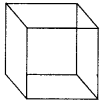
How many faces does a cube have?
Answer:
The total number of faces of a cube is equal to 6.
Question 3.
How many vertices does a cuboid have?
Answer:
The total number of vertices in a cuboid is equal to 8.
Question 4.
Write the number of faces, edges and vertices in the solids given below.
(i) Prism
Answer:
For prism, faces = 5, edges = 9, vertices = 6
(ii) Brick
Answer:
For brick, faces = 6, edges = 12, vertices = 8
Question 5.
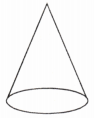
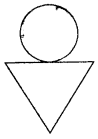
Make a net for given cone.
Answer:
Net for the given cone figure will be
Question 6.
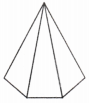
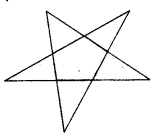
Draw a net for the following pyramid.
Answer:
Net for the given pyramid is as follows.
Question 7.
A sketch of a house on grid is shown below.
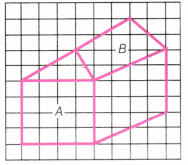
1 block represents one square unit.
Is face A identical to face B? Explain your answer.
[Competency Based Question]
Answer:
No, face A is not identical to face B because face A is a square and face B is a rectangle.
Question 8.
How an object, which is 3D can be viewed in different ways? Name all the ways.
Answer:
Different sections of 3D can be viewed in many ways as follows.
(i) One way is to view by cutting or slicing the shape, which would result in the cross section of the solid.
(ii) Another way is by observing a 2D shadow of a 3D-shape.
(iii) A third way is to look at the shape from different angles.
Question 9.
If two cuboids of dimensions 3 cm × 3cm × 6cmare placed on each other such that they overlap, what would be the dimensions of the resulting figure?
Answer:
Given, dimensions of two cuboid 3 cm × 3 cm × 6 cm.
Dimensions of the resulting figure are ,
height = 6 + 6 = 12 cm,
breadth = 3 cm and length = 3 cm
Question 10.
Jayesh chopped carrots this way.
[Competency Based Question]
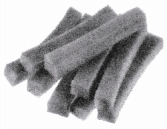
Which geometric shape do the chopped carrots resemble? How many edges does one piece have?
Answer:
The chopped carrot resemble cuboid and contains 12 edges.
Question 11.

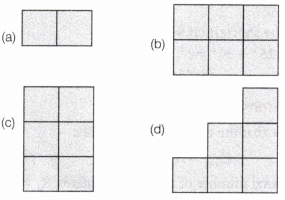
Which of the following shows the side view of the arrangement?
Answer:
Option (c) shows the side view of the arrangement.
Long Answer Type Questions
Question 1.
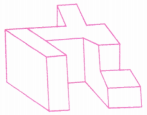
How many faces does following figure have?
[Competency Based Question]
Answer:
There are total 16 faces in the given figure.
Question 2.
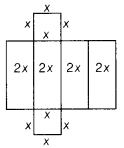
Draw a net of a cuboid having same breadth and height but length double the breadth.
Answer:
Required net of a cuboid will be
Question 3.
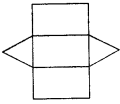
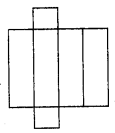
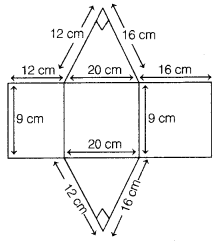
Draw the nets of the followings.
(i) Triangular prism
Answer:
Net for triangular prism,
(ii) Tetrahedron
Answer:
Net for tetrahedron,

(iii) Cuboid
Answer:
Net for cuboid,
Question 4.
Draw a net of the solid given in the figure.
[Competency Based Question]

Answer:
The net of the given solid figure will be
Question 5.
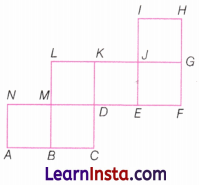
The net given below in figure can be used to make a cube.
(i) Which edge meets AN?
(ii) Which edge meets DE?
Answer:
(i) The given net of a cube shows, edge GH meets edge AN.
(ii) The given net of a cube shows, edge DC meets edge DE.
Question 6.
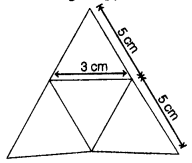
Draw the net of triangular pyramid with base as equilateral triangle of side 3 cm and slant edge 5 cm.
Answer:
The net of such triangular pyramid will be
Question 7.
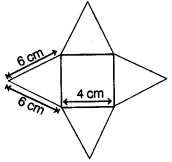
Draw the net of a square pyramid with base as square of side 4 cm and slant edges 6 cm.
Answer:
The net of such square pyramid will be
Question 8.
Draw the net of the following figure.
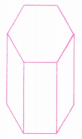
Answer:
The net of the given figure will be as follows.
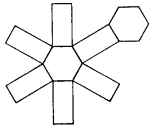
Question 9.
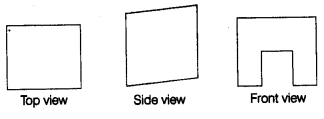
Draw the top, side and front views of the solids given below in figures.
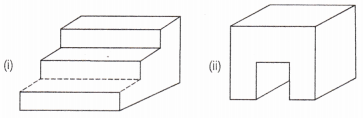
Answer:
For given figure (i),
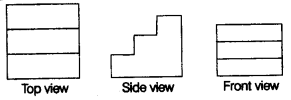
For given figure (ii),
Question 10.
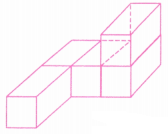
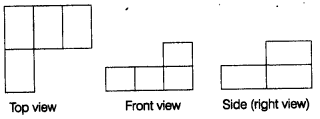
Draw the top, the front and the side views of the following solid figure made up of cubes.
Answer:
For the given figure
Question 11.
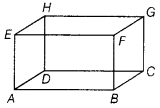
In the following figure,
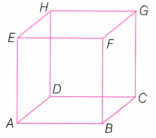
(i) Which edge is the intersection of faces EFGHand EFBA?
(ii) Which faces intersected at edge FB?
(iii) Which three faces form the vertex A?
(iv) Which vertex is formed by the faces ABCD, ADHE and CDHG?
(v) Give all the edges that are parallel to edge AB.
(vi) Give the edges that are neither parallel nor perpendicular to edge BC.
(vii) Give all the edges that are perpendicular to edge AB. [Competency Based Question]
Answer:
(i) EF
(ii) AB FE BFGC
(iii) ABF ABCD, ADHE
(iv) D
(v) CD, EF, GH
(vi) AE, EF, GH, HD
(vi) AE, BF, AD, BC
Skill Based Questions
Question 1.
Crossword Puzzle
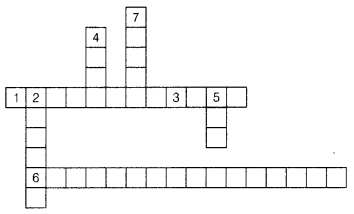
Solve the crossword and fill the given box across, downward as per the mentioned clue in the boxes.
Across
1. The sketch of a solid in which the measurements are kept proportional.
3. The 3D figure, which has a Joker’s cap.
6. The solid which has 5 faces-3 of which are rectangles and 2 are triangles.
Down
2. The solid shape which does not have a vertex or edge.
4. The line where two faces of a 3D-figure meet.
5. The skeleton 2D-figure which when folded results in a 3D-shape.
7. Shadow of a cube.
Answer:
1. Isometric
2. Sphere
3. Cone
4. Edge
5. Net
6. Rectangular Prism
7. Square
Case Study Based Questions
Question 1.
Raveena gives toy erasers as return gifts for her birthday. One of the erasers is shown below.
[Competency Based Question]
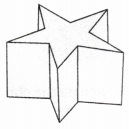
(i) How many edges are there?
(ii) Raveena placed one eraser exactly above another. She claims that the number of faces in the combined shapes is the same as that of the single eraser. Do you agree? Explain your answer.
Answer:
(i) There are 30 edges in the given figure.
(ii) Yes, because the faces of the shape in both cases are 12.
Question 2.
An ice-cream cart has an ice-candy drawn on all sides, except the top and the bottom.
[Competency Based Question]

(i) Which geometric shape does the ice-cream container resemble?
(ii) How many ice-candies are drawn on the cart?
Answer:
(i) We know that a cuboid is a 3D solid shape that 6 faces, 8 vertices and 12 edges.
Hence, the ice-cream container resembles cuboid shape.
(ii) We know that a cuboid is 3D solid shape that has 6 faces.
Therefore, ice-cream container has 4 sides except the top and bottom.
Thus, ice-creams are drawn on four sides.
Question 3.
Rajat arranged some cubes as below.
[Competency Based Question]
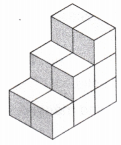
(i) How many cubes did he use?
(ii) “An equal number of cubes are seen in the top, front and side views in this cubical arrangement.”
Is the statement correct? Explain your answer.
Answer:
(i) By counting number of cubes, there are 12 cubes.
Hence, Rajat used 12 cubes.
(ii) Yes, it is correct as top, front and side views have 6 cubes.
Question 4.
A blue cubical box with a sidelength of 25 cm is placed on a stone pavement. A caterpillar is sitting at one of the top corners (labeled Point C). It smells an apple slice located at the diagonally opposite bottom corner (labeled Point D). Since, the caterpillar cannot fly, it must crawl along the outer surface of the cube to reach the apple.
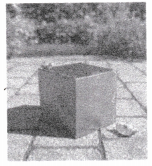
(i) What is the 2D “unfolded” representation of this 3D cube called, which helps in calculating the shortest path?
(ii) If the caterpillar crawls across the top face and then down the front face, what would be the total horizontal and vertical distances of its path, when represented on a flat plane?
(iii) Use the Pythagorean theorem to calculate the shortest distance the caterpillar must crawl to reach the apple.
Answer:
(i) The 2D ‘unfolded’ representation of a 3D solid is called a net.
(ii) Total Horizontal distance = 25 cm
Total vertical distance = 25 cm + 25 cm = 50 cm
(iii) Using Pythagoras theorem,
a2 + b2 = c2,
where a = 25 cm and b = 50 cm
c is the shortest crawl distance.
⇒ 252 + 502 = c2
⇒ c2 = 3125
⇒ c ≈ 55.9 cm