Students can use Our Wondrous World Class 4 Solutions Chapter 2 Exploring Our Neighbourhood Class 4 Questions and Answers as a quick reference guide.
Class 4 EVS Chapter 2 Exploring Our Neighbourhood Question Answer
Exploring Our Neighbourhood Class 4 EVS Question Answer
Our Wondrous World Class 4 EVS Chapter 2 Question Answer – Class 4 EVS Exploring Our Neighbourhood Question Answer
Discuss (Page 21)
Question 1.
Letters took a long time to reach other persons. How do you think it affected communication between people in the past?
Answer:
In the past, transportation was slow as a result the communication system was very slow and delayed letters meant slower responses, making communication less efficient. People had to wait for weeks or even months to receive replies, which could lead to misunderstandings or missed opportunities. However, letters also carried a personal touch and were valued more.

Question 2.
How is it different from the way people communicate now?
Answer:
Today, technology (mobile phones, emails, social media) allows instant communication. People can send messages, make video calls, and share updates within seconds, making interactions faster and more convenient.
Question 3.
Today, quick messages make sharing the news easier, but sometimes wrong information spreads very quickly too. How can we ensure the news we share is true?
Answer:
We should verify information from reliable sources (like trusted news websites or official announcements) before sharing it. Avoid spreading unverified news and encourage others to do the same.
Discuss (Page 25)
If you had to send money to someone, which method would you choose-using a phone, Money Order, or some other mode? Why?
Answer:
(Suggestive answer)
I would choose sending money via phone (UPI/Banking apps) because it is instant, secure, and convenient. Unlike Money Orders, which take time, digital transfers happen within seconds. But, if I have to send money to someone who does not have access to Internet i.e., a person living in remote areas where there is no network, then I will have to send the money through Money Order.
Write (Page 19)
Question 1.
Have you or your family members ever sent or received a letter or a parcel?
Answer:
(Suggestive answer)
“Yes, my grandfather used to send letters to his relatives. Once, we received a parcel containing gifts from my aunt in another city.”
Question 2.
How does the post office help people stay connected with each other?
Answer:
The post office delivers letters, parcels, and money orders, helping people communicate and send important items even over long distances. It also provides other services like speed post, international postal services, and banking.
Write (Page 22)
Question 1.
Which mode of transportation do you use the most?
Answer:
I travel most often by school bus. For long trips, my family uses bus, train or car.
Question 2.
Can you identify the structures in the pictures, and explain how they have made travel faster and connectivity better?
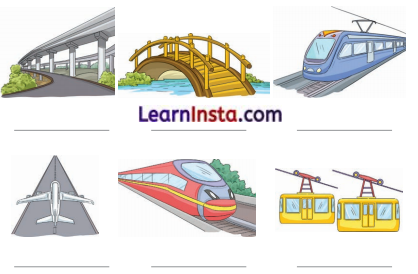
Answer:
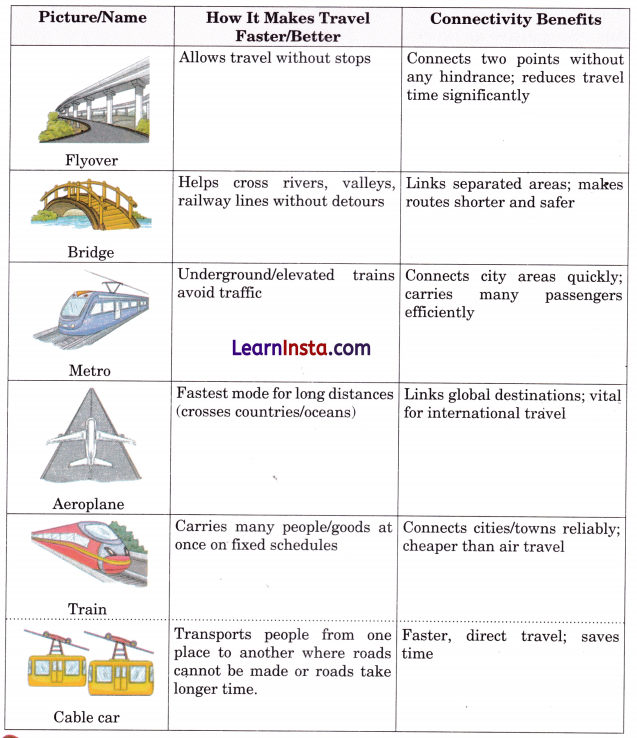
Write (Page 23)
List the people who work at a hospital or a health centre; and write down their role in the following table. One example has been given in the table.
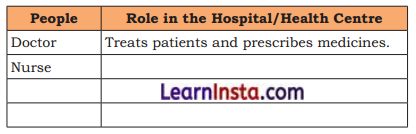
Answer:
| People | Role in the Hospital/Health Centre |
| Doctor | Treats patients and prescribes medicines. |
| Nurse | Assists doctors, gives medicines, and cares for patients. |
| Pharmacist | Prepares and dispenses medicines. |
| Lab Technician | Conducts medical tests (e.g., blood tests, X-rays etc.) |
| Receptionist | Manages patient appointments and records. |
| Sweeper/Cleaner | Maintains hygiene in the hospital. |
Write (Page 25)
Question 1.
If you get pocket money, do you save it? If yes, where do you put your savings?
Answer:
(Suggestive answer. Students may write their own experience.)
Yes, I save my pocket money in a piggy bank. When I have collected sufficient amount of money, my parents deposit it in my bank account.
Question 2.
Why do you think it is important to save money?
Answer:
Saving money helps in emergencies, future needs (like education), and buying important things without borrowing.
Question 3.
What are some things you could do to save more money?
Answer:
Some things that we can do to save more money are:
- Avoid unnecessary spending on toys/snacks.
- Set aside a fixed amount every month.
- Reuse old items instead of buying new ones.
Question 4.
Request one of your family members to show you their bank passbook. Note the important elements given on the first page of the passbook.
Answer:
Request a family member to show you their bank passbook. Note the important elements on the first page.
- Bank’s Name
- Account Holder’s Name
- Account Number and Type of Account
- Branch Name & IFSC Code
- Opening Date
- Transaction Records
Write (Pages 28-29)
Question 1.
Look at the picture and write down the places located in the North, East, West, and South of Navya’s home.

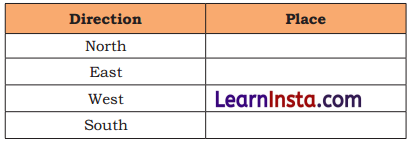
Answer:
| Direction | Place |
| North | Hospital |
| East | Chemist |
| West | Bakery shop |
| South | Post office |
Question 2.
Look at the picture and imagine your school at the centre. Name the buildings or areas near your school and write the direction they are situated in the given spaces.
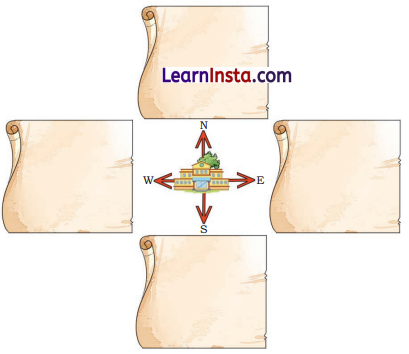
Answer:
(Suggestive answer. Students may write their own experience)
- North: Public Park
- East: Police Station
- West: Market
- South: Temple
Question 3.
Imagine you are giving directions to a friend to visit your favourite place near your school. How would you explain it using directions (left, right, forward, backward, etc.) and landmarks?
Place: …………………………
Instruction: ………………………
Answer:
Place: School
Instruction: Walk straight from the school gate towards your left, turn right at the bookshop, and you’ll see the library beside the park, opposite the library you will see a coffee shop, you will find me there.
Find Out (Page 23)
How did your parents and grandparents go to school or other places, when they were of your age? Is it different from how you travel today? Note it down below.

Answer:
| You | Parents | Grandparents |
| School Bus, Metro, Car, Bicycle, Autorickshaw | Bicycle, Bus, by Foot, Two Wheeler, Autorickshaw | Bicycle, by Foot, Two Wheelers |
Yes, it is very different from how we travel today. Nowadays, the transport system is quite fast, and there are many types of transports available for daily travel – whether for work, school or other activities. During our parents’ and grandparents’ time, transport options were limited and often too expensive. But now, times have changed.
Activity 1 (Page 18)
Question 1.
Write a letter to a friend and post it.
Answer:
84, Civil Lines
Ambala Cantt.
8th September 2025
Dear Harshita,
How are you? I enjoyed our last meeting. I am planning to revise the syllabus of EVS together. Let’s visit the library this weekend. I hope to see you there. Kindly confirm.
Your friend
Kriti
Note: Students to write themselves and post it to their friend.
Question 2.
Teacher can take students on a field trip to a post office, to explore various activities that take place there.
Answer:
(Key observations:)
- How postage tickets and envelopes are sold!
- How Speed Post letters and parcels are sent.
- What facilities for general public are available.
- How letters are sorted by PIN codes.
- Parcel weighing and stamping.
- Money order services.
- Banking service.
Activity 2 (Page 20)
Interview with Elders
1. Discuss with the elders in your neighbourhood and find out how they communicated with each other when they were of your age. Compare their answers to how you and your friends communicate today; and fill in the table below.
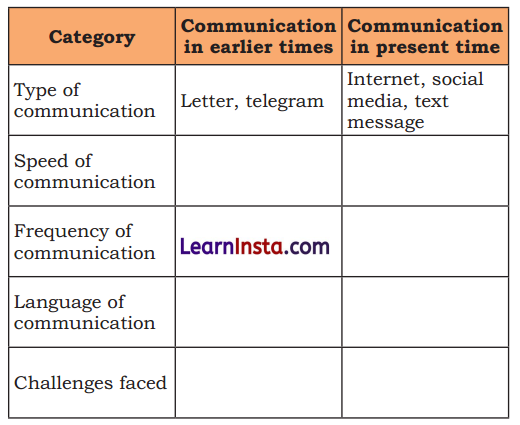
Answer:
| Category | Communication in earlier times | Communication in present times |
| Type of communication | Letter, telegram | Internet, social media, text message |
| Speed of communication | Days/weeks | Seconds/minutes |
| Frequency of communication | Rare (costly) | Multiple times daily |
| Language of communication | English, Hindi, other local languages | English, Hindi, other local languages |
| Challenges faced | Delays, lost letters | Fake news, internet issues |
Activity 3 (Page 26)
Question 1.
Visit a bank in your locality or find out from your elders about how it works. After that, answer the following questions:
(a) Other than saving money, what else do people use banks for?
Answer:
Other than saving money people use banks for commercial transactions, banking services like demand draft, loans, insurance, online payments, lockers etc.
(b) What is an ATM and how does it help people?
Answer:
ATM (Automated Teller Machine) is a self operating machine used for cash withdrawal or deposit without bank staff.
- An ATM helps people withdraw cash, deposit money, check balances, and perform banking transactions 24/7 without visiting a bank branch.
Question 2.
Take an Indian currency note. Look at it closely and answer the following questions:
(a) What is the value of the note?
Answer:
Value: ₹ 100
(b) How many languages do you see on the note?
Answer:
Languages: 17 languages are written on it. Two languages-Hindi, English are written on the front side and 15 languages on the reverse side.
(c) What pictures or symbols are there on the note?
Answer:
Mahatma Gandhi, RBI seal, and National emblem are printed on the front side and picture of Rani Ki Vav is printed on the reverse side. Front side of all denominations have similar pictures/symbols as on ₹ 100 currency note, but the picture on the reverse is different on all denominations.
Activity 4 (Page 30)
Draw a map showing the route from your school to the public library or any such place near your school. Identify landmarks like parks, shops, hospitals, bus stops, etc. on the map.
Answer:
Students to do this activity themselves.
Let us Reflect (Pages 31-32)
Question 1.
Imagine you have ₹ 100 to utilise in a month. Your task is to plan how to spend and save wisely. Think about your expenses for stationery, snacks, toys, etc. Decide how much you will save in your piggy bank and how much you will use for your expenses. After making this plan, think about how saving money could help you in the future. Use the table below to create your budget.

Answer:
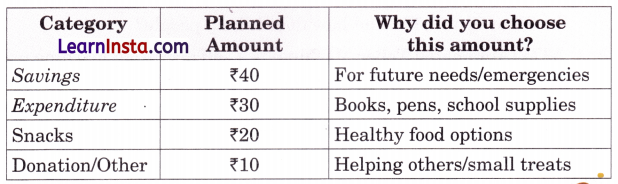
Question 2.
Imagine that your group is in charge of making your neighbourhood better. Discuss what new services or facilities you would add or improve. Present how these changes would help everyone in the community.
Answer:
(Sample answers:)
- Public Park: Making safe playing area for children running track, and benches for the aged. This will help all in relaxation and rejuvenation.
- Cleanliness Drive: Area clean and eco-friendly. This will improve environment and public health.
- Street Lights: Maintenance of street lights will improve safety at night and prevent accidents and theft.
- Community Library: Free books for all ages will be available. This will help in improving the education of people and will also help people enjoy their free time.
Question 3.
As a class, take help of the elders around you to list people in your neighbourhood who helped the community during COVID-19. These could include doctors, nurses, garbage collectors, shopkeepers, teachers and others. Discuss how they made the community safer and why it is important to thank them.
Answer:
| Helpers | Role During COVID-19 |
| Doctors/Nurses | Treated patients, ran vaccination drives |
| Police Officers | Ensured lockdown rules were followed |
| Delivery Persons | Delivered essentials to homes |
| Teachers | Taught online classes |
| Sanitation Workers | Disinfected public spaces |
Therefore, it is important for all of us to thank them. Because they all did their jobs sacrificing their safety and devoted themselves in public service.
Question 4.
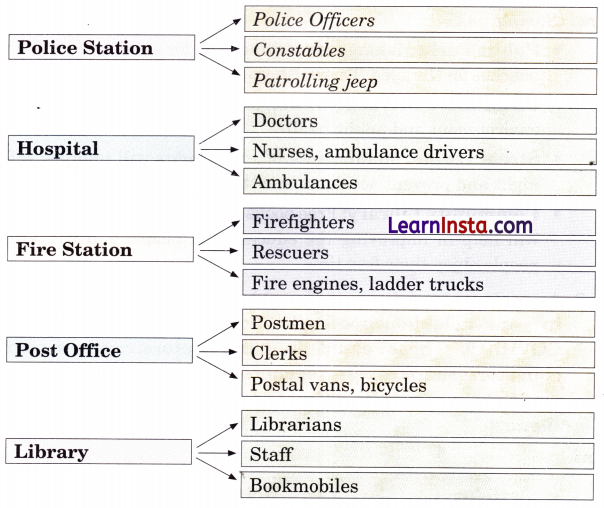
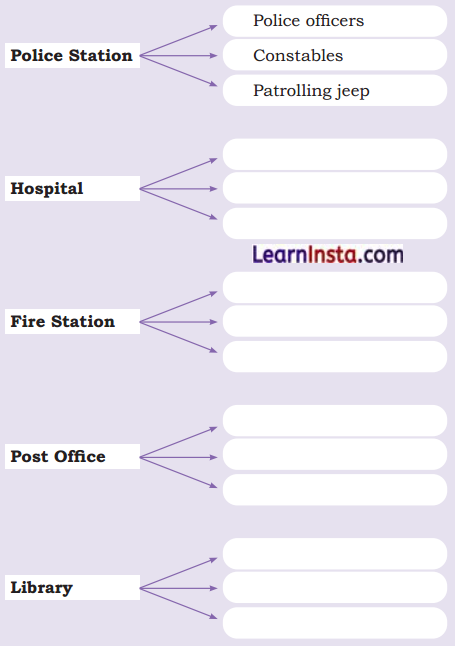
Can you list out the people involved and vehicles used in each of these services in the boxes given below? An example has been given.
Answer: