Experts have designed these Class 8 Science Notes Chapter 5 Exploring Forces Class 8 Notes for effective learning.
Class 8 Science Chapter 5 Exploring Forces Notes
Class 8 Exploring Forces Notes
Class 8 Science Chapter 5 Notes – Exploring Forces Notes Class 8
→ Force is a push or a pull acting on an object.
→ Effects of Force:
- It can move a stationary object.
- It can change the speed of a moving object.
- It can change the direction of a moving object.
- It can change the shape of an object.

→ A force arises due to the interaction between at least two objects.
→ SI unit of force is newton (N).
→ Types of Forces:
- Contact Forces: The forces which acts only when there is a physical contact between the objects.
- Muscular Force: When we do physical activities like running, walking, stretching, etc., a force is caused by the action of muscles in our body and this resulting force is known as muscular force.

- Animals, birds, fish, and insects use muscular forces for movement and survival.
- Humans used the muscular force of some animals to carry out many tasks for a long time.
- Muscular force also helps in chewing food, digestion, and blood circulation in the body.
→ Frictional Force: It is the force that acts between two surfaces when an object moves or tries to move over another surface.
- It always acts in the opposite direction of motion. It arises due to the irregularities in the two surfaces in contact.
- Friction depends on the nature of surfaces in contact.
- It is greater on rough surfaces and less on smooth surfaces.
- Friction also acts in liquids and gases, so vehicles like aeroplanes, ships and boats are designed with a specific shape to reduce force of friction.
→ Non-contact Forces:The forces which acts when there is no contact between the objects. For example magnetic force electrostatic force and gravitational force.
→ Magnetic Force: The force exerted by a magnet on another magnet or magnetic materials(like iron).
Like poles(North-North,South-South) repel,unlike poles(North-South)attract
→ Electrostatic Force:The force exerted by a charged body on another charged body or an uncharged body.
When two objects made of certain materials are rubbed together,electrical charges develop on their surfaces. These charges are called static charges because they do not move on their own. An object that gains these charges is known as a charged object.
- Rubbing certain materials builds up static charges
- Charges can be positive or negative
- Like charges repel unlike charges attract
- Moving charges create paper pieces electric current which can light a lamp or produce heating or magnetic effect.

→ Gravitational Force:The force with which the Earth attracts objects towards itself.It is also known as force of gravity or simply gravity.
- When an object is thrown up,it slows, stops briefly at the top then falls back down with increasing speed due to gravity.This vertical motion is caused by the force of gravity.For example objects thrown up thrown objects coming back to the Earth,etc.
- Gravitational force is always an attractive force unlike magnetic or electrostatic force.
→ Weight: It is the force with which the Earth pulls an object towards itself.
- SI unit of weight is newton (N).
- It varies from place to place due to differences in gravitational force.
→ A spring balance is used to measure weight (force) by the stretching of a spring when an object is hung from its hook. It shows weight in newtons and often mass in grams, based on Earth’s gravity.
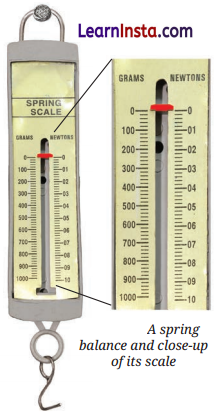
- The maximum weight a spring balance can measure is up to its maximum reading.
- The smallest value it can measure is calculated by dividing the difference between two large markings by the number of small divisions.
- The object should not be heavier than the maximum range of spring balance otherwise it may get damaged.
→ Mass is the amount of matter in an object.
- It is measured in grams (g) or kilograms (kg) by weighing an object with a spring or beam balance.
→ It is constant everywhere.
| Planet | Earth | Moon | Mars | Venus | Jupiter |
| Mass of the object | 1 kg | 1 kg | 1 kg | 1 kg | 1 kg |
| Weight of the object | 10 N | 1.6 N | 3.8 N | 9 N | 25.4 N |
→ In everyday life, we often say “weight” when they actually mean “mass”, like calling a 10 kg bag of wheat its weight. However, scientifically, it is important to use the correct terms and units.
→ Buoyant Force: The upward force exerted by a liquid on an object is called upthrust or buoyant force.
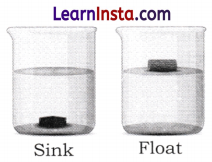
- If gravitational force > buoyant force, the object sinks.
- If gravitational force = buoyant force, the object floats.
→ Archimedes Principle states that when an object is fully or partially immersed in a liquid, it experiences an upward force which is equal to the weight of the liquid it displaces.
- If displaced liquid’s weight < object’s weight, the object sinks.
- If displaced liquid’s weight = object’s weight, the object floats.
→ Pumice rock is a light, porous rock formed during volcanic eruptions when lava filled with gas and water vapour cools quickly. The trapped air pockets make it less dense than water, allowing it to float.