Experts have designed these Class 7 Science Notes Chapter 12 Earth Moon and the Sun Class 7 Notes for effective learning.
Class 7 Science Chapter 12 Earth Moon and the Sun Notes
Class 7 Earth Moon and the Sun Notes
Class 7 Science Chapter 12 Notes – Earth Moon and the Sun Notes Class 7
→ We usually observe that tree shadows are long in the morning but shorter in the afternoon. The common thinking is that the size of the shadows changes because the Sun moves across the sky during the day.
→ In fact, the Sun appears to be moving because we view it from the Earth, which is turning around itself. When we view from the Earth, the Sun appears in the East, moves across the sky from the East to the West and disappears in the West.
Rotation of the Earth
Rotation is the motion of an object in which all its parts move in circles around an imaginary line that passes through it. This line is called the axis of rotation.
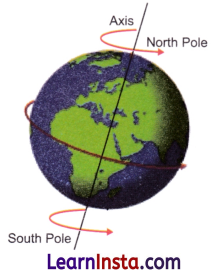
- The Earth spins (or rotates) on its own axis in space as shown in Fig. The Earth’s axis of rotation passes through its geographic the North Pole and the South Pole.
- The Earth’s axis of rotation is not upright with respect to the orbit, but is tilted.
- The Earth completes one rotation in about 24 hours.
- When viewed from the top of the North Pole the Earth is rotating in the anti-clockwise direction, • that is, from West to East.
- The Earth’s rotation from West to East causes the day-night cycle. The side facing the Sun experiences daytime, while the other side is dark and experiences night.
- It is due to the rotation of the Earth, that the Sun appears to rise in the eastward direction. It moves across the sky from the East to the West and sets in the westward direction.
- When the Sun sets the night begins and the stars become visible in the sky.
- In the middle of nineteenth century Leon Foucault, a known scientist, used a long pendulum to give the first simple demonstration of the Earth’s rotation.

Earth, Moon And The Sun
The Earth’s axis of rotation points very close to the Pole Star in the Northern Hemisphere. Therefore, the Pole Star appears nearly stationary in the sky from the Earth.

- In the Northern Hemisphere, the longest day occurs around 21 June—this is known as summer solstice.
- The shortest day and the longest night in this Hemisphere occur around 22 December known as
the winter solstice. - Around 21 March and 23 September, the daytime lasts for 12 hours. In the Northern Hemisphere, these days are called the spring equinox and the autumn equinox.
- The polar regions thus experience continuous sunshine for six months followed by a six-month period of darkness.
- At the North Pole, the Sun rises in the East direction on 21 March and sets on 22 September. Then the Sun rises at the South Pole and sets on 21 March.
Revolution of the Earth
- Revolution is the motion of an object around another object. The path an object takes while revolving around another object is called its orbit.
- The Earth, like all other planets revolves around the Sun.
- If viewed from the top the orbit of the Earth around the Sun is nearly circular.
- The Earth completes one revolution around the Sun in about 365 days and 6 hours.
- As the Earth also revolves around the Sun continuously, the stars seen in the night sky after sunset gradually change over a year.
- The tilt of the Earth’s axis and the spherical shape of the Earth gives rise to seasons.
- In June, the Northern Hemisphere is tilted towards the Sun while the Southern Hemisphere is tilted away from the Sun.
- The sunrays are spread in a smaller area in the Northern Hemisphere due to the spherical shape of the Earth’s surface. So that area is heated more.
- The Northern Hemisphere * receives sunlight for more than 12 hours in June, thus, experiences more intense sunlight, which lasts for a longer time, causing the summer season.
- In December, the Northern Hemisphere receives sunlight for less time and also the sunrays are spread in a larger area. So, the area is heated less compared to the Southern Hemisphere. There is winter on the Northern Hemisphere in December.
- The situation is reverse at the Southern Hemisphere. There is winter in June and summer in December.
- It is wrong to say that changes of seasons are caused due to elliptical shape of the orbit and that the Sun is closer to the Earth during certain periods compared to others. Also, the Northern Hemisphere being closer to the Sun in June due to tilt in the axis does not make much difference in seasons.

Eclipses
- When the Moon comes in between the Sun and the Earth in a way that obstructs the light from the Sun from reaching us. This is known as a solar eclipse.
- The shadow of the Moon falls on a small area on the surface of the Earth. This area is in total darkness, as no part of the Sun can be seen from there. This is called a total solar eclipse.
- In areas where the Moon partially blocks out only some regions of the Sun, we see a partial solar eclipse.
- The total solar eclipse is visible only for a few minutes. As the Moon begins to move away from the front of the Sun, we see a partial solar eclipse and daylight begins to return.
- Viewing the Sun directly even during the eclipse, the Sun is intense enough to damage the eyes and cause blindness. Thus, directly viewing solar eclipse or viewing it through sunglasses, binoculars, or telescopes must be strictly avoided.
- Safe method of viewing a solar eclipse is to view the Sun’s image on a screen.
- When the Earth during its revolution around the Sun and the revolution of the Moon arourtd the Earth, comes in between the Sun and the Moon, it blocks the sunlight from reaching the Moon. This is known as a lunar eclipse.
- When the Moon is completely in the Earth’s shadow, it is called a total lunar eclipse. The bright disc of the Moon starts to appear ‘ dark red in colour and stays that way until the Moon moves out of the shadow of the Earth.
- When part of the Moon is in the Earth’s shadow and the rest of the Moon is visible, it is called a partial lunar eclipse.
- Unlike the Sun, we can safely watch the eclipsed full Moon with our naked eye.

→ Autumn equinox: September 23, when days and nights are equal on the Northern Hemisphere.
→ Axis: When an object rotates around an imaginary line that passes through it, this line is called the axis of rotation.
→ Orbit: The path an object takes while revolving around another object.
→ Partial lunar eclipse: When part of the Moon is in the Earth’s shadow and the rest of the Moon is visible.
→ Partial solar eclipse: Areas on the Earth, where the Moon partially blocks out only some regions of the Sun.
→ Rotation: The motion of an object in which all its parts move in circles around an imaginary line that passes through it.
→ Revolution: The motion of an object around another object.
→ Spring equinox: March 21, when days and nights are equal on the Northern Hemisphere
→ Solar eclipse: Position when the Moon comes in between the Sun and the Earth in a way that obstructs the light from the Sun from reaching us.
→ Summer solstice: June 21, the longest day on the Northern Hemisphere.
→ Total lunar eclipse: When the Moon is completely in the Earth’s shadow. ,
→ Total Solar eclipse: The area on the Earth in total darkness, as no part of the Sun can be seen from there.
→ Winter solstice: December 22, the shortest day on the Northern Hemisphere.
→ Mind Map
