Experts have designed these Class 9 Science Notes and Exploration Chapter 13 Earth as a System Energy Matter and Life Class 9 Notes for effective learning.
Class 9 Science Chapter 13 Earth as a System Energy Matter and Life Notes
Class 9 Science Exploration Chapter 13 Notes
Class 9 Science Chapter 13 Notes – Class 9 Earth as a System Energy Matter and Life Notes
→ Albedo: The fraction of incoming solar radiation reflected by a surface. High albedo surfaces reflect more and stay cooler; low albedo surfaces absorb more and are warmer.
→ Ammoniflcation: The process by which decomposers break down organic matter from dead organisms and return nitrogen compounds like ammonia to the soil.
→ Atmosphere: The air surrounding Earth, held by gravity. Composed mainly of nitrogen (78%) and oxygen (21%), with small amounts of argon, CO2, water vapour, and other gases.
→ Biogeochemical cycle: The cyclic movement of matter and energy between the biotic and abiotic components of the Earth across its various spheres.
→ Biosphere: All living organisms and their habitats.
→ Cryosphere: The solid water component, ice and snow which includes Himalayan glaciers, Ladakh snow, and polar ice caps.
→ Denitrification: Conversion of nitrates back into nitrogen gas by bacteria like Pseudomonas, completing the nitrogen cycle.
→ Electromagnetic (EM) waves: Waves that carry energy through a vacuum at the speed of light. The EM spectrum ranges from gamma rays and X-rays to infrared and radio waves.
→ Electromagnetic spectrum: The entire range of EM radiation comprising gamma rays, X-rays, UV, visible light, infrared, microwaves, and radio waves.
→ Eutrophication: The excessive growth of algae in water bodies due to overuse of nitrogen- based fertilisers, depleting dissolved oxygen and killing fish and other aquatic life.
→ Geosphere: The solid component of Earth such as rocks, soil and the Earth’s interior.

→ Greenhouse effect: The trapping of outgoing heat by greenhouse gases, keeping Earth warm enough for life. Excess CO2 from human activities enhances this effect, causing global warming.
→ Gyres: Large circular ocean current patterns which are formed due to Earth’s rotation.
→ Hydrosphere: All liquid water bodies on Earth.
→ Insolation: The amount of Sun’s radiation that reaches Earth’s surface. Responsible for warming the surface and atmosphere.
→ Mountain breeze: A local wind that blows from the cooled mountain slopes down into the warmer valley after sunset.
→ Nitrification: The conversion of ammonia to nitrite by Nitrosomonas and then to nitrate by Nitrobacter.
→ Planetary winds: Large scale winds driven by pressure differences created by uneven heating between the equator and poles having curved path due to earth’s rotation.
→ Solar constant: The average solar energy received per unit time per unit area perpendicular to the Sun’s rays at the top of Earth’s atmosphere.
→ Stratosphere: Atmospheric layer from 12-50 km. Contains the ozone layer, which absorbs UV radiation. Temperature increases with height here.
→ Troposphere: The lowest atmospheric layer (0-12 km). Almost all-weather phenomena occur here.
→ Urban heat island effect: The phenomenon where cities are warmer than surrounding rural areas because buildings, concrete, and asphalt absorb and re-radiate more solar radiation than vegetation.
→ Valley breeze: A local wind that blows from the cooler valley floor up the heated mountain slope during daytime.
Uneven Heating of the Earth
- The Sun is the primary source of energy on Earth, sending energy as electromagnetic (EM) waves at the speed of light (3 × 10⁸ ms-1).
- The EM spectrum ranges from high-frequency gamma rays and X-rays to low-frequency infrared and radio waves.
- About 99% of the Sun’s energy reaching Earth falls in the UV, visible, and infrared range.
→ Interaction of Solar Radiation on the Earth’s Surface:
- The amount of solar radiation received at the top of the atmosphere is the solar constant ≈ 1.4 kWm-2 (1400 Js-1m-2).
- The radiation reaching Earth’s surface is called insolation; its maximum value under clear skies is ~ 1 KWm-2
- The fraction of solar radiation reflected by a surface is its albedo. High albedo (Snow, ice) = cooler; low albedo (black soil, ocean) = warmer.
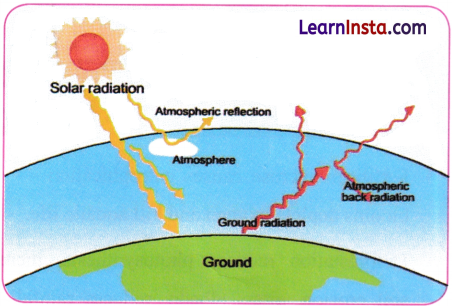
→ Latitude and Earth’s Shape: Earth’s spherical shape causes uneven solar radiation — equatorial regions receive concentrated radiation while polar regions receive spread-out, weaker radiation.
→ Role of the Atmosphere:
- The atmosphere consists of layers namely, Troposphere (0 – 12 km), Stratosphere (12 – 50 km), Mesosphere (50 – 85 km), Thermosphere (85 – 600 km), and Exosphere (600 – 10,000 km).
- Nearly all weather occurs in the troposphere. The ozone layer in the stratosphere absorbs harmful UV radiation.
- Greenhouse gases (CO2, CH4, water vapour) trap outgoing infrared radiation, keeping Earth warm enough for life.
Uneven Heating Causes Wind and Ocean Currents
→ Local Winds: Valley breeze (daytime — cool valley air rises up heated slopes) and mountain breeze (night — cooled slope air sinks into valley).
→ Planetary Winds: Large-scale pressure belts created by uneven equatorial and polar heating drive global wind circulation. Earth’s rotation causes these winds to follow curved paths (Coriolis effect) — rightward in Northern Hemisphere, leftward in Southern Hemisphere.
→ Ocean Currents:
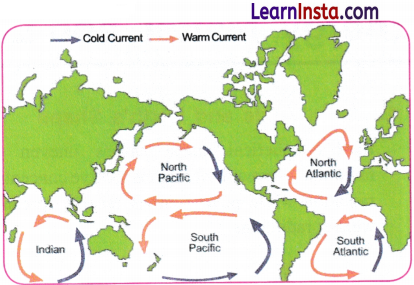
- Driven by planetary winds, temperature/salinity differences, Earth’s rotation, and land masses. Form large circular gyres — clockwise in the Northern Hemisphere, counter-clockwise in the Southern Hemisphere.
- Ocean currents regulate Earth’s climate by transporting heat from the equator toward the poles.
Example: North Atlantic Drift keeps European ports ice-free in winter.
Biogeochemical Cycles
The continuous cycling of matter and energy between living (biotic) and non-living (abiotic) components is called the biogeochemical cycle.
→ Water Cycle:
- Evaporation → condensation → precipitation → runoff → infiltration.
- Climate change intensifies this cycle (heavier rains, droughts, rising sea levels).
→ Carbon Cycle:
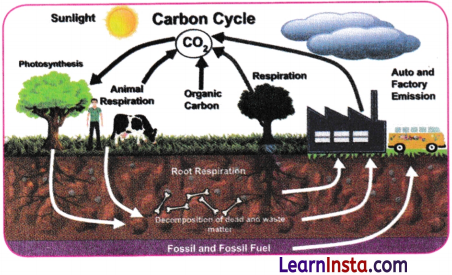
- Carbon cycle has a fast cycle (days-years via photosynthesis/respiration) and a slow cycle (millions of years via fossil fuel formation).
- Human activities have raised atmospheric CO2 ~ 35 % since 1960 (315 → 420 ppm).
→ Nitrogen Cycle:
- Nitrogen fixation (Rhizobium, Azotobacter) → nitrification (Nitrosomonas, Nitrobacter) → assimilation → ammonification → denitrification (Pseudomonas).
- Haber-Bosch process industrially fixes most nitrogen today.
→ Oxygen Cycle:
- O2 is consumed in respiration and combustion; restored mainly by photosynthesis.
- About 21 % of atmosphere is free oxygen.
Human Impact on Earth’s Processes
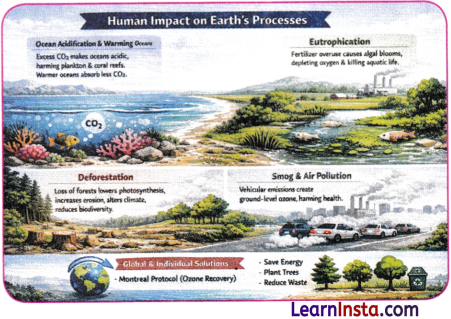
- Excess CO2 makes ocean water more acidic, threatening plankton and coral reefs. Warmer oceans absorb less CO2, reducing their role as carbon sinks.
- Fertiliser overuse causes eutrophication — algal blooms deplete oxygen and kill aquatic life.
- Deforestation reduces photosynthesis, increases soil erosion, alters albedo, reduces rainfall, and lowers biodiversity.
- Vehicular emissions form ground-level ozone (smog), harming health.
- Global solutions include the Montreal Protocol (ozone recovery), and individual actions like saving energy, planting trees, and reducing waste.