Students can practice the best AI Class 10 MCQ Chapter 1 Communication Skills Class 10 MCQ with Answers for exam preparation.
Class 10 AI Communication Skills MCQ
MCQ on Communication Skills Class 10
Class 10 Communication Skills MCQ – Communication Skills MCQ Class 10
Multiple Choice Questions :
Question 1.
Remya travelled to Sweden from India to pursue her higher education. But she doesn’t know how to speak Swedish (the language of Sweden).
Because of this, she was unable to find a part-time job. This is an example of
(A) Interpersonal barrier
(B) Physical barrier
(C) Organisational barrier
(D) Linguistic barrier
Answer:
Option (D) is correct.
Explanation: Remya’s situation highlights the challenges of a linguistic barrier, where individuals struggle to communicate due to differences in language proficiency.
Question 2.
What do you mean by the syntax of a language?
(A) Meaning of a sentence
(B) Grammatical structure of a sentence
(C) Semantics of a sentence
(D) Synonym of a sentence
Answer:
Option (B) is correct.
Explanation: The syntax of a language refers to the grammatical rules and principles governing the arrangement of words and phrases to form wellformed sentences.

Question 3.
Which of these forms of feedback is the most effective for boosting student learning?
(A) Descriptive
(B) Verbal
(C) Spoken
(D) Non-Verbal
Answer:
Option (A) is correct.
Explanation: Descriptive feedback highlights a student’s strengths and weaknesses. Students may use it to identify their strengths and weaknesses to improve their learning. This feedback has been demonstrated to boost student achievement.
Question 4.
Which of the following could be a result of personality conflicts, poor management, reluctance to change, or a lack of motivation?

(A) Language barriers
(B) Cultural barriers
(C) Gender barriers
(D) Attitudinal barriers
Answer:
Option (D) is correct.
Explanation: Attitudinal barriers are actions or ideas that make it hard for people to communicate clearly. These problems can be caused by personality conflicts, bad management, not wanting to change, or not having the desire.
Question 5.
This principle emphasises that communication should take place at the appropriate moment to aid in the execution of plans.
(A) Principle of clarity
(B) Principle of timeliness
(C) Principle of consistency
(D) Principle of feedback
Answer:
Option (B) is correct.
Explanation: The Principle of Timeliness promotes timely communication to help implement plans. This principle states that timely communication delivers information when it is most relevant and can be acted upon, helping corporate goals and objectives accomplish.
Question 6.
Which of the following is not a kind of non-verbal communication?
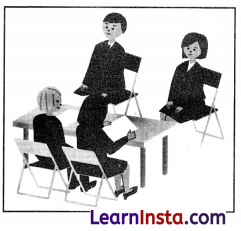
(A) Hand gestures
(B) Signals
(C) Spoken words
(D) Facial expressions
Answer:
Option (C) is correct.
Explanation: All the others except, spoken words are the components of non-verbal communication. Non-verbal communication involves sending messages without words. Hand gestures, signs, and facial expressions are non-verbal communication since they transmit information without words.
Question 7.
Which of the following is the process in which the receiver interprets and understands the message?
(A) Feedback
(B) Encoding
(C) Quarantine
(D) Decoding
Answer:
Option (D) is correct.
Explanation: Decoding is the process in which the receiver interprets and understands the message sent by the sender. It involves translating the symbols or signals into meaningful information that can be comprehended by the receiver.
Question 8.
A mode of communication in which we convey information to others by body language, gestures, and final expressions:
(A) Visual
(B) Verbal
(C) Non-verbal
(D) Written
Answer:
Option (C) is correct.
Explanation: Non-verbal communication is that mode of communication in which a person uses his/ her body language, gestures, and facial expressions to communicate with others.
Question 9.
Which of these forms of feedback is the most effective for boosting student learning?
(A) Descriptive
(B) Verbal
(C) Spoken
(D) Non-Verbal
Answer:
Option (A) is correct.
Explanation: Descriptive feedback is considered the most effective for boosting student learning as it allows students to refocus and increase their grasp of the subject.
Question 10.
Which of the following could be a result of personality conflicts, poor management, reluctance to change, or a lack of motivation?
(A) Language barriers
(B) Cultural barriers
(C) Gender barriers
(D) Attitudjnal barriers
Answer:
Option (D) is correct.
Explanation: Attitudinal barriers are behaviours or perceptions that inhibit people from effectively communicating. Personality conflicts, poor management, aversion to change, or a lack of desire can all contribute to them.
Question 11.
This principle emphasises that communication should take place at the appropriate moment to aid in the execution of plans.
(A) Principle of clarity
(B) Principle of timeliness
(C) Principle of consistency
(D) Principle of feedback
Answer:
Option (B) is correct
Explanation: The principle of timeliness states that communication should take place althe appropriate moment to aid in the implementation of plans.
Question 12.
Which of the following is not a kind of non-verbal communication?
(A) Hand gestures
(B) Signals
(C) Spoken words
(D) Facial expressions
Answer:
Option (C) is correct.
Explanation: All the others except, spoken words are the components of a non-verbal communication.
Question 13.
Which of the following conveys personal warmth and friendliness between the sender and the receiver?
(A) Visual communication
(B) Oral communication
(C) Written communication
(D) Gestures communication
Answer:
Option (D) is correct
Explanation: We can convey personal warmth and friendliness more easily through our gestures than our words.
Question 14.
Which of the following is the process in which the receiver interprets and understands the message?
(A) Feedback
(B) Encoding
(C) Quarantine
(D) Decoding
Answer:
Option (D) is correct.
Explanation: In the process of decoding, the receiver interprets and understands the message.
Assertion & Reason Questions :
Directions: In the following questions, a statement of assertion (A) is followed by a statement of reason (R). Mark the correct choice as:
(A) Both assertion (A) and reason (R) are true and reason (R) is the correct explanation of assertion (A).
(B) Both assertion (A) and reason ( R) are true but reason (R) is not the correct explanation of assertion (A).
(C) Assertion (A) is true but reason (R) is false.
(D) Assertion (A) is false but reason (R) is true.
1. Assertion (A): When communication passes through various levels, successive transmissions of the message results in loss of, or transmission of inaccurate information.
Reason (R): Distrust between the communicator and the communicator acts as a barrier
Answer:
Option (B) is correct.
Explanation: Successive transmissions of a message through various levels can result in loss of or inaccurate information. This phenomenon is commonly known as the “Chinese whispers” effect, where information can become distorted or altered as it passes from person to person. The distrust between the communicator and the recipient is a barrier to effective communication. Distrust can hinder communication by creating a lack of receptiveness or understanding between parties. The loss of accuracy in communication is more closely related to factors such as misinterpretation, distortion, or omission of information during the transmission process, rather than solely being attributed to distrust between parties.
2. Assertion (A): The planning abilities of a manager mainly depend upon his communication skills.
Reason (R): The effectiveness of a manager depends significantly on his ability to communicate effectively.
Answer:
Option (D) is correct.
Explanation: Effective communication is crucial for the success of a manager, regardless of their level of professional knowledge and intelligence. The ability to communicate effectively with subordinates and create understanding among them is essential for a manager’s directing abilities. Organisations prioritise improving the communication skills of both managers and employees because the effectiveness of a manager relies heavily on their capability to communicate with superiors, subordinates, and external stakeholders such as bankers, suppliers, unions, and government agencies.
3. Assertion (A): Decoding is the process of converting the message into communication symbols.
Reason (R): A poor telephone connection causes hindrances to communication.
Answer:
Option (D) is correct.
Explanation: Encoding involves converting a message into communication symbols, such as words, pictures, or gestures. Decoding, on the other hand, is the process of interpreting the symbols transmitted by the sendef. Noise refers to any hindrance or obstruction to communication, which can affect the sender, message, or receiver. Examples of noise include ambiguous symbols leading to incorrect encoding, poor telephone connections, inattentive receivers, misinterpretation of messages, prejudices hindering understanding, and distorted gestures or postures.
4. Assertion (A): Descriptive and specific feedback fosters clearer understanding and enables targeted improvements.
Reason (R): Generic feedback lacks clarity and fails to address specific areas for improvement.
Answer:
Option (A) is correct.
Explanation: Descriptive hd specific feedback is crucial for clear understanding and targeted improvements. It states that generic feedback lacks clarity and fails to address specific areas for improvement. This highlights the importance of providing specific guidance in feedback to help individuals understand what they need to improve upon.
5. Assertion (A): Feedback is an essential principle of effective communication.
Reason (R): Feedback enables individuals to gauge the effectiveness of their meșsage and make necessary adjustments.
Answer:
Option (A) is correct.
Explanation: Feedback is indeed a fundamental principle of effective communication as it allows individuals to receive responses or reactions from the receiver, helping them understand how well their message was understood and received. This feedback loopenables individuals to assess the impact of their communication and make any necessary adjustments to ensure clarity and understanding. Therefore, the reason supports the assertion.
Fill in the Blanks
1. ………. feedback involves detailed comments or conversations.
Answer:
Descriptive
Explanation: Descriptive feedback includes written comments or verbal conversations that offer detailed insights, allowing the recipient to understand strengths and areas for improvement clearly.
2. Non-verbal communication includes ………. expressions, gestures, and body language.
Answer:Facial
Explanation: Facial expressions play a significant role in conveying emotions and attitudes, contributing to the overall understanding of a message.
3. The communication cycle involves encoding, transmission, decoding, and ……….
Answer:
Feedback
Explanation: In the communication cycle, feedback is the final stage where the recipient responds to the message, ensuring that the message is accurately received and understood.
4. To overcome barriers to effective communication, active ………. is essential.
Answer:
Listening
Explanation: Active listening involves fully concentrating on what is being said, understanding the message, and providing appropriate feedback, leading to more effective communication.
5. The 7Cs of effective communication include clarity, ………. conciseness, and courtesy.
Answer:
Concreteness
Explanation: The 7Cs of effective communication are principles that guide clear and impactful communication. Concreteness emphasises the importance of being specific, providing tangible details, and avoiding vague or ambiguous language to ensure understanding and relevance.
6. ………. states that communication should always be consistent with and not in conflict with the organisation’s policies, plans, programmes, and objectives.
Answer:
Principle of consistency
7. In order to avoid all likely communication barriers a manager should try to be a. ……….
Answer:
Good listener
8. ………. uses the body language, gestures, and facial expressions to communicate with people.
Answer:
Non-verbal communication
9. A term that expresses emotion and is frequently followed by an exclamation mark is called ……..
Answer:
Interjection
10. A smile is an example of …….
Answer:
Non-verbal communication
Case Based MCQs (4 mark)
I. Read the following text and answer the following questions based on the same:
Manish has recently been appointed as the new project manager at Techno Consulting Firm. During his first quarterly meeting with his team to discuss the upcoming projects and strategies for growth, several team members express frustration with his communication style. They report that Manish spoke rapidly throughout the meeting, making it difficult for them to comprehend the information being presented. Additionally, they felt that Manish did not allocate enough time for questions or discussions, leaving them feeling unheard and unengaged.
Question 1.
What is the primary issue faced by Manish’s team during the quarterly meeting?
(A) Lack of project resources
(B) Communication barriers
(C) Inefficient time management
(D) Technical difficulties
Answer:
Option (B) is correct.
Explanation: The primary issue faced by Manish’s team during the quarterly meeting is communication barriers, as reported by team members who struggled to comprehend the information due to Manish’s rapid speech and lack of engagement.
Question 2.
Which aspect of communication did team members find lacking in Manish’s approach?
(A) Clarity
(B) Conciseness
(C) Complexity
(D) Ambiguity
Answer:
Option (A) is correct.
Explanation: Team members found Manish’s communication lacking in clarity, as his rapid speech made it difficult for them to understand the information being presented.
Question 3.
What could Manish have done differently to improve commun ication d ring the meeting?
(A) Speak even faster to cover more topics
(B) Allocate more time for questions and discussions
(C) Provide written summaries after the meeting
(D) Ignore team members’ concerns
Answer:
Option (B) is correct.
Explanation: Manish could have improved communication during the meeting by allocating more time for questions and discussions, allowing team members to engage with the material and seek clarification as needed.
Question 4.
What consequence is Techno Consulting Firm considering due to the communication challenges, faced with Manish?
(A) Providing additional training for team members
(B) Replacing Manish with another candidate
(C) Increasing project deadlines
(D) Ignoring the issue altogether
Answer:
Option (B) is correct.
Explanation: Techno Consulting Firm is considering replacing Manish with another candidate due to his dissatisfaction with his communication skills, as reported by the frustrated team members.