Students often refer to Maths Mela Class 5 Solutions Chapter 9 Coconut Farm Question Answer NCERT Solutions to verify their answers.
Class 5 Maths Chapter 9 Coconut Farm Question Answer Solutions
Coconut Farm Class 5 Maths Solutions
Class 5 Maths Chapter 9 Solutions
(Page 119)
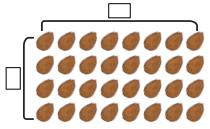
Write the appropriate multiplication fact for the array shown below. Write two division facts that follow from the multiplication fact.
Answer:
4 × 8 = 32
32 ÷ 4 = 8
32 ÷ 8 = 4
Let Us Play (Page 120)
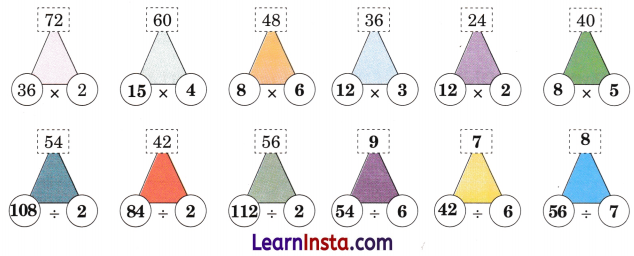
Identify the numbers that can fill the circles such that the numbers in the squares are the products or the quotients of the numbers in the circles.
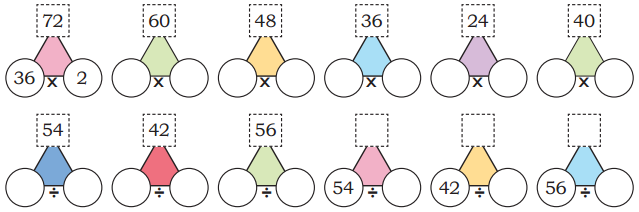
Answer:
Let Us Do (Pages 120-121)
Question 1.
Solve the following multiplication problems. Write two division statements in each case.
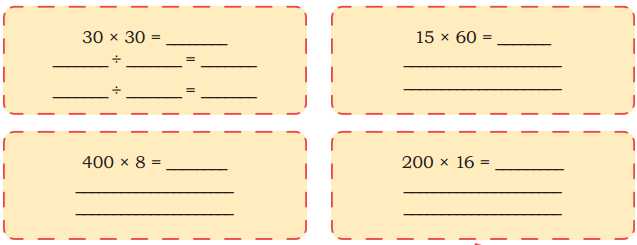
Answer:
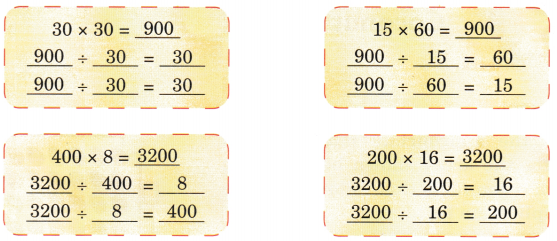
Students should know the relationship between dividend, divisor and quotient.
Question 2.
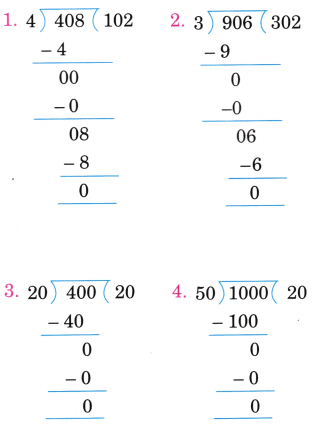
Solve the following division problems. Notice the patterns and discuss in class.
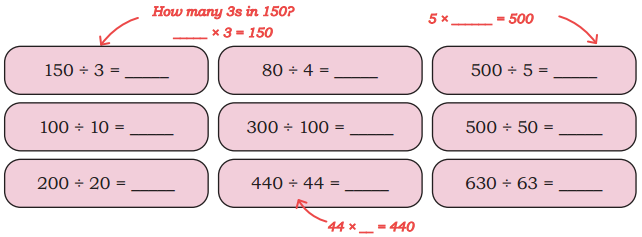
Answer:
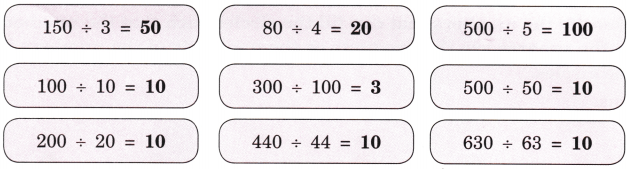
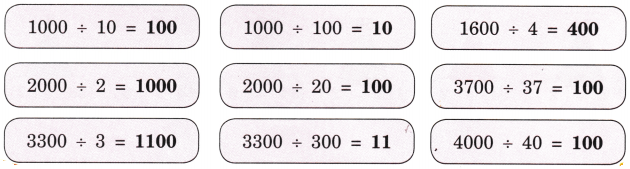
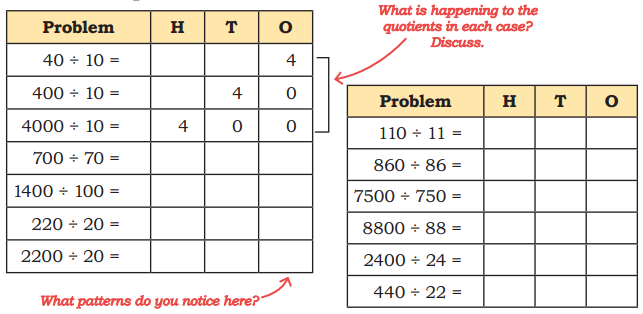
Patterns in Division and Place Value (Page 121)
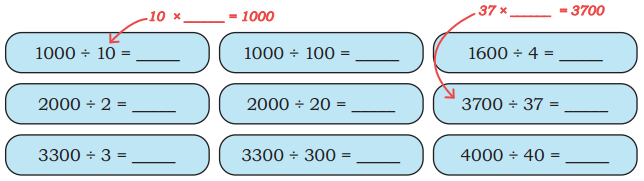
Answer:
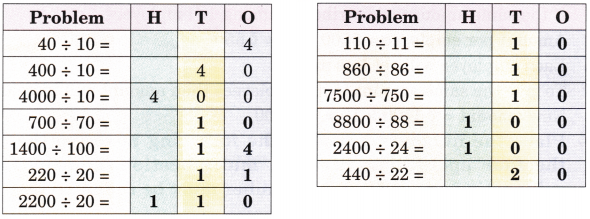
Now fill the place value chart.
Answer:
Let Us Do (Page 122)
Question 1.
Sabina cycles 160 km in 20 days and the same distance each day. How many kilometres does she cycle each day?
Answer:
Distance travelled in 20 days = 160 km
Distance travelled in 1 day = (160 km 4- 20) = 8 km
So, Sabina cycles 8 km each day.
Question 2.
How many notes of? 100 does Seema need to carry if she wants to buy coconuts worth ₹ 4200?
Answer:
Cost of coconuts = ₹ 4200
Denomination of notes = ₹ 100
So, number of notes of ₹ 100
= (Cost of coconuts) ÷ Denomination of notes
= 4200 ÷ 100
= 42
Question 3.
The owner of an electric store has decided to distribute ? 5500 equally amongst 5 of his employees as a Diwali gift. What amount will each employee get?
What will happen if he distributes the same amount of money among 10 employees? Will each employee get more or less? How much money would he have to distribute if everyone must get the same amount as earlier?
Answer:
Total amount = ₹ 5500
Number of employees = 5
Amount per employee = 5500 ÷ 5 = ₹ 1100
If the same amount is distributed among 10 employees.
Amount per employee = 5500 ÷ 10 = ₹ 550
Each employee will get less money.
To give the same amount to all employees then amount will increase.
New amount = ₹ 1100 × 10 = ₹ 11000
Question 4.
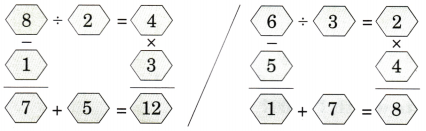
Place the numbers 1 to 8 in the following boxes so that all the four operations, division, multiplication, addition and subtraction are correct. No number must be repeated.
How did you think about solving this? Is there more than one answer?
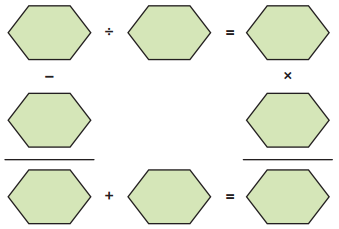
Answer:

Question 5.
Fill in the blanks
(a) _____ ÷ 18 = 100.
(b) _____ ÷ 10 = 610.
(c) _____ ÷ 100 = 72.
(d) _____ ÷ 100 = 10.
(e) 870 ÷ _____ = 87.
(f) _____ ÷ 100 = 70.
(g) 200 ÷ _____ = 2.
(h) 130 ÷ _____ = 13
Answer:
(a) 1800 ÷ 18 = 100.
(b) 6100 ÷ 10 = 610.
(c) 7200 ÷ 100 = 72.
(d) 1000 ÷ 100 = 10.
(e) 870 ÷ 10 = 87.
(f) 7000 ÷ 100 = 70.
(g) 200 ÷ 100 = 2.
(h) 130 ÷ 10 = 13
Try It! (Page 123)
Question 1.
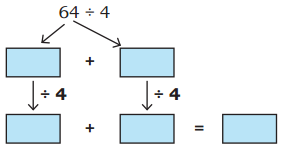
Answer:

Question 2.
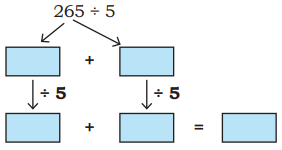
Answer:
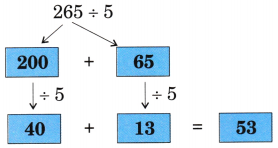
Question 3.
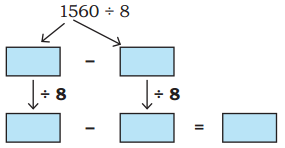
Answer:
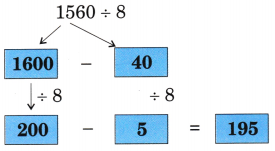
Question 4.
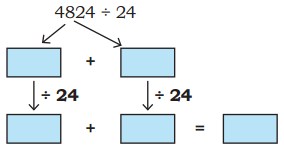
Answer:
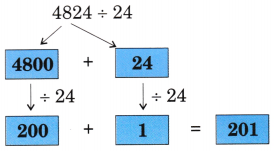
Question 5.

Answer:

Question 6.

Answer:

Let Us Solve (Page 126)
Solve the following word problems
Question 1.
Rani is planning to host a party. She estimates that 250 guests will attend. She plans to serve one samosa to each guest. Samosas are available in packs of 6 or 8. Which pack should Rani buy? Explain your answer.
Answer:
Number of guests = Number of samosa
= 250
Samosas are available in packs = 6 or 8
Packs of 6 samosas
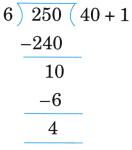
41 packs of 6 samosas and 4 are left in packet.
Packs of 8 samosas
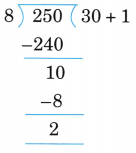
31 packs of 8 same left in packet.
Rani should buy packs of 6 samosas.
Question 2.
342 students from a school are going on a trip to the Science Park. Each bus can carry a maximum of of 41 students. How many buses does the school need to arrange ?
Answer:
Total students = 342
No. of students in 1 bus = 41
No. of buses required = 342 ÷ 41

Number of buses required is 8 and 14 students are left. So required buses will be 9.
Question 3.
Sofia has only ₹ 50 and ₹ 20 notes. She needs to pay ₹ 520 using these notes. How many ₹ 50 and ₹ 20 notes does she need to make ₹ 520? Find out the different possible combinations.
Answer:
Sofia has ₹ 50 and ₹ 20 notes.
Total amount = ₹ 520 Different combination
Let ₹ 50 notes be x and ₹ 20 notes be y.
₹ 50xx + ₹ 20xy = 520
Put x = 2, y = 21
x = 4, y = 16
x = 6, y = 11
x = 8, y = 6
x = 10, y = 1
Possible combinations
₹ 50 × 2 + ₹ 20 × 21 = ₹ 520
₹ 50 × 4 + ₹ 20 × 16 = ₹ 520
₹ 50 × 6 + ₹ 20 × 11 = ₹ 520
₹ 50 × 8 + ₹ 20 × 6 = ₹ 520
₹ 50 × 10 + ₹ 20 × 1 = ₹ 520
Question 4.
Three friends decide to split the money spent on their picnic equally. They buy snacks and sweets for ? 157, juice and fruits for X 124 and pulav and paratha for X 136. How much should each person pay to share the cost equally?
Answer:
Money spent by three friends
Snacks and sweets = ₹ 157
Juice and fruits = ₹ 124
Pulav and paratha = ₹ 136
Total = ₹ 157 + ₹ 124 + ₹ 136 = ₹ 417
Now each friend spends = ₹ 417 ÷ 3
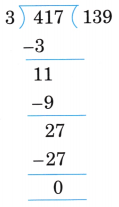
So, each friend should pay ₹ 139.
Question 5.
Identify the remainder, if any. Check if N = D × Q + R.
(a) 887 ÷ 3
Answer:
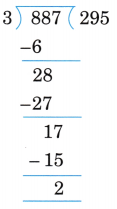
R = 2
Check:
N = D × Q + R
= 3 × 295 + 2
= 885 + 2
N = 887
(b) 283 ÷ 8
Answer:
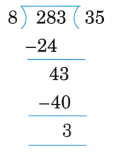
R = 3
Check:
N = D × Q + R
= 8 × 35 + 3
= 280 + 3
N = 283
(c) 745 ÷ 5
Answer:
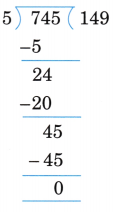
R = 0
Check:
N = D × Q + R
= 5 × 149 + 0
N = 745
(d) 767 ÷ 26
Answer:
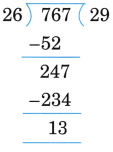
R= 13
Check:
N = D × Q + R
= 26 × 29 + 13
= 754+ 13
N = 767
(e) 530 ÷ 41
Answer:
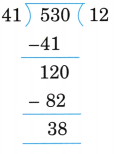
R = 38
Check:
N = D × Q + R
= 41 × 12 + 38
= 492 + 38
= 530
(f) 888 ÷ 67
Answer:
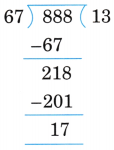
R= 17
Check:
N = D × Q + R
= 67 × 13 + 17
= 871 + 17
N = 888
Kalpavruksha Coconut Oil (Pages 126-128)
Question 1.
In a particular year, Susie and Sunitha used 4376 coconuts for extracting coconut oil. They can extract 1 l of oil from 8 coconuts. What quantity of oil were they able to extract?
Answer:
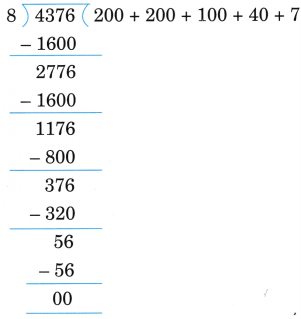
They would get 4376 ÷ 8 litres of coconut oil.
Susie’s solution
Sunitha’s solution
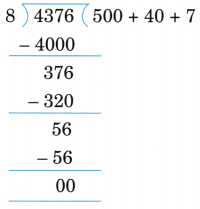
They extracted 547 l of oil in the year.
Both methods are valid and can be effective depending on the students’ understanding and preference.
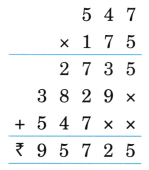
How much will they earn if they sell the oil at ₹ 175 for 1l?
Answer:
They will earn ₹ 547 × 175
Question 2.
Coconut husk is used for making coir. Coir is a natural fibre used in gardening, farming, boat making, and making decorative items.
Susie and Sunitha’s farm sells coconut husk at ₹ 23 per kilogram. They earned ₹ 9913 from the sale of husk in May. What quantity of husk did they sell in May?
The quantity of husk sold in May is 9913 ÷ 23 kg.

Answer:
The quantity of husk sold in May is 9913 ÷ 23
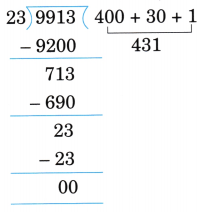
Susie and Sunitha’s farm sold 431 kg of coconut husk in May.
Question 3.
In the hot summer months, tender coconuts are sold for ₹ 35. Ibrahim earns ₹ 8890 in a week. How many tender coconuts did he sell? The number of tender coconuts sold by Ibrahim is 8890 ÷ 35.
Answer:
The number of tender coconuts sold by Ibrahim is 8890 ÷ 35
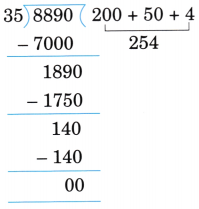
Ibrahim sold 254 tender coconuts.
Let Us Divide (Pages 130-131)
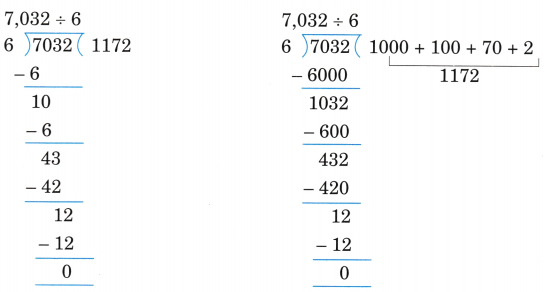
(a) 7,032 ÷ 6
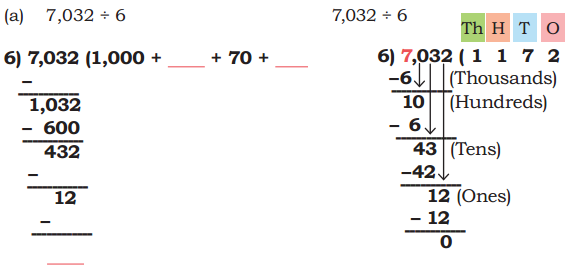
Answer:
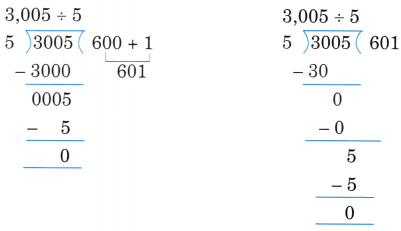
(b) 3,005 ÷ 5
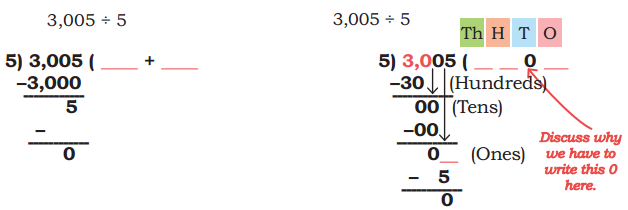
Answer:
(c) 2,874 ÷ 14
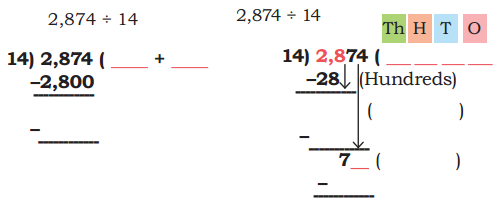
Answer:
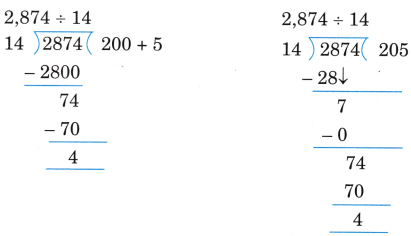
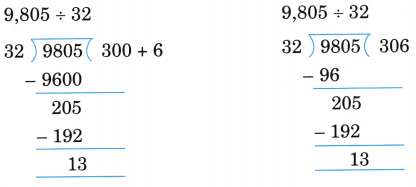
(d) 9,805 ÷ 32
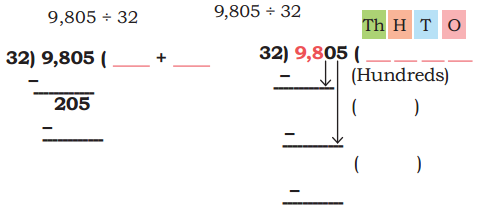
Answer:
Let Us Do (Page 131)
Question 1.
Find the missing numbers such that there is no remainder. Remember, there could be more than one solution.
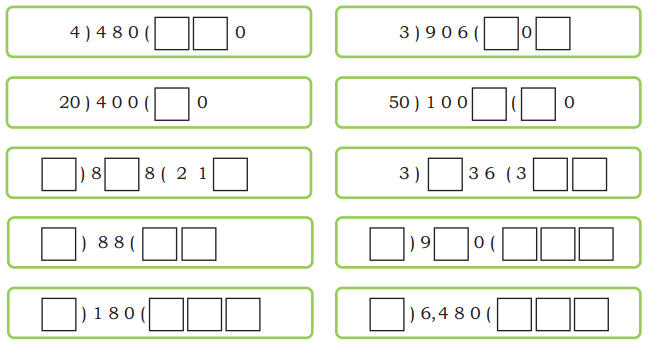
Answer:

Puzzle
I am a 3-digit number.
- If you divide me by 5, you get 42.
- If you multiply me by 2, you get 420.
What number am I?
Answer:
3-digit number
42 × 5 = 210
210 × 2 = 420
I am 210.
Let Us Solve (Pages 132-133)
Question 1.
A theatre company can accommodate 45 people during one show.
(a) A total of 475 people bought tickets for a puppet show. How many shows are needed to seat all the people who bought tickets?
Answer:
Total people = 475
Theater can accommodate people = 45
No. of shows = 475 ÷ 45
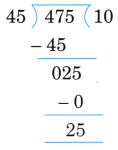
11 shows are needed.
(b) There are 2 shows in a day. How many days will be needed to accommodate all the people?
Answer:
If there are 2 shows in a day.
Number of days = 475 ÷ 90
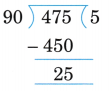
6 days will be needed.
Question 2.
Naina bought 5 kg of ice cream as a birthday treat for her 23 friends. 400 g ice cream was left after everyone had an equal share. How much ice cream did each of her friends eat?
Answer:
Naina bought ice cream = 5 kg
= 5 × 1000 [1 kg = 1000 g]
= 5000 g
No. of friends = 23
Ice cream left = 400 g
Ice cream eaten by friends = 5000 g

Each friend gets ice cream =
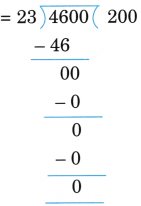
= 200 g
Question 3.
Megha packs 15 packets of ragi-oats biscuits for a 4-day group trip. Each packet contains 8 biscuits. There are 6 people in the group. If distributed evenly, how many biscuits can one person have each day.
Answer:
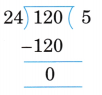
Megha packs ragi-oats biscuits’ packets = 15
Number of days = 4
Number of biscuits in 1 packet = 8
Total packs = 15 × 8
= 120 biscuits
Number of people = 6
Number of days = 4
Total persons = 6 × 4 = 24
Each person gets biscuits
Question 4.
Solve the following and identify the remainder, if any. Check whether N = D × Q + R in each case.
(a) 9,045 ÷ 5
Answer:
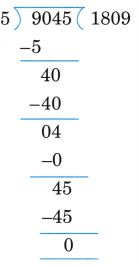
N = D × Q + R
= 5 × 1809 + 0
= 9045
(b) 1,034 ÷ 4
Answer:
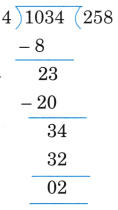
N = D × Q + R
= 4 × 258 + 2
= 1032 + 2
= 1034
(c) 2,504 ÷ 7
Answer:
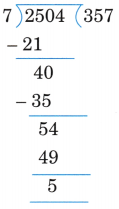
N = D × Q + R
= 7 × 357 + 5
= 2499 + 5
= 2504
(d) 8,900 ÷ 15
Answer:
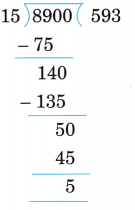
N = D × Q + R
= 15 × 593 + 5
= 8895 + 5
= 8900
(e) 9,876 ÷ 32
Answer:
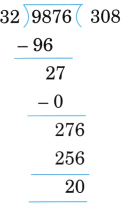
N = D × Q + R
= 32 × 308 + 20
= 9856 + 20
= 9876
(f) 7,506 ÷ 24
Answer:

N = D × Q + R
= 24 × 312 + 18
= 7488 + 18
= 7506
Question 5.
Find the solutions for part A. Observe the relations between the quotient, divisor and dividend and use it to answer parts B and C.
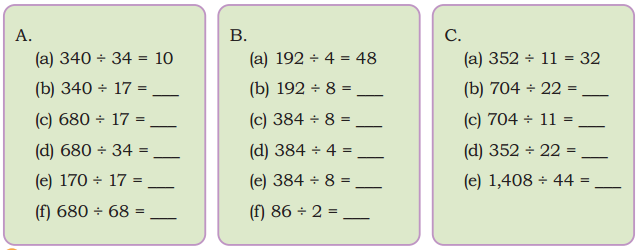
(a) 340 ÷ 34 = 10
(b) 340 ÷ 17 = 20
(c) 680 ÷ 17 = 40
(d) 680 ÷ 34 = 20
(e) 170 ÷ 17 = 10
(f) 680 ÷ 68 = 10
(a) 192 ÷ 4 = 48
(b) 192 ÷ 8 = 24
(c) 384 ÷ 8 = 48
(d) 384 ÷ 4 = 96
(e) 384 ÷ 8 = 48
(f) 86 ÷ 2 = 43
(a) 352 ÷ 11 = 32
(b) 704 ÷ 22 = 32
(c) 704 ÷ 11= 64
(d) 352 ÷ 22 = 16
(e) 1,408 ÷ 44 = 32
Question 6.
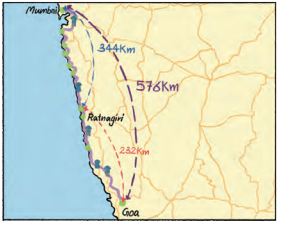
A company in Mumbai organises cycle rallies from Mumbai to Panjim, Goa every year. They aim to cover 576 km in 12 days.
(a) How much distance should they cycle every day, to cover the distance evenly?
(b) After reaching Ratnagiri, they rest for 1 day. How much distance should they cycle each day to reach Goa in 4 days? Assume that they cover the distance evenly.
Answer:
Total distance = 576 km
(a) They cover in 12 days
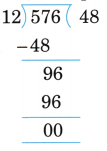
Distance per day = 576 ÷ 12 = 48 km/day
(b) Rest for 1 day after reaching Ratnagiri so only 4 days are left to cover the remaining distance.
From map 1
Distance from Ratnagiri to Goa = 576 km

Distance per day = 232 ÷ 4
= 58 km/day.
Question 7.
Given below are a few problems. You may need some additional information to solve these. Identify the missing information. Write the missing information and find the answer.
(a) A fruit vendor sells 6 baskets of mangoes. Each basket contains 12 mangoes. How much did the vendor earn in total?
(b) A school has 8 classrooms, and each classroom has an equal number of desks. How many desks are there in each classroom?
(c) Rahul buys 5 cricket bats for his team. The total bill is ₹ 3500. How much does one bat cost?
(d) A restaurant serves 125 plates of idlis in a day. The total earnings from selling all the idli plates is ₹ 6250. How many idlis are there in each plate?
Answer:
(a) 1 basket = 12 mangoes
6 baskets = 12 × 6 = 72 mangoes
Rate is missing.
Assume that price per mango is ₹ 5
72 x 5 = ₹ 360
(b) School has 8 classrooms Total desks are missing.
Assume 160 desks
Each classroom has desks = 160 ÷ 8 = 20 desks
(c) Total bill = ₹ 3500
Number of bats = 5
Cost of one bat = ₹ 3500 ÷ 5 = ₹ 700
(d) Total earnings from 125 plates of idlis = ₹ 6250
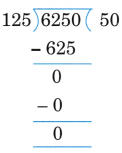
Cost of 1 plate = 6250 ÷ 125 = ₹ 50
Let there be x idlis in one plate
Assume: cost of 1 idlis is ₹ 5
∴ \(\frac{50}{5}\) = 10 idlis per plate.
Question 8.
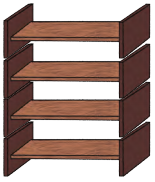
To make one bookshelf, a carpenter needs the following things—
4 long wooden panels 8 short wooden panels 16 small clips 4 large clips 32 screws
The carpenter has a stock of 264 long wooden panels, 306 short wooden panels,
2400 small clips, 120 large clips, and 2800 screws. How many bookshelves can the carpenter make? Discuss your thoughts.
Answer:
Divide each stock by the quantity needed for 1 bookshelf
Long wooden panels = \(\frac{264}{4}\) = 66
Short wooden panels = \(\frac{306}{8}\) = 38.25 = 38
Small clips = \(\frac{2400}{16}\) = 150
Large clips = \(\frac{120}{4}\) = 30
Screws = \(\frac{2800}{32}\) = 87.5 = 87
The limiting factor is the large clips, which allow only 30 complete bookshelves to be made.
Hence, the carpenter can make 30 bookshelves.
Vegetable Market (Page 134)
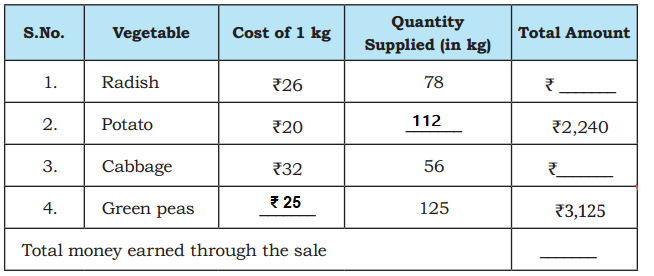
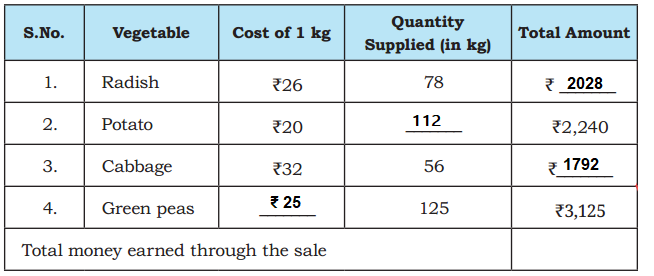
Munshi Lai has a big farm in Bihar. Every Saturday, he sells the vegetables from his farm at Sundar Sabzi Mandi. Munshi ji maintains a detailed record of the quantity of vegetables he sends to the Mandi and the cost of each vegetable. The following table shows his record book on one Saturday.
His naughty grandson has erased some numbers from his record book.
Help Munshi Lal complete the table.
Answer:
Let Us Solve (Page 134)
Divide the following. Try dividing using place values, whenever you can. Identify the remainder, if any, and check whether N = D × Q + R.
1. 506 ÷ 5
Answer:
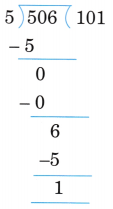
N = D × Q + R
= 5 × 101 + 1
= 505 + 1
= 506
2. 918 ÷ 8
Answer:
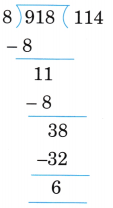
N = D × Q + R
= 8 × 114 + 6
= 912 + 6
= 918
3. 8,126 ÷ 7
Answer:
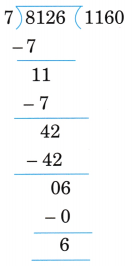
N = D × Q + R
= 7 × 1160 + 6
= 8120 + 6
= 8126
4. 9,324 ÷ 4
Answer:
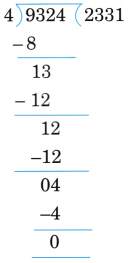
N = D × Q + R
= 4 × 2331 + 0
= 9324
5. 876 ÷ 6
Answer:
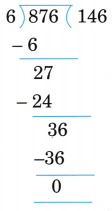
N = D × Q + R
= 6 × 146 + 0
= 876
6. 7,008 ÷ 3
Answer:
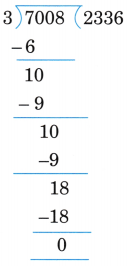
N = D × Q + R
= 3 × 2336 + 0
= 7008
7. 934 ÷ 12
Answer:
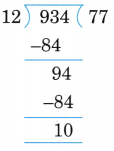
N = D × Q + R
= 12 × 77 + 10
= 924 + 10
= 934
8. 829 ÷ 23
Answer:
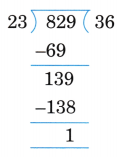
N = D × Q + R
= 36 × 23 + 1
= 828 + 1
= 829
9. 705 ÷ 18
Answer:
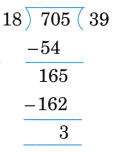
N = D × Q + R
= 18 × 39 + 3
= 702 + 3
= 705
10. 8,704 ÷ 32
Answer:
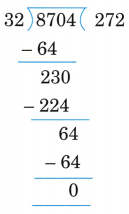
N = D × Q + R
= 32 × 272 + 0
= 8704
11. 6,790 ÷ 45
Answer:
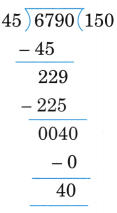
N = D × Q + R
= 45 × 150 + 40
= 6750 + 40
= 6790
12. 5,074 ÷ 21
Answer:
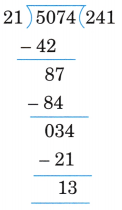
N = D × Q + R
= 21 × 241 + 13
= 5061 + 13
= 5074
Mathematical Statements (Page 135)
Question 1.
Find out whether the following statements are True (T) or False (F). A true sentence is one where both sides of the ‘=’ sign have the same value.
(a) 8 × 9 = 70 + 2
(b) 20 – 6 = 7 × 3
(c) 48 + 3 = 4 × 4
(d) 89 – 9 = 90 + 0
(e) 25 + 10 = 45 – 10
Answer:
(a) 8 × 9 = 70 + 2 (True)
(b) 20 – 6 = 7 × 3 (False)
(c) 48 + 3 = 4 × 4 (True)
(d) 89 – 9 = 90 + 0 (False)
(e) 25 + 10 = 45 – 10 (True)
Question 2.
Complete the following statements such that they are true.
(a) 7 × 6 = ____ + 17
(b) 87 + 6 = ____ × 31
(c) 63 + ____ = 74 – 4
(d) ____ ÷ 9 = 16 ÷ 2
Answer:
(a) 7 × 6 = 25 + 17
(b) 87 + 6 = 3 × 31
(c) 63 + 7 = 74 – 4
(d) 72 ÷ 9 = 16 ÷ 2
Question 3.
Think about the following statements and find examples as suggested below.
(a) “When two odd numbers are added, the sum is even.” Find 5 examples for the above statement. Can you find an example to show that the statement can be false?
(b) “Multiplying a number by 2 can give an odd number.” Give some example for this statement. Can you find any?
(c) “Halving a number always leads to an even number.”
Give 3 examples for the statement. Can you find 3 examples when this is not true?
Answer:
(a) True
Examples: Odd + Odd = Even
Here are 5 examples:
- 3 + 5 = 8
- 7 + 9 = 16
- 11 + 13 = 24
- 15 + 17 = 32
- 21 + 23 = 44
Nope! Mathematically, the sum of two odd numbers is always even.
(b) False
- 2 × 1 = 2 (even)
- 2 × 3 = 6 (even)
- 2 × 5 = 10 (even)
No. Multiplying any integer by 2 always gives an even number. So this statement is false—there are no examples where multiplying by 2 gives an odd number.
(c) False
Examples where it leads to an even number:
- 8 ÷ 2 = 4
- 12 ÷ 2 = 6
- 20 ÷ 2 = 10
Examples where it does not lead to an even number:
- 6 ÷ 2 = 3 (odd)
- 10 ÷ 2 = 5 (odd)
- 14 ÷ 2 = 7 (odd)
Conclusion: Halving a number does not always lead to an even number. It depends on whether the original number is divisible by 4. If not, the result might be odd.
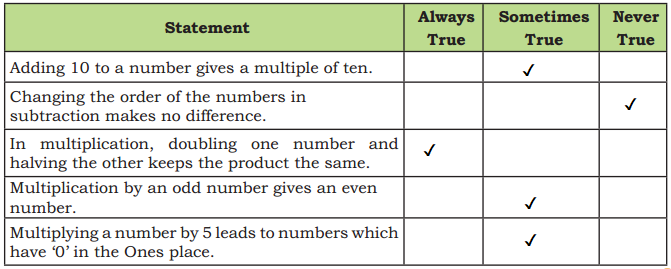
Question 4.
Tick in the appropriate cell for the following statements

Answer: