Students can use Curiosity Class 8 Science Book Solutions Chapter 11 Keeping Time with the Skies Class 8 Question and Answer as a quick reference guide.
Class 8 Science Chapter 11 Keeping Time with the Skies Question Answer
Science Class 8 Chapter 11 Question Answer Keeping Time with the Skies
Keeping Time with the Skies Class 8 Question Answer (InText)
Question 1.
Probe and Ponder (Page 170)
- Have you ever seen the Moon during the day? Why do you think it is sometimes visible when the Sun is up?
- Imagine you lived on the Moon instead of Earth. What would you mean by a day, a month or a year?
- What would happen if Earth had two moons instead of one? How would that change the night sky?
- If we didn’t have clocks or calendars, how else could we measure time?
- Share your questions:
……………………………………………………..
…………………………………………………….. ?
Answer:
(Questions may vary)
(i) Why does the Moon look different on different nights?
(ii) Why do people launch artificial satellites?

Question 2.
Why does the illuminated portion of the Moon seen from the Earth decrease when it appears closer to the Sun? (Page 174)
Answer:
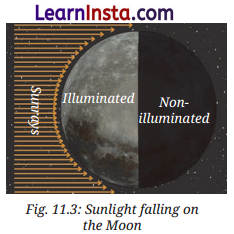
The illuminated portion of the Moon seen from Earth decreases when it appears closer to the Sun because we see less of the sunlit side of the Moon. As the Moon moves closer to the direction of the Sun in the sky, the sunlit part faces away from us, and the dark side faces Earth. This makes the bright portion look smaller each day. Hence, as the Moon comes closer to the Sun, it appears to shrink, and finally, we cannot see it at all on the new Moon day.
Question 3.
How are these periodic events used for keeping time? (Page 178)
Answer:
The repeated movements of celestial bodies like the Sun, Moon, and stars help us measure time. A day is based on the Sun’s movement across the sky due to Earth’s rotation. A month is based on the Moon’s phases, which take about 29.5 days. A year is based on the Earth’s revolution around the Sun, which takes about 365 1/4 days. These natural cycles repeat regularly and form the basis for calendars used to track days, months, and years.
Question 4.
Why do most Indian festivals fall on different dates every year? (Page 183)
Answer:
Most Indian festivals are based on the phases of the Moon and follow either lunar or lunisolar calendars. These calendars do not match exactly with the Gregorian calendar, which is a solar calendar. Because a lunar year is shorter ( 354 days) than a solar year (365 days), the festival dates shift each year in the Gregorian calendar.
Question 5.
When I look at the night sky in early evening, I see some moving stars. What are they? Is their motion also periodic? (Page 185)
Answer:
The moving stars seen in the night sky are actually artificial satellites. They appear as bright points of light moving quickly and steadily across the sky. These satellites orbit the Earth regularly, so their motion is periodic. Most of the satellites complete one orbit in about 100 minutes.
NCERT Class 8 Science Chapter 11 Question Answer Keeping Time with the Skies (Exercise)
Keep the curiosity alive(Pages 187-188)
Question 1.
State whether the following statements are True or False.
(i) We can only see that part of the Moon which reflects sunlight towards us.
(ii) The shadow of Earth blocks sunlight from reaching the Moon causing phases.
(iii) Calendars are based on various astronomical cycles which repeat in a predictable manner.
(iv) The Moon can only be seen at night.
Answer:
(i) True
(ii) False
(iii) True
(iv) False
Question 2.
Amol was born on 6th of May on a full Moon day. Does his birthday fall on the full Moon day every year? Explain your answer..
Answer:
No, Amol’s birthday does not fall on a full Moon day every year. The lunar cycle is about 29.5 days, while our calendar months are based on the solar year, which is about 365.25 days. Because of this, the Moon’s phases do not repeat on the same date every year. So, a full Moon may occur before or after May 6 in different years. This means that although Amol was born on a full Moon day, his birthday will not always be on a full Moon in future years.
Question 3.
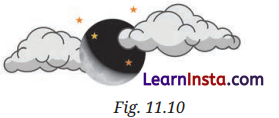
Name two things that are incorrect in Fig. 11.10.
Answer:
- Stars are shown on the dark side of the Moon.
- Orientation of waning crescent.
Question 4.
Look at the pictures of the Moon in Fig. 11.11, and answer the following questions.
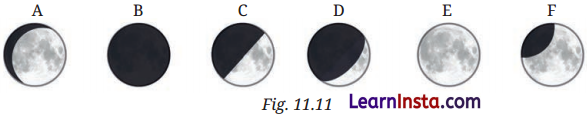
(i) Write the correct panel number corresponding to the phases of the Moon shown in the pictures above.
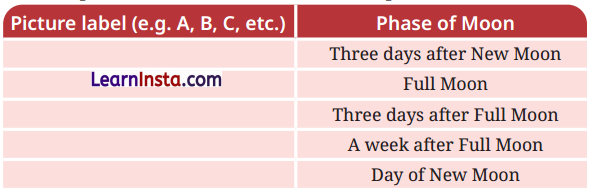
(ii) List the picture labels of the phases of the Moon that are never seen from Earth. Hint: You can use your observations from Activity 11.1 or Fig. 11.2 as reference.
Answer:
(i)
| Picture label (e.g. A, B, C, etc.) |
Phase of Moon |
| D | Three days after New Moon |
| E | Full Moon |
| A | Three days after Full Moon |
| C | A week after Full Moon |
| B | Day of New Moon |
(ii)
- Picture B – On a new Moon day, only the non-illuminated side of the Moon faces the Earth, so it is not visible from Earth.
- Picture F – This is not a phase of the Moon. So, it can never be seen from Earth.
Question 5.
Malini saw the Moon overhead in the sky at sunset.
(i) Draw the phase of the Moon that Malini saw.
(ii) Is the Moon in the waxing or the waning phase?
Answer:
(i) At sunset, if the Moon is seen overhead, it is most likely in the first quarter phase. In this phase, the right half of the Moon
appears bright, while the left half is dark.
(ii) The Moon is in the waxing phase. After the new Moon, the Moon begins to grow, or “wax.” The first quarter Moon occurs about a week after the new Moon, and during this phase, the bright part of the Moon increases each night.
Question 6.
Ravi said, “I saw a crescent Moon, and it was rising in the East, when the Sun was setting.” Kaushalya said, “Once I saw the gibbous Moon during the afternoon in the East.” Who out of the two is telling the truth?
Answer:
Ravi is wrong – a crescent Moon does not rise in the East at sunset. Kaushalya is right – a gibbous Moon can be seen in the East during the afternoon. So, Kaushalya is telling the truth.
Question 7.
Scientific studies show that the Moon is getting farther away from the Earth and slower in its revolution. Will luni-solar calendars need an intercalary month more often or less often?
Answer:
As the Moon moves away, it orbits more slowly. This means there will be fewer lunar months in a year, causing less difference between the lunar and solar calendars. So, intercalary months will be needed less often.
Question 8.
A total of 37 full Moons happen during 3 years in a solar calendar. Show that at least two of the 37 full Moons must happen during the same month of the solar calendar.
Answer:
There are 36 months in 3 years. If 37 full Moons occur during these 36 months, then at least one month must have more than one full Moon. So, at least two of the 37 Moons moons must happen during the same month.
Question 9.
On a particular night, Vaishali saw the Moon in the sky from sunset to sunrise. What phase of the Moon would she have noticed?
Answer:
If the Moon is visible all night from sunset to sunrise, it must be opposite the Sun in the sky. This happens during the full Moon phase. So, Vaishali saw a full Moon.
Question 10.
If we stopped having leap years, in approximately how many years would the Indian Independence day happen in winter?
Answer:
The solar year is about 365.25 days, but if we used only 365 days per year (no leap years), the calendar would shift by 0.25 days each year. To shift by about 6 months (= 182.5 days) into winter: 182.5 ÷ 0.25=730 years So, in approximately 730 years, 15 August would fall in winter.
Question 11.
What is the purpose of launching artificial satellites?
Answer:
Artificial satellites are launched for various purposes, such as communication, navigation, weather monitoring, disaster management, and scientific research.
Question 12.
On which periodic phenomenon are the following measures of time based:
(i) day
(ii) month
(iii) year?
Answer:
(i) Day – Based on the rotation of the Earth on its axis.
(ii) Month – Based on the Moon’s revolution around the Earth.
(iii) Year – Based on the Earth’s revolution around the Sun.
Class 8 Keeping Time with the Skies Question Answer (Activities)
Activity 11.1: let us explore (pages 171-172)
Aim: To observe and record daily changes in the Moon’s appearance and position over a month to understand the pattern of Moon phases.

Observation: Do it yourself.
Conclusion:
- The Moon’s appearance changes daily in a regular pattern known as phases of the Moon.
- The size of the bright portion (illuminated part) of the Moon either increases or decreases each day.
- The Moon was not visible on all days, especially near the new Moon, when it is close to the Sun in the sky and its dark side faces the Earth.
Activity 11.2: let us explore (pages 174-175)
Aim: To understand how the illuminated portion of the Moon, as seen from Earth, changes with its position relative to the Sun.

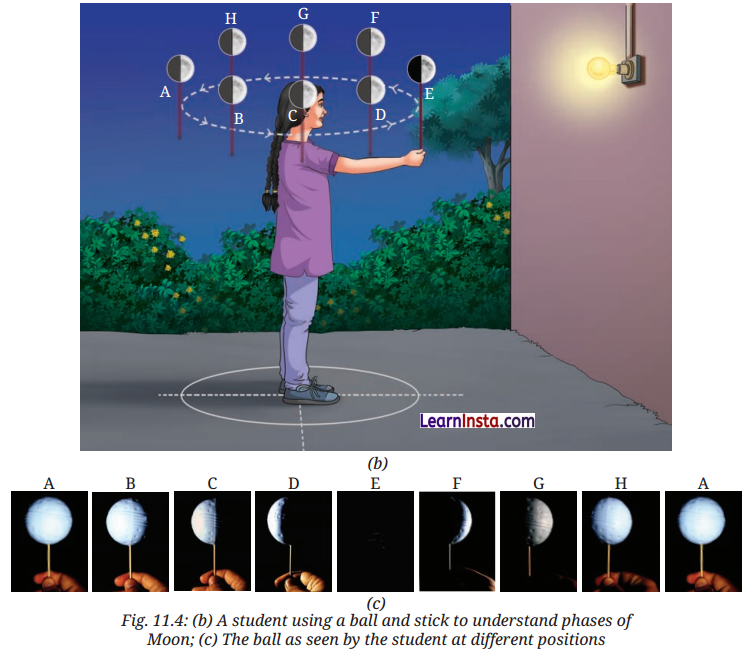
Observation:
- When the ball (Moon) is held towards the lamp (position E), the side facing you appears dark, and the illuminated portion is not visible, like a new Moon.
- As I turn around slowly in a circle, the lit portion changes shape, just like the phases of the Moon.
- When the ball is opposite the lamp (position A), the entire side facing me is bright, just like a full Moon.
- In between positions, the line separating the illuminated and non-illuminated portions of the ball appears curved, similar to the shape of the illuminated portion of the Moon viewed from the Earth on other days.
Conclusion:
- The Moon does not produce its own light; we only see the part that reflects sunlight.
- The phases of the Moon are caused by the changing position of the Moon around the Earth, which makes different portions of its lit side visible from Earth.
- The line between the lit and dark side is always curved.
Activity 11.3: let us measure a day! (Pages 178-179)
Aim: To measure the duration of a solar day by observing the position of the Sun using the shadow of a stick.

Observation:
Do it yourself.
Conclusion:
- The time difference between two solar noons on consecutive days gives the duration of a solar day.
- The average duration of the solar day is nearly 24 hours.
Activity 11.4: let us identify (pages 185-186)
Aim: To observe and identify artificial satellites in the night sky by spotting fast-moving points of light.
Observation:
Do it yourself.
Conclusion:
- Artificial satellites can be seen just after sunset or before sunrise from a place with a clear sky, free from trees or tall buildings. They can be seen with the naked eye or binoculars.
- They appear as fast-moving points of light with steady or flickering brightness, unlike stars (which are fixed) or airplanes (which blink).
- Mobile apps or websites can help predict when satellites will be visible in your area.