Class 6 Science Chapter 12 Notes Beyond Earth
→ Constellations: The stars forming a group that has a recognizable shape of animals, human beings or other objects is called a constellation or groups of forming patterns is also known as constellation.
→ In the early 20th century, International Astronomical Union (IAU) officially listed 88 constellations, dividing the entire sky into 88 regions. These regions of sky are now defined as constellation.
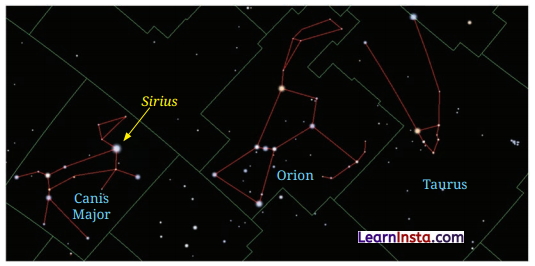
→ The constellation Orion is also known as “Hunter.” It has three stars in the middle, which indicate the hunter’s belt. It can be imagined as the hunter Orion, followed by his dog (Canis Major constellation), engaging in a battle with a bull (Taurus constellation). The brightest star in the Canis Major constellation is called Sirius. Thus, these four bright stars seem to form a quadrilateral shape.
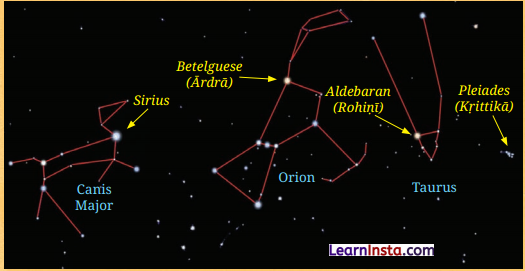
→ Nakshatra: It is used to denote either a certain star or a group of stars, such as Ardra which is a star known as Betelgeuse in the Orion constellation and Pleiades is a group of stars called Krittika and Aldebaran, a star known as Rohini both are part of the Taurus constellation.

→ The Big and Little Dipper: It is a part of a large constellation Ursa Major and in India Big Dipper is known as Saptarishi while the Little Dipper lies in the constellation Ursa Minor and also known as Pole Star Dhruva tara,
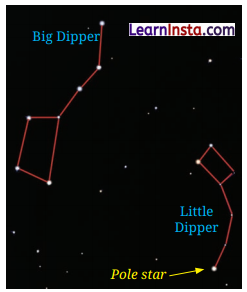
→ Polar Star (Polaris): This star is part of Ursa Minor and generally appears stationary, in the North direction, which helps us to locate the North direction in the Northern hemisphere.
→ Light Pollution: Light pollution is due to the of excessive artificial light at night time and this artificial light makes it difficult for us to see the stars in the sky.
→ Solar System: There are eight planets. In order of increasing distance from the Sun, they are Mercury, Venus, Earth, Mars, Jupiter, Saturn,

→ Uranus, and Neptune. Mercury, Venus, Earth, and Mars are inner planets; they are smaller in size with solid surfaces made of rocks. Jupiter, Saturn, Uranus, and Neptune are outer planets characterized as giant gaseous planets with large flat ring-like structures made of dust and rocky material.
→ The Sun: The Sun is a star and the main source of light. It is the star closest to the Earth. It is an extremely hot spherical ball of gases. The Sun gives large amount of energy and produce heat and light. It is about 100 times bigger than the Earth in diameter. The distance of the Sun from the Earth is about 150 million km.
→ Astronomical Unit (au): One astronomical unit is defined as the average distance from the Earth to the Sun.
→ Proxima Centauri: It is the nearest star that lies at a distance of 269000 au from the Sun. The distance is about 269000 times our distance to the Sun.
→ Revolution: The movement of an object around the Sun is called revolution.
→ Planets: A planet is a large, nearly spherical object that revolves around the Sun is known as planets. Our Earth is a planet as it revolves around the Sun.
→ Mercury (Budha)
Mercury is the smallest planet of our solar system and has no atmosphere.
→ Venus(Shukra)
- It is the nearest to the Earth and is the brightest planet in the night sky.
- It is also recognised as Evening Star and – Morning Star.
→ The Earth [Prithvi]
- Earth is the third planet from the Sun in our solar system and the only known place to support life.
- The Earth is revolving around the Sun and rotating about the axis.
- For one full rotation, the Earth takes about 24 hours which is called a day.
- A large portion of the Earth surface’s is covered with water thus Earth is also called Blue planet.
Mars (Mangala)
- It is the first planet outside the orbit of the Earth.
- It is also known as Red planet because it appears red due to its soil.
→ Jupiter (Brihaspati or Guru)
- It is the largest planet in the Solar System.
- It is a large number of moons.
→ Saturn [Shani]
- It has beautiful rings.
- Saturn has a large number of satellites.
→ Uranus [Indra]
It is one of the outer planets and made of dust particles and rocky material.
→ Neptune (Varun)
It is the outermost planet of the solar system.
→ Dwarf planet (Pluto)
- According to International Astronomical Union (AIU), Pluto declared as dwarf planet.
→ Telescope: A telescope is a tool that makes distant objects in space appear closer by gathering and focusing light.
→ Satellite: Any object that moves around a much larger revolves around can also be called a satellite.
→ Natural Satellite: A natural satellite is an object that revolve around a planet or other body larger than itself. Example, the moon is revolving around the Earth so the moon considers as natural satellite.
→ Moon
- The Moon orbits around the Earth as its natural satellite.
- The Moon has no atmosphere, weather, or liquid water on its surface.
- The moon takes about 27 days to complete one revolution around the Earth.
- The moon surface shows circular bowl-like structure called craters.

→ Asteroids:
- Small objects in the Solar system which are rocky and irregular shape is called Asteroids.
- Many of asteroids revolve around the Sun in paths that lie between of Mars and Jupiter. This region is called asteroid belt.
→ Comets (Dhumaketu)
- Object from the outer regions of the Solar System and these objects with long tails are called comets.
- They are made up of dust, gases, rock and ice.
- Comets appear dim as they move away from the Sun and not possible to see them with the naked eye.

→ In Indian tribes, Comets are also known as Pucchya-Taro or Zendya Taro.
→ The Milky Way Galaxy (Akasha Ganga):
- The galaxy that contains our solar system. It is a large collection of stars, gas, dust, and dark matter held together by gravity.
- Our solar system is part of the Milky Way Galaxy.
→ The Universe: The Universe is everything we can touch, feel, sense, measure or detect and contains billions of galaxies, each containing millions or billions of stars.
→ Asteroid : asteroids are small irregular shaped heavenly bodies of rocks and the metals that revolved around the sun in the gap between the orbits of Mars and Jupiter
→ Draw : to pull out or drag.
→ Comet : a comment is a small body of eyes and does that revolves around the sun in high elliptical orbit.
→ Explore : Travel into or through in order to learn about it.
→ Constellation : the stars that appear in the form of close groups and form recognisable shapes and patterns are called constellations.
→ Identify : Prove who or what it is.
→ Milky way galaxy : Our home Galaxy is called the Milky way galaxy.
→ Observe : To see or notice.
→ Moon : the moon is a natural satellite of the earth.
→ Planet : Planets are solid heavenly bodies that revolve around the sun in closed elleptical orbits or parts.
→ Revolution : Rotating of one planet around another.
→ Satellite : Satellite is a celestial body that revolves around the planet.
→ Solar system : The sun, eight planets, their moons and many smaller objects including asteroids and comets together form the solar system.
→ Stars : A star is a huge ball of glowing gases held together by gravity.
→ Sun : The sun is the nearest star to the earth. The sun is a glowing ball of gases.
→ The sky is divided into regions called constellations which include group of stars that appear to form patterns.
→ The pole star appears stationary in the north direction which helps in locating the not direction in the Northern is sphere.
→ The sun is a star which produces heat and light.
→ A planet is a large nearly spherical object that revolves around the sun.
→ The eight planets in order of their increasing distance from the sun are Mercury, Venus, Earth Jupiter, Saturn, Uranus and Neptune.
→ The Earth revolves around the sun in nearly 1 year.
→ The planet Mercury is the smallest and nearest planet to the sun.
→ Venus is also called the morning and the evening star.
→ Mars is reddish colour. Mass is known as the red plant.
→ Jupiter has faint rings around it. Jupiter can easily be seen with the naked eyes.
→ Saturn has the most visible and beautiful rings that encircle the planet.
→ Uranus has highly tilted rotational Axis. It cannot be seen from the earth with naked eyes.
→ Neptune: Being to far away from the sun, it is very cold and it takes the maximum time to revolve around the sun.
→ Objects that move around planet are commonly called satellite.
→ The moon is earth’s natural satellite.
→ The moon revolves around the earth in nearly 27 days.
→ The sun, eight planets, their moons and many smaller objects including asteroids and comets together form the solar system.
→ Our solar system is part of the Milky way galaxy.
Introduction
Everyone love their surroundings—the majestic mountain peaks, and the glaciers, but their favourite is the night sky when the entire sky is lit up with thousands of stars. They wonder how far away and how big the stars are. They also enjoy trying to find some patterns among the stars that remind them of familiar objects.
Starts And Constellations
A star is a huge ball of glowing gases held together by gravity. Star consists of hydrogen and helium gases. The heat and light of a star is generated by nuclear reactions in which hydrogen changes into helium. From the Earth the stars appear to be very close to one another but in reality they are far away from one another.
All stars appear to move from the east to the west because our Earth rotates about its Axis from the west to the East.
In earlier times groups of stars forming patterns were called constellations. Currently the regions of sky which include these group of stars are defined as Constellations.

(The lines indicate the patterns of stars while the green Lines indicate the regions of the sky. The lines are not seen in the sky and have been drawn only for easy identification) The constellation orion is often represented as a hunter. These are three stars in the middle, which represent the belt of the hunter. Some people imagine that the hunter orion, followed by his dog (constellation Canis Major), is battling a bull (constellation Taurus). Canis Major contains a star called Sirius, which is the brightest star in the night sky.
In Indian astronomy, the term Nakshatra, is used to denote either a certain star or a’ group of stars, such a Ardra (a star called Betelgeuse in the Orion constellation) and Krittika ( a group of stars called Pleiades in the Taurus constellation). Aldebaran, a star in the constellation Taurus, is known as Rohini. Two distinct pattern of stars, The Big dipper and the Little Dipper are shown in Fig. 3. The Pole star or Polaris which is a part of Little Dipper is also shown.

The pole star appears stationary in the north direction, which helps to locate the not direction in the Northern Hemisphere. Pole star does not move at all as other stars move from the east to the west. This is due to the fact that the pole star lies directly above the north pole on the axis of rotation of earth. The position of the pole star does not change with time when the earth spins about its axis. Pole star is not visible in Southern Hemisphere.So, it cannot help in finding directions in Southern Hemisphere. The big dipper lies in the constellation Ursa major while the little dipper lies in the constellation. It is known as big dipper because the seven prominent stars in the constellation that form the shape of a dipper (long handled spoon used for drawing out water). There are three stars in the handle of the ladle (long handle and spoon) and four in its bowl.
There are seven prominent starts in the little dipper that from the shape of a dippet. The stars in Ursa Minor are closer and less bright than those of Ursa Major. At the end of the tail of Ursa Minor is the Pole Star.
Night Sky Watching
The night sky is best viewed from the open dark areas. Not all stars and constellations are visible form all places on earth and on all nights in a year. The pole star is not visible from the southern hemisphere of Earth. To identify a star, or a constellation you need to know how a particular constellation looks like and where to look for it in the night sky.
Preparation for night sky watching :
- Identify a dark open area for Night Sky watching. They should be away from lights, tall buildings and trees.
- Choose the date and time based upon what you plan to identify in the night sky.
- Choose a moonless night with no clouds particularly for the pole star which is not very bright.
- It may be useful to have access to a mobile app with a Sky app, or print out images of the constellation you plan to view. You may also carry a magnetic compass to find directions.
- On the particular day and time selected, go to the identified place, where the Night Sky watching is to be done
- After reaching there, wait for about half an hour for your eyes to get adjusted to the darkness.

You may easily identify the Big Dipper and the Pole Star in the night sky.
Our Solar System
The Sun: The Sun is a star closest to us. It is an extremely hot spherical ball of gases. The sun gives out a huge amount of energy and that is why it glows so brightly. Sun is about 100 times bigger than the earth. The Sun is the main source of heat and light for all the planets. Light from the sun takes on an average of 8 minutes and 20 seconds to reach the earth.

The temperature of the surface of the sun is about 5500 degree Celsius while the temperature at its core is about 15 million degrees celsius. The distance of the sun from the earth is about 150 million km . The sun is much closer to us then the other stars handset appears much with bigger than the stars. The stars nearest to us after the sun is Proxima Centauri which lies at a distance of about 26900 au.
There are many more objects in the sky. Our earth along with some of these objects and the sun together form our solar system. Solar system consists of the Sun, eight planets and their satellites and the million of smaller celestial objects such as Asteroids, Comets and Meteoroids. The sun is at centre of the solar system and all other objects are revolving around it in fixed elliptical paths called Orbits.
Planets: A planet is a large, nearly spherical object that revolves around the sun. There are eight planets in our Solar System.
The four inner planets— Mercury, Venus, Earth and Mars are called terrestrial planets. These terrestrial planets have dense and Rocky surface with a few or no satellite and no ring systems. The four outer planets—Jupiter, Saturn, Uranus and Neptune are called Jovian Planets. These planets have a large amount of gases. So, these are also called gas-giants.

(To fit this figure within the page, the sizes and distances of various objects are not as per their actual sizes and distances in relation to each other, that is, the sizes and distances are not to scale in the figure) Venus is usually seen shining brightly at down and dusk, and is commonly called the Morning Star or The Evening Star. Venus is the closest planet to the earth and is of nearly the same size as that of the Earth. It can be seen with the naked eye from the Earth. It does not have any natural satellite.
→ Natural satellites : A celestial body revolving around an object is called satellite. All planets except Mercury and Venus have natural satellite. The moon is the Earth only natural satellites. Satellite are smaller in size than planets. Mars has two moons. Jupiter, Saturn, Uranus and Neptune have a large number of moons.
→ The Moon : Moon is a satellite of the Earth. It takes about 27 days to complete one revolution around the earth. There is hardly any atmosphere on the Moon. The moon has no light of its own. The moon light is reflected by the moon’s surface. Because the moon is nearer to the earth appears to be much bigger than the stars.
The surface of moon is covered with hard and loose dirt, craters and mountains. The moon has no air. The moon has no water. Since there is no air or water on the moon, therefore, there is no life on the moon. On the Moon, days are extremely hot and nights are extremely’ cold. The craters on the moon’s surface have been formed due to the impact of Asteroids or rocks from the space hitting the moon’s surface.

Chandrayaan-I was launched in 2008 and the second mission, Chandrayaan-II in 2019. The third mission Chandrayan-III was launched in 2023 and its Vikram lander carrying the Pragyan rover successfully got-landed on the moon on August 23, 2023. With this mission, India became the first country in the world to achieve a landing near the little explored Moon’s South Pole.
→ Asteroids : Asteroids are small celestial objects which revolved around the sun between the orbits of Mars and Jupiter. The number of asteroids between Mars and Jupiter is so large that they appear ‘as a belt in this region. Some scientist think that the asteroids are the pieces of materials that failed to come together to form planet when the solar system was being formed.
Some scientists believe that asteroids are the pieces of a large planet that when close to Jupiter and broke up by its gravitational pull. Asteroids can be seen through large telescope. There may be as many as 100,000 asteroids. Asteroids can measure a few metres to hundreds of kilometres in width. The surface of the asteroids is full of craters indicating impact from metorites.

→ Comets : A comet is a collection of gas and dust which appears as a bright ball of light in the Sky with a long glowing tail when it comes closer to the Sun. They are made up of dust, gases, rocks and eyes. As a comet approaches closed to the Sun The Frozen material in it starts evaporating. This evaporating material forms the tail of the comet. Comets appears dim as they move away from the Sun and then, it is not possible to see them with the naked eye. Many comments have been found that revolve around the sun this comets approach close to the sun periodically. One such comet is Halley’s comet. It appears nearly after every 76 years.
→ The Milky Galaxy : In the moonlight Sky viewed from dark locations away from city lights, we can see an extended faint band of light from near North to South across the sky. This is our home galaxy called the Milky way Galaxy. A galaxy has millions to billions of stars. Our Solar system is part of the Milky way galaxy.
→ The Universe : The vast space which includes everything that exists on the earth or around it is called the Universe. The universe includes the celestial or heavenly bodies like the stars, the planets and their satellites, meteors comets and asteroids. There are many galaxies in the outer space beyond The Milky way galaxy. There are about 1011 galaxies in the universe.