Each of our Maths Mela Class 5 Worksheet and Class 5 Maths Chapter 13 Animal Jumps Worksheet with Answers Pdf focuses on conceptual clarity.
Class 5 Maths Chapter 13 Animal Jumps Worksheet with Answers Pdf
Animal Jumps Class 5 Maths Worksheet
Class 5 Maths Chapter 13 Worksheet with Answers – Class 5 Animal Jumps Worksheet
The Magic Pot!
Long ago, there lived a boy named Raju with his mother in a small village near a river. The boy and his mother were honest and they had very limited resources to live their life. One afternoon, while grazing goats on the bank of the river, Raju found a strange earthen pot half-buried in the soil. Curious, he pulled it out and tapped it. To his surprise, the pot spoke in a gentle voice, “Whatever you put inside me, I will return it to you in multiples.”
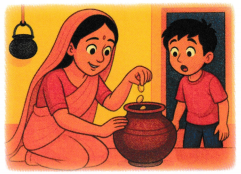
Raju’s eyes widened in wonder. To test it, he dropped two leaves into the pot, the pot returned 12 green leaves!
Raju ran home and showed it to his mother. Mother had only 4 coins, so she put it into the pot, soon after 24 shining coins came out. The mother and Raju used the pot wisely. After sometimes, Raju realised that the pot gives things back as 12, 24, 36, 54, and 72 in numbers. And he discovered that the multipliers 1,2, 3 and 6 work for all these numbers.
Question 1.
The multipliers 1, 2, 3 and 6 are the _________ of the numbers of the things that Raju got from the pot. That means 12, 24, 36, 54 and 72 are _________ of 1, 2, 3, and 6.
Question 2.
Make different arrays for the number 36. How many different arrays could you make?
Question 3.
List all the factor pairs of 36?
Question 4.
Make different arrays for the following numbers. Identify the factors in each. case.
(a) 18
(b) 30
(c) 35

Question 5.
Identify the factors and multiple in the following.

Question 6.
List all the factors of the following numbers.
(a) 12 _____________________________
(b) 32 _____________________________
(c) 42 _____________________________
(d) 54 _____________________________
Question 7.
Write the first Jive multiples of tKe Jollowing numbers.
(a) 8 _____________________________
(b) 10 _____________________________
(c) 13 _____________________________
(d) 15 _____________________________
Think and Answer
Which one is smaller: the 3rd multiple of 2 or the product of the first 2 multiples of 3?
Animal Jumps
Squeaky (a mouse) and Froggy (a frog) decide to have a distance challenge on a number line. They both start from 0 on the number line.
Squeaky takes a jumps of 3 steps each time. Froggy takes a jumps of 4 steps each sprint. The numbers they land on the number line are the multiples of 3 (for Squeaky) and that of 4 (for Froggy). The numbers where both of them land is the common multiples of 3 and 4.

Question 8.
At which number on the number line do both Squeaky and Froggy land on (apart from 0)?
_____________________________
_____________________________
_____________________________
Question 9.
List all the common multiples of 3 and 4 that lie between 51 and 100.
_____________________________
_____________________________
_____________________________
Question 10.
Find the first five common multiples of each of the following pairs of numbers:
(a) 4 and 6 _____________________________
(b) 3 and 7 _____________________________
(c) 5 and 9 _____________________________
(d) 8 and 10 _____________________________
Question 11.
Food is available at the end of a stepping-stone path. Zara, the zebra, hops 7 stones at a time. Milo, the monkey, hops 10 stones at a time, They both start from stone 0. The path ends at stone 70, where a bunch of bananas is waiting.

(a) List all the numbers of the stepping stones on which Zara jumps.
_____________________________
(b) List all the numbers of the stepping stones on which Milo jumps?
_____________________________
(c) Will both Zara and Milo reach the banana?
_____________________________
(d) Who will reach the bananas first? Explain your reasoning.
_____________________________
Question 12.
Suppose a grasshopper is at the number 18 on a number line and a frog starts to jump to catch the grasshopper bg taking jumps of size 2. Help the Jrog so that he can catch the grasshopper by showing the jumps of jump size 2. One jump has been shown on the number line.

(a) In how many jumps will the frog catch the grasshopper? Also, write the numbers on which the frog will land on his way.
____________________________________________
____________________________________________
(b) If the frog increases the jump size to 3, in how many jumps will the frog catch the grasshopper? Show his jumps on the number line.

Also, write the numbers on which the frog will land on his way.
____________________________________________
____________________________________________
(c) Are there any more jump sizes possible to catch the grasshopper? Write them.
____________________________________________
____________________________________________
(d) Now, the grasshopper shifts his position from 18 to 24-off the number line. Can the frog still catch the grasshopper, if he takes the same jump sizes as he took in above, that is, 2 and 3? Show his jumps for both jump sizes on the number lines to catch the grasshopper.
For jump size 2:

For jump size 3:

(e) Write all the possible jump sizes to catch the grasshopper which is at 24.
____________________________________________
____________________________________________
(f) In both cases, when the grasshopper was at 18 and 24 on the number line, were the few jump sizes taken by the frog common? Write them. What do we call these common jump sizes?
____________________________________________
____________________________________________
Question 13.
Observe the number line given below and answer the following questions.

(a) Can we jump by 2 steps at a time to reach both 20 and 30? Is 2 a common factor of 20 and 30?
____________________________________________
____________________________________________
(b) Can we jump by 4 steps at a time to reach both 20 and 30? Is 4 a common factor of 20 and 30?
____________________________________________
____________________________________________
(c) Can we jump by 5 steps at a time to reach both 20and 30? Is 5 a common factor of 20 and 30?
____________________________________________
____________________________________________
(d) What other jumps can we take to reach both 20 and 30?
____________________________________________
____________________________________________
(e) How many common factors can you find for 20 and 30? List them.
____________________________________________
____________________________________________
(f) What would be the jumping to reach both 32 and 48?
____________________________________________
____________________________________________
Question 14.
Find which of the following numbers can be reached by jumps of 5 steps.

____________________________________________
Question 15.
In the number line given in above question, 6 is the common factor of the numbers: _________.
Question 16.
Find the common factors of the following pairs of numbers.
(a) 18 and 24
(b) 10 and 15
(c) 5 and 11
(d) 16 and 20
(e) 13 and 17
(f) 9 and 21
Question 17.
State whether the following statements are true (T) or False (F).
(a) All factors of 20 are even. _________
(b) Multiples of 7 can be even or odd. _________
(c) Factors of 15 can include even numbers. _________
(d) The product of two consecutive numbers is one of their common multiples. _________
(e) The only common factor of 8 and 9 is 1. _________
Question 18.
Pico, the parrot, pecks green chilli every 4th day. Penny, the pigeon, peck sunflower seeds every 6th day. If they both start on Day 1, on which days will they peck their treats together?
Question 19.
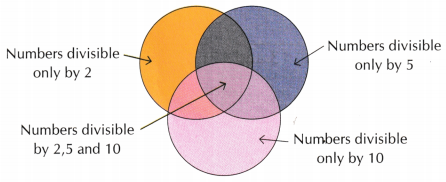
Sushil writes some numbers on a board. These numbers are as follows: 72, 35, 44, 28, 95, 65, 50, 42, 20, 85, 100, 54, 38, 70 Help him to sort these numbers into groups:
(a) divisible by 2
(b) divisible by 5
(c) divisible by 10
(d) divisible by 2, 5, and 10
_____________________________
_____________________________
_____________________________
Question 20.
Fill the numbers given in Question 19 to complete the given Venn diagram
Activity
Draw a 10 × 10 grid of 100 squares on a cardboard sheet. With the help of scissors, cut out the square pieces. Take as many square pieces as the number to be factorised. Here, the number is 24. So, a Jew number of possible rectangular arrangements of the square pieces are as follows:
Possibility 1: Arrangement of 24 pieces in 1 row

Thus, 1 and 24 are factors of 24.
Possibility 2: Arrangement of 24 pieces in 2 equal rows
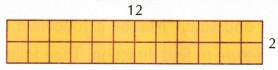
Thus, 2 and 12 are factors of 24.
Possibility 3: Arrangement of 24 pieces in 3 equal rows
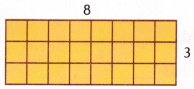
Thus, 3 and 8 are factors of 24.
Possibility 4: Arrangement of 24 pieces in 4 equal rows

Thus, 4 and 6 are factors of 24.
Hence, the number of rows and columns in each arrangement gives the factors of the number.
Thus, the factors of 24 are 1, 2, 3, 4, 6, 8, 12, and 24.