Get the simplified Class 7 Maths Extra Questions Chapter 7 A Tale of Three Intersecting Lines Class 7 Extra Questions and Answers with complete explanation.
Class 7 A Tale of Three Intersecting Lines Extra Questions
Class 7 Maths Chapter 7 A Tale of Three Intersecting Lines Extra Questions
Class 7 Maths Chapter 7 Extra Questions
Question 1.
Is it possible to draw a triangle using three points on a straight line? Explain.
Answer:
No, it is not possible to draw a triangle using three points on a straight line.
If all three points lie on the same line (called collinear), they cannot form A Closed shape.
So, no triangle can be made.
Question 2.
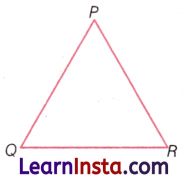
Write the six elements (i.e. the 3 sides and 3 angles) of △ PQR.
Answer:
The six elements i.e. 3 sides and 3 angles of △ PQR are as follow
Sides PQ, QR and PR.
Angles ∠PQR, ∠QPR and ∠QRP.
Question 3.
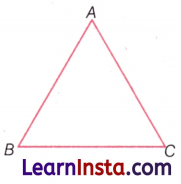
A △ ABC is shown in the figure.
Write the
(i) side opposite to the vertex B.
(ii) angle opposite to the side AB.
(iii) vertex opposite to the side BC.
Answer:
(i) The side opposite to the vertex B of △ ABC is AC.
(ii) The angle opposite to the side AB of △ ABC is ∠ACB.
(iii) The vertex opposite to the side BC of △ ABC is A.
Question 4.
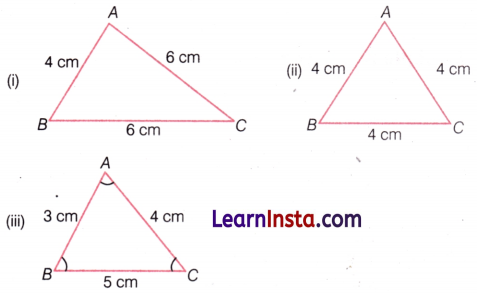
Look at the following figures and classify each of the triangle according to its sides.
Answer:
In figure (i),
AC = 6 cm, BC = 6 cm, AB = 4 cm ∵ AC = BC
Hence, △ ABC is an isosceles triangle.
In figure (ii), AC = 4 cm, AB = 4 cm, BC = 4 cm, ∵ AC = AB = BC
Hence, △ ABC is an equilateral triangle.
In figure (iii), AB = 3 cm, AC = 4 cm and BC = 5 cm
∵ AC ≠ AB ≠ BC
Hence, △ ABC is a scalene triangle.

Question 5.
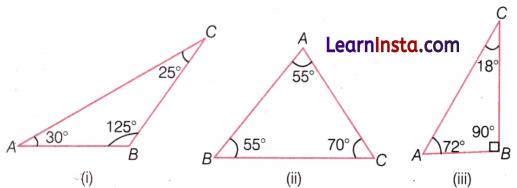
Classify the following triangles according to their angles.
Answer:
In figure (i), ∠B = 125°, which is greater than 90°, so it is an obtuse angled triangle.
In figure (ii), all angles are smaller than 90°, so it is an acute angled triangle.
In figure (iii), ∠B = 90°, so it is a right angled triangle.
Question 6.
Is it possible to have a triangle with following sides?
(i) 3 cm, 5 cm and 8 cm
(ii) 2 cm, 4 cm and 5 cm
Answer:
(i) Given sides are 3 cm, 5 cm and 8 cm.
Sum of two sides = 3 + 5 = 8 cm and third side = 8 cm
Since, the sum of lengths of two sides is equal to third side.
So, a triangle cannot be possible with these sides.
(ii) Given sides are 2 cm, 4 cm and 5 cm.
Since, the sum of lengths of any two sides of a triangle is greater than the length of third side
i.e.
2 cm + 4 cm > 5 cm
2 cm + 5 cm > 4 cm
and
5 cm + 4 cm > 2 cm
So, a triangle can be possible with these sides.
Question 7.
Take any point 0 in the interior of a △ ABC.
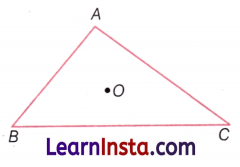
Is
(i) OB + OC > BC ?
(ii) OC + OA > AC ?
Answer:
(i) Yes, OB + OC > BC because on joining OB and OC, we get a △ OBC and in a triangle, sum of the lengths of any two sides is greater than the length of the third side.
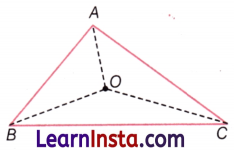
(ii) Yes, OC + OA > ACBecause on joining OC and OA, we get a △ OAC and in a triangle, sum of the lengths of any two sides is greater than the length of the third side.
Question 8.
Find the value of x in the following figure.
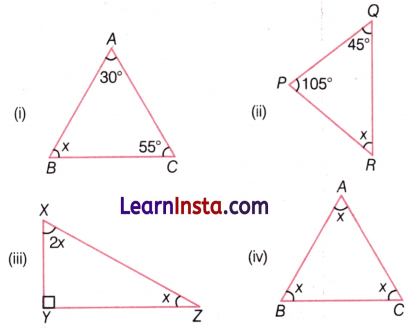
Answer:
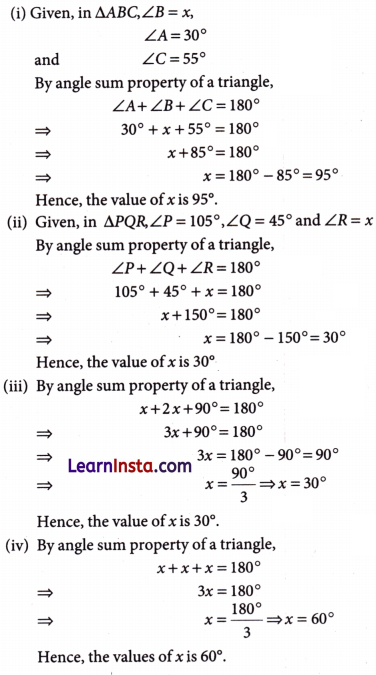
Question 9.
Two angles of a triangle are 40° and 70 Find the third angle.
Answer:
Let the third angle be x.
Then, by angle sum property of a triangle,
x + 40° + 70° = 180°
→ x + 110° = 180°
→ x = 180° – 110°
→ x = 70°
Hence, the third angle is 70°.
Question 10.
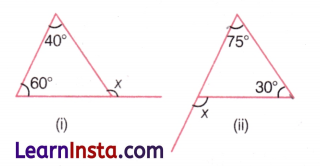
Find the value of unknown exterior angle x in the following figures.
Answer:
(i) By exterior angle property of a triangle, Exterior angle = Sum of interior opposite angles
→ x = 40° + 60° = 100°
Hence, the exterior angle x is 100°.
(ii) By exterior angle property of a triangle,
Exterior angle = Sum of interior opposite angles
→ x = 75° + 30° = 105°
Hence, the exterior angle x is 105°.
Question 11.
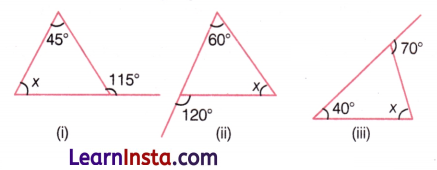
Find the value of the unknown interior angle x in the following figures.
Answer:
By exterior angle property of a triangle,
(i) Sum of the interior opposite angles
= Exterior angle
→ x + 45° = 115°
→ x = 115°-45° = 70°
Hence, the value of interior angle x is 70°.
(ii) Sum of the interior opposite angles
= Exterior angle
→ 60° + x = 120°
→ x = 120°-60°
→ x = 60°
Hence, the value of interior angle x is 60°.
(iii) Sum of the interior opposite angles
= Exterior angle
→ 40° + x = 70°
→ x = 70°-40°
= 30°
Hence, the value of interior angle x is 30°.
Question 12.
Is something wrong in this given figure?
Comment.
Answer:
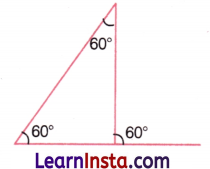
From the given figure, exterior angle = 60°
And sum of two interior angles = 60° + 60° = 120°
By exterior angle property of a triangle,
Exterior angle = Sum of two interior opposite angles.
But here, exterior angle ≠ sum of two interior opposite angles.
So, in the given figure, the given angles are incorrect.
Question 13.
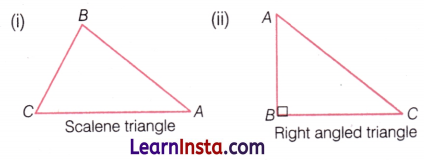
Draw rough sketch of altitude from A to BC for the following given figure.
Answer:
(i) In the given figure, altitude can be drawn as below
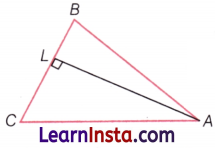
Here, AL = Altitude from A to BC
(ii) In the given figure, altitude can be drawn as below
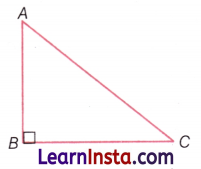
In right angled △ ABC, altitude from A to BC will same as AB.
Question 1.
Construct an equilateral triangle with side length 3 cm. Write down the steps of construction.
Answer:
The steps of construction are given as
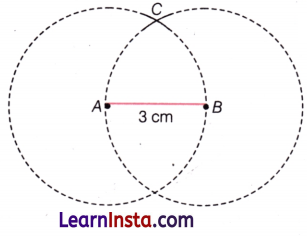
(i) Draw a line segment AB of length 3 cm using a ruler and pencil.
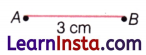
(ii) Place the compass pointer at point A and open it to 3 cm. Draw an arc.
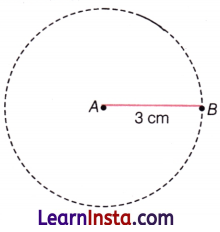
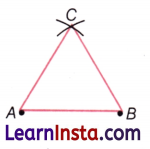
(iii) Now, place the compass pointer at point B (without changing the compass width) and draw another arc. Let the two arcs intersect at point C.
(iv) Join points A to C and B to C using a ruler. Then, ABC is the required equilateral triangle where each side is 3 cm.
Question 2.
Construct a triangle whose sides are 3 cm , 4 cm and 5 cm. Write down the steps of construction.
Answer:The steps of construction are given as
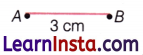
(i) Draw a line segment AB of length 3 cm using a ruler and pencil.
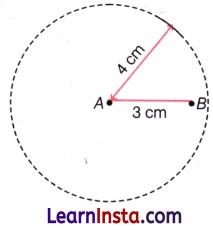
(ii) Place the compass pointer at point A and open it to 4 cm. Draw ACircle.
(iii) Place the compass pointer at point B and open it to 5 cm. Draw another circle.
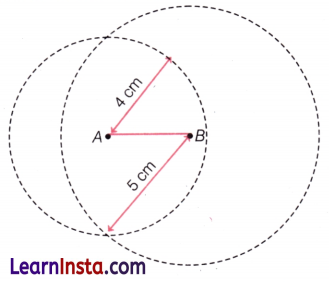
(iv) Let the point C be one of the points of intersection of these two circles. Then, C is the required vertex. Join AC and BC. Then, △ ABC is the required triangle.
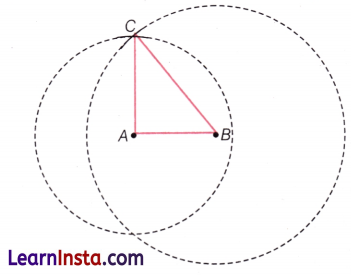
Note If two circles intersect with each other, only then construction of a triangle is possible.
Question 3.
Construct a triangle whose two sides and the included angle are given 3 cm, 4 cm, and 60°, respectively. Write the steps of construction.
Answer:
The steps of construction are given as
(i) Draw a line segment AB of length 3 cm using a ruler and pencil.
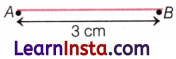
(ii) At point A, draw an angle of 60° using protector and mark X
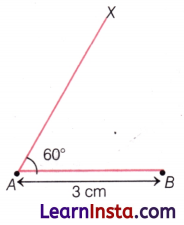
(iii) At point A, mark a point C along AX such that AC = 4 cm.
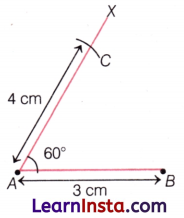
(iv) Join the point C to B. Then, △ ABC is the required triangle.
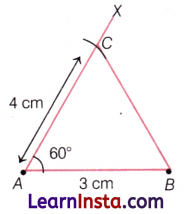
Question 4.
Construct a triangle whose two angles and the included side are given as 40°, 50° and 5 cm , respectively. Write the steps of construction.
Answer:
The steps of construction are given as
(i) Draw a line segment AB of length 5 cm using a ruler and pencil.
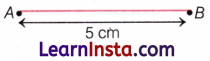
(ii) Draw angles of 40° and 50° at points A and B, respectively using protector.
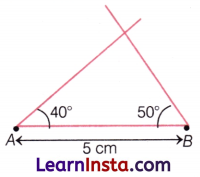
(iii) Let C be the point of intersection which will be the third vertex. Then, △ ABC is the required triangle.
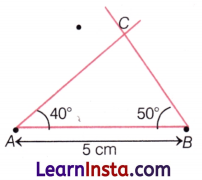
Note If the sum of two angles is more than or equal to 180°, then construction of triangle is not possible.
Question 5.
Construct a △ ABC with side lengths AB = 3.5 cm, BC = 2.5 cm and AC = 4 cm. Construct an altitude from A to BC.
Answer:
The steps of construction are given as
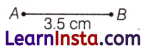
(i) Draw a line segment AB of length 3.5 cm using ruler and pencil.
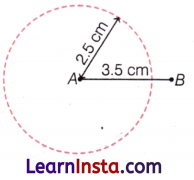
(ii) Place the compass pointer at point A and open it to 2.5 cm. Draw ACircle.
(iii) Place the compass pointer at point B and open it to 4 cm. Draw another circle.
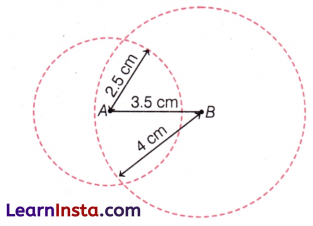
(iv) Let the point C be one of the points of intersection of these two circles. Then, C is the required vertex. Join AC and BC. Then, △ ABC is the required triangle.
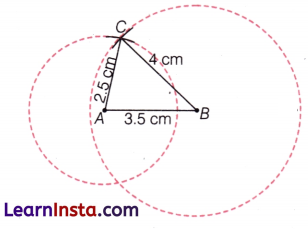
(v) Construction of an altitude
Keep the ruler aligned to the base BC of the △ ABC. Place the set square on the ruler such that one of the edges of the right angle touches the ruler and slide it along ruler till the verticle edge touches A.
Then, draw an altitude to BC from A.
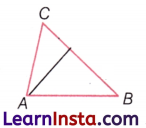
Hence, AD is the required altitude from A to BC.
A Tale of Three Intersecting Lines Extra Questions Class 7
Question 1.
Write the six elements (i.e. angles and sides of a △ LMN.)
Answer:
∠L, ∠M, ∠N and sides LM, MN, LN
Question 2.
Write the
(i) side opposite to the vertex A of △ ABC.
(ii) angle opposite to the side QR of △ PQR.
(iii) vertex opposite to the side PQ of △ PQR.
Answer:
(i) BC
(ii) ∠QPR
(iii) R
Question 3.
Look at the following figures and classify each of the triangle according to its
(a) sides
(b) angles
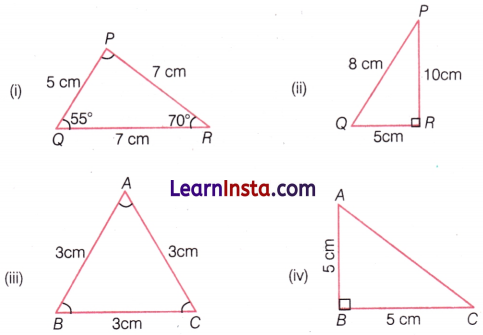
Answer:
(i) (a) Isosceles triangle
(b) Acute angled triangle
(ii) (a) Scalene triangle
(b) Right angled triangle
(iii) (a) Equilateral triangle
(b) Acute angled triangle
(iv) (a) Isosceles triangle
(b) Right angled triangle
Question 4.
Classify the following triangle on the basis of angles.
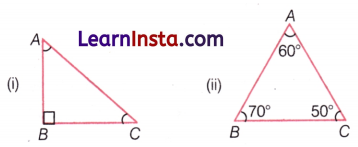
Answer:
(i) Right angled triangle
(ii) Acute angled triangle
Question 5.
Is it possible to have a triangle with the following sides?
(i) 2 cm, 4 cm and 6 cm
(ii) 4 cm, 6 cm and 7 cm
Answer:
(i) No
(ii) Yes
Question 6.
In the following figure, find the value of x.
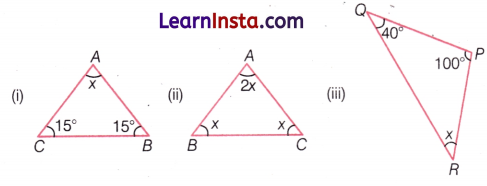
Answer:
(i) 150°
(ii) 45°
(iii) 40°
Question 7.
Find the value of x in the following figures.
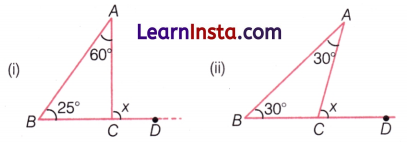
Answer:
(i) 85°
(ii) 60°
Question 8.
Name the altitude of the following figure.
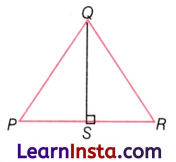
Answer:
QS
Question 9.
In the given △ MNP, a line from vertex M is drawn passing through the side N P at Osuch that ∠MOP = 90°. What would be the other name for OM ?
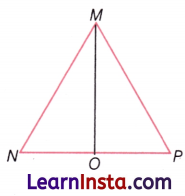
Answer:
Altitude
Question 10.
Can you show that an altitude does not always lies in the interior of a triangle?
Answer:
Yes