Experts have designed these Class 8 Maths Notes and Chapter 1 A Square and A Cube Class 8 Notes for effective learning.
Class 8 Maths Chapter 1 Notes A Square and A Cube
Class 8 Maths Notes Chapter 1 – Class 8 A Square and A Cube Notes
We have been learning about numbers, their patterns and operations since long. Like numbers, number patterns too have a great influence on the way mathematics has evolved and is used to make sense of almost everything-from a tiny particle to the universe. It is exciting to know how number patterns form the foundation for deeper problem-solving.
Unlike arbitrary calculations, odd-even numbers, prime numbers, triangular numbers, factors, multiples, etc, reveal hidden patterns, make strong linkages to geometry-shapes, their areas and volumes, and even appear in real-world puzzles (like the famous locker problem).

In the journey ahead, this chapter facilitates the entry into the fascinating world of square and cube numbers – where mathematics meets mystery, patterns, and even a royal inheritance puzzle. Math isn’t just about calculations; it’s rather a path to logical thinking and discovering useful patterns.
→ A number multiplied by itself, e.g., a × a = a2 is read as ‘ a squared’ and is always positive.
→ A natural number n is said to be a perfect square if there exists some natural number m such that n = m × m = m2.
→ Properties of Perfect Squares
- A number having 2,3,7 or 8 at the unit place is never a perfect square number.
- The number of zeros at the end of a perfect square number is always even.
- Squares of even numbers are even and squares of odd numbers are odd.
- The number of non-perfect square numbers between the squares of two consecutive numbers n and (n+1) is 2 n, where n is a natural number.
- For any natural number n, the square of n, i.e., n² is equal to the sum of the first n odd natural numbers.
- The square of a natural number (other than 1) is either a multiple of 3 or exceeds a multiple of 3 by 1.
- The difference between the squares of two consecutive natural numbers is equal to their sum, i.e., for every natural number n, (n+1)2 – n2 = (n+1) + n.
- By adding two triangular numbers we get a square number.
- The square of any odd number, other than 1 can be expressed as the sum of two consecutive natural numbers.
→ The square root of a number n is that number which when multiplied by itself, gives the number n as the product. √ is the symbol for square root. The square root of n is denoted by √n.
→ A number when multiplied by itself thrice called its cube. The cube of x = x × x × x = x3.
→ A natural number ‘n’ is called a perfect cube if there exists a natural number ‘m’ such that n = m × m × m = m3.
→ Properties of Perfect Cubes
- The cubes of all odd numbers are odd, and the cubes of all even numbers are even.
- The number of zeros at the end of a perfect cube is always a multiple of 3.
- Cubes of positive integers are always positive, and cubes of negative integers are always negative.
- The cube of the numbers having digits 1,4,5,6 and 9 at their ones places ends with in the same digits respectively.
- The cube of a number ending with 2 ends with digit 8 at its ones place and vice versa.
- The cube of a number ending with 3 ends with digit 7 at its ones place and vice versa.
In this chapter, we will study about square numbers or perfect squares, properties of square numbers, patterns of squares, square roots, cube, cube roots and all its properties.
Square and Square Roots
Factor
A factor of a number is an exact divisor of that number i.e., the factor divides the number completely without leaving any remainder.
e.g. 1, 2, 3 and 6 are exact divisors of 6.
So, 1, 2, 3 and 6 are factors of 6.
Partner Factor
If the product of two factors of a number is equal to the number itself then those factors are called partner factor of each other.
e.g. 1, 2, 3 and 6 are factors of 6.
Here, 1 × 6 = 6 and 2 × 3 = 6
So, (1, 6) and (2, 3) are pairs of partner factors of 6.
Square
The square of a number is obtained by multiplying it by itself. If a is a number then the square of a is written as a2.
a2 = a × a
e.g. 122 =12 × 12 = 144
Perfect Square
A natural number n is called a perfect square or a square number if there exists a natural number m such that n = m2.
e.g. The numbers 1, 4, 9, 16, 25, … are square numbers or perfect squares.
1 = 1 × 1,
4 = 2 × 2,
9 = 3 × 3,
16 = 4 × 4
Properties of Square Numbers
(i) The only numbers that have an odd number of factors are the squares.
e.g. The factors of 16 are 1, 2, 4, 8, 16 (5 factors – an odd number).
(ii) A number having 2, 3, 7 or 8 at unit place is never a perfect square.
e.g. 162, 3293 are not perfect squares.
(iii) If a number has 1 or 9 at unit’s place then its square ends with 1.
e.g. (1)2 = 1, (9)2 = 81, (11)2 = 121, (19)2 = 361
(iv) The number of zeros at the end of a perfect square is always even.
e.g. 100, 400, 10000 are perfect squares.
(v) The numbers ending in an even number of zeros may or may not be a perfect square.
e.g. 2500 is a perfect square, but 2600 not a perfect square.
(vi) A number ending in an odd number of zeros is never a perfect square.
e.g. 40, 4000 are not perfect squares.
(vii) If a number has n zeros at the end, its square will have 2n zeros at the end.
e.g. If a number contains 2 zeros then the number of zeros in its square =2n = 2 × 2 = 4
(vii) The unit digit of the square of a natural number is the unit digit of the square of the digit at the unit place of given natural number.
| Unit digit of the number | Unit digit of the square of the number |
| 0 | o |
| 1 or 9 | 1 |
| 2 or 8 | 4 |
| 3 or 7 | 9 |
| 4 or 6 | 6 |
| 5 | 5 |
(ix) The squares of odd numbers are odd and the squares of even numbers are even,
e.g. (a) 32 = 9, here both are odd numbers.
(b) 42 = 16, here both are even numbers.
Patterns of the Square Numbers
1. Adding Triangular Numbers
If we combine two consecutive triangular numbers then we get a dot pattern which represents a square number i.e.
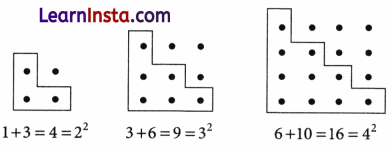
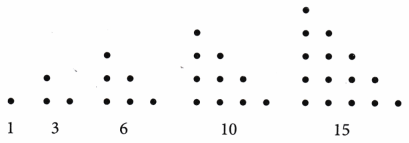
Note Triangular numbers are numbers whose dot patterns can be angled as triangles.
e.g. 1, 3, 6, 10, 15 etc.
2. Numbers between Square Numbers
There are 2n non-perfect square numbers between the squares of the numbers n and (n +1).
e.g. The number of non-perfect square numbers between 82 and 92 = 2 × 8 = 16 [∵n = 8]
3. Adding Odd Numbers
The sum of first n odd natural numbers is n2. e.g. 1 = 1 = 12
1 + 3 = 4 = 22
1 + 3 + 5 = 9 = 32
1 + 3 + 5 + 7 = 16 = 42
Note The nth odd number is 2n -1.
4. Difference of Squares of Two Consecutive Numbers
The difference of squares of two consecutive numbers is equal to their sum.
e.g. 52 – 42 = 5 + 4 = 9
Square Root
The square root of a number a is that number which, when multiplied by itself, gives a as the product.
In general, b2 = a ⇒ b = √a
Here, b is the square root of a, if and only if a is the square of b.
Finding the Square Root
The square root is the inverse operation of squaring.
We have, 12 = 1, therefore square root of 1 is 1.
22 = 4, therefore square root of 4 is 2.
32 = 9, therefore square root of 9 is 3.
The symbol used to denote square root is ‘√’. e.g. √9 = 3
Finding the Square Root through Repeated Subtraction
To find the square root through repeated subtraction, firstly, obtain the given perfect square whose square root is to be calculated then subtract from it successively 1, 3, 5, 7, 9,… till you get zero. At last count the number of times the subtraction is performed to arrive at zero.
e.g. To find the square root of 9 :
9 – 1 = 8, 8 – 3 = 5 and 5 – 5 = 0
The subtraction was performed 3 times, so the square root of 9 is 3.
Finding the Square Root through Prime Factorisation
In prime factorisation method, the numbers are expressed as a product of their prime factors. The identical prime factors are paired and the product of one factor from each pair gives the square root of a number.
Estimating Square Root of a Number
To estimate the square root of a number, follow the following steps.
Step I. Identify two consecutive perfect squares between which the given number lies.
This gives an approximate range for the square root.
e.g. for \(\sqrt{1936}\),
we know that 402 = 1600
and 502 = 2500.
∴\(\sqrt{1936}\) lies between 40 and 50.
Step II. Observe the last digit of the number. For perfect squares, the last digit of the square root must correspond.
e.g. 1936 ends in 6, so its square root may end in 4 or 6, making it likely 44 or 46.
Step III. Square a number from within the interval (like 45) and compare it with the original number to refine the estimate.
e.g. 452 = 2025, which is greater than 1936 so, \(\sqrt{1936}\) < 45.
Step IV. Based on comparison, adjust the interval, e.g. 40 < \(\sqrt{1936}\) < 45.
Step V. Use the logical reasoning and verification to guess the exact square root.
e.g. \(\sqrt{1936}\) = 44
Cube
If a number is multiplied to itself three times then the product of this multiplication is called the cube of that number.
Thus, if a is a number then the cube of a is a3
i. e. a3 = a × a × a
e.g. (4)3 =4 × 4 × 4
= 64
Perfect Cube
In the prime factorisation of any number, if each factor appears three times then the number is a perfect cube or
cube number.
e.g. 8 is a perfect cube of natural number 2
i. e. prime factorisation of 8 = 2 × 2 × 2 = 23
Physical Interpretation : Building a Cube
1. A 1-unit cube is the smallest cube (like a single sugar cube).
2. A 2-unit cube is made of 8 small cubes (2 layers of 4 cubes each).
3. A 3-unit cube has 27 small cubes (3 layers of 9 cubes each).
Note There are only ten perfect cubes from 1 to 1000.
Properties Related to Cube of a Number
- Cubes of all even natural numbers are even.
- Cubes of all odd natural numbers are odd.
- Cubes of the numbers ending in digit 0, 1, 4, 5, 6 and 9 are the numbers ending in the same digit.
- Cubes of numbers ending in digit 2 ends in digit 8 and vice-versa.
- The cubes of the numbers ending in digits 3 and 7 end in digits 7 and 3, respectively.
- Cube of a number which ends in zero, ends in three zeroes.
- There are only three numbers whose cube is equal to the number i.e. (0)3 = 0, (1)3 = 1 and (-1)3 = -1.
- Cube of a negative number is always negative.
e.g. (-3)3 = (-3) × (-3) × (-3) = -27.
Because when negative integer is multiplied in odd terms it remains negative.
Some Interesting Patterns in Cubes
(i) Adding consecutive odd numbers
(Numbers as a sum of odd numbers)
In this pattern, sum of consecutive odd numbers are used to obtain the cubes
i.e. n3 = [n (n – 1) + 1] + [n (n – 1) + 3] + [n(n – 1) + 5] +…+ n terms where, n is the number whose cube is to find.
e.g. 1 = 1 = 13
3 + 5 = 8 = 23
7 + 9 + 11 = 27 = 33
13 + 15 + 17 + 19 = 64 = 43
21 + 23 + 25 + 27 + 29 =125 = 53
(ii) Difference of two consecutive cubes In this pattern, difference of cubes of two consecutive numbers is equal to one more than 3 times the product of those numbers.
i. e. If a and b are two consecutive numbers such that b>a. Then, the difference of their cubes is given as
b3 – a3 = 1 + b × a × 3 or b3 – a3 – 1 + 3ab
e.g. 23 – 13 = 1 + 3 × 1 × 2 =7
33 – 23 = 1 + 3 × 2 × 3 = 19
43 – 33 = 1 + 3 × 3 × 4 = 37
53 – 43 = 1 + 3 × 4 × 5 = 61
(iii) Cubes and their prime factors In this pattern, each prime factor appears three times in its cubes.
eg-
| Prime Factorisation of a Number | Prime Factorisation of its Cube |
| 4 = 2 × 2 | 43 = 64 = 2 × 2 × 2 × 2 × 2 × 2 = 23 × 23 |
| 6 = 2 × 3 | 63 = 216 = 2 × 2 × 2 × 3 × 3 × 3 = 23 × 33 |
| 15 = 3 × 5 | 153 = 3375 = 3 × 3 × 3 × 5 × 5 × 5 = 33 × 53 |
| 12 = 2 × 2 × 3 | 123 = 1728 = 2 × 2 × 2 × 2 × 2 × 2 × 3 × 3 × 3 = 23 × 23 × 33 |
Taxicab Numbers
Taxicab numbers are the smallest numbers that can be expressed as the sum of two cubes in two different ways.
e.g. 1729 is a taxicab numbers, which is the smallest number that can be written as the sum of two cubes in two different ways.
1729 = 13 + 123,
1729 = 93 + 103
Note The next two taxicab numbers after 1729 are 4104 and 13832.
Cube Roots
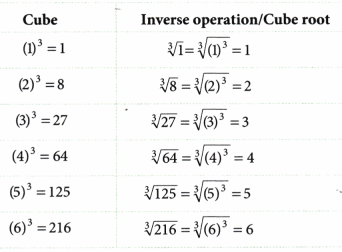
Cube root is the inverse operation of a cube.
A number m is the cube root of a number ti, if n = m3.
e.g. 8 = 23 ⇒ 3√8 = 2, which is read as cube root of 8 is 2. The symbol ‘3√’ denotes cube root.
Some inverse operations of cube of the numbers are given below.
Cube Root Through Prime Factorisation Method
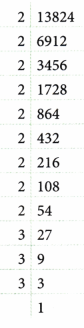
In order to find the cube root of a perfect cube by prime factorisation method, we follow the following steps :
Step I Write the given number.
Step II Resolve it into prime factors.
Step III Group the factors in triplets such that all the three factors in each triplets are equal.
Step IV Take one factor from each triplets termed in Step III.
Step V Find the product of factors obtained in Step IV. This product is the required cube root.
e.g. To find out the cube root of 13824.
On resolving the given number into prime factors, we get
13824 = 2 × 2 × 2 × 2 × 2 × 2 × 2 × 2 × 2 × 3 × 3 × 3
= 23 × 23 × 23 × 33
∴ \(\sqrt[3]{13824}\) = 2 × 2 × 2 × 3 = 24
Note Here, we will find the cube roots of only perfect cubes.