Practicing Class 7 Maths MCQ and Class 7 Maths Chapter 3 A Peek Beyond the Point MCQ Questions Online Test with Answers daily helps in time management.
MCQ on A Peek Beyond the Point Class 7
A Peek Beyond the Point MCQ Class 7
Class 7 Maths MCQ Chapter 3 A Peek Beyond the Point
Multiple Choice Questions
Question 1.
What is the value of \(3 \frac{3}{10}+7 \frac{4}{10}\)?
(a) 7\(\frac{4}{10}\)
(b) 10\(\frac{3}{10}\)
(c) 10\(\frac{7}{10}\)
(d) 7\(\frac{17}{10}\)
Answer:
(c) 10\(\frac{7}{10}\)
Question 2.
How many tenths make a whole?
(a) \(\frac{1}{10}\)
(b) 10
(c) 100
(d) 1
Answer:
(b) 10

Question 3.
Which of the following is the greatest?
(a) \(\frac{7}{10}\)
(b) 7\(\frac{1}{10}\)
(c) \(\frac{71}{10}\)
(d) 71\(\frac{1}{10}\)
Answer:
(d) 71\(\frac{1}{10}\)
Question 4.
Which of the following represents \(\frac{139}{100}\) as a mixed number?
(a) 1\(\frac{39}{100}\)
(b) 13\(\frac{9}{100}\)
(c) 13\(\frac{39}{100}\)
(d) 139\(\frac{1}{100}\)
Answer:
(a) 1\(\frac{39}{100}\)
Question 5.
Arrange \(\frac{3}{10}, \frac{32}{10}, 3 \frac{2}{100}, 23 \frac{2}{10}\) in increasing order.
(a) \(\frac{32}{10}, 3 \frac{2}{100}, \frac{3}{10}, 23 \frac{2}{10}\)
(b) \(\frac{3}{10}, 3 \frac{2}{100}, \frac{32}{10}, 23 \frac{2}{10}\)
(c) \(\frac{3}{10}, 3 \frac{2}{100}, 23 \frac{2}{10}, \frac{32}{10}\)
(d) \(3 \frac{2}{100}, \frac{3}{10}, 23 \frac{2}{10}, \frac{32}{10}\)
Answer:
(b) \(\frac{3}{10}, 3 \frac{2}{100}, \frac{32}{10}, 23 \frac{2}{10}\)
Question 6.
Which of these is equal to \(\frac{33}{100}\)?
(a) \(\frac{3}{10}+\frac{3}{100}\)
(b) \(\frac{30}{10}+\frac{3}{10}\)
(c) 3\(\frac{3}{10}\)
(d) \(\frac{3}{10}+\frac{3}{10}\)
Answer:
(a) \(\frac{3}{10}+\frac{3}{100}\)
Question 7.
What is the value of \(\frac{7}{10} \frac{1}{100}-\frac{6}{10} \frac{10}{100}\)
(a) \(\frac{17}{100}\)
(b) \(\frac{21}{100}\)
(c) \(\frac{3}{10}\)
(d) \(\frac{11}{100}\)
Answer:
(b) \(\frac{21}{100}\)
Question 8.
How many hundredths are there in 0.3?
(a) 3
(b) 30
(c) 300
(d) 0.03
Answer:
(b) 30
Question 9.
0.1 is equal to
(a) \(\frac{1}{10}\)
(b) \(\frac{1}{100}\)
(c) \(\frac{1}{1000}\)
(d) 1
Answer:
(a) \(\frac{1}{10}\)
Question 10.
325 cm in metres is
(a) 325
(b) 32.5
(c) 0.325
(d) 3.25
Answer:
(d) 3.25
Question 11.
750 g in kg is
(a) 0.75
(b) 7.5
(c) 0.075
(d) 75.0
Answer:
(a) 0.75
Question 12.
What is 99 paise in rupees?
(a) ₹ 0.09
(b) ₹ 0.99
(c) ₹ 9.90
(d) ₹ 9.99
Answer:
(b) ₹ 0.99
Question 13.
1 mm is how much of a metre?
(a) \(\frac{1}{100}\)
(b) \(\frac{1}{10}\)
(c) \(\frac{1}{1000}\)
(d) 0.01
Answer:
(c) \(\frac{1}{1000}\)
Question 14.
What is the result of 6.2 + 1.8?
(a) 7.8
(b) 8.0
(c) 8.2
(d) 7.9
Answer:
(b) 8.0
Question 15.
Which of the following is the greatest?
(a) 1.2
(b) 1.02
(c) 1.22
(d) 1.21
Answer:
(c) 1.22
Question 16.
What is the value of 5.00 – 4.99?
(a) 0.01
(b) 0.1
(c) 1.0
(d) 0.001
Answer:
(a) 0.01
Question 17.
Which of the following numbers is smallest?
(a) 0.45
(b) 0.54
(c) 0.405
(d) 0.504
Answer:
(c) 0.405
Question 18.
What is the value of 12.4 + 3.01?
(a) 15.41
(b) 15.31
(c) 15.4
(d) 15.01
Answer:
(a) 15.41
Question 19.
What is the value of 0.75 + 0.25?
(a) 0.9
(b) 1.5
(c) 0.95
(d) 1.0
Answer:
(d) 1.0
Question 20.
Which of the following is between 3.4 and 3.5?
(a) 3.39
(b) 3.50
(c) 3.45
(d) 3.51
Answer:
(c) 3.45
Question 21.
What is the next number in the pattern 0.5, 0.6, 0.7, …..?
(a) 0.75
(b) 0.9
(c) 0.8
(d) 1.0
Answer:
(c) 0.8
Question 22.
Which number is closest to 2.99?
(a) 3.1
(b) 2.95
(c) 2.9
(d) 3.0
Answer:
(d) 3.0
Question 23.
Which number is greater?
(a) 2.00
(b) 0.020
(c) 0.0002
(d) 0.2
Answer:
(a) 2.00
Question 24.
Which sequence is decreasing?
(a) 4.5, 4.55, 4.6
(b) 2.3, 2.2, 2.1
(c) 3.1, 3.0, 3.1
(d) 1.01, 2.001, 3.0001
Answer:
(b) 2.3, 2.2, 2.1
Question 25.
Which of the following is the smallest number?
(a) 0.9
(b) 0.09
(c) 0.099
(d) 0.009
Answer:
(d) 0.009
Question 26.
Sanjay sees that a cricket match has ‘Overs left: 4.3’ displayed on the screen. How many balls are actually left?
(a) 4 overs and 3 balls
(b) 4 overs and 2 balls
(c) 3 overs and 4 balls
(d) 3 balls less than 4 overs
Answer:
(a) 4 overs and 3 balls
Question 27.
\(\frac{9}{4}\) in decimal form is
(a) 9.4
(b) 2.25
(c) 4.9
(d) 0.225
Answer:
(b) 2.25
Question 28.
What is the value of 2.6 + 3.4?
(a) 6.0
(b) 5.9
(c) 6.1
(d) 5.8
Answer:
(a) 6.0
Question 29.
Which of the following is the smallest?
(a) 0.3
(b) 0.03
(c) 0.003
(d) 0.0003
Answer:
(d) 0.0003
Question 30.
Between 7.1 and 7.2 on the number line, point A is marked at 7 hundredths after 7.1. The decimal number at point A is
(a) 7.107
(b) 7.117
(c) 7.17
(d) 7.27
Answer:
(c) 7.17
Question 31.
Which is equivalent to \(\frac{7}{10}\)?
(a) 0.007
(b) 0.07
(c) 0.7
(d) 7.0
Answer:
(c) 0.7
Question 32.
Which is the correct conversion?
(a) 250 g = 0.25 kg
(b) 250 g = 2.5 kg
(c) 250 g = 25 kg
(d) 250 g = 0.025
Answer:
(a) 250 g = 0.25 kg
Question 33.
6.5 cm in metres is equal to
(a) 0.65 m
(b) 0.65 mm
(c) 6.5 mm
(d) 0.065 m
Answer:
(d) 0.065 m
Assertion-Reason Based Questions
Study the Assertion (A) and Reason (R) statements given below and choose the correct alternative.
Question 1.
Assertion (A): 3\(\frac{6}{100}\) is greater than 3\(\frac{6}{10}\).
Reason (R): \(\frac{6}{100}\) has a larger denominator than \(\frac{6}{10}\).
(a) Both A and R are true, and R is the correct explanation of A.
(b) Both A and R are true, but R is not the correct explanation of A.
(c) A is true but R is false.
(d) A is false, but R is true.
Answer:
(d) A is false, but R is true.
Question 2.
Assertion (A): \(\frac{13}{10}\) is the same as 1\(\frac{3}{10}\).
Reason (R): One-tenth means one part when something is divided into 10 equal parts.
(a) Both A and R are true, and R is the correct explanation of A.
(b) Both A and R are true, but R is not the correct explanation of A.
(c) A is true but R is false.
(d) A is false, but R is true.
Answer:
(a) Both A and R are true, and R is the correct explanation of A.
Question 3.
Assertion (A): 3 ones and 5 tenths make \(\frac{35}{10}\).
Reason (R): 3 × 10 = 30 tenths, and 5 more tenths make 35.
(a) Both A and R are true, and R is the correct explanation of A.
(b) Both A and R are true, but R is not the correct explanation of A.
(c) A is true but R is false.
(d) A is false, but R is true.
Answer:
(c) A is true but R is false.
Question 4.
Assertion (A): 1.25 has 2 digits after the decimal point.
Reason (R): The number 1.25 is greater than 1.
(a) Both A and R are true, and R is the correct explanation of A.
(b) Both A and R are true, but R is not the correct explanation of A.
(c) A is true, but R is false.
(d) A is false, but R is true.
Answer:
(b) Both A and R are true, but R is not the correct explanation of A.
Question 5.
Assertion (A): 2.34 = 2.340.
Reason (R): Adding zeros after the last digit of a decimal does not change its value.
(a) Both A and R are true, and R is the correct explanation of A.
(b) Both A and R are true, but R is not the correct explanation of A.
(c) A is true, but R is false.
(d) A is false, but R is true.
Answer:
(a) Both A and R are true, and R is the correct explanation of A.
Question 6.
Assertion (A): 5 kilometres is equal to 500 metres.
Reason (R): Kilometres are larger units than metres.
(a) Both A and R are true, and R is the correct explanation of A.
(b) Both A and R are true, but R is not the correct explanation of A.
(c) A is true, but R is false.
(d) A is false, but R is true.
Answer:
(d) A is false, but R is true.
Question 7.
Assertion (A): 3.5 + 2.6 = 6.1.
Reason (R): Decimal numbers can be added like whole numbers by aligning the decimal point.
(a) Both A and R are true, and R is the correct explanation of A.
(b) Both A and R are true, but R is not the correct explanation of A.
(c) A is true, but R is false.
(d) A is false, but R is true.
Answer:
(a) Both A and R are true, and R is the correct explanation of A.
Question 8.
Assertion (A): 0.9 is greater than 0.09.
Reason (R): All decimal numbers must have 3 digits after the decimal.
(a) Both A and R are true, and R is the correct explanation of A.
(b) Both A and R are true, but R is not the correct explanation of A.
(c) A is true, but R is false.
(d) A is false, but R is true.
Answer:
(c) A is true but R is false.
Question 9.
Assertion (A): 7.10 = 7.01.
Reason (R): Zeros at the end of a decimal do not change its value.
(a) Both A and R are true, and R is the correct explanation of A.
(b) Both A and R are true, but R is not the correct explanation of A.
(c) A is true, but R is false.
(d) A is false, but R is true.
Answer:
(d) A is false, but R is true.
Question 10.
Assertion (A): 0.73 comes after 0.8 on the number line.
Reason (R): 73 is greater than 8.
(a) Both A and R are true, and R is the correct explanation of A.
(b) Both A and R are true, but R is not the correct explanation of A.
(c) A is true, but R is false.
(d) A is false, but R is true.
Answer:
(d) A is false, but R is true.
Question 11.
Assertion (A): The decimal sequence 0.1, 0.2, 0.3, 0.4, 0.5 is in increasing order.
Reason (R): In a decimal sequence, numbers with more digits are always larger.
(a) Both A and R are true, and R is the correct explanation of A.
(b) Both A and R are true, but R is not the correct explanation of A.
(c) A is true, but R is false.
(d) A is false, but R is true.
Answer:
(c) A is true, but R is false.
Question 12.
Assertion (A): Decimal numbers can be compared using number lines.
Reason (R): On a number line, the number to the left is always greater.
(a) Both A and R are true, and R is the correct explanation of A.
(b) Both A and R are true, but R is not the correct explanation of A.
(c) A is true, but R is false.
(d) A is false, but R is true.
Answer:
(c) A is true but R is false.
Fill in the blanks.
1. The length 2\(\frac{7}{10}\) cm is read as _________________
Answer: Two and seven-tenths
2. Kashvi breaks a 1-metre ribbon into 10 equal pieces. The length of one piece is _________________ metres.
Answer: One-tenth
3. 10 one-tenths make a _________________ unit.
Answer: One
4. 3\(\frac{7}{10}\) units means _________________ units and _________________ tenths.
Answer: Three, Seven
5. 5\(\frac{21}{100}\) is same as _________________
Answer: \(5+\frac{2}{10}+\frac{1}{100}\)
6. 4 and \(\frac{1}{10}\) is written as _________________
Answer: 4\(\frac{1}{10}\)
7. 3 units and 6 hundredths _________________
Answer: 3\(\frac{6}{100}\)
8. A pencil is 2\(\frac{3}{10}\) cm long and a pen is 3\(\frac{6}{10}\) cm long. The sum of their lengths is _________________ cm.
Answer: 5\(\frac{9}{10}\)
9. The decimal 4.35 has _________________ in the tenths place and _________________ in the hundredths place.
Answer: 3, 5
10. 0.01 is one _________________ of a unit.
Answer: Hundredth
11. 1 millimetre = _________________ centimetres = _________________ metres.
Answer: 0.1, 0.001
12. 1 rupee = _________________ paise and therefore, 50 paise = _________________ rupees.
Answer: 100, 0.50
13. 254 grams = _________________ kilograms.
Answer: 0.254
14. 6.5 centimetres = _________________ millimetres.
Answer: 65
15. 0.125 has _________________ digits after the decimal point.
Answer: 3
16. In 8.704, the digit 4 is in the _________________ place.
Answer: Thousandths
17. 2.4 + 3.5 = _________________
Answer: 5.9
18. 6.5 – 2.2 = _________________
Answer: 4.3
19. The sum of 15.34 and 2.68 is _________________
Answer: 18.02
20. Priya had ₹ 17.00. She bought a chocolate for ₹ 0.05. After buying, she had _________________ left.
Answer: 16.95
21. While adding decimals, we align the _________________ points.
Answer: Decimal
22. 3.50 and 3.5 are _________________ in value.
Answer: Equal
23. 4.6 > 4.60 is a _________________ statement.
Answer: False
24. The decimal number 1.4 lies between _________________ and _________________ on the number line.
Answer: 1 and 2
25. In the number line between 6 and 7, the decimal 6.6 lies between _________________ and _________________
Answer: 6.5 and 6.7
26. Decimal numbers can be arranged in order by comparing digits from _________________ to _________________
Answer: Leftmost, Rightmost
27. If 5.4, 5.45, 5.5 form a sequence, the next number in the pattern is _________________
Answer: 5.55
28. A number that is close to 3.99 is _________________
Answer: 4.00
29. On a number line, the decimal 4.25 is halfway between _________________ and _________________
Answer: 4.2 and 4.3
Complete the pattern.
1. 4.3, 4.4, 4.5, _________________, _________________, _________________
Answer: 4.6, 4.7, 4.8
2. 3.60, 3.56, 3.52, _________________, _________________, _________________
Answer: 3.48, 3.44, 3.40
3. 7.25, 7.35, 7.45, _________________, _________________, _________________
Answer: 7.55, 7.65, 7.75
4. 1.0, 0.9, 0.8, _________________, _________________, _________________
Answer: 0.7, 0.6, 0.5
Identify and write the decimal number for each labelled point.
On a number line
1. Between 5 and 6, point A is 4 divisions after 5.
Decimal number at A = _________________
Answer: A = 5.4
2. Between 6.4 and 6.5, point B is 3 hundredths after 6.4.
Decimal number at B = _________________
Answer: B = 6.43
3. Between 3 and 4, point C is halfway.
Decimal number at C = _________________
Answer: C = 3.5
Compare and write ‘<‘, ‘>’ or ‘=’.
1. 3.45 _________________ 3.54
Answer: <
2. 5.60 _________________ 5.6
Answer: =
3. 2.05 _________________ 2.50
Answer: <
4. 7.07 _________________ 7.7
Answer: <
5. 0.9 _________________ 0.90
Answer: =
6. 6.000 _________________ 6.0
Answer: =
State whether the following statements are True or False.
1. One-tenth is smaller than one-hundredth.
Answer: False
2. The sum of \(\frac{2}{10}\) and \(\frac{2}{100}\) is equal to \(\frac{1}{22}\).
Answer: False
3. Three and four-tenth and seven-hundredth is equal to 3\(\frac{4}{10}\)\(\frac{7}{100}\).
Answer: True
4. \(6 \frac{5}{10}-2 \frac{3}{10}=5 \frac{8}{10}\)
Answer: False
5. Six and five-tenths and three hundredths is the same as six hundred and fifty-three hundredths.
Answer: True
6. The decimal point separates whole numbers and fractional parts.
Answer: True
7. 0.274 is read as zero point two hundred seventy-four.
Answer: False
8. 0.05 kg = 50 g.
Answer: True
9. 0.01 is less than 0.001.
Answer: False
10. 5.3 and 5.30 have different values.
Answer: False
11. 10 cm = 0.1 m.
Answer: True
12. 0.05 is greater than 0.5.
Answer: False
13. To subtract decimals, we align decimal points.
Answer: True
14. 6.1 – 2.0 = 4.1.
Answer: True
15. 1.2 and 1.20 denote the same value.
Answer: True
16. 10.75 – 4.35 = 6.4.
Answer: True
17. 0.3 < 0.33 < 0.333.
Answer: True
18. 4.65 and 4.650 are equal.
Answer: True
19. 1.0 is greater than 0.99.
Answer: True
20. 0.5 and 0.50 are different numbers.
Answer: False
21. 3.99 is closer to 4 than to 3.
Answer: True
22. On a number line, 7.1 comes after 7.11.
Answer: False
23. ₹ 2.3 represents 2 rupees and 3 paise.
Answer: False
Match the Following Table.
Question 1.
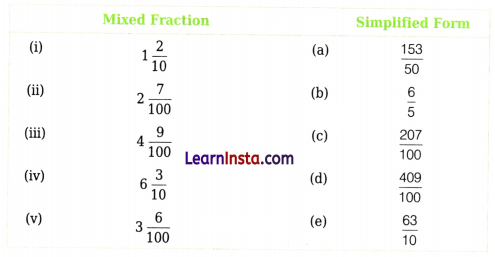
Answer:
(i) – (b)
(ii) – (c)
(iii) – (d)
(iv) – (e)
(v) – (a)
Question 2.
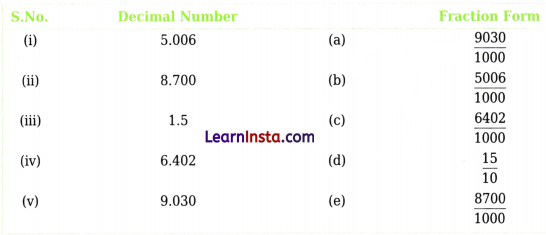
Answer:
(i) – (b)
(ii) – (e)
(iii) – (d)
(iv) – (c)
(v) – (a)
Case-Based Questions
Question 1.
A tailor is preparing fabric pieces for stitching a custom dress. He has three pieces of cloth that measure 2.45 meters, 1.35 meters, and 0.75 meters, respectively. The dress he plans to make requires a minimum of 4.5 metres of cloth.
Answer the following questions
(i) What is the total length of fabric he has?
(ii) Does he have enough material? If not, how much more does he need?
(iii) Convert each length to centimetres and calculate the total again.
(iv) If he wants to add a border of 0.05 m to each piece, what will be the new total?
Answer:
(i) 4.55 m
(ii) No, 0.05 m
(iii) 245 cm, 135 cm, 75 cm, 455 cm
(iv) 4.70 m
Question 2.
Mira visits the market to buy vegetables for the week. She picks up four items weighing 0.75 kg, 1.35 kg, 2.0: kg and 0.65 kg. She is carrying a reusable shopping bag that has a weight limit of 5 kilograms. Mira wants to ensure that the bag does not tear while carrying the vegetables back home.
Based on the context, answer the following.
(i) What is the total weight of the vegetables she bought?
(ii) Can she buy another item weighing 0.45 kg? Why or why not?
(iii) Convert the total weight to grams.
(iv) How much more weight can she carry?
Answer:
(i) 4.8 kg
(ii) No
(iii) 4800 g
(iv) 0.2 kg
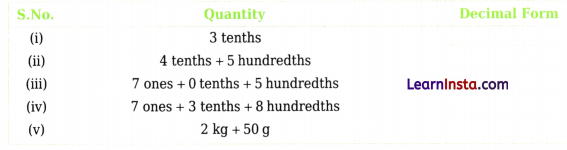
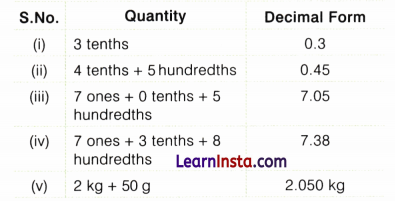
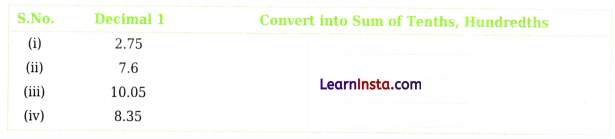
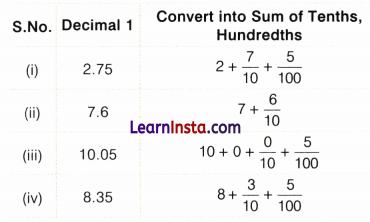
Complete the following table.
Question 1.
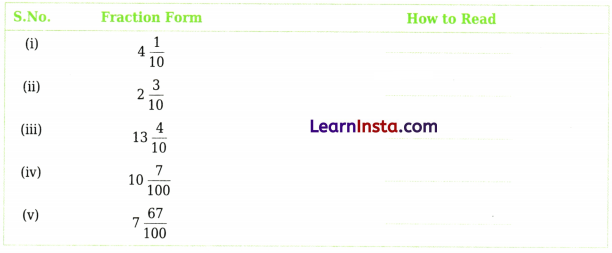
Answer:
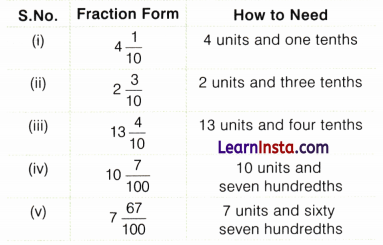
Question 2.
Answer:
Question 3.
Answer:
Write the length of the following items.
Question 1.
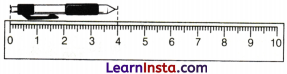
Answer:
4 cm
Question 2.
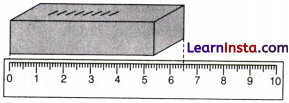
Answer:
6\(\frac{5}{10}\) cm
Question 3.
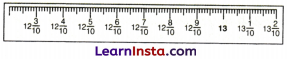
Answer:
13\(\frac{3}{10}\) cm
Question 4.

Answer:
9\(\frac{17}{10}\) cm
Very Short Answer Type Questions
Question 1.
What is the place value of 6 in 4.62?
Answer:
0.6
Question 2.
Write \(\frac{7}{10}\) in decimal form.
Answer:
0.7
Question 3.
Write the decimal for ‘5 ones and 9 tenths’.
Answer:
5.9
Question 4.
How many thousandths make one tenth?
Answer:
100
Question 5.
Round off 3.87 to the nearest whole number.
Answer:
4
Question 6.
Which is greater 0.55 or 0.505?
Answer:
0.55
Short Answer Type Questions
Question 1.
Add 3.251 and 1.75.
Answer:
5.001
Question 2.
Subtract 3.45801 from 7.2632.
Answer:
3.80519
Question 3.
Convert 125 paise into rupees.
Answer:
₹ 1.25
Question 4.
Arrange the following in ascending order.
2.03, 2.3, 2.303, 2.003
Answer:
2.003, 2.03, 2.3, 2.303
Question 5.
Write any two pairs of decimal numbers whose sum is 1.5.
Answer:
0.6 + 0.9, 0.8 + 0.7
Question 6.
Write the two whole numbers between the sum of 48.76 and 35.19 lies. Show your working.
Answer:
83 and 85
Question 7.
Reena is measuring the height of two stacked books. The thickness of the first book is 4\(\frac{4}{10}\) units and the second book is 2\(\frac{9}{10}\) units. What is the total height of the stacked books?
Answer:
7\(\frac{3}{10}\) units
Question 8.
Aisha measured the length of her foot as 10\(\frac{6}{10}\) units and the heel as 4\(\frac{2}{10}\) units. What is the length of the rest of her foot?
Answer:
6\(\frac{4}{10}\) units
Question 9.
Ravi ran 3.45 km on Monday, 5.75 km on Wednesday, and 7.1 km on Friday. How many kilometres did he run in total?
Answer:
3.45 + 5.75 + 7.1 = 163 km
Question 10.
Identify the numbers marked on the number line.
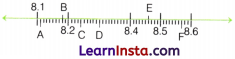
Answer:
A = 8.11, B = 8.18, C = 8.24, D = 8.3, E = 8.46, F = 8.57
Long Answer Type Questions
Question 1.
Solve step-by-step
(a) 1.2 + 2.35 – 0.55
(b) 24.9137 + 3.2806
(c) 479.3865 – 342.7943
Answer:
(a) 3
(b) 28.1943
(c) 136.5922
Question 2.
A man runs 2.431 km in the morning and 3.715 km in the evening.
(a) What is the total distance he runs in a day?
(b) How much more does he run in the evening than in the morning?
(c) What will be the total distance run by the man if he runs 1km more in the afternoon?
Answer:
(a) 6.146 km
(b) 1.284 km
(c) 7.146 km