Get the simplified Class 8 Maths Extra Questions Chapter 6 We Distribute, Yet Things Multiply Class 8 Extra Questions and Answers with complete explanation.
Class 8 We Distribute, Yet Things Multiply Extra Questions
Class 8 Maths Chapter 6 We Distribute, Yet Things Multiply Extra Questions
Class 8 Maths Chapter 6 Extra Questions – We Distribute, Yet Things Multiply Extra Questions Class 8
Very Short Answer Type Questions
Question 1.
Find the value of \(\frac{4}{5}\)(15x + 20y).
Answer:
We have, \(\frac{4}{5}\) (15x + 20v) = \(\frac{4}{5}\) × 15x + \(\frac{4}{5}\) × 20y
[by distributive property] = 4 × 3x + 4 × 4y
= 12x + 16y
Question 2.
Find the increase in 21 × 42, when 21 is increased by 1.
Answer:
We know that, in ab, when a is increased by 1 then ab is increased by b.
∴ If 21 is increased by 1 then 21 × 42 is increased by 42.
Question 3.
Find the product of 56 × 101.
Answer:
We know that a × 101 = a × 100 + a
∴ 56 × 101 = 56 × 102 + 56 [∵ a = 56]
= 5600 + 56
= 5656
Question 4.
Find the area of square with side y + 4.
Answer:
Given, side of square = y + 4
Area of square = (y + 4)2
[Y area of square = side x side] = y2 + 2 × y × 4 + 42
[∵ (a + b)2 = a2 + 2ab + b2]
= y2 + 8y + 16
Question 5.
Find the value of 972.
Answer:
We have, 972 = (100 – 3)2
= (100)2 – 2 × 100 × 3 + (3)2
[∵ (a – b)2 = a2 – 2ab + b2]
= 10000 – 600 + 9
= 10009 – 600
= 9409

Question 6.
Find the value of (2a + b)2 +(2a – b)2.
Answer:
We have, (2a + b)2 + (2a – b)2
= 2[(2a)2 + (b)2]
[∵ (x + y)2 + (x – y)2 = 2 (x2 + y2)]
= 2[4a2 + b2]
= 8 a2 + 2b2
Question 7.
What is the value of 13 × 99.
Answer:
We have, 13 × 99 = 13 × (100 – 1)
= 13 × 100 – 13
= 1300 – 13
= 1287
Short Answer Type Questions
Question 1.
In the product 576 × 321, if both numbers are increased by 1 then increase in its product.
Answer:
We know that, in ab, if both numbers are increased by 1 then its product is increased by a + b + 1
Required increase in product = 576 + 321 + 1 = 898
Question 2.
What is the sum of 46 × 101 and 12 × 10001?
Answer:
We know that a × 101 = a × 102 + a
46 × 101 = 46 × 102 + 46 [∵ a = 46]
= 4600 + 46 = 4646
We know that a × 10001 = a × 104 + a
12 × 10001= 12 × 103 + 1 + 12 [∵ a = 12]
= 12 × 104 + 12
= 120000 + 12
= 120012
Required sum = 4646 + 120012
= 124658
Question 3.
If p + q = 16 and p – q = 4 then find the value of p2 + q2.
Answer:
We have, p + q = 16
⇒ (p + q)2 = 162
⇒ (p + q)2 = 256
Also,p – q = 4
⇒ (p – q)2 = 42
⇒ (p – q)2 = 16
∵ (a+b)2 + (a – b)2 = 2(a2 + b2)
(p + q)2 + (p – q)2 = 2(p2 + q2)
⇒ 256 + 16 = 2 (p2 + q2)
⇒ 272 = 2(p2 +q2)
⇒ p2 + q2 = 136
Question 4.
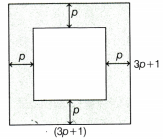
Find the shaded area in the given figure.
Answer:
Given, side of square ABCD = 3p + 1

Side of square PQRS = 3p + 1 – p – p
= 3p + 1 – 2p
= p + 1
Shaded area = Area of square ABCD – Area of square PQRS
= (3p + 1)2 – (p + 1)2
= (3p)2 + 2 × 3p × 1 + (1)2 – [p2 + 2 × p × 1 + (1)2]
[∵ (a + b)2 = a2 + 2 ab + b2]
= 9p2 + 6p + 1 – p2 – 2p – 1
= (8p2 + 4p) sq units
Question 5.
Study the following pattern carefully and find the number of circle in step 14.

Answer:
We observe the following.
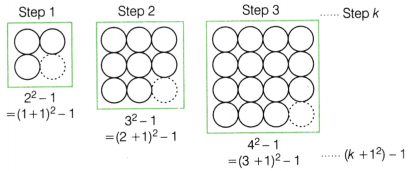
∵ Number of circles in step k = (k + 1)2 – 1
Number of circles in step 14 = (14 + 1)2 – 1
= 152 – 1
= 225 – 1
= 224
Long Answer Type Questions
Question 1.
Find the following product.
(i) 32 × 10001
(ii) 102 × 1001
(iii) 145 × 11
(iv) 3246 × 101
Answer:
We know that if any number a is multiplied by 11, 101, 1001, 10001, then result will be a × 10k+1 + a, where
k is the number of zeros between is.
(i) We have, 32 × 10001 = 32 × 103+1 + 32
[∵ a = 32 and k = 3]
= 32 × 104 + 32
= 320000 + 32
= 320032
(ii) We have, 102 × 1001 = 102 × 102+1 + 102
[∵ a = 102 and k =2]
= 102 × 103 + 102
= 102000 + 102
= 102102
(iii) We have, 145 × 11 = 145 × 100 + 1 + 145
[∵ a = 145 and k = 0]
= 145 × 10 + 145
= 1450 + 145
= 1595
(iv) We have, 3246 × 101
= 3246 × 101+1 + 3246
[∵ a = 3246 and k = 1]
= 3246 × 102 + 3246
= 324600 + 3246
= 327846
Question 2.
Find the following.
(i) 472
(ii) 497 × 503
(iii) 912 – 892
(iv) (x + 4)2 – (x – 4)2
Answer:
(i) We have, 472 = (50 – 3)2
= 502 – 2 × 50 × 3 + (3)2
[∵ (a – b)2 =a2 – 2ab + b2]
= 2500 – 300 + 9
= 2509 – 300
= 2209
(ii) We have, 497 × 503 = (500 – 3) × (500 + 3)
= (500)2 – (3)2
[∵(a – b)(a + b) = a2 – b2]
= 250000 – 9
= 249991
(iii) We have, 912 – 892 = (91 + 89) (91 – 89)
[∵ a2 – b2 = (a + b)(a – b)]
= 180 × 2
= 360
(iv) We have, (x + 4)2 – (x – 4)2 = 4 × x × 4
[∵ (a + b)2 – (a – b)2 = 4ab]
= 16x
Question 3.
If m + n = 48 and m – n = 24 then find the value of m2 + n2 + mn.
Answer:
We have, m + n = 48
⇒ (m + n)2 = 482 = (50 – 2)2
⇒ (m + n)2 = 2500 – 200 + 4
[∵ (a – b)2 = a2 – 2ab + b2]
⇒ (m + n)2 = 2304
Also, m – n = 24
⇒ (m – n)2 = 242
=> (m – n)2 = 576
[∵ (a + b)2 + (a – b)2 = 2(a2 + b2)]
∴ (m + n)2 + (m – n)2 = 2(m2 + n2)
⇒ 2304 + 576 = 2(m2 + n2)
⇒ 2(m2 + n2) = 2880
⇒ m2 + n2 = 1410
Also, (m + n)2 – (m – n)2 = 4mn
⇒ 2304 – 576 = 4mn
⇒ 4mn = 1728
⇒ mn = 432
m2 + n2 + mn = 1410 + 432
= 1842
Question 4.
Find the shaded area in the given figure, if
PT = TD.

Answer:
We have, AB = a + b and QR = b
AR = AB – BR
= a + b – b [∵BR = QR]
= a
DV = a [∵ DV = AR]
Also, AD = a + b
⇒ AP + PD = a + b
⇒ PD = a + b – AP = a + b – b [∵AP = QR = b]
⇒ PD = a
⇒ DT + PT = a [∵PT = TD, given]
⇒ 2DT = a
⇒ DT = \(\frac{a}{2}\)
Now, shaded area = Area of square ABCD – Area of square QSBR – Area of rectangle TDVU
= AB × AB – QR × QR – DV × DT
= (a + b) × (a+b) – b × b – a × \(\frac{a}{2}\)
= (a + b)2 – b2 – \(\frac{a^2}{2}\)
= a2 + 2ab + b2 – b2 – \(\frac{a^2}{2}\)
= (a2 – \(\frac{a^2}{2}\)) + 2ab
= (\(\frac{a^2}{2}\) + 2ab) sq.units
Skill Based Questions
Question 1.
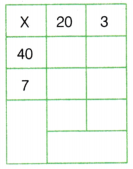
Complete the boxes for multiplication of 47 and 23.
Answer:
Do yourself
Question 2.
Each students writes the sequence of numbers:
2, 5, 10, 17 ……….. upto step 5.
Find a pattern or a rule that describes how to get the next number.
Answer:
n2 + 1
Question 3.
“Pattern Hunt in Squares” Observe the pattern :
2 (32 + 22) = 52 + 12
2 (62 + 22) = 82 + 42
(i) Find the next two such patterns in this sequence using your own numbers.
Answer:
Do yourself
(ii) Make a general formula for this pattern using variables a and b.
Answer:
2 (a2 + b2 ) = (a + b)2 + (a – b)2
Question 4.
Without doing actual multiplication, decide which is larger?
(i) 18 × 22 or 20 × 20
(ii) 47 × 53 or 50 × 50
Answer:
(i) 20 × 20
(ii) 50 × 50
Case Study Based Question
Question 1.
Hardik is preparing return gift bags for his birthday party. Each bag will contain 3 chocolates and 3 pencils. The cost of one chocolate and one pencil are ₹ 10 and ₹ 5, respectively.
He plans to prepare 6 such bags.
Based on the above information, answer the following question.

(i) Find the cost of one gift bag.
(ii) What is the cost of 6 such bags?
(iii) If he plans to prepare 8 such bags then what is the total cost of 8 such bags?
Answer:
Given, number of chocolates in each bag = 3,
number of pencils in each bag = 3,
cost of one chocolate = ₹ 10 and cost of one pencils = ₹ 5
(i) Cost of one gift bag = 3 × 10 + 3 × 5
= 3 × (10 + 5)
[by distributive property] = 3 × 15 = ₹ 45
(ii) Cost of 6 such bags = 6 × 45
= ₹ 270
(iii) Cost of 8 such bags = 8 × [3 × 10 + 3 × 5]
= 8 × 3(10 + 5]
[by distributive properly] = 24 × 15 = ₹ 360
Question 2.
Mayank has a square garden with its side (2a + b) m.
There is a path ‘a’m wide inside the garden along its sides.

Base on the above information, answer the following questions.
(i) What is the area of the garden?
Answer:
Given, side of square garden ABCD = 2a + b

Area of square garden ABCD = (2a + b)2
= 4a2 +2 × 2a × b + b2
[∵ (a + b)2 = a2 + 2ab + b2}
= (4a2 + 4ab + b2) m2
(ii) What is the area of the path?
Answer:
Side of square garden ABCD = 2a + b
Side of square PQRS = 2 a + b – (a + a)
= 2a + b – 2a = b
Area of square PQRS = b2 m2
∴ Area of path = Area of square ABCD
– Area of square PQRS = 4a2 + 4ab + b2 – b2
= (4a2 + 4ab)m2