This World of Things Class 3 Questions and Answers Solutions
EVS Class 3 Chapter 10 This World of Things Question Answer
(Page 123)
Question 1.
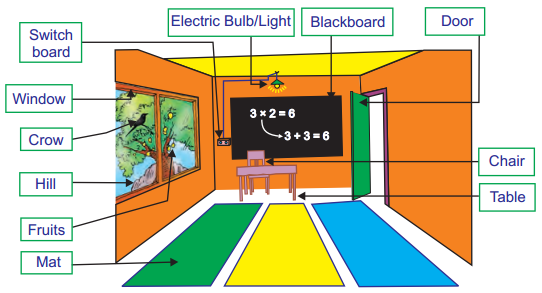
Can you name the things that Khushi has drawn? Write in the boxes given.

Answer:
Question 2.
Do you see the window glass? Why or why not?
Answer:
No, I don’t see window glass because we can see objects behind the glass but not glass.

Activity-1 (Page 124)
Understand Your Classroom
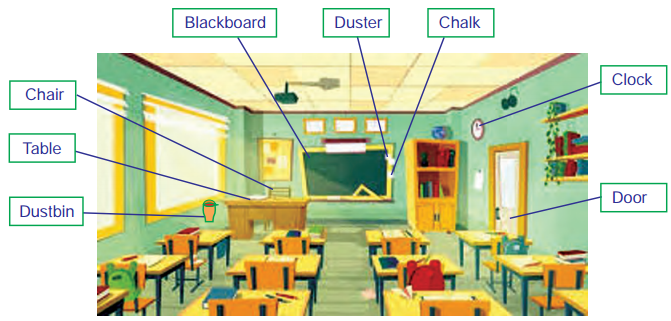
Draw a picture of your classroom in your notebook. Label the things that you have drawn.
Answer:
Classroom
Activity-2 (Page 125)
Spot the Metals
Find as many things or parts of things, that are made of metals. Which metals do you recognise around you? If you do not know the name of the metal, ask your friends or an elder. Make a list of these metals in your notebook.
Answer:
| Item | Metal |
| Box | Iron |
| Spoon, Glass, and Other Utensils | Steel |
| Earring | Gold |
| Large Container | Aluminium |
| Window Grill | Iron |
| Lock and Key | Steel |
Find Out (Page 125)
Question 1.
What are other things in the classroom, such as mats, bulbs and electric switches, made of?
Answer:
Mats are made of jute, electric switches are made of plastic and bulb is made of glass.
See-through Materials! (Page 125)
Question 1.
Does your window have a glass pane?
Answer:
Do yourself.
Question 2.
Can you see through it?
Answer:
Do yourself.
Question 3.
What do you see?
Answer:
Do yourself.
Activity-3 (Page 126)
Seeing through things
Collect a few small objects of different materials from your surroundings like bottles, papers, cloth, and utensils, etc. Look at a light bulb or a candle flame through them.
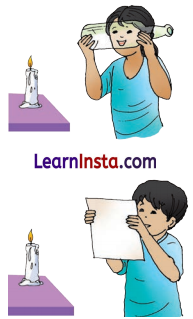
You can see through some objects very clearly, you can partially see through some others, while you cannot see through some objects at all. Order these objects from those you can see through very clearly, to those you cannot see through at all.

Answer:
| See through Clearly | See through Partially | Cannot see through at all |
| (i) Glass, Bottle | Polythene | Utensil |
| (ii) Window Glass | Butter Paper | Book |
| (iii) Clean Water in Glass Bowl | Plastic Scale | School Bag |
| (iv) Spectacle | Paper with Oil Patches | Blanket |
| (v) Glass Sheet | Thin Plastic Sheet | Metal Sheet |
Activity-4 (Page 127)
Let us colour the world!
Collect two or three see through bags, bottles or thin cloth of different colours. Look at a sheet of white paper through them.

Question 1.
Does the colour of the paper appear to change?
Answer:
Yes, the colour of the paper appear to change.
Question 2.
Does white paper appear different when you look at it through thin blue plastic or glass? Or, thin yellow plastic or glass?
Answer:
Yes, it appears in the different colour.
Question 3.
Do the colours of different objects appear to change? How did a blue object look through thin yellow plastic?
Answer:
Yes, the colours of different objects appear to change. A blue object looks yellowish-green when look through this yellow plastic.
Question 4.
Have you earlier experienced looking through coloured transparent objects? Try to recall such experiences.
Answer:
I have seen a toy ‘Rainbow viewer’, a small toy with a rotating wheel of coloured transparent glass. When I looked through it at an object, the object appear in different colours as I turned the wheel.
Write (Page 128)
Chain Game
In the table below, Khushi has grouped objects according to the materials that they are made of. Her list of objects is in the first column of the table. The names of the materials are in the second column.
The third column of the table is for you to complete. Here write the names of some objects you have seen that are made from that material. Some objects around you may be made from materials not in this list, e.g., clay and rubber are missing in Khushi’s list. Use one of these to add an additional row in the table.

Answer:
| Khushi’s List | Name of the Material | Objects made of this material which are in your classroom or home |
| Table, Chair, Door | Wood | For Example, Pencil |
| Door Hinges, Nails | Metal | Utensils |
| Windowpanes, Light Bulb | Glass | Jam Bottle, Tomato Sauce Bottle |
| Electric Switches | Plastic | Bucket, Dustbin |
| Earthen Pot | Clay | Diya, Clay Pot |
Where do all these materials come from? Can you locate their source?
For example, Wood – Tree
- Metals – ____________________
- Cloth – ____________________
Answer:
- Metals – Earth
- Cloth – Plant
Find out (Page 129)
Talk to your Grandparents
Question 1.
In their childhood, were these things made of the same materials?
Answer:
No
Question 2.
Are there new materials now that they might not have seen before?
Answer:
Yes
Question 3.
Are there any materials that they saw in their childhood that are not in use now? Why?
Answer:
Wrought iron. It is replaced by steel. As steel is more durable and high strength.
Find Out (Page 129)
Question 1.
What material is your spoon made of?
Answer:
Spoon made of steel.
Question 2.
Is it made of metal, wood or some other material? Can you guess?
Answer:
Metal
Question 3.
Which of these words or phrases describes the spoon?

Answer:
Smooth and Shiny.
Write (Page 130)
Odd Pairs
List five objects and pair them with a material that is not suitable for it! Explain why these materials will not work to make these objects. One example is done for you.

Answer:
| S. No. | Objects | Material | Reasons |
| 1. | Umbrella | Paper | Paper will tear if it gets wet in the rain. |
|
2. |
Fry Pan | Glass | Glass will break if heated high. |
| 3. | Balloon | Plastic | Plastic will not stretch and air would not fill in it. |
| 4. | Bucket | Cloth | Water will flow out when filled. |
| 5. | Matchstick | Plastic | Plastic would not burn. |
Activity-6 (Page 132)
Question 1.
Let’s group them another way!
Here are the names of some objects: ink, a stone, smoke, ice, steam, a spoon, honey, a bottle, a bag, water.
If it is a solid, write its name on the tray; if it is a liquid, write its name in the bottle; if it is a gas, write its name in the balloon.

Answer:

Question 2.
Add some of your own objects in the tray, bottle and balloon.
Answer:

Question 3.
Some objects could be confusing, such as sand or a sponge or clay. Identify more such objects and write names of at least three of them.
Answer:
Glue, jam and cream.
Natural Artificial (Page 133)
List out five things in each group.
- Natural: ________________________________
- Artifiial: _______________________________
Answer:
- Natural: Sun, Moon, Plant, Animal, Mountain.
- Artificial: Pencil, Utensil, Bag, Bicycle, Box.
Find Out (Page 133)
Question 1.
Have you seen trees around you that bear flowers and fruits at special times of the year? If you have ever eaten a ripe mango or seen mangoes in the market or watched a mango tree through the year, try to guess— at what time of the year did Khushi draw her picture? Could it be around January or around June?
Answer:
Yes, I have seen. It could be around June.
Let us Reflect (Page 134)
A. Write
Things around us are made of different types of materials. Write down the names of three materials we commonly see around us.
___________________________________
Answer:
Metal, Plastic, Wood.
B. Discuss
Suppose you find a shining spoon. You don’t know if it is made of metal or whether it is made of some other material and then painted with shiny paint. How would you find out?
Answer:
I tap the spoon on a metallic object, if large sound of ting-ting like comes shows that it is made of metal.
C. Draw
Draw three natural and three artificial things.

Answer:
Natural things

Artificial things

D. Do it.
Match the pairs.

Answer:
