Get the simplified Class 7 Maths Extra Questions Chapter 6 Number Play Class 7 Extra Questions and Answers with complete explanation.
Class 7 Number Play Extra Questions
Class 7 Maths Chapter 6 Number Play Extra Questions
Class 7 Maths Chapter 6 Extra Questions
Question 1.
Find out the parity of the following sums.
(i) Sum of an even number and an odd number
(ii) Sum of 3 even numbers and 2 odd numbers
(ii) Sum of 6 odd numbers
(iv) Sum of 7 even numbers
Answer:
(i) We know that sum of an even number and an odd number is odd number, so the parity is odd.
(ii) We know that sum of 3 even numbers is even and sum of 2 odd numbers is even.
Therefore, the result is even. So, the parity is even.
(iii) We know that the sum of 6 odd number is even, so the parity is even.
(iv) We know that the sum of 7 even numbers is even, so the parity is even.
Question 2.
Ram has an even number of ₹ 1 coins and even number of ₹ 2 coins and an odd number of ₹ 5 coins in his piggy bank. He calculated the total and got ₹ 310 . Did he make a mistake ? If he did; explain why. If he did not, how many coins of each type could he have?
Answer:
Given, Ram has an even number of ₹ 1 coins, even number of ₹ 2 coins and odd number of ₹ 5 coins.
∵ The value of an even number of ₹ 1 coins is even and value of an even number of ₹ 2 coins is also even.
Since, the sum of two even numbers is an even number and the value of an odd number of ₹ 5 coins is odd.
So, the sum of an even number and an odd number is odd.
Therefore, the parity of resultant money should be odd parity.
But the money calculated by Ram = ₹ 310 (even parity).
So, Ram must have made a mistake in his calculation.
He mistook because the money, he calculated, has an even parity and the money, derived from properties of parity, has an odd parity.

Question 3.
What is the parity of the expression 3n + 4 ?
Answer:
Here, the parity depends on the value of n.
If n = 3, 3 × 3 + 4 = 13 (odd)
If n = 8, 3 × 8 + 4 = 28 (even)
So, the parity of this expression can be either even or odd.
Question 4.
Find the parity of the number of small squares in these grids without calculating them.
(i) 25 × 33
(ii) 15 × 36
(iii) 52 × 54
Answer:
(i) We have, 25 × 33
We know that the product of two odd numbers is odd. So, the parity of the number of small squares in this grid is odd.
(ii) We have, 15 × 36
We know that product of an odd number and an even number is even.
So, the parity of the number of small squares in this grid is even.
(iii) We have, 52 × 54
We know that product of two even numbers is even. So, the parity of the number of small squares in this grid is even.
Question 5.
Construct a 3 × 3 magic square whose magic sum is 54 using any nine consecutive numbers.
Answer:
We know that for any nine consecutive numbers. n, n+1, n+2, ….., n+8, the magic sum is given by 3 n+12
∴ 3 n+12 = 54
→ 3 n = 54-12 → 3 n = 42 → n = 14
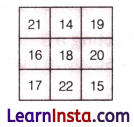
So, we have gotten all the nine numbers 14,15,16, ….., 22. Now, place the middle number which is 18 at the centre of the magic square. After this, place the smallest number, 14 and the largest number, 22 at either left and right or up and down to the number, 18 which is at centre.
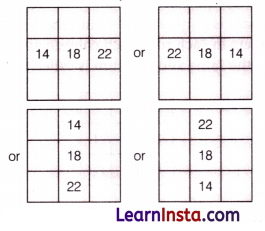
Now, fill all the small squares by keeping the magic sum 54 same across each row, each column and both the diagonals.
∴ The required magic square with magic sum 54 is given as
Question 6.
Complete the magic square using the numbers 1 to 9.

Answer:
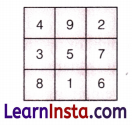
In this grid, each row 4+9+2 = 15, 3 + 5 + 7 = 15, 8 + 1 + 6 = 15; each column 4 + 3 + 8 = 15, 9 + 5 + 1 = 15, 2 + 7 + 6 = 15 and each diagonal 4 + 5 + 6 = 15, 2 + 5 + 8 = 15.
Question 7.
Write the next 2 numbers in the sequence
1,2,3,5,8,13,21,34, ……..
Answer:
We know that the given sequence is a Virahanka-Fibonacci sequence, where each number is the sum of the two preceding once.
∴ 21 + 34 = 55
and 34 + 55 = 89
Hence, the next two numbers are 55 and 89.
Question 8.
How many all the rhythms of short and long syllables are there having 7 beats?
Answer:
We know that the Virahanka-Fibonacci sequence given as
1,2,3,5,8,13,21,34, …..
Now, we simply take the 7th element of the sequence. Thus, there are 21 rhythms having 7 beats.
Question 9.
How many 5 beat rhythms are there?
Answer:
As we know, the Virahanka-Fibonacci sequence is
1,2,3,5,8,13,21,34 ……
Now, we take the 5th element of the sequence.
Thus, there are 8 rhythms having 5 beats.
Question 10.
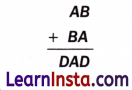
Solve this cryptarithm.
Answer:
Let A = 2 and B = 9
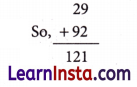
Then, D = 1
Hence, A = 2, B = 9 and D = 1
Question 11.
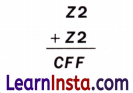
Solve the cryptarithm
Answer:
Here, Z 2 means that the number is a 2-digit number having ‘ 2 ‘ in the unit place and Z in the tens place.
So, Z = 7
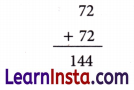
Hence, C = 1 and F = 4.