These Class 6 Science Curiosity Worksheet and Class 6 Science Chapter 10 Living Creatures Exploring their Characteristics Worksheet with Answers are excellent for board exam practice.
Class 6 Science Chapter 10 Living Creatures Exploring their Characteristics Worksheet
Class 6 Living Creatures Exploring their Characteristics Worksheet
Worksheet On Living Creatures Exploring their Characteristics Class 6 – Living Creatures Exploring their Characteristics Worksheet Class 6
A. Objective Type Questions
Multiple Choice Questions
Question 1.
Which of the following is correct with respect to Drosera plant?
(a) Dependent on sunlight for nutrition
(b) Presence of saucer-shaped leaves
(c) Hair like projections present on stem
(d) It do not show any kind of movement
Answer:
(b) Presence of saucer-shaped leaves
Question 2.
Priya has written several statements. Which of the following statement is incorrect?
(a) Plants can move only certain parts of their body such as leaves, flowers, shoots and roots
(b) Opening of flower is an example of movement in plant
(c) Plants cannot move from one place another like animals
(d) Falling of leaf is an example of movement in plant
Answer:
(d) Falling of leaf is an example of movement in plant

Question 3.
Identify the incorrect statement based on Badal’s understanding of how respiration work in living organisms.
(a) Every leaf of a plant has a large number of tiny pores or holes called stomata on its
surface
(b) The exchange of gases (oxygen and carbon dioxide) in plants, during respiration, take place through the tiny pores
(c) In plants, respiration takes place only during day time
(d) Breathing is an important part of respiration
Answer:
(c) In plants, respiration takes place only during day time
Question 4.
Select the correct statement from the options given below.
(a) The purpose of breathing is to provide oxygen to the body, for carrying out respiration
(b) Plants excrete excess water in the form of small droplets on leaves.
(c) Urine is formed as excretory product in animals
(d) All of the above
Answer:
(d) All of the above
Question 5.
The removal of waste substances from the body is called
(a) reproduction
(b) respiration
(c) breathing
(d) excretion
Answer:
(d) excretion
Question 6.
Which of the following is not an example of a response to a stimulus?
(a) Watering in mouth when we see delicious food items
(b) Closing of leaves of ‘Mimosa’ plant when touched
(c) Shutting our eyes when an object is suddenly thrown in our direction
(d) A chick hatching out of an egg
Answer:
(d) A chick hatching out of an egg
Question 7.
In a science quiz competition, Kruti is asked to choose the incorrect statement. Select the appropriate answer from the options given below.
(a) Drosera plant depend on insects for its nutrition
(b) The sweat consists of water and salts removed by body as waste products
(c) Respiration is a life process that take place in dry, stored seeds even when other usual life processes are not observed
(d) The only characteristic of living things shown by wheat seeds is reproduction
Answer:
(d) The only characteristic of living things shown by wheat seeds is reproduction
Question 8.
Which one of the following is true about both plants and animals?
(a) They can make their own food
(b) They need sunlight for energy
(c) They can move from one place to another
(d) They need water to live
Answer:
(d) They need water to live
Question 9.
Which of the following does not represents the characteristics of living things?
(a) All living things respond to stimuli
(b) All living things show growth
(c) All living things can change position from one place to another
(d) All living things require nutrition for growth
Answer:
(c) All living things can change position from one place to another
Question 10.
Consider the following statements and choose the incorrect one.
(a) Every living thing has a limited lifespan on the earth after which it dies
(b) Shoots of plants grow upward and exhibit movement towards sunlight
(c) Some seeds of flowering plants, like Calendula and Zinnia require light to germinate
(d) A crescograph is a machine that measures and records the growth of a plant
Answer:
(c) Some seeds of flowering plants, like Calendula and Zinnia require light to germinate
Question 11.
Which of the following conditions are necessary for germination of Petunia seeds?
(a) Light conditions, water and soil
(b) Light conditions, water and fertilisers
(c) Dark conditions, water and fertilisers
(d) Dark conditions, soil and water
Answer:
(a) Light conditions, water and soil
Question 12.
Which of the following is not associated with reproduction?
(a) A new leaf coming out of a tree branch
(b) A dog giving birth to puppy
(c) A seed growing into a plant
(d) A chick hatching from an egg
Answer:
(a) A new leaf coming out of a tree branch
Question 13.
Which of the following best describes the plant’s life cycle?
(a) The series of events from seed germination to flowering only
(b) The sequence from seed germination to seed production and then to plant death
(c) The growth of a plant through various environmental conditions
(d) The process of photosynthesis and respiration in plants
Answer:
(b) The sequence from seed germination to seed production and then to plant death
Question 14.
Which of the following activities can help to prevent dengue and malaria?
(a) Keeping water containers covered and free from standing water
(b) Using mosquito nets and repellents
(c) Spraying kerosene oil on stagnant water
(d) All of the above
Answer:
(d) All of the above
Question 15.
Which of the following option correctly represents the life cycle of a frog?
(a) Spawn → Embryo → Tadpole → Froglet → Frog
(b) Embryo → Spawn → Tadpole → Frog
(c) Spawn → Tadpole → Embryo → Frog
(d) Embryo → Tadpole Spawn → Froglet Frog
Answer:
(a) Spawn → Embryo → Tadpole → Froglet → Frog
Fill in the Blanks
Fill in the blanks by choosing appropriate words from the box given below.
Froglets, Droplets, Mosquitoes, Roots, Climbers, Shoots, Dead
Question 1.
____ wind themselves around any object placed close to them.
Answer:
Climbers
Question 2.
Plants excrete excess water and minerals in the form of ____ on the leaves.
Answer:
droplets
Question 3.
When a living being is not able to exhibit all of the living characteristics, despite the availability of all resources (like food, air and water) needed for being alive, it is said to be.
Answer:
dead
Question 4.
During germination of seeds, ____ generally grow downwards, while ____ grow upwards.
Answer:
roots, shoots
Question 5.
____ are bloodsucking insects that transmit several diseases like malaria, dengue and chikungunya.
Answer:
Mosquitoes
Question 6.
The tadpoles gradually develop hindlimb in the ____ stage.
Answer:
froglets
True/False
State whether the given statements are true or false.
Question 1.
Plants and animals are a part of the living world.
Answer:
True
Question 2.
All living beings do not respond to stimuli.
Answer:
False. Alt living beings respond to stimuli.
Question 3.
The sleeping leaves of amla tree, facing each other, tend to come together after sunset.
Answer:
True
Question 4.
A seed grows into a young plant, which eventually matures to produce flowers and fruit.
Answer:
True
Question 5.
Seeds need air and fibers for germination.
Answer:
False. Seeds need air, water, soil, minerals for germination
Question 6.
Some seeds of flowering plants, like Coleus and Petunia, do not require light to germinate.
Answer:
False. Seeds of Coleus and Petunia require light to germinate.
Question 7.
A cluster of eggs of a frog is known as spawn.
Answer:
True
Match the Following
Question 1.
Match the Column I with Column II.
| Column I | Column II |
| (a) Mimosa | (i) Dengue |
| (b) Female mosquito | (ii) Living |
| (c) Jagadish Chandra Bose | (iii) Insectivorous plant |
| (d) Clouds | (iv) Respond to stimuli |
| (e) Seed | (v) Non-living |
| (f) Drosera | (vi) Crescograph |
Answer:
(a) (iv)
(b) (i)
(c) (vi)
(d) (V)
(e) (ii)
(f) (iii)
Question 2.
Match the Column I with Column II.
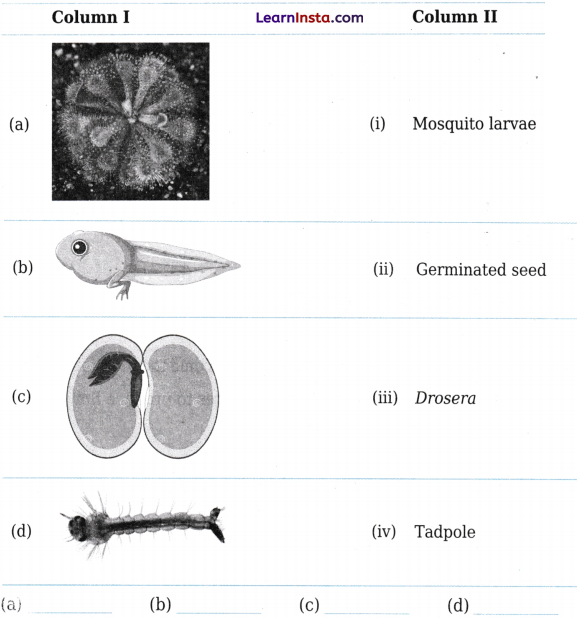
Answer:
(a) (iii)
(b) (iv)
(c) (ii)
(d) (i)
Assertion-Reason Questions
In the following questions, two statements are given. One is labelled as Assertion (A) and the other is labelled as Reason (R). Read the statements carefully and choose the correct option.
(a) Both A and R are true and R is correct explanation of the A.
(b) Both A and R are true, but R is not the correct explanation of the A.
(c) A is true, but R is false.
(d) A is false, but R is true.
Question 1.
Assertion (A) All animals move from one place to another in search of food.
Reason (R) Movement is a characteristic feature of living organisms.
Answer:
(b) Both A and R are true, but R is not the correct explanation of A.
All animais move from one place to another in search of food because they require essential resources, like food and water for survival.
Question 2.
Assertion (A) Breathing is part of a process called respiration.
Reason (R) There are tiny pores called stomata on the surface of leaves which helps the plants in gaseous exchange.
Answer:
(b) Both A and R are true, but R is not the correct explanation of A.
Breathing supplies O2 and removes CO2. which is crucial for respiration.
Question 3.
Assertion (A) Respiration is necessary for animals.
Reason (R) Respiration in plants only occurs when they are actively growing.
Answer:
(c) A is true, but R is false, R can be corrected as
Respiration occurs in plants throughout their life span.
Question 4.
Assertion (A) Living things produce more of their own kind through reproduction. Reason (R) Only animals can produce their own kind, while plants cannot.
Answer:
(c) A is true, but R is false. R can be corrected as
Both the plants and animals can produce their own kind.
Question 5.
Assertion (A) The silk moth undergoes four life stages: egg, larva, pupa, and adult. Reason (R) The larvae secrete thread-like material that is used to make silk fabric.
Answer:
(b) Both A and R are true, but R is not the correct explanation of A.
The silk moth passes through four life stages egg, larva, pupa and adult. Eggs hatch into larva, which then grow in size and converts into pupa and became adult.
Case Based Questions
A local health department has observed an increase in mosguito-borne illnesses in a residential area. Upon investigation, they find that several objects in the neighborhood, such as unused containers, old tires, and birds baths, have stagnant water. The local authorities are concerned about the potential for a larger outbreak of mosquito-borne diseases and are looking for effective strategies to address the problem.
Question 1.
Which is the primary reason why stagnant water contributes to the spread of mosquito-borne diseases?
(a) Stagnant water provides food for adult mosquitoes
(b) Stagnant water attracts other insects that repel mosquitoes
(c) Stagnant water serves as a breeding ground for mosquitoes, increasing their population
(d) Stagnant water prevents mosquitoes from laying eggs.
Answer:
(c) Stagnant water serves as a breeding ground for mosquitoes, increasing their population
Question 2.
Which of the following measures is not recommended to reduce mosquito-borne diseases related to stagnant water?
(a) Emptying containers that collect water regularly
(b) Covering or removing old tires and other items that can hold water
(c) Applying mosquito repellents only during the day
(d) Installing screens on windows and doors to keep mosquitoes out
Answer:
(c) Applying mosquito repellents only during the day
B. Subjective Type Questions
Define the following terms
Question 1.
Respiration
Question 2.
Excretion
Question 3.
Stimulus
Question 4.
Response
Question 5.
Germination
Question 6.
Life span
Very Short Answer Type Questions
Question 1.
Can we consider movement as one of the characteristics to differentiate between the living and the non-living?
Question 2.
Why is reproduction considered a necessary process?
Question 3.
What conditions are essential for seed germination to occur?
Question 4.
How would you categorise a seed, living or non-living?
Question 5.
Observe the figure given below and identify X and Y.

Question 6.
I have seen my mother spraying kerosene oil on stagnant water. Why does she do so?
Question 7.
Which stage of frog life cycle has a tail and developing hindlegs?
Question 8.
Is there a change in the habitat during various stages of life cycle of a frog?
Question 9.
How can we contribute to the flourishing living world?
Short Answer Type Questions
Question 1.
Which of the following were once a part of living things?
Leather, wool, electric bulb, salt, mango, wooden table, metallic bucket
Question 2.
What is meant by respiration? Why is respiration essential for living organisms?
Question 3.
Manoj sees a dog in his garden. He picks up a stone and throws it at the dog. The dog gets hurt and within no time bites Manoj’s leg. Manoj’s friend, Arjun, takes him to the doctor who immediately gives him first aid and injections. Manoj promises his parents and friends that he will not repeat this behaviour in the future.
(a) Name the ‘stimulus’ and ‘response’ in this case.
(b) What values do you learn from Arjun and Manoj?
Question 4.
Charan says that a wooden log is non-living as it cannot move. Charu counters it by saying that it is living because it is made of wood, which is obtained from trees. Give your arguments in favour or against the two statements given by Charan and Charu.
Question 5.
Tara and Vijay set up an experiment as shown in the picture given below. What do you think they want to find out? How will they know if they are correct?

Question 6.
You have learnt that different conditions are required for seed germination. How can we use this knowledge for proper storage of grains and pulses?
Question 7.
What is meant by life cycle? List the various stages in the life cycle of a plant.
Question 8.
Mosquito larvae and pupae present in water bodies repeatedly come to the water surface. What can be the reason for this?
Question 9.
Write a short note on the life cycle of a mosquito.
Question 10.
How does the life cycle of animals differ from that of plants?
Question 11.
How silk is obtained from the silk moth?
Long Answer Type Questions
Question 1.
Give any four differences between living things and non-living things.
Which characteristic of living things is shown in the given figure? Also describe other characteristics of living in brief.

How do insectivorous plants, like Drosera, capture their prey?
(a) What is meant by ‘stimulus’? Give any two examples of plants that respond to stimulus?
(b) A plant grows towards sunlight. Mention the stimulus and the response.
Question 2.
What are the similarities and differences between the life cycles of a mosguito and a frog?
Answer:
Skill Based Activities
Question 1.
Design an experiment to check if temperature has an effect on seed germination.
Question 2.
Can we grow plants without germinating their seeds? Explore and cite some examples.
Question 3.
Try to observe some of the stages in the life cycle of a butterfly or a moth. Are these stages similar to the stages in the life cycle of a mosquito?
Question 4.
Do you think the environment affects the life cycles of insects? Explore and list the factors that affect the life cycles of insects.
Question 5.
The diagram given below represents the life cycle of a frog. Observe it carefully and lable the parts A to F correctly.

Question 6.
Unscramble the given words below to get the correct word using the clues given against them.
(a) RETECOXNI- Waste products are removed by this process
(b) LUMISIT- All living things respond to these
(c) ROUCDPRENTOT It ensure continuity of life on the earth.
(d) ITNMRIOAGEN- The process by which seed develops into a new plant.