Teachers guide students to use Exploring Society India and Beyond Class 6 Solutions and Class 6 Social Science SST Chapter 7 India’s Cultural Roots Question Answer NCERT Solutions for quick learning.
India’s Cultural Roots Class 6 Question Answer Social Science Chapter 7
NCERT Class 6 Social Science SST Chapter 7 India’s Cultural Roots Questions and Answers Solutions
India’s Cultural Roots Class 6 Questions and Answers (In-Text)
The Big Questions (Page 106)
Question 1.
What are the Vedas? What is their message?
Answer:
- The Vedas are a collection of sacred religious text in Sanskrit originating in ancient India, giving the foundation of Hinduism.
- They were composed during 1500 and 500 BCE and are among the most ancient texts in the whole world.
- There are four Vedas: The Rig Veda, the Yajur Veda, the Sama Veda and the Atharva Veda.
- The Rig Veda contains the Hymns about the mythology.
- The Sama Veda consists mainly of the hymns about the religious rituals.
- The Yajur Veda contains the instructions for religious rituals. .
- The Atharva Veda consists of the spells against the enemies and diseases.
- The Vedas declares that God manifested himself in the beginning as the creator of the Universe.
- The main purpose of the divine knowledge contained in the Vedas is to instruct human beings to live a truthful meaningful, progressive, happy and righteous life in the material world and also to plan for the future and final goal of the life.
Question 2.
What new schools of thought emerged in India in the 1st millennium BCE? What are their core principles?
Answer:
The Vedas gave rise to numerous further schools of thought early in the first millennium BCE.
Yoga: which created techniques meant to help one realize Brahman in their consciousness focused on disciplined life to attain spiritual enlightenment.
Vedanta: This school is based on the Upanishads, building upon Vedic concepts and introducing ideas such as rebirth and karma. Vedanta holds that everything is one divine essence called Brahman, and it emphasises the unity and interdependence of all beings.
Buddhism: Founded by Siddhartha Gautama (the Buddha), this school rejects the authority of the Vedas and teaches that ignorance and attachment are the sources of human suffering
Jainism: Jainism, founded by Mahavirra, rejects the Vedas and emphasises nonviolence (ahimsa), non-possession (aparigraha) and the multifaceted nature of truth (anekantavada). Jainism says that all living beings are inextricably linked and encourages ethical behaviour and spiritual purity.
‘Charvaka’ school: (‘Lokayata’), believed that this material world is the only thing that exists, and therefore, there can be no life after death. Together, these schools of thought became the foundations for what we call ‘Hinduism’ today.

Question 3.
What is the contribution of folk and tribal traditions to Indian culture?
Answer:
Folk and tribal traditions have made significant contributions to Indian culture, enriching it with their unique practices, art forms, and perspectives. These traditions are integral to the cultural diversity of India and have influenced mainstream cultural expressions in various ways.
There has been a constant interaction between folk and tribal traditions. Deities, concepts,., legends and rituals have been freely exchanged in both directions. It is because folk, tribal and Hindu belief systems have many similar concepts. The thousands of castes and tribes on the Indian subcontinent have influenced each other in their religious beliefs and practices since the beginning of history. Folk and tribal traditions are vital to the cultural mosaic of India, offering a wealth of knowledge, artistic expression, and values that continue to inspire and enrich the broader Indian society.
Let’s Explore
Question 1.
Do you know the term for a society where people select their leaders? How do you think people can benefit from such a situation? What could happen if they live under leaders that they did not choose? (Hint: Think back to what you’re learning in the theme ‘Governance and Democracy’!)
Write your thoughts in a paragraph of 100-150 words. (Page 109)
Answer:
- As we know throughout the history, one can find evidence of direct democracy in which communities make decisions through popular assembly.
- Today, the dominant form of democracy is a representative democracy, where citizen elect government officials to govern on their behalf such as in a Parliamentary or Presidential democracy.
People can get the benefit from such a situation. They will be able to follow the following points:
- Representation: People feel that their voices are heard by the leaders they have chosen.
- Accountability: Elected leaders are accountable to the people who voted for them, which can lead to better government responsiveness to the needs of the population.
- Participation: Democratic Processes encourage civic engagement and participation in decision making leading a more active and informed citizens. Overall, choosing leaders through democratic means can promote equality in the society where the interests of the people are at the forefront of governance.
If they live under leaders that they did not choose. In such case their life could have become quiet worst. They will not be able to a lead a comfortable life.
As the leader chosen is without the consent of the people, that is without the democratic process, it is autocratic or a dictatorship. Kings were known as autocrat, where only family of the king ruled the territory under them. In history, many kings ruled with good governance.
Another example is of Britishers who ruled Indian sub-continent for over two centuries as a dictatorship rule. Under their rule, Indians were suppressed and looted a lot, thus changing a developed Indian nation, known as Golden Bird (Sone ki Chidiya) into underdeveloped country with severe poverty.
Question 2.

Discuss the way the Buddha is depicted in the above stone panel. Can you name some states of India or some other countries where Buddhism is a major religion even today? Try to plot these on a world map.
Answer:
In the image, Buddha is depicted imparting his teachings to his disciples. Buddhism remains a major religion in several regions and countries.
Some countries and states in India where Buddhism is widely practiced even today are
– States in India Sikkim, Arunachal Pradesh, Ladakh and today Himachal Pradesh.
– Countries Thailand, Myanmar (Burma), Sri Lanka and Bhutan.
Question 3.
Can you name some states of India or some other countries where Buddhism is a major religion even today? Try to plot these on a world map.
Answer:
- States in India
- Sikkim
- Arunachal Pradesh
- Ladakh (Union Territory)
- Maharashtra (regions like Nagpur)
- Himachal Pradesh (Dharamshala)
Countries
- Thailand
- Myanmar (Burma)
- Sri Lanka
- Bhutan
- Nepal
Question 4.
Observe the above panel (from a Jain temple in New Delhi). What is striking about it? What messages does it carry?

Answer:
The Jain temple panel in New Delhi features exquisite and precise carvings, demonstrating the period’s high degree of craftsmanship. Jain spiritual gurus, known as Tirthankaras, are commonly shown in meditation poses surrounded by symbols such as lotus flowers and fortunate symbols. This panel’s messages emphasise meditation, nonviolence (ahimsa), and spiritual knowledge.
Jainism stresses a life of purity, renunciation, and compassion for all living things. The Jain concepts of inner serenity, discipline and inter connectivity are emphasised through elaborate iconography and tranquil faces in the figures. These visual representations serve as both religious symbols and educational tools, reminding devotees and viewers of Jainism’s essential beliefs.
Picture-Based Question (Page 124)
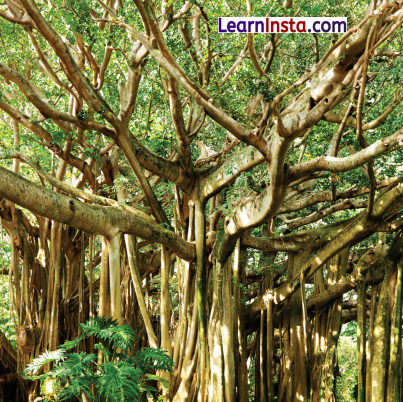
“The banyan tree is an apt illustration for the themes in Chapters 7 and 8, and a fine symbol for Indian civilisation. With its deep root system, massive trunk and branches spreading in all directions, it can extend to a vasts area and last for many centuries. It shelters a variety of flora and fauna and encourages its branches, though united at the trunk, to throw fresh roots of their own. Indeed, Hinduism, Buddhism and Jainism regard the banyan tree as sacred.”
Read the above passage and fill in the blanks:
1. The trunk of the banyan tree stands for ________.
Answer:
Indian civilization
2. The branches of the banyan tree are the four schools of thoughts which are ________ ________ ________ and ________.
Answer:
Hinduism, Buddhism, Jainism, Sikhism
3. The banyan tree shelters a variety of flora and fauna. Similarly ________ shelters people from different ________ and ________.
Answer:
Indian civilization, castes, creeds, religions
4. All the branches of the tree are united at the trunk. Similarly Hinduism, Buddhism, and Jainism have ________ as their trunk.
Answer:
Indian civilization
5. Find out why banyan tree is regarded as sacred in Hinduism, Buddhism, and Jainism?
Answer:
Do it yourself.
India’s Cultural Roots Question Answer (Exercise)
Question 1.
If you were Nachiketa, what questions would you like to ask Yama? Write them down in 100-150 words.
Answer:
I would like to ask Yama, the god of death, following questions, if I was Nachiketa:
- What happens after the death of a body?
- What is soul?
- What happens to soul after death?
- Will soul also die with death, if not where will it go?
- Will soul take rebirth in form of another body?
Question 2.
Explain a few central ideas of Buddhism. Briefly comment upon them.
Answer:
Life involves suffering and dissatisfaction. Suffering arises from attachment, desire, and ignorance. It is possible to end suffering by eliminating attachment. Buddhism teaches that everything in the universe is in a constant state of flux. Nothing is permanent, and clinging to the idea of permanence leads to suffering. Nirvana is the ultimate goal of Buddhism.
It is the state of liberation and freedom from the cycle of birth, death, and rebirth (samsara). Achieving Nirvana means ending the suffering that comes from desire and ignorance. Buddhism emphasizes developing compassion and lovingkindness towards all beings. This involves selfless actions and thoughts, aimed at reducing suffering for oneself and others.
These ideas form the core of Buddhist philosophy and practice, guiding adherents towards a life of ethical conduct, mental discipline, and wisdom.
Question 3.
Discuss in class the quotation of the Buddha which begins with “Not by water is one made pure, though many people may bathe here [in sacred rivers]” to make sure that its meaning has been understood by all.
[Activity]
Answer:
Do it yourself
Hints: Here water means holy water like Ganga river. One needs to be pure from heart that can be attained through truth and dharma only.
Question 4.
Explain a few central ideas of Jainism. Briefly comment upon them.
Answer:
Few central ideas of Jainism are as follows
Ahimsa (Non-violence) Jainism teaches that one should avoid causing harm to any living being, emphasising the interconnectedness of all life.
Anekantavada (Non-absolutism) The idea that truth and reality are complex and have multiple aspects. No single perspective can capture the whole truth, and understanding requires recognising different viewpoints.
Aparigraha (Non-possessiveness) It advocates for detachment from material possessions and the limiting of one’s needs to what is necessary.
Question 5.
Consider and discuss ỉn class Andrẹ́ Béteille’s thought (see page 122). [Activity]
Answer:
Class-discussion.
Question 6.
Make a list of popular gods and goddesses in your region and the festivals they are associated with. [Project]
Answer:
Do it yourself.
Question 7.
As a class activity, list two or three tribal groups from your region or State. Document some of their art and belief systems. [Activity]
Answer:
Do it yourself.
True or false
1. The Vedic hymns were written on palm-leaf manuscripts.
Answer:
False
2. The Vedas are India’s oldest texts.
Answer:
True
3. The Vedic statement ekam sat vipra bahudha vadanti reflects a belief in the unity of cosmic powers.
Answer:
True
4. Buddhism is older than the Vedas.
Answer:
False
5. Jainism emerged as a branch of Buddhism.
Answer:
False
6. Both Buddhism and Jainism advocated for peaceful coexistence and the avoidance of harm to all living beings.
Answer:
True
7. Tribal belief systems are limited to belief in spirits and minor deities.
Answer:
False
Class activity
1. Stage a small play with Yama, god of death, surrounded by several Nachiketas asking him questions about life.
Answer:
Do it yourself.